

Despite all the buzz around artificial intelligence, 80% of policies are still sold through traditional channels. That gap between hype and reality is exactly where your opportunity lives. Insurance agents who figure out how to layer AI into their existing workflows, without losing the human touch that builds trust, will pull ahead in 2026. This guide walks you through the most practical, evidence-backed AI engagement strategies available right now, from hybrid customer journeys to automated outreach and data personalization, so you can start modernizing without overhauling everything at once.
Table of Contents
- Why customer engagement needs to change in 2026
- The three waves of AI-enhanced insurance engagement
- Data-driven personalization: From hype to trust
- Best AI-driven engagement strategies for insurance agencies
- Pitfalls and safeguards: When AI-powered engagement can backfire
- Our take: Cut through the AI hype and focus on real results
- Ready to modernize your customer engagement?
- Frequently asked questions
Key Takeaways
| Point | Details |
|---|---|
| Hybrid engagement wins | Blending AI with human involvement leads to greater satisfaction and conversions in insurance. |
| Quality data is crucial | Personalized engagement relies on unified, accurate data and transparency to build trust. |
| Beware AI limitations | AI works best for routine tasks; keep humans in the loop for exceptions and relationship building. |
| Actionable steps available | Modern engagement strategies can be applied today with the right tools and mindset. |
Why customer engagement needs to change in 2026
Your customers have changed. They research policies on their phones at midnight, expect instant answers, and compare quotes across three tabs before you even know they exist. Legacy engagement methods, phone calls, paper forms, and generic email blasts, simply cannot keep pace with those expectations.
The numbers back this up. 55% of UK insurers have AI integrated across some functions, compared to 48% globally, yet 28% of those same respondents report that customer engagement behavior is still lagging behind what technology now makes possible. That is a significant gap, and it signals that adoption alone is not enough. You need to apply AI where it actually touches the customer.
Here is what digitally-native customers now expect from their insurance experience:
- Instant responses at any hour, not just business hours
- Personalized policy recommendations based on their actual situation
- Frictionless digital touchpoints alongside available human support
- Proactive communication, not reactive damage control
Purely traditional approaches are losing ground fast. Agents who rely only on cold calls and annual check-ins are invisible to a growing segment of buyers who never pick up the phone for a brand they do not already trust.
“The agents winning in 2026 are not the ones with the most calls made. They are the ones with the most relevant, timely, and personalized conversations.”
Hybrid models that combine digital automation with human expertise are outperforming both extremes. You can explore AI strategies for customer engagement to see how agencies are structuring these blended approaches right now.
Pro Tip: Audit your current touchpoints. Map every place a prospect or customer interacts with your agency and ask: could AI make this faster, more relevant, or more consistent? That audit alone will reveal your biggest wins.
The three waves of AI-enhanced insurance engagement
Not all AI adoption looks the same. Understanding where your agency sits on the adoption curve helps you make smarter decisions about where to invest next.
AI-influenced distribution evolves across three distinct waves: augmented, assisted, and autonomous. Each wave represents a different level of AI involvement in the customer relationship.
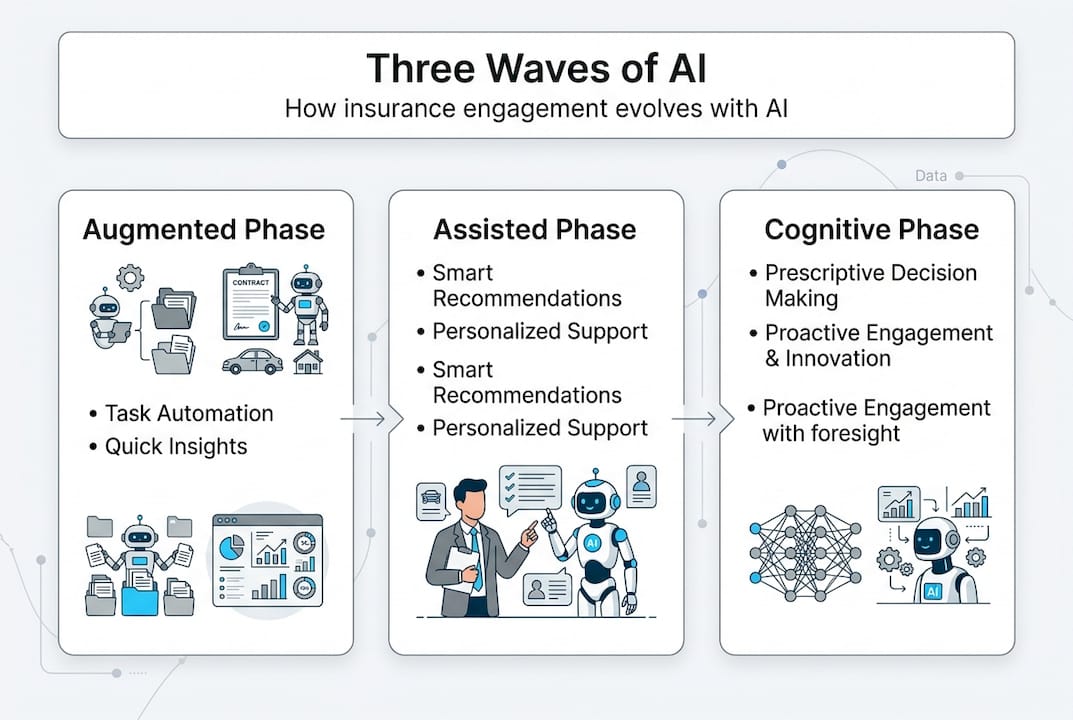
| Wave | AI role | Best for | Risk level |
|---|---|---|---|
| Augmented | Supports agent decisions | Most agencies today | Low |
| Assisted | Virtual assistants boost productivity | Growing agencies | Medium |
| Autonomous | AI acts independently | Digital-native segments | Higher |
Here is how each wave plays out in practice:
- Augmented: AI surfaces the right information at the right time. Think lead scoring, next-best-action prompts, and automated data entry. You are still in the driver’s seat, but AI removes the busywork.
- Assisted: Virtual assistants handle routine queries, appointment scheduling, and follow-up sequences. Your team focuses on complex conversations while AI manages the volume.
- Autonomous: AI handles entire journeys for simple products, from quote to bind, with no human involved unless the customer requests it. This works well for straightforward term life or auto policies with digitally-native buyers.
Most agencies are operating in the augmented or assisted phase right now, and that is exactly the right place to be building competency. Jumping straight to autonomous engagement before your data and processes are solid is a recipe for costly mistakes.
You can learn more about AI adoption in insurance engagement and see which wave aligns with your agency’s current capacity.
Data-driven personalization: From hype to trust
Personalization sounds simple until you try to do it at scale. The reality is that AI personalization is only as good as the data feeding it, and most agencies have a data problem they have not fully acknowledged yet.

Over 80% of firms report data quality concerns, and the fix requires unified platforms that connect pricing, underwriting, and engagement data in one place. Siloed spreadsheets and disconnected CRM tools produce fragmented customer profiles, and fragmented profiles produce irrelevant outreach. Irrelevant outreach destroys trust faster than no outreach at all.
Trust is the other half of this equation. 59% of policyholders distrust generative AI in insurance contexts. That is not a reason to avoid AI. It is a reason to be transparent about how you use it. When customers know their data is being used to serve them better, not just to sell to them, trust increases.
Key principles for trustworthy AI personalization:
- Start with clean data. Audit your CRM for duplicates, outdated contacts, and missing fields before layering AI on top.
- Connect your systems. A unified platform that links your marketing, CRM, and policy data gives AI the full picture it needs.
- Be transparent. Tell customers when AI is involved in their experience and give them easy access to a human.
- Collect feedback. Short post-interaction surveys reveal where AI personalization is landing and where it is missing the mark.
Pro Tip: Do not try to personalize everything at once. Pick one high-volume touchpoint, like renewal reminders or policy anniversary messages, and build a clean, personalized workflow there first. Then expand.
Building trust with AI marketing starts with honest communication, and the agencies that get this right early will have a significant competitive advantage. You can also explore the full picture of AI-powered insurance engagement to see how unified data transforms the customer experience.
Best AI-driven engagement strategies for insurance agencies
With the right data foundation in place, these are the strategies delivering measurable results for agencies right now.
- Build hybrid digital-human journeys. Hybrid journeys achieve 23% higher customer satisfaction and 31% higher Net Promoter Scores compared to purely digital or purely human approaches. AI handles the routine, humans handle the relationship. That combination is hard to beat.
- Implement Answer Engine Optimization (AEO). AEO means structuring your content so AI-powered search tools surface your agency when prospects ask questions. This approach yields a 15 to 25% lift in conversion rates for agencies that execute it well.
- Automate routine outreach with smart escalation. Use AI to send policy reminders, birthday messages, and renewal alerts automatically. But always include a clear path to a human agent for anything complex. AI-enhanced agents show 28% better handle times and 35% higher first-contact resolution when AI and humans work in tandem.
- Use AI for segmentation and quoting. Let AI identify which leads are most likely to convert, then route high-value prospects to your best closers. This frees your team for relationship-building instead of sorting.
- Leverage predictive analytics for proactive outreach. AI can flag customers who are likely to lapse, upgrade, or cross-buy before they even realize it themselves. Acting on those signals early is far more effective than reactive retention calls.
“The agencies seeing the biggest gains are not replacing agents with AI. They are giving agents AI-powered tools that make every conversation more informed and every follow-up more timely.”
Pro Tip: Use AI for lead generation to identify high-intent prospects, then pair that with AI marketing tools for agents to automate follow-up sequences. You can also explore automating engagement for faster leads to see how the full workflow fits together.
Pitfalls and safeguards: When AI-powered engagement can backfire
AI is a powerful tool, but it is not a universal solution. Knowing where it breaks down is just as important as knowing where it excels.
Agentic AI performs well in structured, repeatable tasks but struggles with edge cases that require human judgment, fairness considerations, and complaint handling. A customer disputing a claim denial needs empathy and nuanced reasoning, not a chatbot that loops back to the same FAQ.
The hype around fully autonomous AI agents is also worth questioning. Real autonomy is limited by regulatory constraints, exception handling, and the trust issues that come with removing humans from sensitive decisions. Agencies that chase full automation too aggressively often discover these limits the hard way.
Here are the safeguards every agency should have in place:
- Human escalation paths. Every automated interaction must have a clear, easy way to reach a live agent.
- Regular script reviews. Automated messaging can drift out of compliance or become tone-deaf over time. Review scripts quarterly.
- Feedback loops. Monitor customer satisfaction scores on AI-handled interactions separately from human-handled ones.
- Compliance checks. Any AI-generated communication should pass through your compliance review process, especially for regulated products.
Pro Tip: Set a calendar reminder every 90 days to review your top five automated engagement workflows. Check for outdated offers, compliance gaps, and any patterns in negative feedback. Small adjustments caught early prevent big problems later.
For a deeper look at managing risk while scaling, see how AI in lead generation can be structured with the right guardrails from the start.
Our take: Cut through the AI hype and focus on real results
Here is something most AI vendors will not tell you: the agencies getting the best results from AI are not the ones with the most sophisticated technology. They are the ones who defined clear goals before they bought anything.
AI’s real power in insurance engagement is augmentation, not replacement. The agents who thrive are those who use AI to be more prepared, more timely, and more relevant in every conversation, while still showing up as a trusted human advisor when it counts. Chasing full automation at the expense of empathy is a short-term efficiency play with long-term trust costs.
The future belongs to adaptive agencies: teams that continuously re-skill around new tools, build strong feedback loops, and treat AI as a colleague rather than a magic fix. The AI tools driving insurance leads that deliver sustainable results are the ones built into a culture of accountability and continuous improvement, not just plugged in and left to run.
Ready to modernize your customer engagement?
The strategies in this guide work best when your tools are built for insurance from the ground up. CallBack CRM gives agents and agencies a single platform to automate outreach, manage leads, and personalize every customer interaction without juggling five disconnected apps.
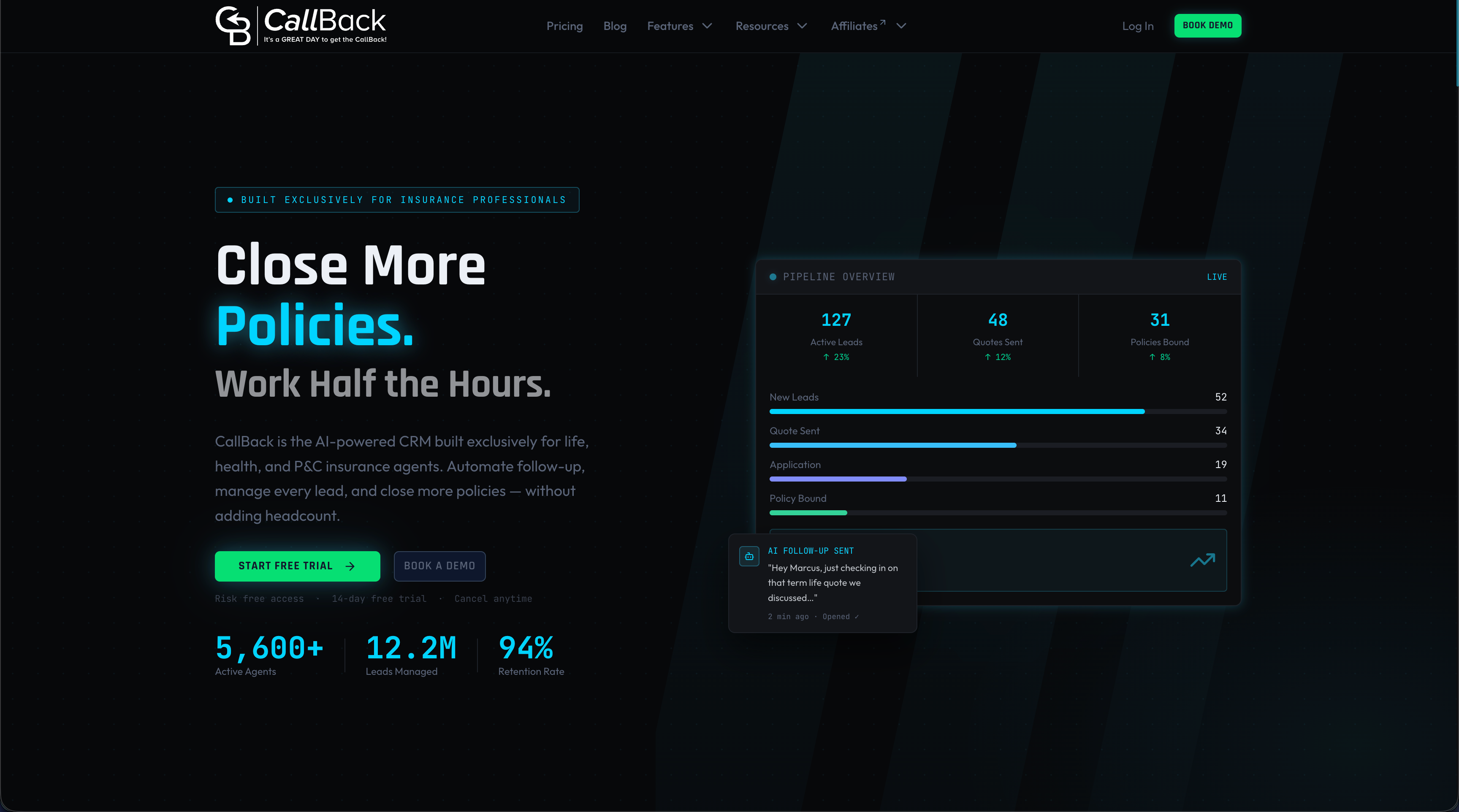
From AI-powered SMS marketing that reaches prospects where they actually respond, to a full suite of comprehensive AI tools covering CRM, automation, and reputation management, everything is designed to help you engage smarter. No long contracts, no complicated setup. Get started today with a free trial and see how quickly the right platform changes your results.
Frequently asked questions
What is the most effective AI-driven customer engagement strategy for insurance in 2026?
Hybrid digital-human journeys that blend AI automation with human expertise deliver the highest satisfaction, achieving 23% higher customer satisfaction and 31% higher Net Promoter Scores than single-channel approaches.
How can insurance agents build customer trust when using AI tools?
Agents should prioritize data quality, be transparent about how AI is used, and always offer clear human escalation paths. With 59% of customers distrusting generative AI, honesty about AI involvement is a competitive differentiator, not a liability.
What are the main risks of over-automating customer engagement?
Over-automation can miss complex edge cases, create compliance exposure, and erode the human trust that insurance relationships depend on. Agentic AI excels in structured tasks but requires human oversight for exceptions, complaints, and fairness-sensitive decisions.
What technology should agencies prioritize for customer engagement in 2026?
Agencies should focus on unified data platforms that connect CRM, marketing, and policy data, paired with automation and Answer Engine Optimization. AEO yields a 15 to 25% lift in conversion rates for agencies that implement it well.