

Insurance agents know that consistent, engaging email communication is the difference between closing deals and losing leads to competitors. Yet most struggle with low open rates, generic messaging, and time-consuming manual workflows that fail to nurture prospects effectively. AI-driven automation transforms this challenge by streamlining every stage of the email marketing process, from strategic preparation through execution to performance verification. This guide walks you through the complete email marketing framework tailored specifically for insurance professionals in 2026, showing you how to leverage intelligent automation tools to boost engagement, generate quality leads, and scale your outreach without sacrificing personalization.
Table of Contents
- Identifying Challenges And Preparing Your Email Marketing Strategy
- Step-By-Step Execution Of The Email Marketing Process With AI Automation
- Verifying Success And Optimizing Your Email Marketing Campaigns
- How Callback CRM Elevates Your Email Marketing Process
Key takeaways
| Point | Details |
|---|---|
| Preparation drives success | Define clear goals, segment contacts by policy type and engagement level, and select AI tools that integrate with your CRM before launching campaigns. |
| AI automation transforms execution | Personalized content, behavior-triggered workflows, and optimized send times increase engagement rates significantly compared to manual approaches. |
| Verification enables optimization | Track open rates, click-throughs, and conversions through AI dashboards to refine strategies and maximize ROI continuously. |
| Integration amplifies results | Connecting email marketing with CRM lead management creates seamless nurturing paths from first contact to policy purchase. |
Identifying challenges and preparing your email marketing strategy
Insurance agents face unique email marketing obstacles that generic business advice rarely addresses. Your prospects need education about complex products, trust-building over extended sales cycles, and timely communication aligned with life events like marriage, home purchases, or retirement planning. Generic batch emails fail to address these nuanced needs, resulting in dismal engagement rates and wasted opportunities.
Common challenges include low open rates from poorly timed sends, generic content that fails to resonate with specific demographics, and manual workflows that prevent consistent follow-up. Many agents lack the bandwidth to segment contacts meaningfully or personalize messages at scale. Without automation, you’re stuck choosing between volume and quality, a false trade-off that costs you leads daily.
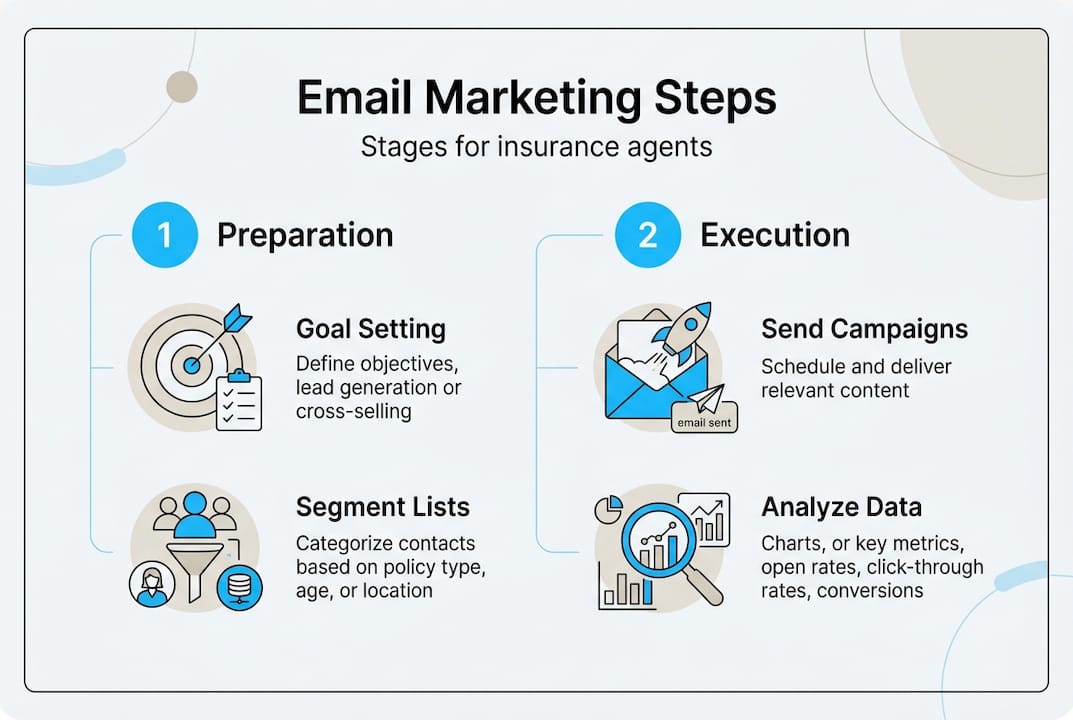
Preparation starts with defining specific objectives for your email campaigns. Are you generating new leads through educational content? Nurturing warm prospects with product comparisons? Re-engaging dormant clients with policy reviews? Each goal demands different messaging, frequency, and calls to action. Write down your primary objective before touching any email platform.
Segment your contact list into actionable groups based on criteria that matter for insurance sales. Organize by demographics like age and family status, policy types they own or need, engagement levels from previous interactions, and position in the sales funnel. A 30-year-old renter needs different messaging than a 55-year-old homeowner planning retirement. AI marketing tools improve insurance leads by 40% when segmentation aligns content with prospect needs precisely.
Select AI-powered email marketing platforms that integrate seamlessly with your existing CRM system. Look for features like behavioral triggers, dynamic content insertion, predictive send time optimization, and automated A/B testing. The platform should handle routine tasks while giving you strategic control. Check integration capabilities with your email automation guide for insurance agents to ensure smooth data flow between systems.
Pro Tip: Use AI analytics to identify the optimal sending times for each contact segment. Morning sends might work for business owners reviewing policies, while evening sends could engage families planning coverage together. Let data guide timing rather than guessing.
Step-by-step execution of the email marketing process with AI automation
Executing effective email campaigns requires systematic implementation of AI-powered workflows that handle repetitive tasks while maintaining genuine personalization. Start by creating compelling email content using AI templates designed specifically for insurance products. These templates adapt messaging based on recipient data, inserting relevant policy details, local regulations, or life stage considerations automatically.
Build your core automation workflows around the insurance customer journey. Welcome series introduce new subscribers to your expertise and value proposition across 3-5 emails over two weeks. Follow-up sequences nurture leads who downloaded resources or requested quotes, providing additional information and gentle prompts toward consultation booking. Re-engagement campaigns target contacts who haven’t interacted in 60-90 days with fresh angles or special offers.

Personalize emails dynamically using data points your CRM already captures. Insert first names, reference specific policies they own, mention their location to discuss regional weather risks or regulatory changes, and adjust tone based on their engagement history. AI systems analyze past behavior to predict which content types, subject line styles, and call-to-action formats will resonate most with each recipient.
Implement these automation steps in sequence:
- Configure behavioral triggers based on contact actions like form submissions, email opens, link clicks, or website visits to specific product pages.
- Design email templates with variable content blocks that swap based on recipient attributes and preferences automatically.
- Set up drip campaigns with conditional logic that adjusts messaging paths based on engagement levels or responses received.
- Enable AI-powered send time optimization that analyzes each contact’s historical engagement patterns to deliver messages when they’re most likely to open.
- Activate automated A/B testing for subject lines, preview text, and primary calls to action to continuously improve performance.
Over 50+ features in AI tools simplify marketing workflows by handling technical complexity behind intuitive interfaces. You focus on strategy and relationship building while automation manages execution precision.
This table illustrates a typical automated email sequence for insurance lead nurturing:
| Email Number | Trigger/Timing | Primary Goal | Content Focus |
|---|---|---|---|
| 1 | Immediate after signup | Welcome and set expectations | Introduce expertise, preview valuable content coming |
| 2 | 2 days later | Educate on common need | Address frequent insurance question or misconception |
| 3 | 5 days after email 2 | Build trust through proof | Share client success story or testimonial |
| 4 | 7 days after email 3 | Present solution | Explain specific policy benefits matching their profile |
| 5 | 5 days after email 4 | Prompt action | Offer free consultation or personalized quote |
Pro Tip: Test multiple subject line variations using AI-powered tools that predict open rates based on language patterns, length, and emotional triggers. Winning subject lines often ask questions, create curiosity, or promise specific value rather than making generic announcements.
Monitor your email marketing automation features dashboard daily during the first two weeks of any new campaign. Watch for unexpected patterns like high unsubscribe rates or spam complaints that signal messaging misalignment. Adjust quickly based on early signals rather than waiting for campaign completion. Integration with CRM lead management tools ensures every email interaction updates contact records automatically, maintaining clean data for future targeting decisions.
Verifying success and optimizing your email marketing campaigns
Measuring email campaign performance reveals what’s working and where you’re leaving money on the table. AI-powered analytics dashboards track critical metrics in real time, giving you immediate visibility into campaign health. Focus on four core measurements that directly impact your insurance business growth.
Open rates indicate how well your subject lines and sender reputation attract attention. Industry benchmarks for insurance emails hover around 20-25%, but segmented, personalized campaigns regularly achieve 35-45%. Track open rates by segment to identify which groups respond best to your messaging approach.
Click-through rates measure engagement quality beyond the initial open. You want recipients taking action, whether that’s reading a blog post, downloading a guide, or clicking through to a quote form. Strong insurance email campaigns generate 3-5% click-through rates, with highly targeted sequences reaching 8-10%.
Conversion rates connect email activity to business outcomes. Track how many email recipients book consultations, request quotes, or purchase policies. This metric matters most because it ties marketing effort directly to revenue. AI systems attribute conversions accurately even when the customer journey spans multiple touchpoints over weeks or months.
Unsubscribe rates signal content relevance and frequency appropriateness. Rates above 0.5% per campaign suggest messaging misalignment or excessive sending. Monitor this metric closely, as high unsubscribe rates damage sender reputation and reduce future deliverability.
Compare manual versus AI-automated campaign results to quantify return on investment:
| Metric | Manual Campaigns | AI-Automated Campaigns | Improvement |
|---|---|---|---|
| Average Open Rate | 18% | 38% | +111% |
| Click-Through Rate | 2.1% | 6.4% | +205% |
| Time Spent Per Campaign | 8 hours | 1.5 hours | 81% reduction |
| Cost Per Lead | $47 | $18 | 62% lower |
Troubleshoot common issues proactively to maintain campaign effectiveness. Avoid spam filters by maintaining clean contact lists, using authenticated sending domains, and avoiding trigger words like “free,” “guarantee,” or excessive capitalization. Manage unsubscribes gracefully by honoring requests immediately and offering frequency reduction options before complete removal.
These optimization tactics improve results continuously:
- Review email performance weekly to spot trends early and adjust messaging before campaigns complete
- Segment underperforming contacts into separate re-engagement sequences with different angles or offers
- Test email frequency by creating control groups receiving different sending schedules to find the sweet spot
- Analyze which content types generate the most engagement and double down on those formats
- Monitor deliverability rates and sender reputation scores to catch technical issues before they impact reach
Integrating CRM with marketing automation improves campaign outcomes by ensuring every interaction informs future messaging. When your email platform knows a contact opened three emails about life insurance but ignored property coverage content, it can automatically adjust future sends to focus on their demonstrated interests.
Use A/B testing powered by AI to refine every campaign element systematically. Test one variable at a time: subject lines, preview text, email length, image usage, call-to-action placement, or sending day. AI systems analyze results faster than manual review and automatically apply winning variations to future sends. This continuous improvement approach compounds gains over time, turning mediocre campaigns into high-performing lead generation engines.
Set up automated alerts for significant metric changes. If open rates drop 15% suddenly, you need to investigate immediately rather than discovering the problem weeks later. Similarly, unexpected spikes in engagement signal opportunities to amplify what’s working. Real-time monitoring through CRM and marketing integration benefits keeps you responsive to market shifts and contact behavior changes.
How CallBack CRM elevates your email marketing process
CallBack CRM delivers the AI-powered email marketing automation insurance agents need to compete effectively in 2026’s digital-first marketplace. The platform combines intelligent email templates designed specifically for insurance products with sophisticated automation workflows that nurture leads from initial contact through policy purchase. You’ll spend less time on repetitive tasks and more time building relationships that close deals.
The system integrates email marketing seamlessly with comprehensive lead and customer management, ensuring every interaction updates contact records automatically. This unified approach eliminates data silos and gives you complete visibility into each prospect’s journey.
CallBack’s interface is built for insurance professionals, not technical experts. Set up complex automation sequences through intuitive visual builders without coding or lengthy training. Access email marketing automation features that include behavioral triggers, dynamic personalization, and AI-optimized send times right out of the box. Combine these capabilities with CRM lead management tools that score leads automatically and route hot prospects to your sales team instantly. Explore all-in-one AI marketing features through a free trial, and schedule a marketing audit to identify quick wins for your agency.
FAQ
What is the email marketing process for insurance agents?
The email marketing process includes three core stages: preparation, execution, and verification. During preparation, you define campaign goals, segment your contact list by relevant criteria like policy needs or demographics, and select AI-powered tools that integrate with your CRM. Execution involves creating personalized content, setting up automated workflows for welcome series and follow-ups, and using AI to optimize send times and messaging. Verification focuses on tracking performance metrics like open rates and conversions, then refining strategies based on data insights to improve results continuously.
How can AI improve email marketing for insurance agents?
AI transforms email marketing by personalizing content dynamically based on each recipient’s profile, behavior, and preferences without manual customization work. The technology predicts optimal send times by analyzing individual engagement patterns, ensuring messages arrive when prospects are most likely to open them. AI automates complex lead nurturing sequences that adapt based on recipient actions, maintaining consistent follow-up that manual processes can’t match. These capabilities increase engagement rates significantly while reducing the time agents spend on campaign management, as shown by AI marketing tools for insurance leads improving results by 40%.
What metrics should insurance agents track for email campaigns?
Track four essential metrics to measure email campaign effectiveness: open rates showing subject line and sender reputation strength, click-through rates indicating content relevance and engagement quality, conversion rates connecting email activity to actual business outcomes like quote requests or policy purchases, and unsubscribe rates signaling content alignment issues. Use AI-powered dashboards for real-time monitoring rather than waiting for campaign completion to assess performance. The CRM and marketing integration benefits include automated metric tracking that attributes conversions accurately across multiple touchpoints, giving you clear ROI visibility for every campaign you run.
How often should insurance agents send marketing emails?
Email frequency depends on your audience segment and campaign type, but most insurance agents find success with one to two educational emails weekly for engaged prospects and monthly touchpoints for existing clients. New lead nurturing sequences work well with higher frequency initially, sending three to five emails over two weeks, then spacing out to weekly or biweekly as the relationship matures. Test different frequencies with your specific audience using A/B testing, as some segments prefer daily tips while others engage better with weekly digests. Monitor unsubscribe rates closely, as they signal when you’ve crossed from helpful to annoying.
What makes email subject lines effective for insurance marketing?
Effective insurance email subject lines create curiosity, promise specific value, or ask relevant questions rather than making generic announcements. Keep length under 50 characters so mobile devices display the full message, and personalize with the recipient’s name or location when it adds genuine relevance. Avoid spam trigger words like “free,” excessive punctuation, or all caps that damage deliverability. Test multiple variations using AI tools that predict open rates based on language patterns, emotional triggers, and proven insurance industry benchmarks to identify winners before sending to your full list.