

TL;DR:
- Retention marketing focuses on growing revenue from existing customers through lifecycle communication and AI-driven segmentation. It is a continuous strategy that deepens customer relationships, reduces costs, and stabilizes long-term profits.
Retention marketing is the discipline of growing revenue from existing customers through lifecycle communication, predictive segmentation, and post-purchase optimization. Rather than chasing new audiences, it deepens the relationships a brand has already built. The three core levers are:
- Lifecycle journeys: Automated sequences tied to customer behavior, from onboarding through renewal and win-back
- Predictive segmentation: AI-driven scoring that flags disengagement early and prioritizes outreach by expected value
- Loyalty and experience: Programs, personalized recommendations, and support touchpoints that increase purchase frequency and satisfaction
The business case is direct: retained customers cost less to serve and compound revenue more efficiently than newly acquired ones, making retention one of the most reliable drivers of long-term profit growth.
Table of Contents
- What is retention marketing, and how does it differ from acquisition?
- Why retention marketing matters for revenue and profit
- Key retention metrics: formulas, worked examples, and benchmarks
- Which channels work best for retention marketing?
- Core retention strategies and how to execute them
- Retention marketing best practices and a testing framework
- How to build a retention program: a 30‑90‑180 day plan
- What organizational and technology prerequisites does retention require?
- Real-world retention examples and what the numbers show
- Key Takeaways
- The part most retention guides skip
- How Callbackcrm helps insurance teams run retention programs
- Useful sources and further reading
What is retention marketing, and how does it differ from acquisition?
Retention marketing is a continuous operating model, not a one-time campaign. The discipline covers everything from the second purchase onward, optimizing each interaction to increase repeat rate, average order value, and customer lifetime value. Customer retention, by contrast, is the outcome: the percentage of customers who stay active over a given period. The practice produces the outcome.
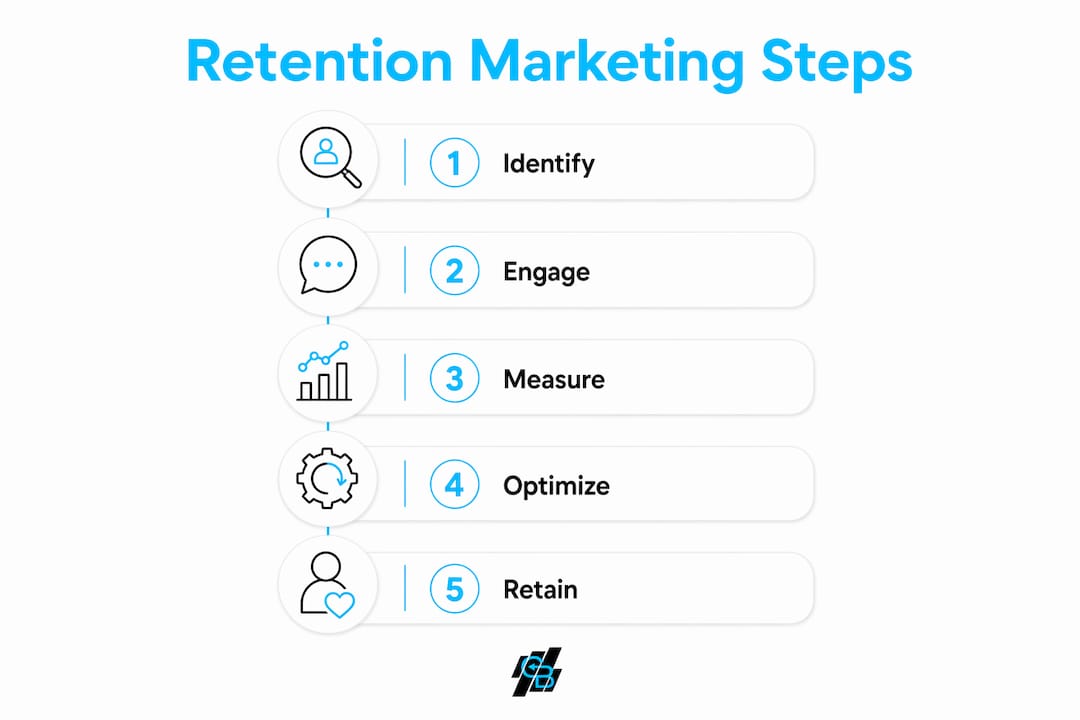
Retention sits in the post-purchase half of the customer lifecycle. A standard lifecycle model moves through four stages after the initial sale: onboarding (activating the customer and delivering early value), retention (sustaining engagement and repeat behavior), expansion (increasing spend through upsell or cross-sell), and advocacy (converting loyal customers into referrers). Retention marketing owns all four, though its heaviest work happens in the first two.
Acquisition marketing and retention marketing serve different goals, cost structures, and measurement frameworks:
- Goal: Acquisition targets new, unknown audiences; retention deepens relationships with identified customers
- Cost structure: Acquisition relies on paid media, lead generation, and awareness content; retention uses owned channels (email, SMS, push, loyalty) at a fraction of the cost
- Primary metrics: Acquisition tracks cost per lead, cost per acquisition, and new customer volume; retention tracks retention rate, churn rate, repeat purchase rate, and customer lifetime value
- Measurement horizon: Acquisition results appear in days or weeks; retention results compound over months and years
Neither replaces the other. Acquisition fills the top of the funnel; retention multiplies the value of every customer who enters it.
Why retention marketing matters for revenue and profit
The financial case for retention is well established. A 5% increase in retention can increase profits by 25% or more, depending on the industry. That leverage exists because retained customers cost less to serve, convert at higher rates, and spend more per transaction than newly acquired customers.
Stat: Acquiring a new customer can cost five to 25 times more than retaining an existing one, according to research by W. Earl Sasser of Harvard Business School and Frederick F. Reichheld of Bain & Company.
Retention marketing also delivers a 5–25x lower cost-per-revenue-dollar than paid acquisition for direct-to-consumer and subscription businesses. That gap widens as digital advertising costs rise. One recent research report found that 42% of marketers spend more than half their budget on retention, reflecting a broad shift in how growth teams allocate resources.
Beyond cost efficiency, retention stabilizes unit economics. A business with high churn must constantly replace lost revenue with expensive acquisition spending. A business with strong retention builds a compounding base: each cohort of retained customers generates predictable recurring revenue, which reduces dependence on paid channels and makes forecasting more reliable. The Pareto Principle applies directly here: roughly 20% of customers generate 80% of revenue, and retention marketing is how you protect and grow that 20%.
Key retention metrics: formulas, worked examples, and benchmarks
Measuring retention correctly requires a small set of formulas applied consistently to cohort data. Here are the core calculations:
- Retention rate: ((Customers at end of period – New customers acquired) ÷ Customers at start of period) × 100
- Churn rate: (Customers lost during period ÷ Customers at start of period) × 100. Note: Retention rate + Churn rate = 100%
- Repeat purchase rate: Customers who purchased more than once ÷ Total unique customers × 100
- Average order value (AOV): Total revenue ÷ Number of orders
- Customer lifetime value (LTV): AOV × Purchase frequency × Average customer lifespan
Worked example (12-month cohort): A subscription business starts January with 1,000 customers. By December 31, it has 950 of those original customers still active and acquired 200 new ones during the year. Retention rate = ((950 – 0 new from original cohort) ÷ 1,000) × 100 = 95%. Churn rate = 5%. If those 950 customers each average $120 AOV and purchase 4 times per year over a 3-year lifespan, LTV = $120 × 4 × 3 = $1,440.
Cohort retention tracks groups of customers who joined in the same period (same month or quarter) and measures what percentage remain active at 30, 60, 90, 180, and 365 days. Cohort analysis reveals whether retention is improving over time and which acquisition channels produce the most durable customers. Analytics in marketing applied to cohort data consistently produces better resource allocation decisions than aggregate reporting alone.
Benchmark reference by business model:
| Business model | Typical annual retention rate | Notes |
|---|---|---|
| SaaS / subscription | 95% | Higher for enterprise; lower for SMB self-serve |
| Direct-to-consumer (DTC) | 25% | Varies sharply by category and AOV |
| B2B services | 90% | Relationship-driven; longer sales cycles |
| Insurance | 80–90% | Policy renewal rates; high switching cost |
| E-commerce (general) | 20% | Commodity categories trend lower |
Benchmarks are directional reference points. Actual rates vary by category, price point, and competitive intensity.
Which channels work best for retention marketing?
Multi-channel coordination moves the needle more than any single channel. Teams that rely on email alone leave significant retention gains on the table. The channel mix should match the lifecycle stage and the customer’s communication preferences.

| Channel | Best lifecycle stage | Primary use case | Key consideration |
|---|---|---|---|
| Onboarding, retention, win-back | Lifecycle flows, newsletters, offers | Permission-based; CAN-SPAM compliance required | |
| SMS | Retention, renewal, win-back | Time-sensitive alerts, reminders, offers | Explicit opt-in required under TCPA |
| Push / in-app | Onboarding, engagement | Feature adoption, usage nudges | Requires app install; opt-in rates vary |
| Loyalty portal | Retention, expansion | Points, rewards, tier status | Works best with frequent purchase categories |
| Direct mail | Win-back, high-value segments | Re-engagement, premium offers | Higher cost; reserve for high-LTV customers |
| Customer support | All stages | Issue resolution, proactive check-ins | Human escalation is a retention lever, not a cost center |
| Community / forum | Retention, advocacy | Peer connection, product education | Builds long-term brand attachment |
Pro Tip: Before adding a new channel, confirm you have explicit consent and a clear opt-out path. In the US, SMS campaigns require TCPA-compliant opt-in, and email programs must comply with CAN-SPAM. Non-compliance creates legal exposure and destroys deliverability.
Tools like SendGrid handle transactional and lifecycle email at scale with strong deliverability infrastructure. Klaviyo is widely used for e-commerce retention flows combining email and SMS. Omnisend adds push and web push to that mix. Braze serves enterprise teams needing real-time, cross-channel orchestration. HubSpot provides CRM-native lifecycle marketing for B2B and mid-market teams. SaaSquatch specializes in referral and loyalty program infrastructure.
Escalate to human support when a customer signals high dissatisfaction, when churn risk is elevated for a high-value account, or when an automated sequence has failed to re-engage after two or three touchpoints. Automation handles volume; humans handle the moments that determine whether a customer stays or leaves.
Core retention strategies and how to execute them
Successful retention programs combine lifecycle journeys with loyalty and replenishment triggers. These are the highest-impact tactics, each with a concrete execution note:
- Onboarding flows: Trigger a 3–5 email sequence within the first 14 days of signup or first purchase. Goal: deliver early value, reduce time-to-first-success, and set expectations. Metric to move: 30-day activation rate.
- Lifecycle email automation: Map behavioral triggers (first purchase, second purchase, 60-day inactivity) to specific message sequences. Each email responds to what the customer just did, not a broadcast schedule. Metric to move: repeat purchase rate.
- Win-back campaigns: Target customers inactive for 90+ days with a 2–3 message sequence. Lead with value (a relevant recommendation or content piece), follow with a time-limited offer if needed. Metric to move: reactivation rate.
- Loyalty programs: Assign points or tier status based on purchase frequency or spend. Communicate tier progress proactively. Metric to move: purchase frequency and AOV.
- Replenishment triggers: For consumable products or recurring services, send a reminder at the predicted reorder window based on average purchase interval. Metric to move: repeat purchase rate and churn.
- Cancel-flow optimization: When a customer initiates cancellation, present a structured retention offer: a pause option, a downgrade, or a personalized reason to stay. Metric to move: save rate.
- Personalized recommendations: Use purchase history and browsing data to surface relevant products or services. Personalization tactics applied at the individual level consistently outperform segment-level promotions. Metric to move: AOV and cross-sell rate.
- Referral programs: Activate loyal customers as a growth channel. Offer a reward for both the referrer and the new customer. Metric to move: referral conversion rate and new customer LTV.
Pro Tip: Prioritize tactics by two dimensions: expected revenue impact and implementation speed. Onboarding flows and win-back campaigns typically deliver the fastest measurable lift with the least technical complexity. Run those first, then layer in loyalty and predictive personalization once baseline data is established.
Common pitfalls: launching too many tactics simultaneously without clean event data, using the same message for all segments, and measuring opens instead of downstream revenue impact.
Retention marketing best practices and a testing framework
Strong retention programs are built on consistent segmentation, deliberate testing, and a clear measurement discipline.
Best practices:
- Segment by predicted behavior, not just demographics. Customers with similar purchase history but different engagement patterns need different messages.
- Map the full customer journey before building any automation. Identify the moments where customers typically disengage and design interventions for those specific points.
- Personalize at the individual level where data allows. Multi-channel CRM platforms that unify behavioral data make this practical at scale.
- Optimize cadence continuously. Sending too frequently increases unsubscribes; too infrequently allows customers to forget the brand. Test frequency as a variable, not a constant.
- Treat every campaign as a learning opportunity. Define the hypothesis before sending, not after.
Testing framework (six steps):
- Hypothesis: State what you expect to change and why (e.g., “Sending the win-back email on day 75 instead of day 90 will increase reactivation rate because customers are less disengaged”).
- Primary metric: Identify one metric the test will move (reactivation rate, repeat purchase rate, AOV).
- Test design: Split the audience randomly. Control group receives the current approach; test group receives the variation.
- Sample size: Calculate the minimum sample needed to detect a meaningful difference at 95% confidence before starting.
- Duration: Run the test long enough to capture a full purchase cycle. Cutting tests short produces unreliable results.
- Evaluation: Measure the primary metric and one secondary metric. Document the result and apply the learning to the next iteration.
What to test first: Subject lines and preview text (highest volume, fastest results), send timing by day and hour, offer versus value-content framing, and message length. Save multivariate tests for after the program has enough volume to reach statistical significance quickly.
Privacy and compliance note: US retention programs must comply with CAN-SPAM for email, TCPA for SMS, and state-level privacy laws including the California Consumer Privacy Act (CCPA). Always provide a clear opt-out mechanism, honor opt-outs within the required timeframe, and review consent records before launching new channels.
How to build a retention program: a 30‑90‑180 day plan
A phased rollout prevents the common mistake of building too much at once before the data infrastructure is ready.
30-day milestones (quick wins):
- Define 3–5 retention KPIs and set baseline measurements
- Audit existing customer data: completeness, accuracy, and event coverage
- Launch one onboarding flow and one transactional post-purchase sequence
- Set up basic cohort tracking in your analytics platform
90-day milestones (scale automation):
- Build behavioral segmentation: active, at-risk, lapsed
- Launch win-back campaign for the 90-day inactive segment
- Add SMS as a second channel for high-priority segments (with proper consent)
- Establish a weekly retention review cadence with defined owners
180-day milestones (predictive and loyalty):
- Integrate predictive churn scoring into segmentation logic
- Launch a loyalty or referral program for the top-value customer segment
- Begin A/B testing cadence and offer strategy systematically
- Build a monthly retention dashboard shared across marketing, product, and support
Program checklist:
- Goals and KPIs documented with owners
- Customer journey maps for onboarding, retention, and win-back
- Required data points: purchase history, behavioral events, contact preferences, opt-in status
- Technology integrations: CRM, email/SMS platform, analytics, loyalty engine
- Team roles: retention marketer, data analyst, CRM admin, and support escalation contact
- Governance: weekly metric review, monthly cohort analysis, quarterly program audit
What organizational and technology prerequisites does retention require?
Retention programs fail more often from data and alignment gaps than from poor messaging. Churn frequently reflects misalignment across product, marketing, and sales rather than a purely tactical messaging failure.
Data prerequisites:
- A single customer view that merges purchase history, behavioral events, support interactions, and contact preferences into one profile
- Event-level telemetry: knowing what a customer did (viewed a product, opened an email, contacted support) and when
- Clean opt-in records for every channel
Team alignment:
- Marketing owns lifecycle messaging and campaign execution
- Product feeds usage data and feature adoption signals into the retention stack
- Sales provides context on customer expectations set during the acquisition process
- Support surfaces early churn signals and feeds exit feedback into product and pricing decisions
AI and automation in practice: Predictive analytics can flag disengagement early, often within a 14-day window before expected churn. Advanced systems use next-best-action scoring to prioritize interventions: heavy-touch re-engagement for high-value customers with moderate churn risk, and light-touch automation for lower-risk segments. This approach is more efficient than treating all at-risk customers identically.
Recommended tech stack:
- CRM with automation: manages profiles, triggers workflows, and tracks lifecycle stage
- Email and SMS platform: handles message delivery, segmentation, and A/B testing
- Analytics: cohort tracking, funnel analysis, and revenue attribution
- Loyalty engine: points, tiers, and referral mechanics
- Payment recovery / dunning: automated retry logic for failed payments in subscription businesses
Pro Tip: Before evaluating new tools, audit whether your current stack is generating complete behavioral event data. A sophisticated platform built on incomplete data produces unreliable segmentation. Fix the data layer first.
Real-world retention examples and what the numbers show
Three concrete examples illustrate how retention tactics translate into measurable outcomes.

Example 1: Subscription SaaS onboarding optimization. A mid-market SaaS company identified that customers who did not complete a key setup step within the first seven days churned at three times the rate of those who did. The team built a 5-email onboarding sequence triggered by inactivity, with each message focused on one specific setup action. The result was a measurable reduction in 30-day churn for the targeted cohort. The tactic is directly transferable to any subscription business with a defined activation milestone. For smaller teams, a 2–3 email version with a single clear call to action produces similar directional results.
Example 2: Win-back campaign for lapsed e-commerce customers. A direct-to-consumer brand segmented customers inactive for 90–120 days and ran a 3-message win-back sequence: a value-led reminder, a personalized product recommendation based on past purchases, and a time-limited offer. Reactivated customers showed higher AOV on their return purchase than their original order, consistent with the broader finding that retained customers spend more and convert at higher rates than new ones. Smaller brands can replicate this with a 2-message sequence and a modest offer, prioritizing the highest-LTV lapsed segment first.
Example 3: Insurance client retention through automated follow-up. Insurance agencies that integrate AI-driven follow-up and unified client profiles into their renewal workflows see improved policy renewal rates compared to manual outreach alone. Automated touchpoints at 90, 60, and 30 days before renewal, combined with a personalized summary of the client’s coverage, reduce the likelihood of a client shopping competitors. The approach scales to solo agents and large agencies alike, with the primary variable being the quality of the client data feeding the automation.
Key Takeaways
Retention marketing delivers compounding revenue growth by keeping existing customers active, loyal, and spending more over time through lifecycle automation, predictive segmentation, and multi-channel engagement.
| Point | Details |
|---|---|
| Retention rate formula | ((End customers – New customers) ÷ Start customers) × 100; track by cohort, not just in aggregate. |
| Profit leverage | A 5% retention increase can raise profits by 25% or more; small improvements compound significantly over time. |
| Channel mix matters | Multi-channel programs (email, SMS, push, loyalty) outperform email-only approaches; coordinate by lifecycle stage. |
| Start with quick wins | Launch onboarding flows and win-back campaigns first; they deliver the fastest measurable lift with the least complexity. |
| Callbackcrm fit | Callbackcrm’s AI-driven automation and unified client profiles support lifecycle retention workflows for insurance agents and agencies. |
The part most retention guides skip
Retention marketing is often framed as a messaging problem. Send the right email at the right time, and customers stay. That framing is incomplete, and it leads teams to over-invest in campaign optimization while under-investing in the data and organizational alignment that actually determine whether retention programs work.
The more accurate framing: retention is a diagnostic. When churn is high, the first question should not be “what should we say?” It should be “what is the customer experiencing that makes leaving feel like the right decision?” The answer is usually found in product usage data, support ticket themes, and exit survey responses, not in email open rates.
Teams that treat churn as a strategic signal, rather than a metric to suppress with discounts, tend to build more durable retention programs. They fix the underlying experience gaps that drive disengagement, then layer messaging on top of a product and service that customers actually want to stay with. The messaging amplifies a good experience; it cannot substitute for one.
The 30/90/180 day rollout framework is useful precisely because it forces this sequence. The first 30 days are about understanding the data and fixing the most obvious activation gaps. The next 60 days are about scaling what works. Predictive models and loyalty programs come last, because they require clean data and a baseline of behavioral history to function correctly. Teams that skip to loyalty programs before fixing onboarding are building on an unstable foundation.
One practical piece of advice: pick one retention metric to own in the first 90 days. Not five. One. Define it clearly, measure it weekly, and build every decision around moving it. Retention programs that try to improve everything simultaneously tend to improve nothing measurably.
How Callbackcrm helps insurance teams run retention programs
Insurance agents and agencies face a specific retention challenge: policy renewals happen on a fixed annual cycle, client relationships are long-term, and the cost of losing a client to a competitor is high relative to the cost of keeping them. Manual follow-up at scale is not practical, and generic email platforms were not built for the insurance workflow.
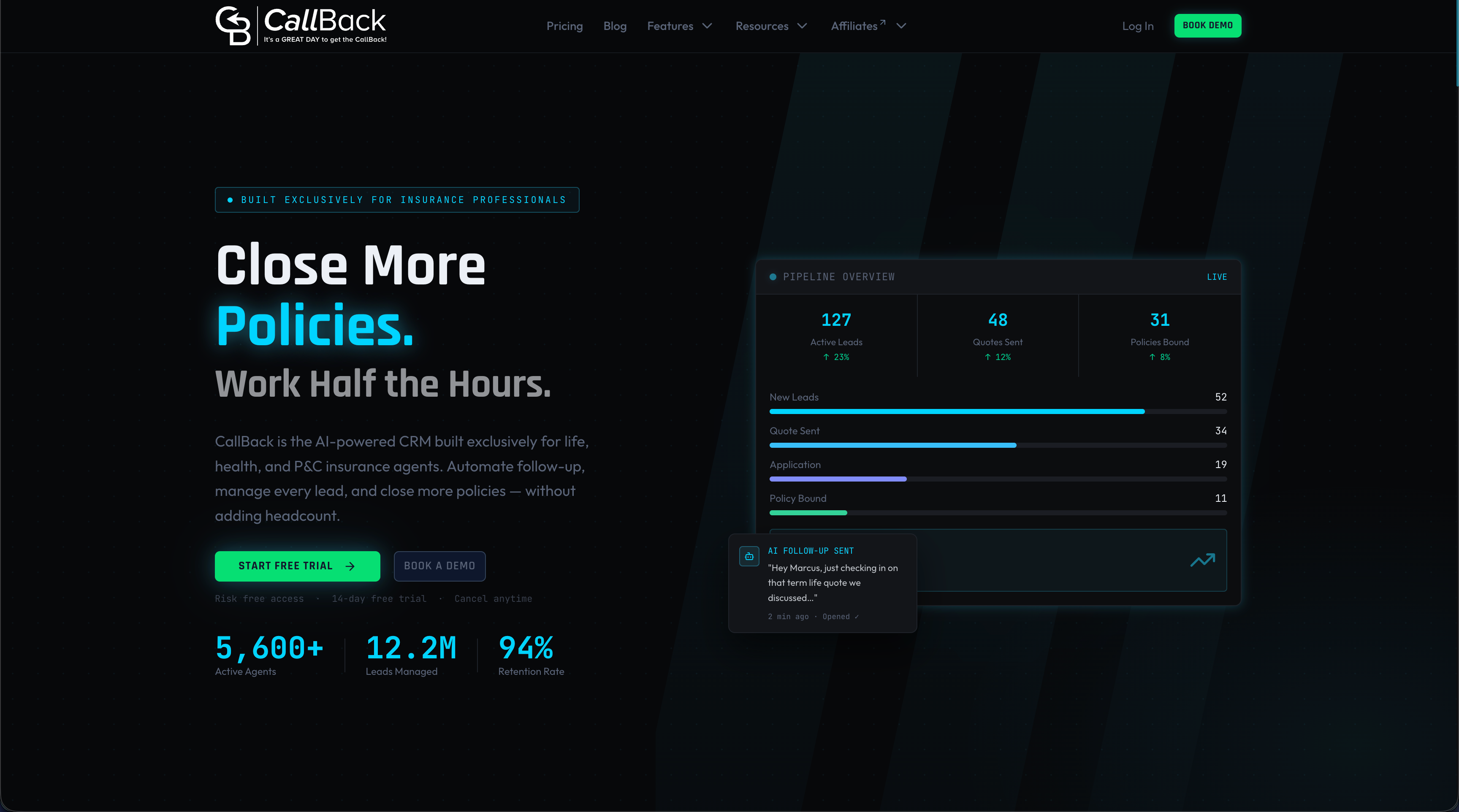
Callbackcrm addresses this directly. The platform combines a CRM with AI-driven automation, SMS and email marketing, and unified client profiles in a single system built for insurance professionals. Automated renewal sequences can be triggered at 90, 60, and 30 days before a policy expiration date, with each message personalized to the client’s coverage and history. AI-assisted lead scoring identifies which clients are most likely to shop competitors, so agents can prioritize outreach before the renewal window closes. The SMS marketing features support time-sensitive renewal reminders with TCPA-compliant opt-in management built in.
For agencies and IMOs ready to move from manual follow-up to a structured retention program, Callbackcrm provides the automation infrastructure, the messaging channels, and the analytics to measure what is working. Start a free trial at callbackcrm.com to see how the platform fits your retention workflow.
Useful sources and further reading
- What Is Retention Marketing? Strategy, Examples & AI Guide | Braze: Comprehensive overview of retention marketing as a discipline, with coverage of AI tools and lifecycle strategy.
- Customer Retention: What It Is and Why It Matters | Stripe: Authoritative treatment of retention’s financial impact, including the 5% retention / 25% profit finding and cross-functional alignment requirements.
- 10 Key Retention Marketing Strategies | NetSuite: Practical strategy overview with historical context on acquisition vs. retention cost research.
- The Value of Keeping the Right Customers | Harvard Business Review: Foundational HBR piece on the economics of customer retention and the cost of churn.
- Retention Marketing Tactics | SAP Emarsys: Tactical breakdown of loyalty programs, lifecycle automation, and personalization approaches.
- Customer Retention Strategies | Klaviyo: Channel-specific retention strategies with a focus on email and SMS for e-commerce and DTC brands.
- Client retention in insurance: why it drives profit | Callbackcrm: Callbackcrm’s domain-specific analysis of retention economics in the insurance vertical.
- The role of AI in client retention for insurance pros | Callbackcrm: Practical guide to AI-driven retention tactics for insurance agents and agencies.
- Customer lifecycle explained: stages, metrics, and strategy | Callbackcrm: Background on lifecycle stages and how retention maps to each phase of the customer journey.
Recommended
- Personalized Marketing Strategies That Drive Real Growth | CallBack CRM Blog
- Client Retention in Insurance: Why It Drives Profit | CallBack CRM Blog
- Customer Lifecycle Explained: Stages, Metrics, and Strategy | CallBack CRM Blog
- Email Marketing Optimization Steps for Better Conversions | CallBack CRM Blog