

TL;DR:
- The customer lifecycle involves five stages from awareness to advocacy, helping teams optimize relationships and reduce costs. Managing this cycle with shared data and stage-specific tactics boosts customer lifetime value and minimizes churn. Effective lifecycle management aligns marketing, sales, and service efforts to build lasting, mutually beneficial customer relationships.
The customer lifecycle is the complete sequence of stages a person moves through from first learning about a business to becoming a repeat buyer and advocate. The five canonical stages are: awareness/reach → acquisition/consideration → conversion/purchase → retention → loyalty/advocacy. Understanding this model helps teams reduce churn, increase customer lifetime value (CLV), and allocate resources where they produce the most return.
TL;DR: The customer lifecycle maps every stage of the customer relationship. Managing it well lowers acquisition costs and raises long-term revenue.
- Lifecycle thinking directly improves CLV by identifying where customers drop off and what keeps them engaged.
- Proactive retention and advocacy programs reduce churn without proportional increases in ad spend.
Table of Contents
- What are the five customer lifecycle stages?
- How does customer lifecycle management differ from CRM?
- How do you map your customer’s lifecycle?
- What metrics should you track across the lifecycle?
- What are the best strategies for each lifecycle stage?
- What mistakes do teams make with lifecycle management?
- How do you start lifecycle management in five steps?
- How insurance agents can apply lifecycle thinking
- Key Takeaways
- Why lifecycle thinking changes how teams operate
- Callbackcrm helps you act on lifecycle data faster
- Useful sources and further reading
What are the five customer lifecycle stages?
Each stage has a distinct objective, a set of customer behaviors, and a short list of tactics that move people forward. The five-stage model is the most widely used framework across marketing, sales, and customer success teams.
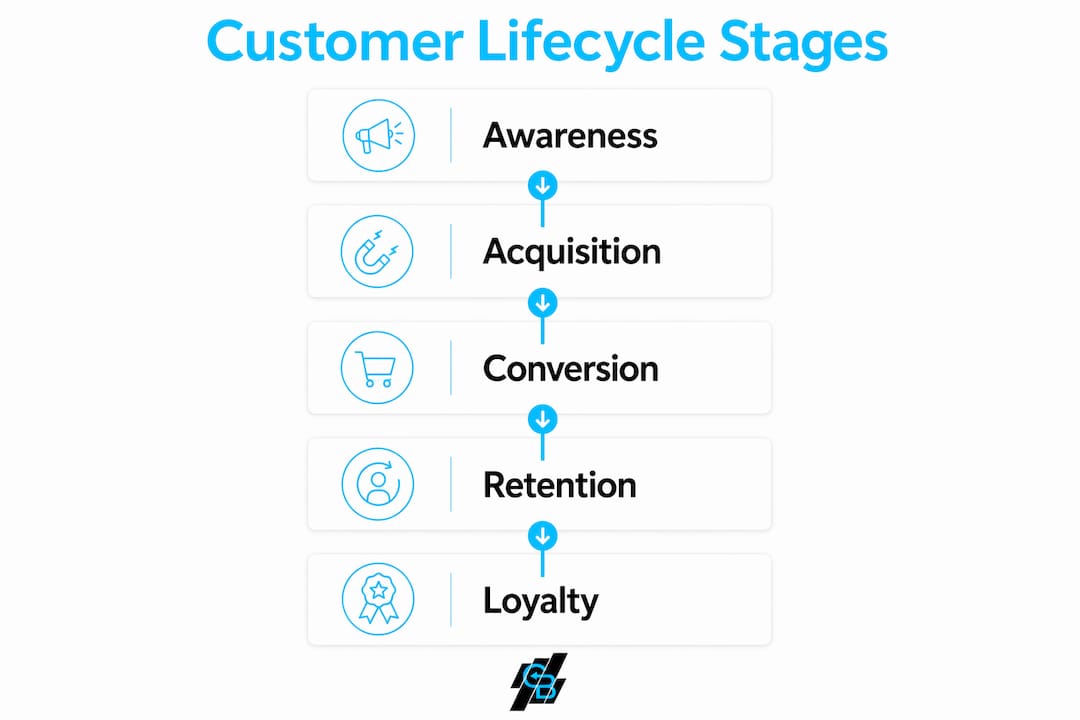
Stage 1: Awareness/reach
Objective: Get in front of the right people before they are actively comparing options.
At this stage, potential customers do not know your brand or have only a vague sense it exists. They are consuming content, scrolling social feeds, or searching for answers to a problem. The team’s job is to be present and credible.
- Primary touchpoints: paid search ads, organic blog content, social media posts, podcast sponsorships, word-of-mouth referrals.
- Example tactics: publish SEO-optimized content that answers common questions; run targeted display ads to lookalike audiences; build a referral incentive for existing customers to share.
- Stage KPI: impressions, organic reach, branded search volume.
Stage 2: Acquisition/consideration
Objective: Convert anonymous visitors into identified leads and move them toward a decision.
The prospect is now actively researching. They compare options, read reviews, and consume detailed content like case studies or product demos. Teams need to capture contact information and qualify intent.
- Primary touchpoints: landing pages, gated content (guides, webinars), demo requests, email nurture sequences.
- Example tactics: offer a gated resource in exchange for an email address; run a drip sequence that addresses common objections; use lead scoring to prioritize follow-up.
- Stage KPI: lead-to-opportunity conversion rate, cost per lead.
Stage 3: Conversion/purchase
Objective: Remove friction from the buying decision and close the sale.
The prospect is ready to buy but may hesitate over price, complexity, or trust. A simplified checkout, a clear value proposition, and a well-timed incentive can tip the decision.
- Primary touchpoints: pricing pages, sales calls, proposal documents, checkout flows, contract signing.
- Example tactics: A/B test call-to-action copy and button placement; offer a limited-time discount or free trial; use social proof (reviews, case studies) directly on the purchase page.
- Stage KPI: conversion rate, average deal size, sales cycle length.
Stage 4: Retention
Objective: Keep customers active and satisfied after the first purchase.
A customer who buys once is not yet loyal. Retention requires proactive communication, a smooth onboarding experience, and ongoing value delivery. This is where most businesses lose ground silently.
- Primary touchpoints: onboarding emails, in-app prompts, support tickets, usage check-ins, renewal outreach.
- Example tactics: build a structured onboarding sequence for new customers; send usage-based nudges when engagement drops; proactively reach out before a renewal date.
- Stage KPI: retention rate, churn rate, product usage frequency.
Stage 5: Loyalty/advocacy
Objective: Turn satisfied customers into active promoters who bring in new prospects.
Loyalty is not a destination. Organizations that invest in advocacy and referral programs capture organic, low-cost growth that compounds over time. A referred customer typically costs less to acquire and stays longer.
- Primary touchpoints: referral program invitations, community forums, review request emails, loyalty rewards.
- Example tactics: launch a structured referral program with clear incentives; invite top customers to co-create content or case studies; send personalized anniversary or milestone messages.
- Stage KPI: Net Promoter Score (NPS), referral rate, customer advocacy rate.
Pro Tip: Map one real customer’s path through all five stages before building any automation. The gaps you find in that single journey will tell you more than a spreadsheet of aggregate data.
Stage-to-metric mapping
| Lifecycle stage | Primary KPI | Secondary KPI |
|---|---|---|
| Awareness/reach | Impressions, organic reach | Branded search volume |
| Acquisition/consideration | Lead conversion rate | Cost per lead |
| Conversion/purchase | Purchase conversion rate | Average deal size |
| Retention | Retention rate | Churn rate |
| Loyalty/advocacy | NPS | Referral rate |
How does customer lifecycle management differ from CRM?
Customer lifecycle management (CLM) is the operational discipline of tracking, analyzing, and optimizing every touchpoint across the customer relationship. CLM focuses on analytics and optimization rather than data storage, which is where it parts ways with a CRM system.

A CRM is a records system. It stores contact data, deal history, and communication logs. CLM is what you do with that data: it spans marketing, sales, and service teams working from a shared view to improve stage-by-stage outcomes.
CLM vs. CRM at a glance:
- Focus: CLM targets lifecycle analytics and optimization; CRM targets data capture and record management.
- Output: CLM produces stage-level insights and action plans; CRM produces contact records and pipeline reports.
- Ownership: CLM is a cross-team discipline (marketing, sales, service); CRM is typically owned by sales or IT.
- Goal: CLM reduces churn and raises CLV; CRM supports sales activity tracking.
The organizational implication is direct: lifecycle thinking requires breaking down the walls between teams. When marketing hands a lead to sales without a shared definition of “qualified,” or when service has no visibility into what the customer was promised during the sale, the customer experience fractures. Unified data platforms and shared dashboards are the structural fix, not a process memo.
Lifecycle thinking also reframes the relationship as cyclical rather than linear. Satisfied customers feed back into the awareness stage through referrals and social proof, lowering future acquisition costs. That is the flywheel effect: the better you serve existing customers, the cheaper it becomes to acquire new ones.
How do you map your customer’s lifecycle?
A lifecycle map is a structured document that lists every touchpoint, the data source behind it, the team responsible, and the friction points that need fixing. Effective lifecycle mapping spans marketing, sales, and service with shared data sources, not siloed spreadsheets.
Step-by-step mapping method
- Define your stages. Agree on the five canonical stages and write a one-sentence definition for each that every team accepts. Without shared definitions, handoffs break.
- List all touchpoints. For each stage, write down every channel and interaction point where the customer encounters the business: ads, landing pages, emails, sales calls, onboarding sessions, support tickets, renewal notices.
- Identify data sources. For each touchpoint, name the system that captures the data: CRM, email platform, website analytics, product usage logs, support ticket system.
- Collect behavioral signals. Combine CRM records with behavioral data like email open rates, site visits, and product usage to detect where a customer actually is in the lifecycle, not just where the record says they are.
- Annotate friction points. Mark every touchpoint where customers drop off, delay, or complain. These are the optimization priorities.
- Validate with qualitative research. Run five to ten customer interviews or review support transcripts to confirm that the map reflects real behavior, not internal assumptions.
Mapping checklist for teams:
- Stages defined and agreed across marketing, sales, and service.
- All touchpoints listed per stage with channel and format noted.
- Data source named for each touchpoint.
- Friction points flagged with supporting data (drop-off rate, complaint volume).
- Qualitative validation completed (interviews or support review).
- Map reviewed quarterly and updated when product or channel mix changes.
Pro Tip: For multi-channel attribution, start simple: tag every inbound lead source in your CRM on day one. You cannot retroactively attribute a conversion to the right channel if the source field is blank.
What metrics should you track across the lifecycle?
Core lifecycle metrics include CLV, CAC, churn rate, retention rate, conversion rate, and NPS/CSAT. Each maps to a specific stage and answers a different operational question.
Metric definitions and formulas
-
Customer Lifetime Value (CLV): The total revenue a customer generates over the full relationship. Formula: CLV = Average Purchase Value × Purchase Frequency × Average Customer Lifespan Example: $500 average purchase × 3 purchases/year × 4 years = $6,000 CLV.
-
Customer Acquisition Cost (CAC): The total cost to acquire one new customer. Formula: CAC = Total Sales and Marketing Spend ÷ Number of New Customers Acquired Example: $50,000 spend ÷ 200 new customers = $250 CAC.
-
Churn Rate: The percentage of customers who stop doing business in a given period. Formula: Churn Rate = (Customers Lost in Period ÷ Customers at Start of Period) × 100
-
Retention Rate: The inverse of churn; the percentage of customers who stay. Formula: Retention Rate = ((Customers at End of Period - New Customers) ÷ Customers at Start) × 100
-
Conversion Rate: The percentage of prospects who complete a target action (purchase, sign-up, demo). Formula: Conversion Rate = (Conversions ÷ Total Visitors or Leads) × 100
-
NPS/CSAT: Net Promoter Score measures likelihood to recommend (scale of 0–10); CSAT measures satisfaction with a specific interaction.
Metrics by stage and reporting cadence
| Metric | Lifecycle stage | Reporting cadence |
|---|---|---|
| Impressions, reach | Awareness | Weekly |
| Lead conversion rate | Acquisition | Weekly |
| Purchase conversion rate | Conversion | Weekly |
| Churn rate | Retention | Monthly |
| Retention rate | Retention | Monthly |
| CLV | Loyalty/advocacy | Quarterly |
| CAC | Acquisition/conversion | Monthly |
| NPS/CSAT | Loyalty/advocacy | Quarterly |
Leading vs. lagging indicators: Conversion rate and email engagement are leading indicators — they signal what is about to happen. CLV and churn rate are lagging — they confirm what already happened. Track both, but act on the leading indicators before the lagging ones confirm a problem.
Pro Tip: Set a CLV:CAC ratio target of at least 3:1. If you are spending more than one-third of a customer’s lifetime value to acquire them, the unit economics do not work at scale.
What are the best strategies for each lifecycle stage?
Tactics only work when they match the stage. A retention email sent to someone who has not yet converted is noise. A referral request sent to a customer who just had a bad support experience is worse.
Awareness
- Publish SEO content that answers the questions your ideal customer is already searching.
- Run lookalike audience campaigns on paid channels using your best existing customers as the seed.
- Build a referral incentive so current advocates actively generate reach for you.
Acquisition/consideration
- Gate high-value content (guides, templates, webinars) to capture email addresses and qualify intent.
- Use personalized marketing sequences to address objections specific to each lead segment.
- Implement lead scoring so sales focuses time on the highest-intent prospects first.
Conversion
- Simplify the purchase path: remove unnecessary form fields, reduce steps to checkout, and make pricing transparent.
- Optimize email sequences for conversion by testing subject lines, CTAs, and send timing.
- Use social proof directly on the purchase page: reviews, case study snippets, and trust badges.
Retention
- Build a structured onboarding sequence that delivers value within the first 30 days.
- Send usage-based nudges when engagement drops below a defined threshold — do not wait for the customer to churn.
- Reach out proactively before renewal dates with a value summary and a clear next step.
- Apply proven customer retention strategies like milestone rewards and check-in calls to reduce passive churn.
Loyalty/advocacy
- Launch a referral program with a clear, easy-to-share incentive.
- Invite top customers to participate in case studies, testimonials, or community events.
- Use relationship marketing tactics to build emotional connection beyond the transaction.
Pro Tip: Before scaling any tactic, run a two-week experiment on a small segment. Measure one outcome metric. If it moves in the right direction, scale. If not, adjust and re-test. This prevents wasting budget on tactics that look good in theory but do not fit your specific audience.
What mistakes do teams make with lifecycle management?
Most lifecycle failures come from a small set of recurring errors. Recognizing them early saves significant time and budget.

Mistake 1: Treating the lifecycle as a straight line. Teams build a funnel and assume customers move cleanly from left to right. In practice, customers skip stages, re-enter for new products, or loop back after a lapse. Processes and automation rules must handle non-linear movement, not just the happy path.
Fix: Build re-entry triggers in your CRM for customers who go quiet after purchase. A lapsed customer is not lost — they are in an unmanaged retention stage.
Mistake 2: Ignoring loyalty as an active stage. Many teams treat loyalty as a passive outcome of good service. It is not. Without a deliberate referral program or advocacy incentive, satisfied customers stay quiet. The organic growth that comes from advocacy does not happen by accident.
Fix: Assign ownership of the loyalty stage to a specific team member. Build at least one repeatable referral or advocacy program and measure its output monthly.
Mistake 3: Siloed data across teams. When marketing tracks leads in one system, sales tracks deals in another, and service tracks tickets in a third, no one has a complete picture of the customer. Stage handoffs break, and customers repeat themselves to every new team member they reach.
Fix: Establish a single source of truth — one platform where all three teams can see the customer’s full history. Define handoff events with clear criteria (e.g., “a lead becomes a sales opportunity when lead score exceeds 50”).
Mistake 4: Over-relying on raw CRM records. A CRM record shows what was entered, not what the customer actually did. A contact marked “active” may not have engaged in six months. Without behavioral data layered on top, lifecycle stage assignments are guesses.
Fix: Integrate behavioral signals (email opens, site visits, product logins) with CRM records. Use those signals to trigger automated outreach, not just to update a field.
Pro Tip: To detect a stuck stage quickly, pull a cohort report: group customers by the month they entered a stage and check what percentage moved to the next stage within 30, 60, and 90 days. A stage where most customers stall past 60 days needs immediate attention.
How do you start lifecycle management in five steps?
You do not need a major project to begin. Five focused steps get a team from zero to operational within a month.
- Agree on stage definitions. Write one sentence per stage that marketing, sales, and service all accept. Post it somewhere everyone can see it. Shared language is the foundation.
- Connect your key data sources. Link your CRM, email platform, website analytics, and product usage data. Even a basic integration that passes lead source and email engagement into the CRM is a significant improvement over nothing.
- Instrument three to five core metrics and set baselines. Start with conversion rate, churn rate, and CLV. Pull current numbers. You cannot improve what you have not measured.
- Run a two-week experiment to improve one stage conversion. Pick the stage with the most obvious friction. Change one variable — a subject line, a CTA, a follow-up timing — and measure the result. Small, fast experiments build the habit of lifecycle optimization.
- Adopt a weekly lifecycle review cadence. Spend 30 minutes each week reviewing the stage metrics. Who moved forward? Who stalled? What triggered the change? Consistency here matters more than sophistication.
Who to involve first: Start with one person from marketing, one from sales, and one from service. Three people with shared data and shared definitions will outperform a ten-person committee with siloed systems.
Low-cost tools to start: Your existing CRM, a free or low-cost email platform, and Google Analytics cover the basics for most teams. The goal in the first month is measurement and shared visibility, not automation.
- Review your current CRM for completeness: are lead sources, stage dates, and contact status fields populated?
- Identify the one stage where the most customers stall or drop off.
- Set a 30-day goal for one metric improvement in that stage.
How insurance agents can apply lifecycle thinking
An independent insurance agency provides a clear, practical example of lifecycle management in action. The stages map directly to the agent’s daily workflow.
Stage-by-stage application for insurance:
- Awareness: Run targeted Facebook or Google ads to homeowners or small business owners in a defined zip code. Publish short educational content on common coverage gaps.
- Acquisition: Use lead scoring to prioritize inbound inquiries. Send an immediate SMS or email response within five minutes of a form submission — response speed is a primary driver of lead conversion in insurance.
- Conversion: Send a personalized proposal with a clear summary of coverage and pricing. Follow up with a call within 24 hours. Use a digital signature tool to remove friction from the close.
- Retention: Build an onboarding sequence that confirms coverage details, introduces the agent’s contact information, and schedules a 90-day check-in. Send a renewal reminder 60 days before the policy date.
- Loyalty/advocacy: Ask satisfied policyholders for a Google review and a referral. A simple, automated message at the 12-month mark converts a passive customer into an active promoter.
The customer outreach process for insurance agents maps these stages to specific workflows, including SMS follow-up timing and onboarding call scripts.
Immediate automations an insurance agent can implement:
- Triggered SMS within five minutes of a new lead form submission.
- Three-email drip sequence for unconverted leads over 14 days.
- Automated 90-day check-in email for new policyholders.
- Renewal reminder sequence starting 60 days before policy expiration.
- Post-renewal review request sent automatically after confirmation.
Pro Tip: Start with the renewal reminder sequence first. It protects existing revenue before you invest in growing new acquisition, and it is the fastest automation to build and measure.
For more on customer engagement best practices specific to insurance sales, the Callbackcrm blog covers stage-specific tactics in detail.
Key Takeaways
The customer lifecycle is a five-stage model that, when managed with shared data and stage-specific tactics, reduces churn and raises CLV across every customer relationship.
| Point | Details |
|---|---|
| Five canonical stages | Awareness → acquisition → conversion → retention → loyalty; each needs distinct tactics and KPIs. |
| CLM vs. CRM | CLM is an analytical discipline; CRM is a records system. Both are needed, but CLM drives outcomes. |
| Core metrics | Track CLV, CAC, churn rate, retention rate, conversion rate, and NPS mapped to their respective stages. |
| Start small | Run a two-week experiment on one stage before scaling; set baselines for three to five metrics first. |
| Callbackcrm for insurance | Callbackcrm automates lifecycle touches (SMS, email, lead scoring) for insurance agents managing multiple stages at once. |
Why lifecycle thinking changes how teams operate
Most organizations already collect enough data to manage the customer lifecycle well. The gap is not data — it is the discipline to use it consistently across teams. Marketing, sales, and service each have a partial view of the customer, and each optimizes for their own metrics. Lifecycle thinking forces a shared frame: one customer, one journey, one set of outcomes everyone is accountable for.
The early wins from lifecycle management tend to be concrete and fast. A team that instruments churn rate for the first time and then builds a single retention email sequence will see the impact within 30 days. That result builds the internal case for the next experiment. The compounding effect is real: each stage improvement lowers the cost of the next one, because better retention means fewer customers to replace, and better advocacy means lower acquisition spend.
Lifecycle management is an operational discipline. It requires agreed definitions, shared data, and a weekly review habit. It does not require a large budget or a new platform to start.
Callbackcrm helps you act on lifecycle data faster
Insurance agents and agencies managing multiple lifecycle stages simultaneously face a specific problem: the manual work of follow-up, lead scoring, and renewal tracking consumes time that should go to selling. Callbackcrm addresses that directly. The platform automates SMS and email touches at each lifecycle stage, scores leads based on behavioral signals, and gives agents a single view of every contact’s status across the pipeline.
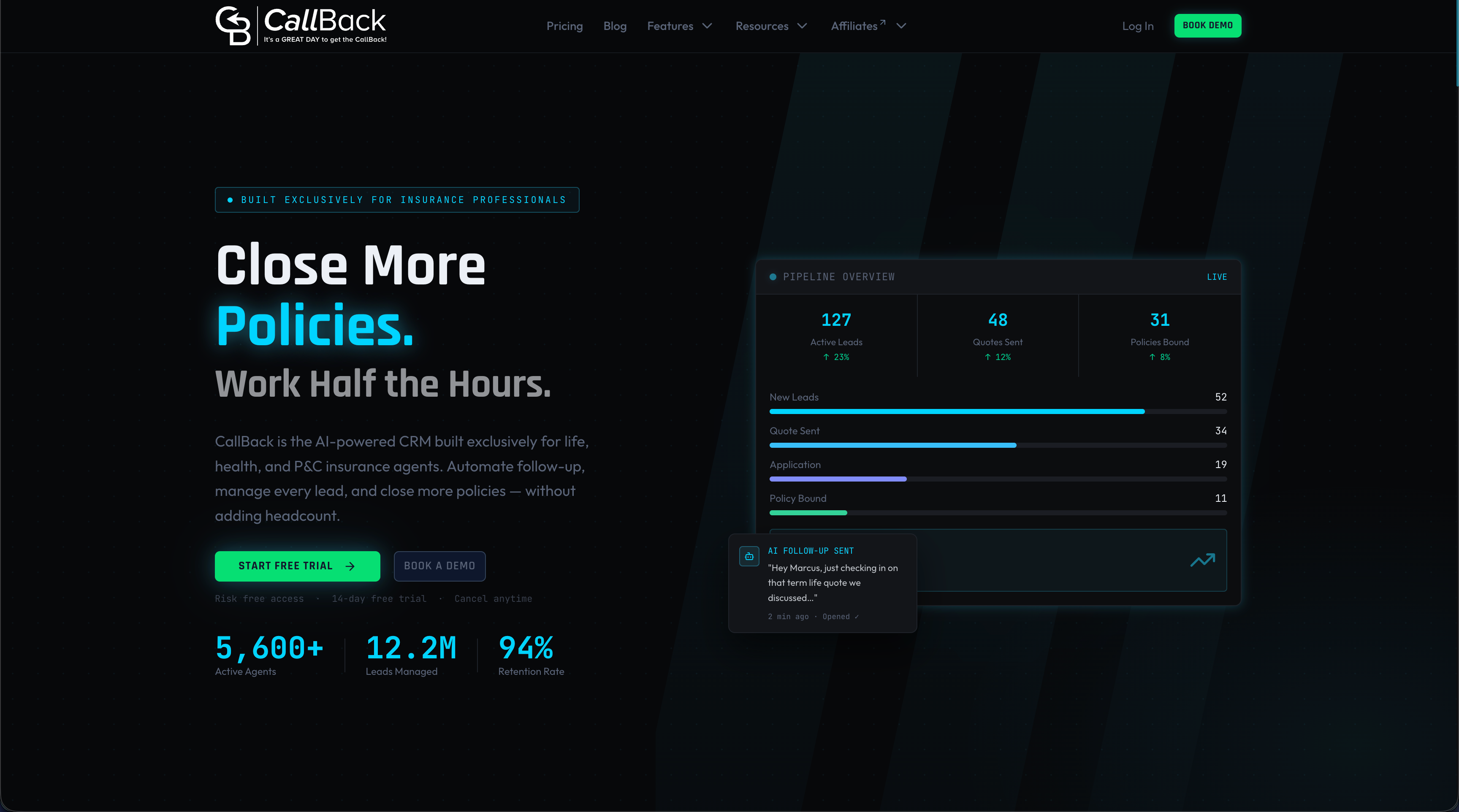
The SMS marketing features in Callbackcrm are built for triggered, lifecycle-aware outreach: a new lead gets an immediate text, a stalled prospect gets a timed follow-up, and a renewing policyholder gets a reminder sequence, all without manual intervention. Agents who use automated lifecycle workflows spend less time on administrative follow-up and more time on conversations that close. If you are ready to put lifecycle automation to work for your agency, start a free trial at callbackcrm.com.
Useful sources and further reading
The following sources were used to build the stage model, metrics, and mapping guidance in this article.
- Customer lifecycle management — Wikipedia: Definitions and formulas for CLV, CAC, and core lifecycle metrics.
- What is customer lifecycle management? — ServiceNow: CLM definition and how it differs from CRM as a records system.
- Customer lifecycle management: Everything you need to know — HubSpot: Five-stage model, flywheel framing, and behavioral data integration guidance.
- Customer lifecycle management: Definition, strategy, and 5 stages — Zendesk: Retention and loyalty program design, including referral and advocacy tactics.
- Customer lifecycle: Stages, strategies, and metrics — Sprinklr: Lifecycle mapping methodology and touchpoint inventory framework.
- Customer outreach process for insurance agents: 2026 — Callbackcrm Blog: Domain-specific workflows and outreach checklists for insurance agents.
- Lead lifecycle management: A practical guide — Callbackcrm Blog: How lead lifecycle concepts connect to the full customer lifecycle model.
- Step-by-step sales workflow: 2026 process guide — Callbackcrm Blog: Operational workflow guidance that aligns lifecycle stages with daily sales activity.