

TL;DR:
- A customer outreach process in insurance involves structured, multi-channel steps to engage prospects and build loyalty.
- It requires defining the ideal customer profile, verified contact lists, reliable infrastructure, targeted messaging, multi-touch sequences, and ongoing measurement.
A customer outreach process is a structured, measurable series of steps insurance agents use to engage prospects and clients across multiple channels to build loyalty and drive consistent sales. In the insurance industry, this process goes by a more formal name in sales operations circles: outbound engagement sequencing. Both terms describe the same discipline. The difference between agents who generate predictable pipeline and those who scramble for renewals every quarter comes down to whether they treat outreach as a system or a series of random calls. A well-built process, supported by tools like Callbackcrm or HubSpot, creates repeatable results through personalization, timing, and multi-touch communication. This guide breaks down every component you need to build and run that system.
What does a customer outreach process actually require?
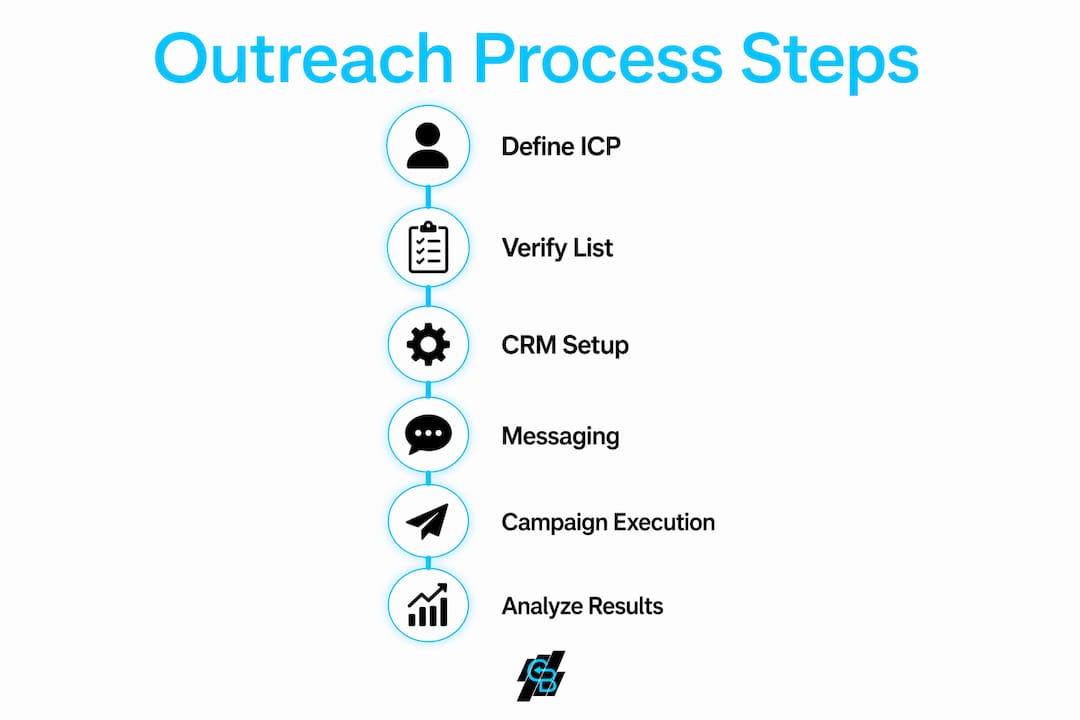
A strong outbound process requires six core components: a defined Ideal Customer Profile (ICP), a verified prospect list, a reliable sending infrastructure, tested messaging, a multi-touch sequence, and a measurement system. Each component depends on the one before it. Skip one, and the whole system underperforms.

Define your ideal customer profile first
Your ICP is not a vague description like “small business owners.” For insurance agents, it means specifying industry, employee count, coverage gaps, renewal timing, and decision-maker role. A well-built ICP helps you rank prospects by fit so you spend time on the ones most likely to convert and retain. Without this filter, you waste outreach on low-value contacts and dilute your results.
Build and verify your prospect list
A verified list is not optional. Email bounce rates above 3% signal list health problems that damage your sender reputation and reduce deliverability across every future campaign. Use tools that validate email addresses and confirm phone numbers before you load contacts into your CRM. Callbackcrm’s lead management features let you import, clean, and segment lists inside one platform without juggling spreadsheets.
Set up your sending infrastructure and CRM tracking
Your CRM is the backbone of your outreach marketing strategy. It records every touchpoint, tracks reply rates, and triggers next steps automatically. The table below shows the key infrastructure components and what each one does for your process.
| Component | Role in Outreach |
|---|---|
| CRM (e.g., Callbackcrm) | Tracks contacts, logs interactions, triggers sequences |
| Email sending domain | Protects deliverability and sender reputation |
| SMS platform | Adds a direct, high-open-rate channel to sequences |
| Analytics dashboard | Measures reply rates, conversions, and drop-off points |
| Segmentation tags | Groups contacts by value, need, and lifecycle stage |
Develop messaging frameworks around customer problems
Your messaging must lead with the client’s problem, not your product. An agent who opens with “We offer competitive life insurance rates” loses to one who opens with “Most business owners I talk to don’t realize their key-person coverage has a gap.” Frame every message around a specific risk, concern, or outcome your prospect cares about. This approach is the foundation of effective outreach methods that generate replies rather than silence.
How do you execute a winning outreach campaign step by step?
Execution is where most agents fall apart. They have a list and a CRM, but no sequence logic. Here is a proven step-by-step approach built for insurance sales.
-
Segment your contacts by value and need. High-value clients with complex coverage needs get deeper, more personalized outreach. Lower-value prospects receive lighter sequences. Segmentation enables prioritization of high-value groups while keeping your workload manageable.
-
Write distinct messages for each touchpoint. A cold email sequence should carry distinct value in each message, not just bump the previous one. Use different angles: a risk insight on day one, a case study on day five, a direct question on day ten.
-
Spread touchpoints across 14–21 days using multiple channels. Effective outreach spans 14 to 21 days with 4–6 touchpoints across email, phone, and SMS. Each channel reaches a different segment of your audience at a different moment.
-
Set inactivity triggers. Win-back campaigns should trigger after 60 days of no engagement. Automate this inside your CRM so no lapsing client slips through unnoticed.
-
Respond fast when a prospect engages. A reply or a link click is a buying signal. Respond within the same business day. Update your CRM record immediately so the next automated step does not fire and create confusion.
-
Test sequence logic, not just subject lines. Testing what happens next based on behavioral context outperforms testing email copy alone. Try leading with value before any upsell, and measure whether that order improves conversion.
-
Review metrics weekly and iterate. Weekly reviews and iterations increase conversion rates by 2–3x compared to static campaigns. Look at open rates, reply rates, and meeting bookings every week, not every quarter.
Pro Tip: Never run automated marketing sequences while a client has an open claim or unresolved service issue. Pausing automated outreach during active support interactions protects trust and prevents tone-deaf messaging that can cost you a renewal.
For a complete workflow structure, the 2026 sales workflow guide from Callbackcrm walks through sequencing logic in detail.
What are the most common outreach mistakes insurance agents make?
Most outreach failures trace back to a short list of repeatable mistakes. Recognizing them is the first step to fixing them.
-
Stopping too early. 80% of replies in outbound sequences come from follow-up messages, not the first email. Agents who quit after three attempts leave the majority of their potential responses on the table. Persist to five or six touchpoints before marking a prospect inactive.
-
Treating all clients the same. Sending the same message to a 20-year policyholder and a cold prospect destroys relevance. Segmentation is not optional. It is the mechanism that makes personalization possible at scale.
-
Sending marketing emails during open claims. This is one of the most damaging mistakes in insurance outreach. A client dealing with a denied claim who receives a promotional email about bundling policies will not renew. Pause all automated sequences for any contact with an active service issue.
-
Leading with product instead of problems. Agents who open with coverage features lose to agents who open with a specific risk scenario the prospect has not considered. Your messaging framework must center on the client’s world, not your product catalog.
-
Ignoring deliverability. A bounce rate above 3% signals a list health problem that reduces how many of your emails reach the inbox. Clean your list before every major campaign.
-
Skipping measurement. You cannot improve what you do not track. Set up conversion tracking for every stage: open rate, reply rate, meeting booked, quote sent, policy bound.
Pro Tip: Building a professional outbound process takes 4–6 weeks to set up and 2–3 months of consistent execution before you see predictable results. Agents who abandon the process at week four never see the payoff that comes at month three.
How does outreach build lasting customer loyalty?
Outreach is not just a prospecting tool. It is the primary mechanism for building customer loyalty over a client’s lifetime with your agency. The table below compares reactive versus proactive outreach approaches and their impact on retention.
| Approach | Behavior | Loyalty Outcome |
|---|---|---|
| Reactive | Contact clients only at renewal | High churn, low referrals |
| Proactive | Regular value-driven touchpoints | Higher retention, more referrals |
| Personalized | Segment-specific messaging | Emotional connection, lower price sensitivity |
| Omnichannel | Email, SMS, phone, social | Consistent experience across all touchpoints |
46% of consumers base loyalty primarily on product quality and consistent service, not rewards programs. This means your outreach must consistently reinforce the quality of your service, not just promote new products. Loyalty programs amplify existing trust. They do not create it from scratch.
Personalization is the mechanism that turns outreach into a relationship. When a client receives a message that references their specific policy, their renewal date, or a risk relevant to their industry, they feel recognized. That recognition is what builds emotional connection and separates agents who retain 90% of their book from those who fight for every renewal.
Win-back campaigns are a specific loyalty tool for lapsing clients. Trigger them automatically after 60 days of inactivity. Use a sequence that acknowledges the gap, offers a specific value, and makes it easy to re-engage. Referral incentives work best after a client has had a positive claims or service experience. That is the moment their trust is highest and their willingness to advocate is strongest.
Key takeaways
A disciplined, multi-touch customer outreach process is the single most reliable way insurance agents build a consistent pipeline and retain clients long-term.
| Point | Details |
|---|---|
| Build the six foundations first | Define ICP, verify lists, set up CRM, and write messaging before launching any sequence. |
| Persist past three touchpoints | 80% of replies come from follow-up messages; run 5–6 touchpoints before marking a prospect inactive. |
| Pause automation during claims | Never send marketing messages while a client has an open service issue. |
| Lead with problems, not products | Frame every message around a specific client risk or concern to generate replies. |
| Measure weekly and iterate | Weekly metric reviews increase conversion rates by 2–3x compared to static campaigns. |
Why most agents underestimate how long this takes
I have watched agents build a solid outreach system, run it for three weeks, and then declare it does not work. That is the most common and most costly mistake in this business. A professional outbound process takes 4–6 weeks to stand up correctly and 2–3 months of consistent execution before the pipeline becomes predictable. Agents who quit at week four never see the results that arrive at month three.
The second thing I have learned is that timing and trust matter more than message volume. Sending six emails in a week to a prospect who just filed a claim does not generate business. It generates unsubscribes and resentment. The agents who win long-term treat outreach as lifecycle management. They know when to push and when to go quiet. That judgment comes from having clean CRM data and the discipline to follow sequence rules even when you are tempted to improvise.
The third lesson is harder to accept: automation is a multiplier, not a replacement for judgment. The best outreach I have seen combines automated sequences with human review at key decision points. An AI-powered tool like Callbackcrm can handle the mechanics of delivery, timing, and tracking. The agent still needs to read the signals and decide when to pick up the phone. That combination is what separates a high-performing book of business from a mediocre one.
— Kyle
How Callbackcrm supports your outreach process
Callbackcrm is built specifically for insurance agents who want to run a professional, multi-channel outreach process without managing five separate tools. The platform combines email and SMS marketing, CRM tracking, automation workflows, and a social inbox in one place.
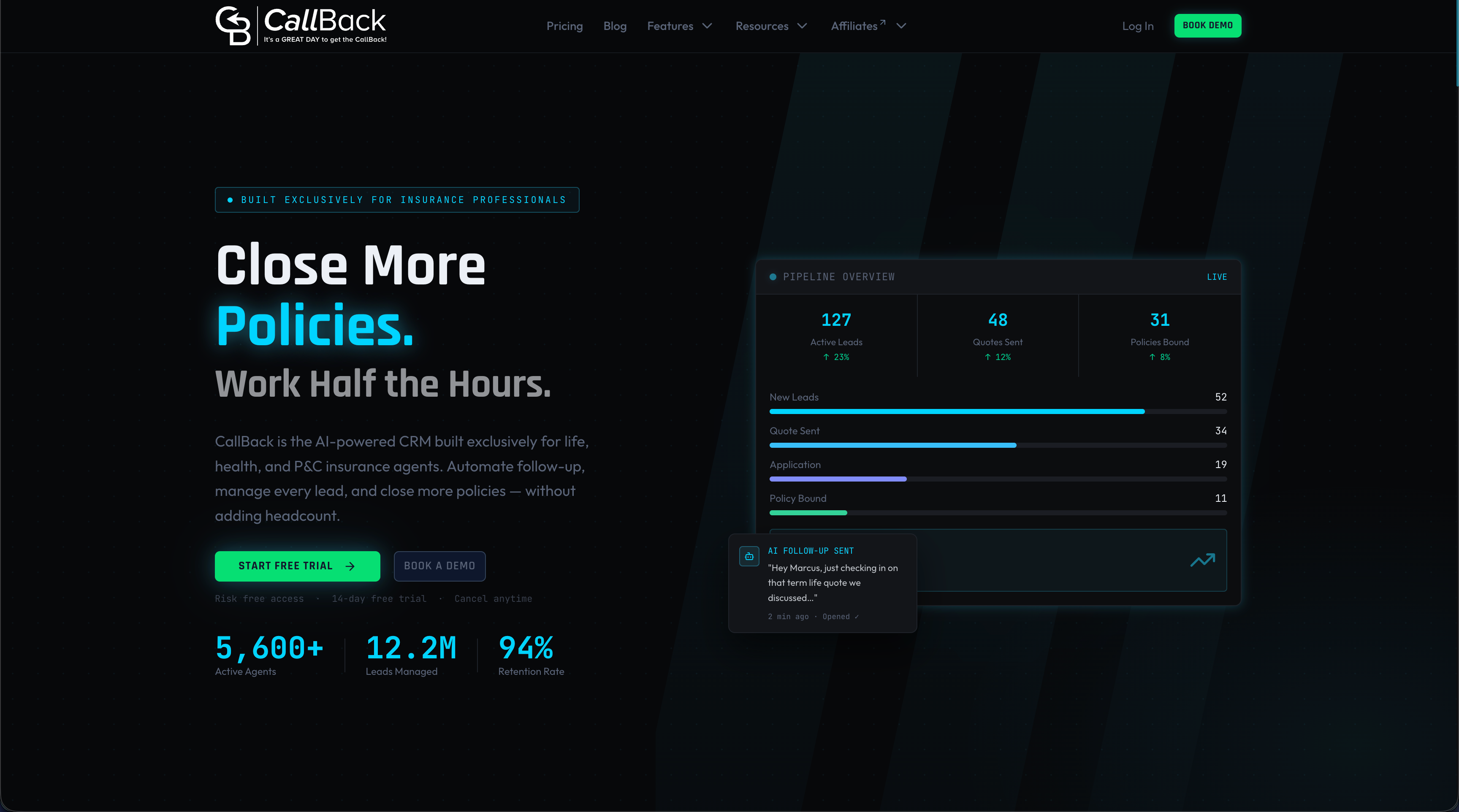
You can build multi-touch sequences that span email, SMS, and social media, then track reply rates and conversion stages from a single dashboard. The AI-powered lead scoring identifies which prospects are most likely to convert so you focus your time where it counts. If you want to see exactly where your current outreach has gaps, Callbackcrm offers a free marketing audit that maps your process against proven benchmarks. Explore the full feature set to see how it fits your agency’s workflow.
FAQ
What is a customer outreach process in insurance sales?
A customer outreach process is a structured sequence of multi-channel communications an insurance agent uses to engage prospects and clients at defined intervals. It includes email, phone, and SMS touchpoints designed to build trust and drive conversions.
How many touchpoints should an insurance outreach sequence include?
An effective sequence spans 14–21 days with 4–6 touchpoints across multiple channels. Research shows that 80% of replies come from follow-up messages, so stopping after three attempts leaves most responses unclaimed.
How do i avoid damaging client trust with automation?
Pause all automated marketing sequences whenever a client has an open claim or unresolved service issue. Sending promotional messages during active support interactions is one of the fastest ways to lose a renewal.
How long before an outreach process delivers consistent results?
A well-built outreach process takes 4–6 weeks to set up and 2–3 months of consistent execution before it generates a predictable pipeline. Agents who abandon the process before month three rarely see the results it can produce.
What is the best way to use segmentation in outreach?
Segment contacts by policy value, coverage type, and lifecycle stage. High-value clients receive deeper, personalized sequences while lower-value prospects get lighter outreach. This approach lets you prioritize high-value groups without burning out your team.