

TL;DR:
- AI-powered outreach automates multi-channel prospecting by targeting high-value insurance leads with personalized, behavior-triggered messages. Success relies on precise customer profiling, human review of AI drafts, and multi-channel sequencing using if/then logic to optimize engagement. Consistent, data-driven efforts improve reply and meeting conversion rates, scaling outreach effectively over time.
An ai-powered outreach process is a structured, automated workflow that uses machine learning and real-time behavioral data to personalize and deliver multi-channel prospecting at scale. For insurance sales professionals and marketers, this means replacing manual cold calling with intelligent sequences that identify high-value leads, trigger personalized messages, and track engagement across LinkedIn, email, and phone. Platforms like Outreach, Katie AI, and Appify have made this approach accessible to agencies of any size. A well-built workflow delivers 20–30% connection acceptance rates, 12–18% first-message reply rates, and 3–5% meeting conversions per total invites sent. Those numbers represent a measurable lift over traditional prospecting methods.
What does an ai-powered outreach process actually require?
Before you write a single message, you need the right foundation. The most common mistake insurance marketers make is deploying AI content before defining a precise Ideal Customer Profile (ICP). Without a clearly defined ICP, AI content generation produces generic, low-conversion messages that get ignored. Your ICP should specify the prospect’s role, company size, geographic market, product need, and trigger events like a recent business expansion or policy renewal window.
Once your ICP is locked, you need four categories of tools:
- AI content generation tools: These write personalized LinkedIn messages and email copy based on your ICP inputs. Katie AI and similar platforms generate first drafts that you refine before sending.
- Lead enrichment platforms: Tools like Appify scrape and structure lead data at roughly $1 per 1,000 results, making large-scale data enrichment cost-effective for insurance agencies.
- Sending and sequencing platforms: Outreach and similar tools manage multi-touch sequences, track opens and replies, and trigger next steps automatically.
- CRM integration: Your outreach data must flow into a CRM so you can track lead status, score prospects, and hand off warm leads to closers without data gaps.
Pro Tip: Before selecting any tool, map your current outreach steps on paper first. AI tools work best when they automate a process you already understand, not one you are still figuring out.
Choosing the right lead generation tools early prevents expensive platform switches later. Prioritize tools that integrate natively with your CRM and support both LinkedIn and email channels from a single dashboard.

How to build a step-by-step AI outreach workflow for insurance
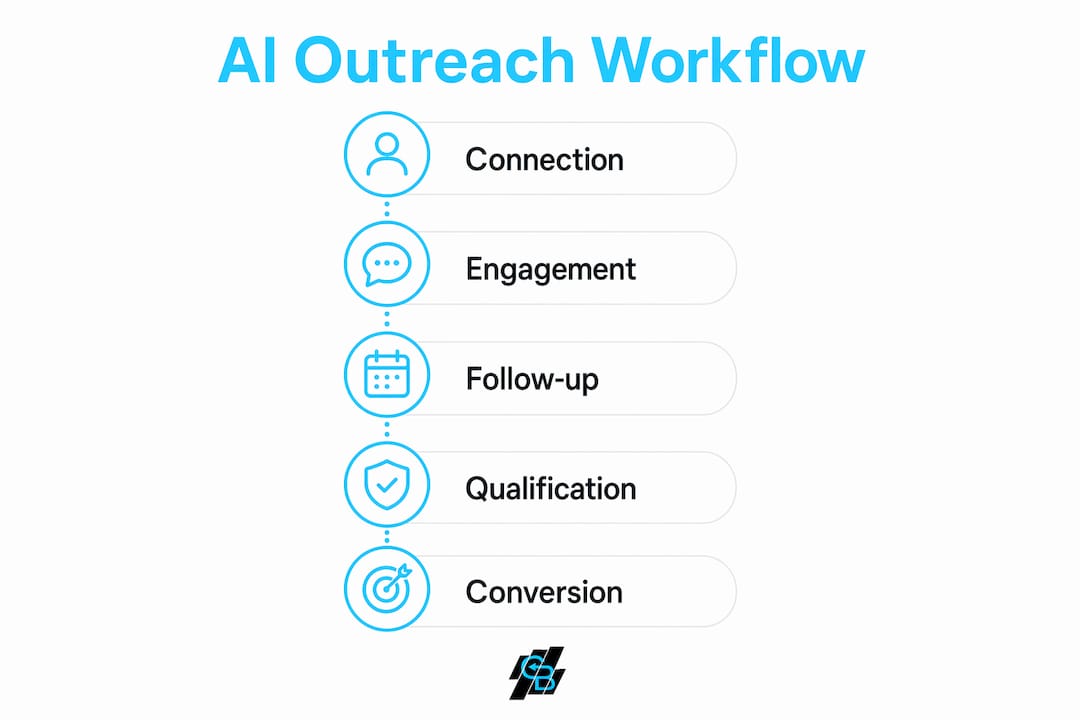
The most effective automated outreach strategy for insurance professionals runs across three channels in a logical sequence. Here is how to build it.
-
Define your daily LinkedIn volume. New LinkedIn accounts should send 5–10 connection requests per day and ramp up over 2–3 weeks. Warmed accounts cap at 20–25 requests daily to avoid platform restrictions. Exceeding these limits triggers account flags that can shut down your outreach entirely.
-
Optimize your LinkedIn profile headline. A headline that reads like a resume can cut acceptance rates by more than 50% compared to a value-proposition style headline. Write your headline to answer one question: “Why should this prospect connect with me?”
-
Send the connection request with no pitch. The first touch is purely relational. A short, personalized note referencing something specific about the prospect’s role or company performs better than any sales opener.
-
Wait 2–3 days, then send the first message. Use AI to generate a message that references a specific business signal, such as a recent company hire, a new office opening, or a policy renewal trigger. Keep it under 75 words.
-
Follow up twice more over 10–14 days. Space follow-ups 4–5 days apart. The final follow-up should use soft opt-out language. Phrases like “I understand if the timing isn’t right” reduce pressure and increase reply rates by giving prospects a graceful exit that often prompts a response instead.
-
Trigger email outreach if LinkedIn goes unanswered. This is where if/then logic creates a natural conversation flow. If a prospect accepts your connection but does not reply to two messages, your system automatically shifts to email with a fresh angle.
| Channel | Touch | Timing | Goal |
|---|---|---|---|
| Connection request | Day 1 | Acceptance | |
| First message | Day 3–4 | Reply | |
| Follow-up 1 | Day 8 | Engagement | |
| Intro email | Day 10 | Reply or click | |
| Follow-up | Day 15 | Meeting booking |
Pro Tip: Scale LinkedIn outreach safely by using multiple aged accounts rather than one personal profile. A decentralized account architecture lets you reach more prospects without risking your primary professional presence.
How do you measure and improve your outreach results?
Measurement is where most insurance marketers lose momentum. They launch a sequence, watch the numbers for a week, and then make changes too quickly or not at all. Effective outreach optimization requires tracking three core metrics consistently.
Open rates tell you whether your subject lines and LinkedIn preview text are working. Reply rates reveal whether your messaging resonates with your ICP. Meeting conversion rates show whether your value proposition is strong enough to earn a call. A healthy benchmark is 12–18% replies on first LinkedIn messages and 3–5% meeting conversions across total invites sent.
The three most common reasons these numbers fall short:
- Vague ICP definition: If your ICP includes “small business owners,” you are targeting too broadly. Narrow it to “commercial property owners in the Southeast with 10–50 employees and no current broker relationship.”
- Unedited AI copy: AI drafts require human review. Manually adding one specific, human insight to each AI-generated message improves conversion significantly. Never send raw AI output without reading it first.
- Ignoring reply data: Every reply, positive or negative, contains signal. If prospects keep asking the same clarifying question, your messaging is missing a key piece of information.
“AI should amplify an effective process, not replace one. The teams that win with AI outreach are the ones that treat it as a force multiplier on top of a strong ICP and a clear value proposition.”
Use your AI platform’s analytics to segment reply patterns by industry, company size, and message type. This data refines your ICP over time and makes each campaign more precise than the last. Explore AI lead scoring methods to prioritize which replies deserve immediate follow-up from a human closer.
What are the best AI outreach strategies for insurance in 2026?
The biggest shift in 2026 is the move from broad automation toward context-aware, behavior-triggered messaging. Context-aware AI outreach that connects to live business signals, such as a company posting a new job listing or announcing a funding round, outperforms static firmographic filters by a wide margin. For insurance professionals, relevant triggers include business license renewals, new commercial property listings, and employee count changes that signal a group benefits opportunity.
The table below contrasts the old approach with the current standard:
| Approach | Old Model | 2026 Standard |
|---|---|---|
| Targeting | Static firmographic filters | Live business signals and behavioral triggers |
| Personalization | Name and company merge fields | ICP-specific context from real-time data |
| Channel logic | Linear blast sequences | If/then multi-channel orchestration |
| Follow-up tone | Persistent and direct | Soft opt-out language with low pressure |
| Measurement | Open rates only | Reply rates, meeting conversions, ICP refinement |
Multi-channel orchestration with if/then logic reduces friction because it mirrors how real conversations develop. A prospect who opens your email three times but never replies is showing intent. A smart sequence detects that signal and triggers a LinkedIn message with a different angle rather than sending the same email again.
Pro Tip: Set up a “warm signal” filter in your CRM to flag prospects who engage with your content but do not reply. These are your highest-priority follow-up targets because they have already shown interest.
AI lead scoring adds another layer by ranking prospects based on engagement history, firmographic fit, and behavioral signals. Insurance agencies using AI for lead generation in 2026 are prioritizing accounts that show multiple intent signals simultaneously, rather than working a list in alphabetical order.
Key takeaways
A successful AI-powered outreach process in insurance sales depends on ICP precision, multi-channel logic, and consistent human review of AI-generated content.
| Point | Details |
|---|---|
| ICP definition comes first | Define your Ideal Customer Profile before generating any AI content to avoid generic, low-converting messages. |
| LinkedIn volume limits matter | Cap new accounts at 5–10 daily requests and warmed accounts at 20–25 to avoid platform restrictions. |
| If/then logic drives results | Link LinkedIn and email channels with behavioral triggers to create natural, high-response sequences. |
| Human review is non-negotiable | Always edit AI drafts before sending; one specific human insight per message lifts conversion rates. |
| Measure reply rates, not just opens | Track reply rates and meeting conversions as primary KPIs, then use that data to sharpen your ICP over time. |
What i’ve learned after watching hundreds of insurance outreach campaigns
Most insurance teams I have observed fail at AI outreach for one reason: they treat the AI as the strategy instead of the tool. They buy a platform, feed it a vague audience description, and expect the technology to compensate for unclear positioning. It never does.
The campaigns that consistently hit 15%+ reply rates share two traits. First, the ICP is specific enough that a single message could not plausibly be sent to more than a few hundred people. Second, a human reads every AI draft before it goes out. That second step takes about 90 seconds per message, and it is the difference between a response and a delete.
The other thing I have noticed is that consistency beats volume every time. Teams that send 20 well-targeted messages per day for 90 days outperform teams that blast 200 messages for two weeks and then stop. Daily, reliable execution with gentle opt-out phrasing builds a pipeline that compounds over time. AI makes that consistency achievable without burning out your sales team.
Treat AI as a force multiplier on a process you have already validated. If your manual outreach is not working, AI will scale the failure. If it is working, AI will scale the success. That distinction is worth more than any platform feature.
— Kyle
How Callbackcrm helps insurance teams run smarter outreach
Callbackcrm is built specifically for insurance agents, agencies, and IMOs who want to put their outreach on autopilot without sacrificing personalization. The platform combines CRM management, AI assistants, email and SMS marketing, and automation workflows into a single system, so your team is not stitching together five separate tools.
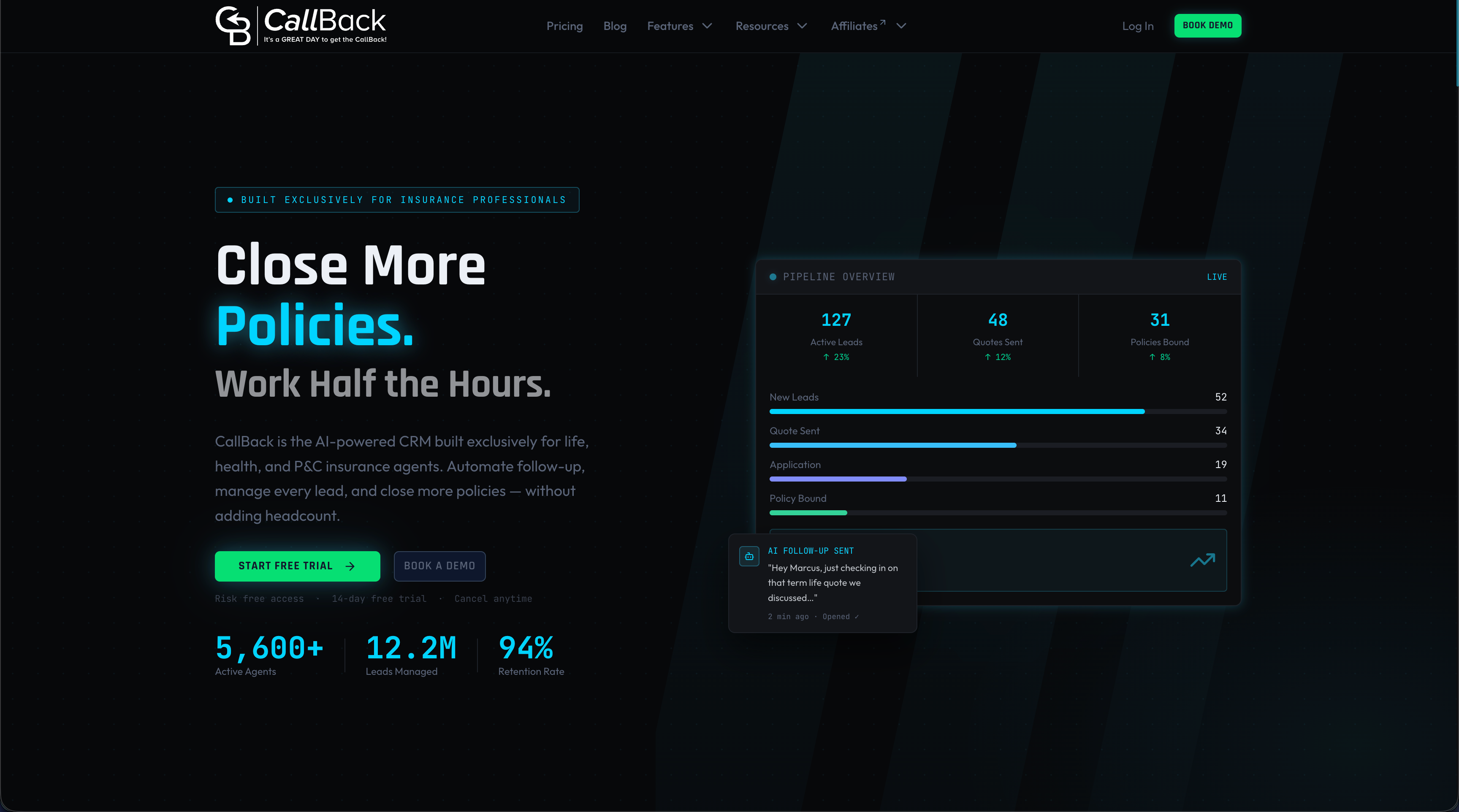
For insurance sales teams, this means AI-driven lead scoring, automated follow-up sequences, and real-time engagement tracking all in one place. You can build the multi-channel workflows described in this article directly inside Callbackcrm without needing a developer. Explore the full suite of AI-powered sales features and see how Callbackcrm can replace the manual work that is slowing your pipeline down.
FAQ
What is an ai-powered outreach process?
An AI-powered outreach process is an automated, multi-channel prospecting workflow that uses machine learning to personalize messages, trigger follow-ups based on behavior, and prioritize leads by engagement signals. It replaces manual cold outreach with data-driven sequences across LinkedIn, email, and phone.
How many LinkedIn connection requests can i send per day safely?
New LinkedIn accounts should send 5–10 connection requests daily and ramp up over 2–3 weeks. Warmed accounts can safely send 20–25 requests per day without triggering platform restrictions.
What metrics should i track in an AI outreach campaign?
Track connection acceptance rates (benchmark: 20–30%), first-message reply rates (12–18%), and meeting conversion rates (3–5% of total invites). Reply rates are the most actionable metric for improving messaging quality.
Why does ICP definition matter so much for AI outreach?
Without a precise ICP, AI generates generic messages that fail to resonate with any specific prospect. A well-defined ICP gives the AI enough context to produce personalized, relevant copy that converts at a meaningfully higher rate.
How does multi-channel if/then logic improve outreach results?
If/then logic connects LinkedIn and email actions so each channel responds to the prospect’s actual behavior rather than a fixed schedule. This approach mirrors natural conversation flow and reduces the friction that causes prospects to ignore or unsubscribe from outreach sequences.