

An AI SMS writer can save an insurance agency real time and personalize outreach, provided you pair it with documented consent, DNC checks, and CRM audit trails. The FCC’s TCPA rules set the legal floor, and the NAIC expects governance around any AI you use. We built CallBack CRM to help agents manage sales and marketing workflows in one place.
TL;DR:
- Marketing texts generated with automated technology require prior express written consent naming your agency alone; retain the exact wording, timestamp, source, and consenting phone number.
- Screen recipients against the National Do Not Call Registry and your suppression list, and immediately honor any request to stop future messages.
- A licensed person should review every AI draft before sending, because models can invent policy terms or benefits and state marketing rules differ.
- Record each text’s full content, timestamp, sending number, delivery receipt, and linked consent event in an exportable CRM audit trail.
- Start with one workflow and a small group with documented consent; track reply and booking rates, complaints, opt out rates, and delivery before expanding.
Table of Contents
- What does an AI SMS writer do for an insurance agency?
- What do the TCPA and FCC rules require before you text a lead?
- How does NAIC guidance apply to AI-written messages?
- What do good insurance SMS templates and AI prompts look like?
- How do you connect AI SMS to your CRM and keep an audit trail?
- How do you keep your texts out of carrier filters?
- What is the step-by-step rollout checklist for an AI SMS pilot?
- Why industry-specific AI and governance beat generic tools
- Run compliant AI texting with CallBack CRM
- FAQ
- Sources
What does an AI SMS writer do for an insurance agency?
An AI SMS writer drafts text messages from a short instruction and the data already sitting in your CRM. It pulls in a first name, a policy type, an appointment time, or a renewal date, then produces a message in the tone you ask for. Most agents also request two or three variants of the same message so they can compare wording and keep the one that gets replies.
The useful part is the connection to CRM fields. A draft is only as personal as the data behind it. If your CRM holds the lead source, the product the person asked about, and the last contact date, the writer can reference all three without you typing them in. If those fields are empty, the draft will be generic, and generic texts get ignored or reported.
Here are the insurance tasks where an AI SMS writer helps first:
- Lead follow-up: a short, personal text within minutes of a form submission, while the prospect still remembers asking.
- Appointment reminders: confirmations and day-before nudges with a simple reply option for rescheduling.
- Renewal outreach: reminders ahead of a policy anniversary, with a clear next step.
- Cross-sell: a gentle note to a Term Life client about Whole Life or Final Expense, based on what the file already shows.
- Claim-status pings: short updates telling a client you are following up, without discussing coverage details.
- Reactivation: a low-pressure check-in to a quote that went quiet.
The typical send flow has four steps: draft, human review, send, log. The draft comes from the AI. A person on your team reads it, fixes anything off, and approves it. The message goes out through your registered number. Then record the content, timestamp, and delivery result. Skipping the review step is where agencies get into trouble, because the AI does not know your state’s rules or your carrier’s approved language.
The limits are practical. An AI writer can invent a product term, quote a benefit that does not exist, or sound confident about something it should not discuss. Text messages about coverage can also trigger insurance advertising and licensing rules that vary by state. Treat the AI as a fast first-draft assistant, not as a licensed producer. Anything that sounds like advice, a rate quote, or a coverage promise should be written or checked by a licensed person.
One more point: a good tool makes the compliant path the easy path. Consent status, opt-out status, and message history should be visible at the moment you hit send. If an agent has to go looking for them in another system, some texts will go out without the check.
What do the TCPA and FCC rules require before you text a lead?
Before any marketing text goes out, you need the right consent, a clean Do-Not-Call check, and a record that proves both. The FCC’s Second Report and Order is the clearest recent statement of these rules, and it affects how agencies collect leads and store proof.
Prior express written consent
Marketing texts sent with automated technology require prior express written consent. The FCC order tightened this so that consent must be one-to-one, meaning it is tied to a single seller rather than shared across a list of companies. In practice, a lead form that says “you agree to be contacted by our partners” no longer gives you a safe basis for texting. The person needs to agree to hear from your agency specifically.
For agencies that buy leads, this matters a great deal. Ask every vendor to show the exact consent language the consumer saw, the date, and the source. If a vendor cannot produce it, you are carrying the risk, not them.
Do-Not-Call protections apply to texts
The same FCC order clarifies that the National Do-Not-Call Registry protections apply to text messages. A number on the registry is not a number you can send marketing texts to just because you have a text tool. Screen against the registry before sending, and keep your own internal suppression list for people who told you to stop.
Mandatory blocking
The order also requires terminating mobile providers to block text messages after the Commission notifies them. You do not control this step, but it explains why one bad campaign can damage a number’s reach overnight. A flagged sender can find its messages blocked at the carrier level with little warning.
The FCC’s order requires one-to-one consent tied to a single seller. Shared or bundled consent from a lead vendor is not enough on its own, so your agency needs its own proof of consent for every number it texts.
Revocation timing
Revocation rules have been moving. The FCC issued waiver orders that extended effective dates for certain revocation requirements, delaying parts of the rule into 2026 and 2027 while the agency reviews them. Do not read a delay as permission to ignore opt-outs. Honor every stop request immediately, in any reasonable form (STOP, a reply like “don’t text me,” or a phone call), because that is the safest practice whichever deadline applies.
The FCC’s consumer guidance also reminds the public that autodialed texts to wireless numbers need prior consent, and consumers are told to forward spam to 7726. Expect some of your recipients to know exactly how to report you.
Your compliance to-do list
- Store the exact consent text the person saw, not a summary of it.
- Record the timestamp and the source (web form, event, vendor, inbound call).
- Save the specific number that consented, since people change numbers.
- Link every outbound message to the consent event behind it.
- Keep opt-out status on the contact record and check it before every send.
- Preserve message logs and delivery data in a place you can export on request.
We walk through the record-keeping side in more detail in our guide to building a TCPA-compliant audit trail in a week. Nothing here is legal advice. Have counsel review your consent language and your state’s insurance marketing rules.
How does NAIC guidance apply to AI-written messages?
The NAIC Model Bulletin tells insurers to govern their use of AI the way they would govern any other function that affects consumers. Even if you are an independent agency rather than a carrier, your carriers may pass these expectations down to you through contracts and audits, so it pays to be ready.
The bulletin expects insurers to adopt an AIS Program that covers governance, documentation, validation, monitoring, and oversight of AI systems across the insurance lifecycle. It also contemplates that regulators may ask to see the artifacts of that program. The NAIC describes the bulletin as a framework that requires AI-driven decisions to comply with applicable laws, with an emphasis on fairness, accountability, documentation, and risk management.

The bulletin’s text also lays out program components such as lifecycle management, model validation, and oversight of third-party vendors. That last item is the one most relevant to agencies using an outside AI tool. Using a vendor does not move your accountability to the vendor.
Texting is a lower-stakes use of AI than underwriting or claims decisions. Still, a message that misstates coverage or treats groups of people differently is a consumer-protection problem, and writing down how you control it is cheap insurance.
Governance items to adopt
- An inventory of AI uses. A one-page list of where AI touches client communication: SMS drafting, email drafting, chat, voicemail.
- Vendor diligence. Notes on what each vendor does with your data, how it stores messages, and what controls it provides.
- Monitoring. A recurring review of sample messages for accuracy, tone, and compliance language.
- Documentation. Short written records of who approved the use case, when, and under what rules.
Concrete actions for a small agency
- Name one person responsible for AI messaging oversight, even if that person also does ten other things.
- Create an approval flow so new templates are reviewed before they are used at scale.
- Schedule a quarterly audit of a sample of sent messages against your consent records.
- Keep a change log whenever you modify prompts, templates, or the tool’s settings, so you can explain why messaging looked different in a given month.
None of this requires a compliance department. A shared document and a calendar reminder cover most of what a small team needs.
What do good insurance SMS templates and AI prompts look like?
Good templates are short, name your agency, and give the reader one easy next step. Good prompts tell the AI what to fill in, what to leave alone, and what it must never say. Keep the compliance text out of the AI’s hands: put it in as fixed wording the model is told to preserve.
Ready-to-adapt templates
Adjust the wording to your agency and your state’s rules. Bracketed items are fields your CRM fills in automatically.
- Lead follow-up: “Hi [first name], this is [agent name] at [agency]. You asked about [product] on [date]. Do you have a few minutes this week to talk? Reply STOP to opt out.”
- Appointment confirmation: “Hi [first name], confirming your call with [agent name] on [day] at [time]. Reply C to confirm or R to reschedule. Reply STOP to opt out.”
- Appointment reminder: “Reminder: your call with [agent name] is tomorrow at [time]. Reply R if you need a new time. Reply STOP to opt out.”
- Renewal reminder: “Hi [first name], your [policy type] with [agency] is up for review on [date]. Want to go over it together? Reply YES and we will set a time. Reply STOP to opt out.”
- Reactivation: “Hi [first name], [agent name] here. I wanted to check whether you still want help with [product]. A quick reply either way is great. Reply STOP to opt out.”
Every template carries opt-out language, names the sender, and links back to a reason the person has to expect the message: a form they filled out, a policy they hold, or a call they booked.
Prompt patterns that keep drafts safe
A reliable prompt identifies the situation, the fields to use, the fixed text to keep, and the forbidden content. For example:
“Write a concise text to [first name], who requested a quote for [product] on [date]. Use a friendly, plain tone. Keep this sentence exactly as written: ‘Reply STOP to opt out.’ Do not mention prices, benefits, coverage amounts, or eligibility. End with one question about scheduling a call.”
Asking for two or three variants helps you pick the clearest one. Telling the model to keep messages short matters too, since long texts get split into multiple parts and cost more to send.
Pro Tip: Add the line “Do not give coverage advice or describe policy terms” to every prompt, because a model asked for a persuasive text will sometimes invent benefits that your product does not have.
For more on stitching these messages into a wider follow-up sequence, see our guide to insurance lead nurturing.
How do you connect AI SMS to your CRM and keep an audit trail?
Wire the AI writer into your CRM so that drafting, approval, sending, and logging can happen as part of your workflow. The goal is simple: if anyone asks why you texted a particular person, you can quickly show the relevant records.
CRM fields to capture
- Consent language shown to the person
- Consent timestamp
- Consent source (form, event, inbound call, vendor)
- The specific number that consented
- Opt-out status and the date of any opt-out
- Last message sent and its delivery result
Make these fields required for any contact who will receive marketing texts. A message trigger that checks “consent present and not opted out” before it fires prevents most accidents.
Number management and 10DLC basics
Business texting over local numbers can run through 10DLC, a system for application-to-person messaging. Brands and campaigns are registered so carriers know who is sending and why. Two practical rules follow. First, own your numbers instead of borrowing a shared pool, because a shared pool means someone else’s behavior can hurt your reach. Second, avoid rotating through many numbers to dodge filtering. It looks evasive to carriers and makes your records harder to reconstruct.
Audit-trail mechanics
An audit trail is more than a list of sent messages. For each text, store the full content, the contact, the timestamp, the number it was sent from, the consent event it relies on, and the delivery receipt. Message hashing gives each message a unique fingerprint that can help show a stored record matches what was sent. Archive these records somewhere you can export them, and keep them for as long as your counsel recommends.
An example workflow
- A lead submits a form with a consent checkbox that names your agency.
- The CRM records the consent text, time, source, and number.
- A workflow triggers an AI draft with placeholders filled from the contact record.
- A team member reviews and approves the draft.
- The message sends from your registered number.
- The CRM logs the content, delivery status, and any reply.
- A STOP reply updates the opt-out field instantly and blocks future sends.
This structure mirrors the approach in our article on sales automation workflows for insurance agents. The same logic works for texts, email, and voicemail drops.
How do you keep your texts out of carrier filters?
Carriers filter messages that look like spam, and one filtered campaign can drag down the number behind it. Deliverability is mostly discipline: register properly, write plainly, send in measured volumes, and watch the numbers.
- Register your campaigns for 10DLC and classify them accurately. Insurance and financial messaging gets scrutiny, so describe your use case honestly.
- Use carrier-approved verbiage. Avoid ALL CAPS, excessive exclamation points, urgent “act now” phrasing, and shortened links that hide the destination.
- Keep messages short and focused. One purpose, one call to action, and a clear opt-out.
- Identify yourself. Name your agency in the first line so the recipient recognizes the sender.
- Throttle your sending. Do not send a large batch in one burst from a new number. Ramp up gradually.
- Test on a small group first. Send to a limited cohort, check delivery and replies, then expand.
- Watch complaint and opt-out rates. A rising opt-out rate is an early warning that your list, timing, or wording is off.
- Use message hashing and iMessage where appropriate. Unique message fingerprints can help distinguish messages, and iMessage is another delivery option for Apple devices.
Channel choice matters as well. Texts work best for time-sensitive and short interactions, while longer explanations belong in email. We compare the two in SMS vs email for insurance agents, including how to keep opt-outs down.
Pro Tip: Before launching a new template, send it to your own team’s phones on different carriers and check how it renders, including whether the link preview and opt-out line display cleanly.
What is the step-by-step rollout checklist for an AI SMS pilot?
Start small, measure honestly, and expand only when the numbers and the compliance records look clean. A short pilot can help a small agency learn what works.
- Choose a narrow use case. Pick one workflow, such as new-lead follow-up or appointment reminders, rather than launching everything at once.
- Select a small list. Use a few hundred contacts or fewer, all with clear, documented consent.
- Define your KPIs. Track reply rate, appointments booked, opt-out rate, complaint rate, and delivery rate. Write down what a good result looks like before you start.
- Prepare your data. Remove sensitive information such as health details, Social Security numbers, and account numbers from anything you feed into prompts or training samples.
- Run the pre-send compliance check. Verify the consent source, screen against the Do-Not-Call Registry and your internal suppression list, confirm the campaign is registered, and confirm the opt-out mechanism works.
- Set approval and escalation rules. Decide who approves drafts, who handles angry replies, and who decides when to pause a campaign. Assign each role to a named person.
- Train your staff. Walk the team through the templates, the forbidden content list, and what to do when someone replies with a coverage question that needs a licensed agent.
- Monitor daily. Check delivery results and complaints every day during the pilot, and pause at the first sign of filtering.
- Audit weekly. Compare a sample of sent messages to their consent records and confirm the logs are complete.
- Review quarterly. Revisit your AI inventory, vendor notes, prompts, and change log, and update your governance document.
- Expand deliberately. Add a new use case or a larger list only after the pilot’s compliance records and KPIs hold up.
Measure more than volume. A pilot that sends fewer texts but books more appointments with fewer opt-outs is the better result, and it tells you which messages deserve to scale. Personalization beyond a first name, such as referencing the product the person asked about or their renewal month, usually does more for engagement than any clever wording.
Privacy deserves its own line in your checklist. Keep personal data out of prompts when you can, restrict who can see message logs, and ask any vendor how it stores and protects messages. Agencies that grow should also plan for volume: more agents means more numbers, more approvals, and more consent records, so build the process before the headcount arrives.
Why industry-specific AI and governance beat generic tools
I have watched agencies adopt text automation, and the pattern repeats: the ones that do well treat the AI as a drafting assistant inside a process, while the ones that struggle treat it as a shortcut around the process. A generic AI writer does not know that your lead came from a vendor with doubtful consent, that a client opted out last spring, or that your carrier restricts certain phrases. An insurance-focused platform can hold those facts next to the draft, which cuts risk and gets you to useful output faster.
The common belief is that compliance slows automation down. In my view it is the other way around. A clean consent record, a documented approval step, and a searchable log are what let you send more with confidence. Agencies that skip them end up pausing campaigns after a complaint, which costs far more time than the setup would have.
My advice is to pilot small, write down your rules, and review a sample of messages every week. Governance is not glamorous, but it is what keeps a good tool usable.
— Kyle
Run compliant AI texting with CallBack CRM
Agencies that want tools for sales and marketing automation can use our CRM, which we built for insurance agents, agencies, and IMOs. Here is what we offer for AI-assisted texting:
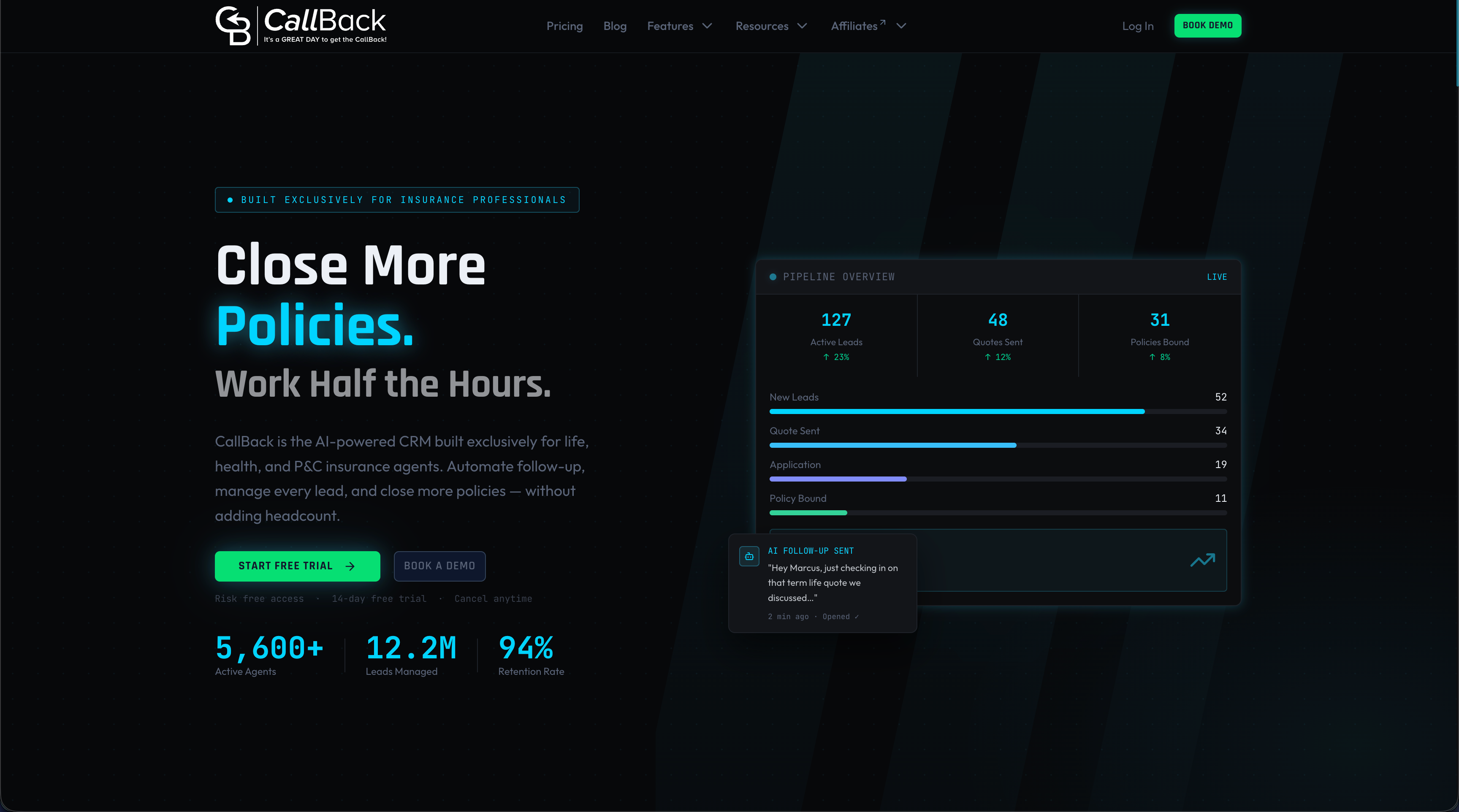
- AI-assisted SMS alongside email, voicemail, and workflow automation in one CRM
- Unique message hashing and iMessage deliverability to help your texts arrive
- Phone-carrier-approved verbiage in our sending practices
- Contact records and workflow automation
- Pipelines and follow-up tailored to insurance products such as Final Expense, Mortgage Protection, Term Life, Whole Life, Medicare, and Property and Casualty
Start with a pilot on our Professional plan at $97 per month, or look at our SMS features first. Larger teams can review our Enterprise plans and request a demo. Current pricing details are on our fees page.
FAQ
Who has the best AI for insurance texting?
The best fit is a platform that combines AI drafting with consent records, opt-out handling, and delivery tracking in one place. Judge any tool on its compliance controls and audit trail, not just the quality of its writing. We built CallBack CRM for exactly that job in insurance.
Is there a free AI writer for insurance texts?
Free AI writers exist, and they can produce a decent first draft. They usually lack consent tracking, opt-out handling, and message logging, which are the parts regulators and carriers care about. If you use one, paste the result into a system that records consent and keeps a log before anything is sent.
Does SMS use AI?
SMS itself is just a delivery channel and does not use AI. AI enters when software drafts, personalizes, or schedules the message. The rules that apply to texting, including consent and Do-Not-Call protections, apply to the text however it was written.
Do I need consent to text insurance leads?
Yes, for marketing texts sent with automated technology you need prior express written consent, and the FCC has made that consent one-to-one with a single seller. Keep the exact consent language, timestamp, source, and number on file. Ask your attorney to review your forms.
Sources
- DA-24-910A1.txt
- Implementation of NAIC Model Bulletin: Use of Artificial Intelligence Systems by Insurers