

Insurance agencies can text U.S. wireless numbers, but promotional messages generally require prior express written consent tied to your specific agency name rather than a generic marketing checkbox. The first action item is simple: pause any automated promotional campaign that lacks documented, seller-specific consent, and turn on a STOP/opt-out process today. Everything else, including recordkeeping and legal review, follows from that one fix.
TL;DR:
- Agencies must obtain seller-specific, documented consent that explicitly names their business for promotional texts, as broad checkboxes are insufficient under current FCC rules.
- Sending automated promotional texts without prior express written consent exposes agencies to statutory damages up to $1,500 per violation, especially with purchased lead lists lacking clear consent.
- Consumers can revoke consent easily using words like “stop” or “unsubscribe,” and agencies must honor revocations within 10 business days, with strict disclosure requirements for revocation channels.
- Continuous scrubbing of contact lists against the National Do Not Call Registry is essential, and suppression lists must be kept updated and applied across all campaigns to avoid violations.
- Using a dedicated compliance system like CallBack CRM helps automate consent recording, suppression, and revocation management, reducing the risk of non-compliance during audits.
Table of Contents
- What Counts as TCPA Compliant Texting Insurance Communication
- STOP Words, Revocation Timing, and Confirmation Rules
- National Do Not Call Registry Rules for Insurance Text Campaigns
- Recordkeeping That Actually Holds Up Under a TCPA Audit
- Building a Compliant Insurance Texting Program Step by Step
- How CallBack CRM Supports Insurance Texting Compliance Workflows
- Where the Real Risk Sits in Insurance Texting Programs
- Get Your Insurance Texting Compliance Workflow Running
- Sources
- FAQ
What Counts as TCPA Compliant Texting Insurance Communication
Text messages sent to wireless numbers fall under the same statute that governs robocalls. Under 47 U.S.C. § 227, an SMS or MMS message is treated as a “call” for TCPA purposes, and courts apply the same restrictions to automated texts that they apply to autodialed phone calls. That single fact is why “text message insurance compliance” and “TCPA compliant texting insurance” are really the same conversation.
The autodialer question matters more than most agencies realize. The Supreme Court’s Facebook v. Duguid ruling narrowed what qualifies as an automatic telephone dialing system, holding that a system must have the capacity to generate numbers using a random or sequential number generator. That clarified some gray areas, but it didn’t eliminate exposure. Violations can still carry statutory damages up to $1,500 per violation when a text is sent willfully or knowingly without consent, and most CRM-driven bulk texting platforms still fall within the rule’s reach regardless of how the dialing technology is classified.
Insurance teams need to separate two consent standards, because using the wrong one is the single most common compliance failure:
- Prior express consent covers informational and transactional texts, such as policy servicing updates, appointment reminders, or claims status. Simply providing a phone number during a business transaction can establish this consent.
- Prior express written consent covers telemarketing and promotional texts, including cross-sell and upsell campaigns. This requires a signed or electronically signed agreement that clearly discloses the recipient will get autodialed marketing messages and that consent isn’t a condition of purchase.
Recent FCC rulemaking pushed this further for insurance specifically. The agency’s Second Report and Order requires seller-specific, one-to-one consent, meaning a consumer’s agreement to receive texts from “insurance partners” or a lead aggregator’s network of carriers does not satisfy the standard. Consent has to name your agency, not a category of businesses. Broad multi-seller checkboxes on comparison-shopping sites, a common source of purchased leads in this industry, generally will not hold up as valid consent under the FCC’s current framework.
STOP Words, Revocation Timing, and Confirmation Rules
Consumers can revoke consent through almost any reasonable method, and the FCC has been explicit about which words agencies must honor automatically. Standard reply terms including “stop,” “quit,” “end,” “cancel,” “unsubscribe,” and “opt out” all trigger revocation, and your platform has to recognize each one without requiring the consumer to call in or fill out a form.
Timing and confirmation rules work like this:
- Send one confirmation, and only if it’s clean. After a consumer texts STOP, you may send a single confirmation message, but it cannot contain any marketing content, links, or upsell language. A second confirmation is not permitted.
- Honor the revocation within 10 business days. The FCC’s Report and Order sets 10 business days as the outer limit for stopping messages after a valid opt-out request, though best practice is same-day suppression.
- Disclose any exclusive revocation channel. If you tell consumers the only way to opt out is by calling a phone number, that disclosure must be clear and conspicuous in the original consent language. Without that disclosure, you have to accept revocation through any reasonable method, including a reply text, a phone call, or a website form.
- Apply revocation across the seller, not just the campaign. A STOP reply generally revokes consent for that specific sender relationship, not just the one campaign that triggered it.
The FCC has also granted a limited waiver delaying certain cross-category revocation requirements until April 11, 2026, giving carriers and platforms more time to build systems that treat a revocation on one message category as a revocation across related categories. Don’t treat that waiver as a reason to slow down your own suppression work. Build the stricter version now.
Pro Tip: If your texting platform doesn’t support two-way replies on every number you send from, you must offer an alternative revocation method, like a dedicated phone line or web form, and state it plainly in your consent language. Silent gaps here are one of the easiest things a plaintiff’s attorney finds.
National Do Not Call Registry Rules for Insurance Text Campaigns
The National Do Not Call Registry isn’t just for telemarketing calls. Telemarketing texts sent to a wireless number listed on the NDNC require the same prior express invitation or permission that a phone call would need, and the exemption windows insurance agents sometimes rely on for calls don’t automatically extend to texts.
The scale of the registry makes scrubbing a genuine operational necessity rather than a formality. The FTC reported more than 258 million numbers on the Registry, and complaint volume remains high enough that regulators actively track patterns by industry, including insurance sales. That means your scrubbing process should be continuously updated, not just a one-time check performed when a lead first enters your funnel.
Build your suppression process around these steps:
- Subscribe to the Registry by area code and pay the required access fees if you or your agency conducts telemarketing texts, per FTC guidance on the Telemarketing Sales Rule.
- Scrub every promotional list against the Registry before each send, not just at intake, since registrations can be added at any time.
- Maintain an internal suppression list separate from the federal registry, covering anyone who has opted out of your agency’s texts directly.
- Propagate suppression instantly across every campaign and channel your agency uses, not just the one where the opt-out occurred.
If you work with outside lead vendors or call center partners, get explicit written agreement on who owns the scrubbing step for each data feed. A vendor’s failure to scrub becomes your liability the moment you send to that list.
Recordkeeping That Actually Holds Up Under a TCPA Audit
Consent isn’t worth much if you can’t prove it existed. When a regulator or plaintiff’s attorney challenges a campaign, the burden falls on the sender to produce the specific record showing valid consent for that specific number, at that specific time.
Retain, at minimum, the following for every phone number in your system:
- The exact consent language the consumer agreed to, word for word
- The seller name disclosed in that consent (your agency’s actual name, not a parent brand or lead network)
- A timestamp for when consent was captured
- The capture source, such as a specific web form URL, a signed application, or a recorded call script
- IP address or electronic signature evidence tied to the consent event
- The campaign category assigned to that number (informational, transactional, or promotional)
- Delivery logs showing what was sent and when
- Every opt-out event, including the exact reply text and the date it was honored
Document your technology stack too. Regulators and courts increasingly ask whether a platform meets the legal definition of an autodialer, and you need a clear answer backed by vendor documentation, not a guess. Keep workflow diagrams, vendor contracts, and any compliance certifications your texting platform provides.
With more than 258 million numbers on the National Do Not Call Registry, the volume of potential complainants makes sloppy recordkeeping a bigger financial risk than most agencies assume, especially given statutory damages that can run up to $1,500 per violation when a court finds a willful violation.
Schedule quarterly exports of your consent and messaging archive, and have counsel review a sample of records before you scale any new campaign type. A ringless voicemail compliance checklist offers a useful parallel for how to structure multi-channel documentation, since many of the same recordkeeping principles apply across voice and text channels.
Building a Compliant Insurance Texting Program Step by Step
A working TCPA compliance program for insurance texting breaks into three phases: what you do before launch, what you control during the campaign, and what you check after messages go out.
Prelaunch:
- Classify every SMS workflow by purpose (transactional, informational, or promotional) before writing a single message, since the consent standard changes with the category.
- Draft seller-specific consent language naming your exact agency, and instrument every capture point, web forms, phone scripts, and paper applications, so the language is identical everywhere.
- Verify your sender is properly registered for 10DLC or A2P messaging with your carrier or platform, since unregistered senders face throttling and blocking that can look like a compliance failure even when consent is solid.
- Confirm your suppression list is current across every vendor feeding your CRM.
Launch controls: 5. Synchronize suppression across all campaigns before the first send, not after. 6. Disclose two-way texting availability or your designated alternative revocation method clearly in the initial message. 7. Throttle send volume to avoid carrier filtering, and monitor deliverability and spam complaint rates daily during the first week of any new campaign.
Post-launch: 8. Process every STOP reply immediately, well inside the 10 business day ceiling. 9. Run a weekly suppression audit comparing your active send list against your internal opt-out log and the National Do Not Call Registry. 10. Keep consent and delivery logs export-ready so counsel can review them on demand, not scrambled together after a complaint arrives.
Pro Tip: Treat existing-client informational texts and prospect-facing promotional texts as two entirely separate systems with separate consent records and separate suppression logic. Agencies that blend the two almost always end up sending a promotional message to someone who only ever agreed to policy service alerts. An automated outreach workflow built around this distinction is far easier to audit than one that tries to handle both categories with a single rule set.
A general marketing automation checklist can also help structure the broader campaign controls around this workflow.

How CallBack CRM Supports Insurance Texting Compliance Workflows
CallBack CRM is built for insurance agencies running exactly this kind of workflow. At intake, the platform can capture seller-specific consent language and store the metadata that matters most in an audit: timestamp, source URL, and signature or IP evidence, attached directly to the contact record rather than scattered across spreadsheets.
STOP handling and suppression sync run through the same system, so a revocation on one number automatically applies across every campaign tagged to that contact. Messages get tagged by category, informational, transactional, or promotional, which makes it straightforward to export audit reports when legal review is needed. The SMS feature set also supports phone number management and vendor registration checks relevant to 10DLC and A2P compliance.
None of this replaces a lawyer’s review of your specific consent language or campaign design. What it does is give your compliance team a single, searchable record instead of a patchwork of vendor exports when a regulator or plaintiff’s attorney comes asking.
Where the Real Risk Sits in Insurance Texting Programs
Purchased and aggregated lead lists are the most common source of TCPA exposure in this industry, and agencies keep learning that the hard way. If a list didn’t come with seller-specific, documented consent naming your agency by name, texting it is a bet, not a compliance program. Pause those campaigns first, before you fix anything else.
Legal sign-off should happen before you scale promotional robotexts, not after a complaint forces the review. One suppression master table, synchronized across every vendor and campaign, beats five fragmented lists that nobody can reconcile during an audit.
Quarterly compliance reviews sound bureaucratic until you’ve sat across from a plaintiff’s attorney who found a gap your team didn’t know existed. Build an incident playbook now for handling complaints or regulator inquiries. The agencies that treat this as ongoing governance, not a one-time setup task, are the ones still texting freely in three years.
— Kyle
Get Your Insurance Texting Compliance Workflow Running
Building the checklist above by hand, across separate form tools, spreadsheets, and a texting platform that doesn’t talk to your CRM, is exactly how consent records go missing when you need them most. CallBack CRM keeps consent metadata, suppression lists, and campaign tags in one system built specifically for insurance sales workflows, so the audit trail exists automatically instead of getting assembled after the fact.
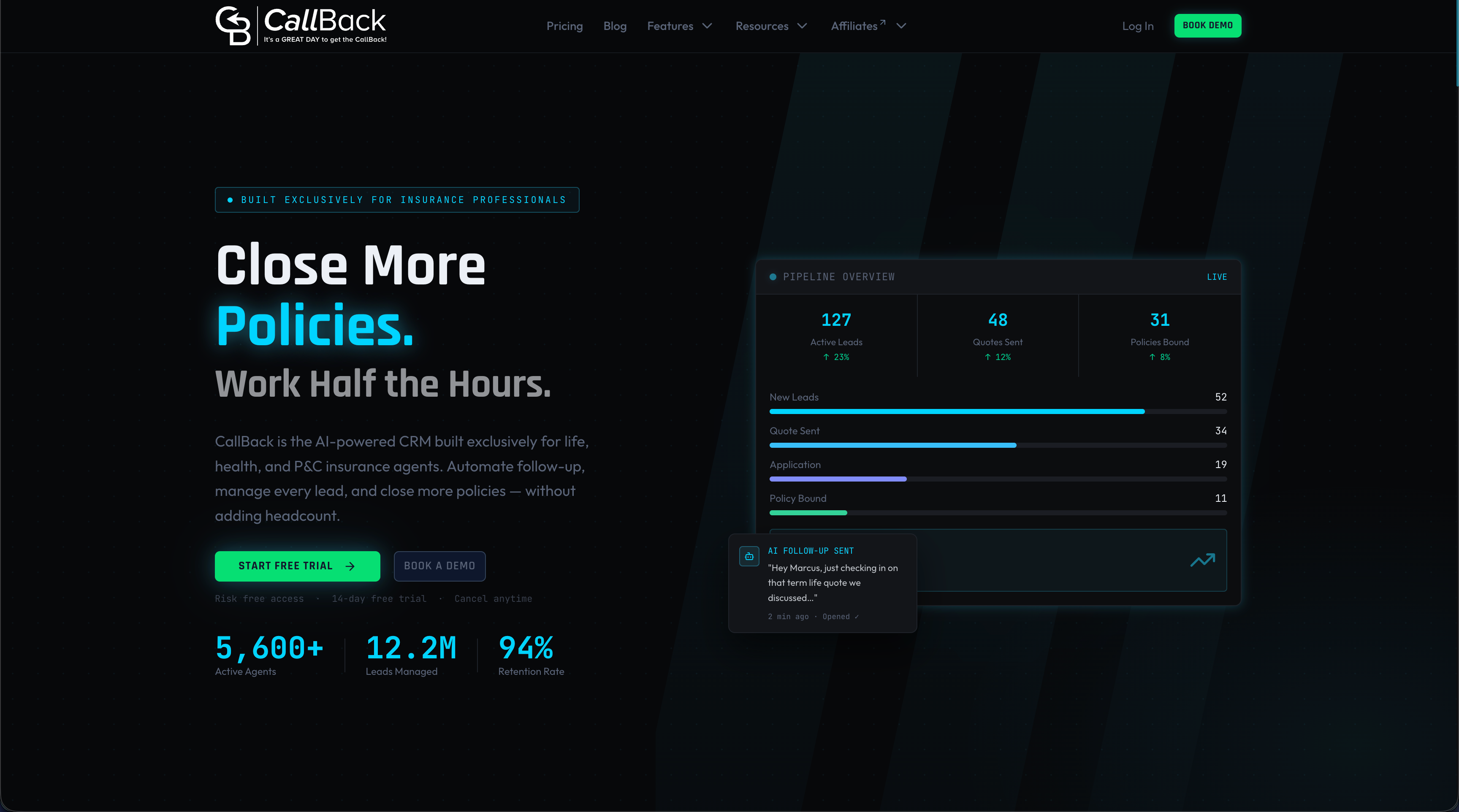
The platform’s SMS marketing tools handle STOP automation and suppression sync across campaigns, and its funnel and intake builder lets you capture seller-specific consent at the exact point a lead enters your system. None of this replaces your attorney’s review of your specific consent language and campaign design. It gives your team the documentation that review actually requires.
If you’re running a small book of business, the Professional plan at $97 per month covers core CRM and texting workflows. Agencies managing multiple producers or IMO downlines can look at the Enterprise plans, which start at $297 per month for 10 full CRM accounts and scale up for larger teams. Start a trial, run your consent capture through it for one campaign, and see what your audit trail looks like a week later.
This article is general information, not a substitute for advice from a qualified lawyer. Consult a qualified legal professional about your own circumstances before acting on anything here.
Sources
- FTC press release and report on the National Do Not Call Registry (January 2026)
- DA-24-910: Second Report and Order (Targeting and Eliminating Unlawful Text Messages)
FAQ
What Are the TCPA Requirements for Texting Insurance Customers?
Promotional texts require prior express written consent naming your specific agency, while informational or transactional texts about an existing policy generally need only prior express consent. Every campaign also needs a working STOP process and suppression against the National Do Not Call Registry.
Does TCPA Insurance Coverage Exist for Compliance Claims?
Some general liability and errors and omissions policies exclude or limit TCPA-related claims, so agencies should ask their carrier directly whether their policy covers statutory damages tied to texting violations. Given exposure up to $1,500 per violation, confirming coverage before scaling any SMS campaign is worth the conversation with your insurance broker and legal counsel.
What New TCPA Texting Rules Take Effect in 2026?
The FCC’s revised revocation rules, including certain cross-category suppression requirements, have a compliance deadline of April 11, 2026 under a limited waiver. Agencies should build to the stricter standard now rather than waiting for the deadline.
Which Insurance Texts Are Exempt From TCPA Restrictions?
Purely informational messages sent with prior express consent, such as claims status updates or appointment confirmations to an existing customer, face fewer restrictions than promotional messages. No text sent through an autodialer to a wireless number is fully exempt from TCPA obligations, though the required consent standard is lower for non-marketing content.
Can CallBack CRM Help Manage TCPA Compliant Texting Insurance Workflows?
CallBack CRM captures seller-specific consent metadata at intake and automates STOP handling and suppression sync across campaigns for insurance agencies. Pricing starts with the Professional plan at $97 per month, with Enterprise options available for larger teams needing multiple CRM accounts.