

TL;DR:
- Effective insurance email marketing focuses on audience segmentation, personalized content, and trust-building.
- Planning triggered sequences like welcome, renewal reminders, and quote recovery boosts client retention.
- Tracking policy outcomes and automating campaigns with the right tools maximizes long-term agency growth.
You send an email to 500 prospects and hear nothing back. A renewal slips through the cracks because your reminder landed in a spam folder. Sound familiar? Most insurance agents run email campaigns that prioritize pitching over connecting, and that single mistake costs them renewals, referrals, and revenue. Welcome sequences build trust, renewal reminders sent 60 or more days early improve retention, and value-driven nurturing consistently outperforms hard sales messaging. This guide walks you through a step-by-step email marketing strategy built specifically for insurance professionals who want real results.
Table of Contents
- Understand your audience and set clear goals
- Plan the perfect insurance email workflow
- Create compelling and compliant email content
- Measure, optimize, and automate your results
- Why most insurance email marketing advice gets it wrong — our take
- Streamline your insurance email marketing with Callback CRM
- Frequently asked questions
Key Takeaways
| Point | Details |
|---|---|
| Map clear objectives | Define your core email goals—renewals, leads, or cross-sells—before you start writing. |
| Build value-driven sequences | Use educational, timely messaging like welcome emails and renewal reminders to nurture trust. |
| Automate and personalize | Leverage email automation and detailed segmentation for relevant, scalable outreach. |
| Track what matters | Measure results by policy renewals and lifetime value, not just opens or clicks. |
Understand your audience and set clear goals
Now that you see why most email campaigns fall flat, the first step is understanding who you are talking to and what you actually want to achieve. Not every subscriber is the same, and treating them like they are is one of the most common and costly mistakes agents make.
Your list likely contains three distinct groups: prospects who have never bought from you, new clients still forming their opinion of your agency, and long-term policyholders who already trust you. Each group needs a different message, a different tone, and a different goal. Sending the same newsletter to all three is like giving every patient the same prescription regardless of their symptoms.
Before writing a single email, define what success looks like for each segment. Here are the most useful goals to set:
- Prospects: Convert quote requests and schedule consultations
- New clients: Onboard smoothly and reduce early cancellations
- Long-term policyholders: Drive renewals, cross-sells, and referrals
- All segments: Build consistent trust through education and service
Most agents obsess over open rates and click-through rates because those numbers are easy to see. But tracking policy outcomes like renewals and customer lifetime value (CLV) is far more valuable than surface-level engagement metrics. A 20% open rate means nothing if no one renews.
CLV tells you how much revenue a single client generates over their entire relationship with your agency. When you use CLV as your north star, you naturally shift toward emails that build loyalty rather than emails that push for a quick sale. That shift changes everything about how you write, segment, and schedule your campaigns.
Understanding why email marketing matters for insurance agents goes beyond just sending messages. It is about building a system that reflects the real needs of each subscriber at each stage of their journey with you.
Pro Tip: Segment your list by policy type and renewal date from day one. This single habit makes every future campaign more relevant and more profitable without adding significant extra work.
Plan the perfect insurance email workflow
With clear goals and audience segments in place, you can design an effective sequence that guides each subscriber from first contact to loyal client. The key is mapping your triggers before you write a single word.
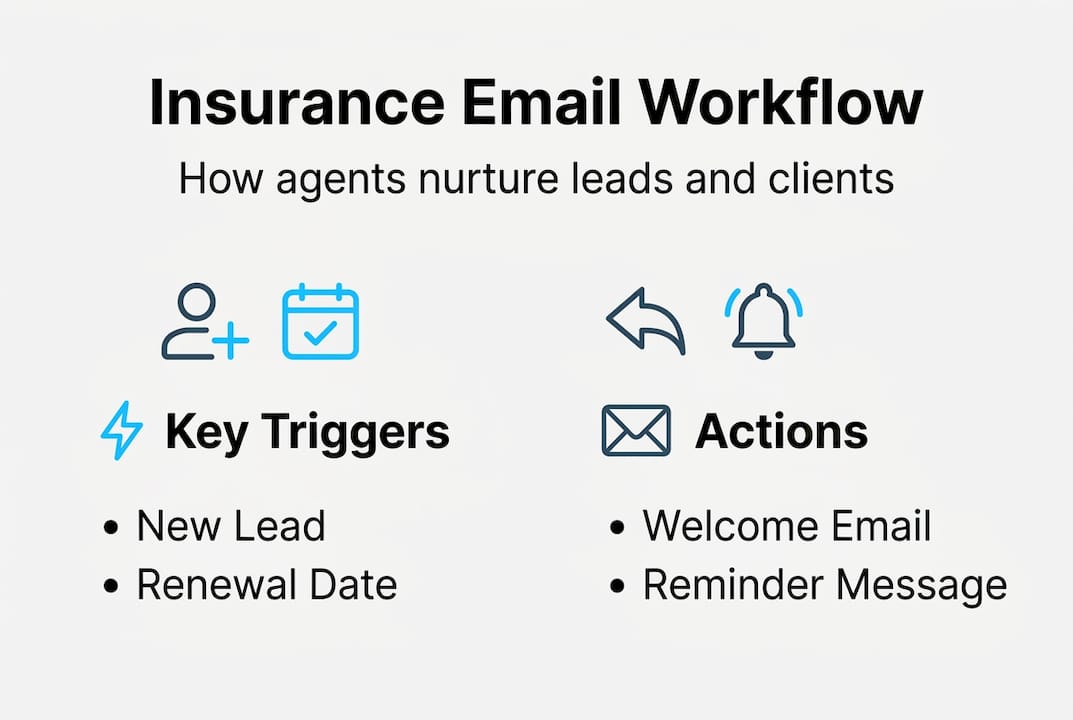
A trigger is the event that starts an email sequence. A new quote request triggers a welcome flow. An upcoming renewal date triggers a reminder series. A prospect who abandoned a quote form triggers a recovery sequence. Without defined triggers, your emails are random. With them, your emails feel timely and personal.
Here is a comparison of the core email sequences every insurance agency should have running:
| Sequence | Trigger | Timing | Primary goal |
|---|---|---|---|
| Welcome | New subscriber or lead | Immediately, then days 3 and 7 | Build trust and set expectations |
| Nurture | Ongoing prospect | Monthly or bi-monthly | Educate and stay top-of-mind |
| Renewal reminder | Policy expiration date | 90, 60, and 30 days before | Retain clients and reduce churn |
| Quote abandonment | Incomplete quote form | Days 1, 3, 5, 7, and 10 | Recover lost opportunities |
| Transactional | Claim filed or payment made | Immediately | Confirm and reassure |
Welcome email sequences build trust quickly, and quote abandonment recovery flows using four to five emails over seven to ten days recover leads effectively. In fact, a well-structured quote recovery series can re-engage up to 30% of lost opportunities, which is revenue that most agencies simply leave on the table.
Here is how to build your workflow step by step:
- List every trigger event relevant to your agency (new lead, quote request, renewal date, claim filed)
- Map the sequence of emails for each trigger, including timing between sends
- Draft content focused on value, not sales, for each email in the sequence
- Load everything into your CRM and set automation rules
- Test each flow with a small segment before rolling out agency-wide
Exploring a solid lead generation workflow for insurance will help you connect these sequences to your broader sales pipeline. And if you want a deeper look at sequencing strategy, drip campaigns for insurance break down the mechanics in practical detail.
Create compelling and compliant email content
Once your sequence is planned, it is time to craft emails that not only get opened but also drive action without risking compliance issues. Content is where most agents either win or lose their audience.

Subject lines are your first and sometimes only chance to earn attention. Keep them clear, specific, and relevant to the recipient. Vague subject lines like “Important update” get ignored. Specific ones like “Your auto policy renews in 60 days” get opened. A/B testing subject lines and calls-to-action drives significantly better outcomes than relying on generic messaging.
Personalization goes far beyond inserting a first name. Use policy type, renewal dates, coverage gaps, and past interactions to make each email feel written for that specific person. A homeowner should never receive an email about commercial liability. A client who just filed a claim should receive empathy and guidance, not a cross-sell pitch.
Here is what to avoid in your email content:
- Hard sales pitches in welcome or nurture sequences
- Irrelevant offers that do not match the subscriber’s policy type or life stage
- Misleading subject lines that promise something the email does not deliver
- Excessive frequency that trains readers to ignore or unsubscribe
On the compliance side, every email you send must include a clear unsubscribe link and accurate sender information. CAN-SPAM regulations are not optional, and violations carry real financial penalties. Keep your legal disclosures visible and your opt-out process simple.
“Value-driven nurturing outperforms sales pitches. Focus on service and education in your emails, and the sales will follow naturally.”
Pro Tip: Send renewal reminders at least 60 days before a policy expires. Clients who receive early reminders have significantly more time to review their options with you rather than shopping competitors.
Looking at email automation for insurance agents will show you how to personalize at scale without manual effort. You can also browse ready-made email template solutions to speed up your content creation process.
Measure, optimize, and automate your results
Great content only delivers results if you measure intelligently and keep improving. Most agents check open rates, feel satisfied or disappointed, and move on. That is a missed opportunity.
The metrics that actually predict agency growth are tied to real business outcomes. Here is what to track and what each metric actually tells you:
| Metric | What it reveals |
|---|---|
| Policy renewal rate | Whether your retention sequences are working |
| Customer lifetime value | Long-term revenue impact of your email strategy |
| Quote requests per sequence | How effectively nurture emails convert prospects |
| Cross-sell conversion rate | Whether your upsell emails reach the right segment |
| Unsubscribe rate | Whether your content is relevant and frequency is appropriate |
A/B test subject lines and CTAs, but always tie your conclusions back to end outcomes like policy renewals, CLV, and quote requests. A subject line that doubles open rates but produces zero quotes is not a win.
Here is a practical process for continuous improvement:
- Pull campaign data every 30 days and compare against your baseline metrics
- Identify the one sequence with the lowest renewal or conversion rate
- Run a single A/B test on that sequence, changing only one variable at a time
- Wait for statistically meaningful results before drawing conclusions
- Apply the winning variation and document what worked for future reference
- Automate the updated sequence in your CRM and move to the next priority
Automation is what turns a good email strategy into a scalable one. When your insurance CRM features include workflow automation, you stop relying on memory and manual effort. Every trigger fires on time, every follow-up lands when it should, and you can focus on conversations rather than logistics. Connecting your email strategy to a plan to optimize your lead funnel creates compounding returns over time.
Why most insurance email marketing advice gets it wrong — our take
Most email marketing guides for insurance agents stop at tactics. Open rates, click rates, send times. Those things matter, but they are not where the real leverage is. What separates agencies that grow consistently from those that plateau is something most guides never mention: relational continuity.
The agents we see succeed long-term are not the ones with the highest open rates. They are the ones whose clients feel genuinely cared for between renewals. They send a check-in email after a claim is settled. They acknowledge a client’s home purchase with a relevant coverage note. They treat transactional emails as hidden engagement opportunities, not just administrative confirmations.
Conventional wisdom says optimize for clicks. We say optimize for trust. Trust is what drives renewals without friction, referrals without asking, and cross-sells without resistance. You build trust by understanding policyholder needs and life cycles, not by sending more emails with better subject lines.
The uncomfortable truth is that most agencies treat email as a broadcast channel when it should function as a relationship channel. Rethinking that distinction is the foundation of mastering the insurance email process in a way that produces durable, compounding results.
Streamline your insurance email marketing with Callback CRM
Putting these strategies into practice requires the right tools, and that is exactly where Callback CRM was built to help.
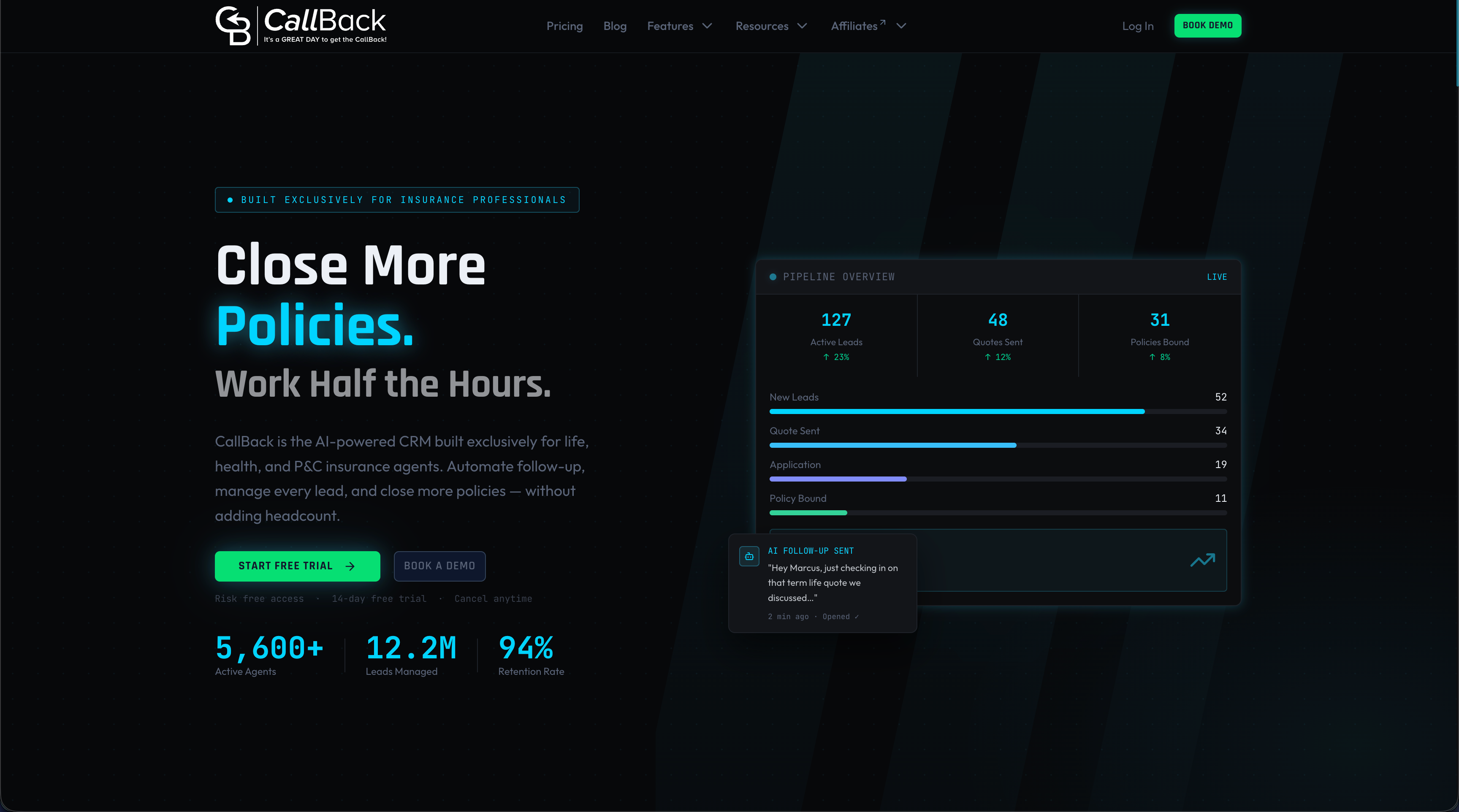
Callback CRM gives insurance agents and agencies a purpose-built platform to automate welcome sequences, renewal reminders, and quote recovery flows without manual effort. The email marketing automation features include pre-built templates, personalization fields, and A/B testing built directly into the workflow builder. Combined with task automation features that trigger sequences based on CRM events, you can run a fully automated email engine that runs in the background while you focus on closing. Explore the full insurance CRM toolkit to see how everything connects.
Frequently asked questions
How often should I email my insurance clients?
Aim for monthly or bi-monthly communications to stay top-of-mind without overwhelming your audience or training them to tune you out.
What types of email sequences work best for insurance sales?
The most effective sequences are trust-building welcome emails, renewal reminders sent 60 or more days in advance, and quote abandonment recovery flows that re-engage prospects over seven to ten days.
How do I measure the success of my insurance email campaigns?
Move beyond open and click rates by tracking renewals, cross-sells, and CLV. Tracking policy outcomes gives you a far more accurate picture of whether your campaigns are actually growing your agency.
What compliance rules must insurance agents follow in email marketing?
Every email must include a clear unsubscribe link and accurate sender information under CAN-SPAM regulations. Avoid misleading subject lines and aggressive sales content that could trigger complaints or penalties.
Recommended
- Master the email marketing process for insurance agents | CallBack CRM Blog
- Customer Engagement Best Practices That Drive Insurance Sales | CallBack CRM Blog
- Why email marketing matters for insurance agents in 2026 | CallBack CRM Blog
- Lead generation tips for agents: boost your insurance sales | CallBack CRM Blog