

Ringless voicemail is legal in the United States only when it complies with the TCPA and related state rules. The FCC’s 2022 ruling settled the underlying question: a ringless voicemail drop counts as a “call” under federal law, which means it needs the same consumer consent as any prerecorded or robocall message. Get consent wrong, and the legal exposure is real. Get it right, and the channel works.
TL;DR:
- Most ringless voicemail campaigns must obtain prior express written consent if the message is marketing and lands on a wireless number.
- Federal law requires documenting consent each time, including the number, date, and campaign details, and that record must be stored securely for years.
- Stricter state laws can impose higher damages, different consent rules, and broader private right of action, so multi-state campaigns need careful planning.
- Violations of TCPA can lead to damages of $500 to $1,500 per unconsented message, creating significant legal and financial risk at scale.
- Compliance requires operational discipline, including capturing and logging consent at contact points and maintaining real-time opt-out management systems.
Table of Contents
- Is Ringless Voicemail Legal? The FCC Ruling That Changed Everything
- Consent Standards: Prior Express Written Consent vs. Informational Consent
- State Laws Add Another Layer: Mini-TCPAs and Local Variance
- A Practical Compliance Checklist for Ringless Voicemail Campaigns
- What Enforcement Actually Costs: Damages and Real-World Risk
- How a Compliant Marketing Team Actually Runs Voicemail Drops
- Why Most Compliance Advice Misses the Point
- How CallBack CRM Supports TCPA-Compliant Voicemail Campaigns
- Sources
Is Ringless Voicemail Legal? The FCC Ruling That Changed Everything
Ringless voicemail sends an audio message straight to a recipient’s voicemail box without the phone ever ringing. For years, some marketers argued that because the handset never rang, the message fell outside telephone-call regulations entirely. The FCC closed that argument in November 2022.
FCC 22-85 declared that ringless voicemail deposited to a wireless number is a “call” for purposes of the Telephone Consumer Protection Act, codified at 47 U.S.C. § 227. The commission’s rationale centered on the consumer’s experience rather than the technical delivery method.
The FCC reasoned that ringless voicemail uses the recipient’s wireless number as a unique identifier, and that the experience of finding an unsolicited message in a voicemail box is functionally the same as receiving an unwanted call.
That framing comes straight from the commission’s own analysis, as Manatt’s legal team explains. Whether a message arrives through a ring or slides directly into voicemail storage, the recipient still has to deal with it. Consumer advocacy groups, including the National Consumer Law Center, had pushed for exactly this outcome for years before the FCC agreed. The practical effect: if your message uses an artificial or prerecorded voice and lands on a wireless number, TCPA consent rules apply, full stop.
Consent Standards: Prior Express Written Consent vs. Informational Consent
Not every voicemail drop needs the same level of consent. The TCPA splits messages into two buckets, and mixing them up is the single most common compliance mistake marketers make.
Marketing messages require prior express written consent. That means the consumer signed a written agreement (electronic signatures count) that clearly states they agree to receive autodialed or prerecorded marketing calls at a specific number, and that consent isn’t a condition of purchasing anything. A sales pitch for a new insurance product, a discount offer, or a cross-sell campaign all fall into this category.
Informational or service messages face a lower bar. Appointment reminders, policy renewal notices, or account-servicing updates to an existing customer generally rely on the consent already established through the business relationship, not a fresh written agreement.
Acceptable documentation methods include:
- Signed electronic consent forms with a timestamp and the specific phone number listed
- Opt-in checkboxes on web forms, logged with IP address and submission time
- Recorded call scripts where the consumer verbally agrees, paired with a written confirmation
- CRM-tagged consent records tied to a campaign ID
Pro Tip: Never rely on a single checkbox buried in a terms-of-service page. Tie consent to the exact phone number and campaign, and store it somewhere you can retrieve instantly if a regulator or plaintiff’s attorney asks.
State Laws Add Another Layer: Mini-TCPAs and Local Variance
Federal compliance is the floor, not the ceiling. A growing number of states have passed their own “mini-TCPA” statutes that impose stricter rules than federal law, and national campaigns need to treat state review as a planning step, not an afterthought.
Common areas of state variance include:
- Higher statutory damages per violation than the federal $500 to $1,500 range
- Stricter calling-hour windows or frequency caps on repeat contacts
- Broader private right of action, making lawsuits easier to file
- State-specific examples: Florida’s amended mini-TCPA expanded autodialer definitions, while Oklahoma and Washington have their own telemarketing statutes with distinct consent requirements
Before launching a multi-state campaign, cross-check your target list against each state’s telemarketing statute, not just federal law.
A Practical Compliance Checklist for Ringless Voicemail Campaigns
Running a defensible campaign comes down to six operational habits:
- Capture consent properly. Collect the specific number, the date, and the campaign context, then store it in a system that timestamps every entry.
- Manage opt-outs and DNC lists. Screen every list against the National Do Not Call Registry and maintain your own internal suppression list that updates in real time.
- Review message content. “Your policy renewal is due” is safe informational language; “Save 20% on a new plan today” needs marketing-level consent.
- Vet your vendor. Contracts should include audit rights, indemnity clauses, and confirmation that the vendor supports call authentication standards like STIR/SHAKEN.
- Control volume and monitor complaints. Sample new campaigns at low volume first, and track complaint trends through the FCC’s consumer complaint portal before scaling.
- Retain documentation. Keep consent records for years, not months. Litigation over a single campaign can surface long after the messages went out.
Pro Tip: Build a consent audit trail that lives outside your messaging vendor’s system too. If the vendor disappears or gets acquired, you still need proof of consent on hand.
What Enforcement Actually Costs: Damages and Real-World Risk
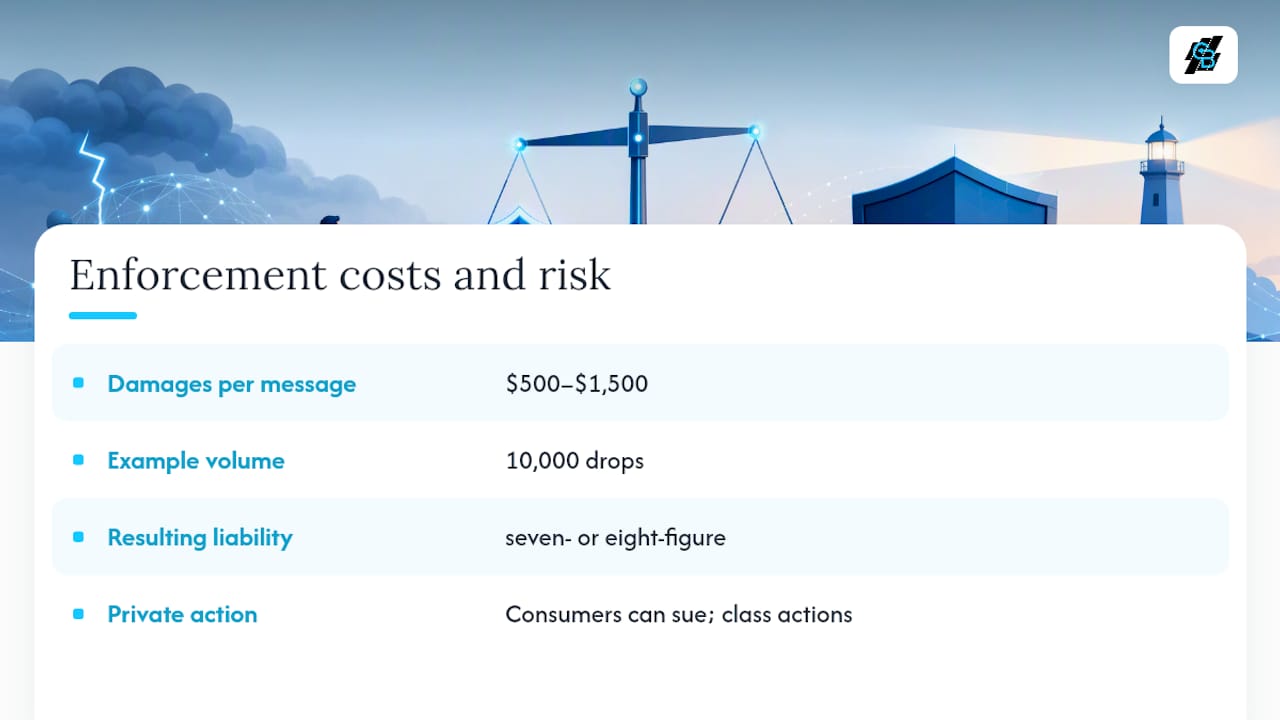
The TCPA sets statutory damages of $500 to $1,500 per violating message, and that figure applies per call, not per campaign. Send 10,000 unconsented voicemail drops and the math turns a marketing budget line into a seven or eight-figure liability fast.
The TCPA also grants a private right of action, meaning individual consumers can sue directly, and plaintiffs’ firms have built entire practices around aggregating these claims into class actions. Because statutory damages multiply by message, a modest list-hygiene failure at scale creates disproportionate exposure long before intent or bad faith enters the picture.
How a Compliant Marketing Team Actually Runs Voicemail Drops
Compliant teams build consent capture directly into landing pages, intake forms, and onboarding flows, so the phone number and the agreement are captured in the same step, not reconciled later. Operationally, that means automated opt-out processing, real-time DNC syncing, and audit logs that record every consent event with a timestamp and campaign ID. Treat that log as evidence you may need to produce, not just a backend record.
Why Most Compliance Advice Misses the Point
Most guides on this topic recite the FCC ruling and stop there, as if knowing the law were the same as operating within it. It isn’t. The businesses that get burned aren’t the ones who misunderstand TCPA law, they’re the ones who understand it fine but never built the systems to prove compliance when a plaintiff’s attorney comes calling.
Consent taxonomy gets treated as a legal footnote when it should be the first design decision in any campaign. Whether a message counts as marketing or informational determines your entire consent obligation, and too many teams default to the loosest interpretation because it’s convenient, not because it’s defensible.
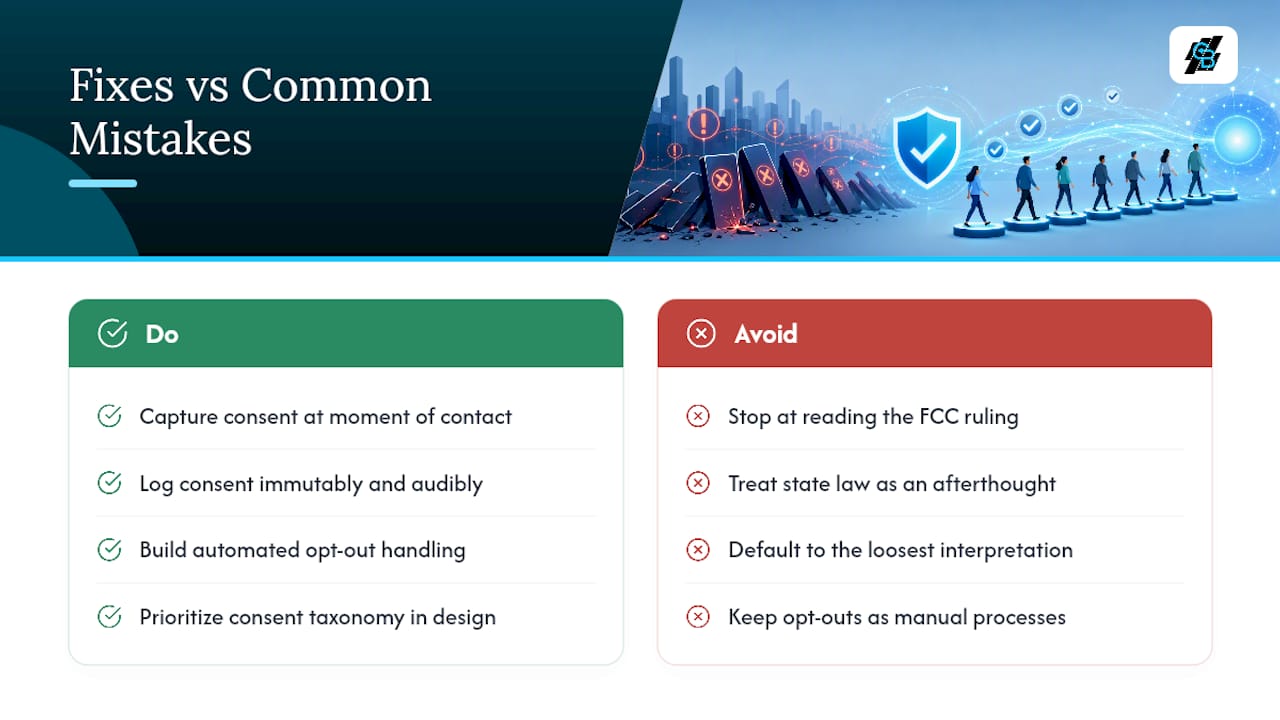
State mini-TCPA variance gets even less attention. Marketers plan campaigns at the federal level and treat state law as a compliance afterthought, which is backwards. If you’re running voicemail drops across state lines, that review belongs at the planning stage, not the legal-defense stage.
The fix isn’t more legal reading. It’s operational discipline: capture consent at the moment of contact, log it immutably, and build opt-out handling into the system rather than a manual process someone forgets during a busy quarter.
— Kyle
How CallBack CRM Supports TCPA-Compliant Voicemail Campaigns
There are platforms that provide insurance agents and agencies a documented way to run voicemail drops without rebuilding compliance infrastructure from scratch. Consent capture connects directly to your funnel and website builder, so a signup form can log the phone number, timestamp, and campaign ID at the exact moment a prospect opts in, no separate spreadsheet required.
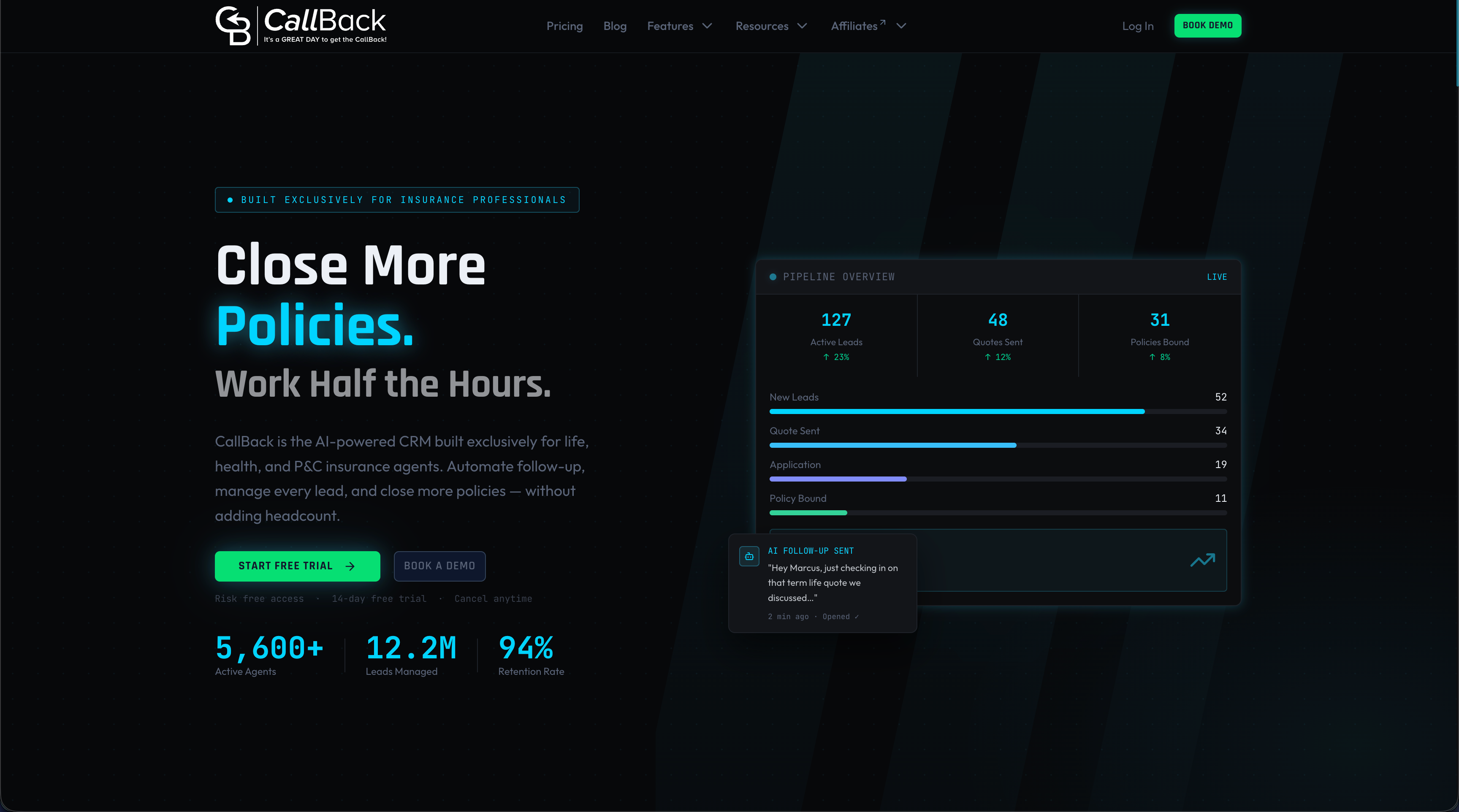
Automated opt-out flagging syncs across your SMS and voicemail messaging tools, so a “stop” reply or DNC match suppresses that number across every future send, not just the current campaign. Consent events and opt-outs can be logged with an audit trail accessible if a complaint surfaces. For agencies running voicemail drops in insurance marketing, that documentation is the difference between a defensible campaign and a costly guess. Users can start a trial and build compliant consent forms with available tools.
This article is general information, not a substitute for advice from a qualified lawyer. Consult a qualified legal professional about your own circumstances before acting on anything here.
Sources
- Federal Communications Commission, FCC 22-85 (Declaratory Ruling and Order)
- 47 U.S.C. § 227 (TCPA)
- Manatt: FCC: Ringless voicemails are ‘calls’ for TCPA purposes
- Donotcall