

Yes, CAN-SPAM applies to insurance marketing emails, including messages sent to businesses, not just consumers. Senders must use accurate headers, truthful subject lines, a clear ad disclosure, a valid physical postal address, and a working unsubscribe link, and they must honor opt-out requests within 10 business days. Penalties apply per message, and the FTC and other agencies enforce the rule.
TL;DR:
- Keep renewal notices and policy documents free of sales language; an upgrade pitch or referral offer can make the message commercial under CAN-SPAM.
- Keep unsubscribe free and single step, require no more than an email address, honor requests within 10 business days, and maintain the link for 30 days.
- Configure SPF, DKIM, and DMARC on one consistent sending domain, then monitor DMARC reports monthly and start with monitoring before quarantining failed messages.
- Vendors do not absorb liability: agencies and other parties benefiting from a commercial email may each count as senders, so retain independent suppression records.
Table of Contents
- Quick compliance checklist for insurance senders
- Breaking down each CAN-SPAM requirement for insurance emails
- Which insurance emails actually fall under CAN-SPAM
- Deliverability and authentication: SPF, DKIM, and DMARC
- Liability, multi-sender emails, and vendor oversight
- Operationalizing CAN-SPAM with your CRM
- Compliance as a business advantage, not just a legal shield
- How CallBack CRM keeps your email compliant and automated
- FAQ
- Sources
Quick compliance checklist for insurance senders
Before a single campaign goes out, agencies can run their email program against a short list of requirements drawn directly from the FTC’s compliance guide. This checklist works as a recurring audit, not a one-time setup task.
- Include a single-click or single-page unsubscribe link and honor opt-outs within 10 business days.
- Avoid deceptive “From,” “To,” and routing information, and write subject lines that match the email’s actual content.
- Clearly label promotional content as an advertisement and include a valid physical postal address.
- Keep the opt-out mechanism active and functional for at least 30 days after each campaign.
- Set up SPF, DKIM, and DMARC on every domain used to send marketing email.
- Log vendor access to your sending systems and maintain an up-to-date suppression list.
Agencies that want a longer reference can use our email marketing checklist for agents alongside this list.
Breaking down each CAN-SPAM requirement for insurance emails
Each CAN-SPAM requirement addresses a specific way marketing email can mislead or burden recipients, and each has a practical fix for insurance senders.
- Accurate header information: The “From,” “To,” and domain name must identify who actually sent the message. A common mistake is routing agent emails through a generic domain that does not match the agency’s real sending identity; fix this by registering and authenticating the domain you actually use.
- Subject lines: “Your Policy Update” is deceptive if the email is a renewal promotion. “New Auto Insurance Rates Available, Get a Quote” describes the content accurately.
- Ad disclosure: A simple line such as “This is an advertisement” placed near the top of the email satisfies the requirement without needing bold formatting or a banner.
- Valid physical postal address: A street address, PO box, or registered private mailbox all qualify, as long as it is current and able to receive mail.
- Opt-out mechanism: The process must be a single step, free of charge, and cannot require the recipient to provide more than an email address. 16 CFR Part 316 defines these mechanics along with the legal definition of “sender.”
- Timing rules: Opt-outs must be honored within 10 business days, and the mechanism itself must stay active for at least 30 days following the send.
Per-message penalties for CAN-SPAM violations can be very high, according to the FTC’s compliance guide, with penalties that scale fast across a single batch send to a large book of business.
Which insurance emails actually fall under CAN-SPAM
CAN-SPAM covers any email whose primary purpose is commercial, meaning it advertises or promotes a product or service. Renewal notices and policy documents are typically transactional and fall outside the strictest promotional requirements, but a renewal email that also pitches an upgraded policy or a referral bonus shifts toward commercial.
The FTC looks at subject line wording, where promotional content sits in the message, and how an ordinary recipient would read it. An email titled “Your Declaration Page” that leads with a cross-sell offer reads as commercial despite the subject line. The safest practice is to keep transactional notices free of sales language and run promotional offers as clearly separate messages.

Deliverability and authentication: SPF, DKIM, and DMARC
Inbox providers increasingly reject or filter unauthenticated mail, which makes SPF, DKIM, and DMARC part of staying compliant and part of staying visible. The FTC recommends all three protocols as standard practice for preventing domain spoofing and improving email security.
SPF confirms which servers are allowed to send mail for your domain, DKIM attaches a verified signature to each message, and DMARC tells receiving mail servers what to do when a message fails either check.
- Add SPF and DKIM records through your domain’s DNS settings before any large campaign.
- Keep a single, consistent sending domain across your CRM, website forms, and any third-party tools.
- Publish a DMARC policy and review its reports regularly to catch spoofing attempts early.
Pro Tip: Start your DMARC policy at “none” to monitor traffic safely, then move to “quarantine” once you confirm legitimate mail is passing all checks.
Agencies without in-house IT support can lean on their CRM or hosting provider to apply these records correctly; our guide on enforcing SPF, DKIM, and DMARC walks through a six to eight week rollout.
Liability, multi-sender emails, and vendor oversight
When more than one party benefits from a commercial email, CAN-SPAM can treat each of them as a “sender” with independent legal responsibility. Hiring a marketing vendor, a lead generation partner, or an outside agency to send email on your behalf does not transfer your obligations away from you.
- Require a written compliance warranty from any vendor that sends email using your brand or policy information.
- Limit vendor access to your sending domain and CRM, and review that access on a set schedule.
- Specify in the contract who processes opt-out requests and how fast they must act.
- Keep your own suppression list and opt-out logs independent of any vendor’s records, so you can produce them during an audit.
Operationalizing CAN-SPAM with your CRM
Compliance holds up best when it runs on automation instead of manual review. Start by mapping every place emails originate, your agency website, a quoting tool, a referral form, and routing them all through one CRM with a single, authenticated sending domain.
- Automate unsubscribe processing so suppression lists update instantly across every list and campaign.
- Segment contacts by policy type, renewal date, and engagement history to send fewer, more relevant messages.
- Roll out SPF, DKIM, and DMARC on a testing schedule, then monitor DMARC reports monthly for failures.
- Keep documented records of opt-out timestamps, suppression list changes, and campaign content for at least a year.
Pro Tip: Review your suppression list monthly, since a stale list is one of the most common sources of accidental CAN-SPAM violations.
For a closer look at how automation workflows enforce these rules in practice, see our breakdown of email automation for insurance agents. Outside our platform, the marketing automation checklist from Babylove Growth offers a broader framework for building these habits into a small marketing team’s routine.
Compliance as a business advantage, not just a legal shield
Treating CAN-SPAM as a formality misses the point. Clean lists, honored opt-outs, and authenticated domains build sender reputation, which directly affects how many of your renewal and cross-sell emails actually reach an inbox. Agencies that layer this awareness alongside TCPA and GLBA obligations build a stronger, more defensible outreach program overall.
— Kyle
How CallBack CRM keeps your email compliant and automated
We built suppression list management and unsubscribe automation directly into CallBack CRM, so opt-out requests update across every campaign the moment they come in, not days later. Segmentation tools let you target policy types and renewal windows instead of mailing your entire book at once, which keeps complaint rates down and sender reputation intact.
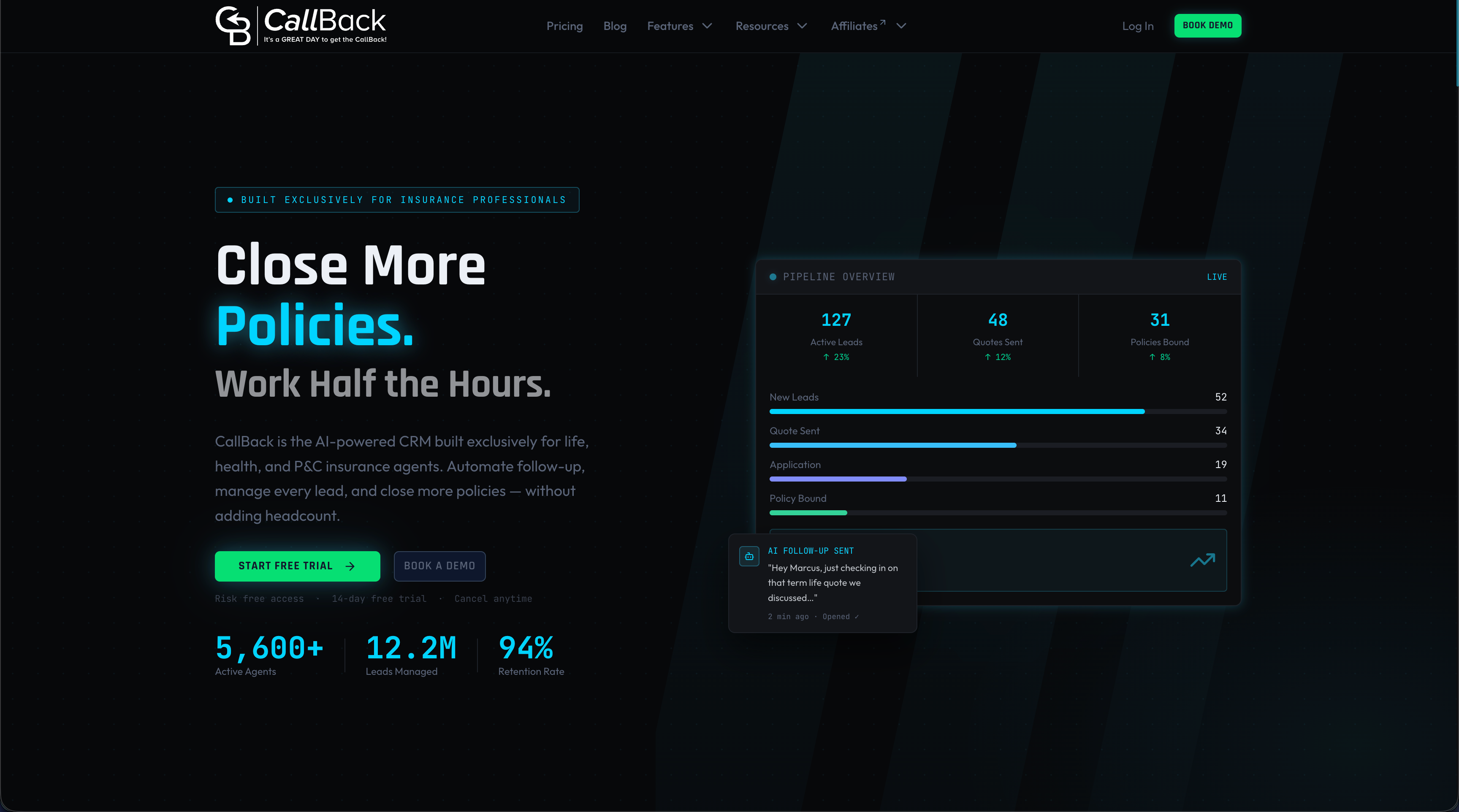
Agencies running larger teams can review our Enterprise plans starting at $297 per month for 10 full CRM accounts, while independent agents can start with the Professional plan at $97 per month. Sign up to see how automated suppression lists and segmentation fit your current email workflow.
This article is general information, not a substitute for advice from a qualified lawyer. Consult a qualified legal professional about your own circumstances before acting on anything here.

FAQ
How can I stop unwanted insurance-related spam calls?
Registering your number with the National Do Not Call Registry reduces legitimate telemarketing calls, though it will not stop illegal scam calls. The FCC also enforces TCPA rules against unauthorized robocalls and robotexts, which run alongside, but separately from, CAN-SPAM’s email rules.
How do I keep my insurance marketing emails out of spam folders?
Authenticating your domain with SPF, DKIM, and DMARC is one of the most reliable ways to improve inbox placement, according to FTC guidance. Keeping your list clean, honoring opt-outs quickly, and avoiding misleading subject lines also reduce spam complaints that hurt sender reputation.
Is sending unsolicited commercial email illegal in the United States?
Sending commercial email itself is not illegal, but CAN-SPAM requires it to meet specific rules on headers, disclosures, and opt-outs. The FTC’s compliance guide confirms there is no exemption for business-to-business email, and violations can carry per-message penalties.
Why do I still get marketing emails after unsubscribing?
Senders are legally required to honor opt-out requests within 10 business days, so some delay can be normal. If emails continue well past that window, the sender may not be following CAN-SPAM’s opt-out rules, including the requirement that subscription or membership status does not remove the need for a working unsubscribe link.