

Short voicemails win. A 20 to 30 second message with one clear reason to call back and a single next step outperforms long, apologetic messages every time. This article gives you copy-ready scripts for the scenarios you face most, the five elements every effective voicemail needs, and a follow-up workflow that turns each message into a tracked, compliant touchpoint.
TL;DR:
- Voicemail scripts should be kept to 20-30 seconds, focusing on a clear reason to call back and a single, specific next step.
- Using a structured approach with identification, reason, teaser, call to action, and timeframe improves response rates.
- Sending a follow-up text within 15 minutes of leaving the voicemail greatly increases callback and reply chances.
- Automating follow-ups through CRM systems ensures consistent, timely contact and maintains a compliant audit trail.
- Testing different script phrases and tracking response data over time helps optimize voicemail effectiveness.
Table of Contents
- Scenario-based voicemail scripts you can copy today
- The five elements every effective voicemail needs
- Common voicemail mistakes and their one-line fixes
- Turning a voicemail into an automated follow-up sequence
- Quick phrases and hooks to swap into any script
- Recording and delivery: a short checklist
- What to do when a client stops responding
- Measuring whether your voicemails are working
- What changed when we paired scripts with automated follow-up
- How CallBack CRM automates your voicemail follow-up
- FAQ
- Sources
Scenario-based voicemail scripts you can copy today
Each scenario below includes a primary script built for a 20 to 30 second message, plus two quick variations you can swap in depending on how warm the lead is. Read each one at a normal pace before recording. If it runs past 30 seconds, cut a sentence.
New lead (inbound inquiry or purchased lead): “Hi, this is [Name] with [Agency]. I’m reaching out about the [auto/home/life] quote request you submitted. I found a couple of options that could save you money, and I’d like to walk you through them. Call me back at [number], or I’ll try you again tomorrow around [time].”
Missed quote follow-up: “Hi [First Name], it’s [Name] from [Agency]. I put together your quote and noticed one detail that could change your rate. Give me a call back at [number] so I can explain, it only takes a minute.”
Claim follow-up: “Hi [First Name], this is [Name] with [Agency] checking in on your claim. I have an update on where things stand and wanted to walk you through next steps. Call me back at [number] when you get a chance today or tomorrow.”
Renewal reminder: “Hi [First Name], it’s [Name] from [Agency]. Your policy renews soon, and I want to make sure you’re still getting the best rate before it processes. Call me back at [number], or I’ll follow up by text this afternoon.”
Referral request: “Hi [First Name], it’s [Name] from [Agency]. I enjoyed helping you with your policy, and I wanted to ask a quick favor. If you know anyone who’s shopping for [auto/home/life] coverage, I’d appreciate the introduction. Call or text me at [number].”
Post-bind welcome and cross-sell: “Hi [First Name], it’s [Name] from [Agency]. Welcome aboard. I wanted to check that everything’s set up correctly and mention one coverage gap I noticed on the home side. Call me back at [number], or I’ll follow up by email today.”
Two quick variations for each scenario:
- Friendly tone: Add “Hope you’re doing well” after the greeting and soften the CTA to “whenever’s convenient.”
- Urgency tone: Swap the CTA to “I need to hear back by [specific day]” and mention a deadline tied to the quote, renewal, or claim window.
For auto and home lines, mention the specific vehicle or property address if you have it. For health and life lines, keep the message more general since these topics are more sensitive and specific numbers can sound like a sales pitch rather than a service call.
The five elements every effective voicemail needs
Voicemail best practices point to a consistent structure: greeting and identification, a brief reason for the call, a value teaser, a clear call to action, and an expected response timeframe. Messages built around these five elements tend to run naturally in the 20 to 30 second range that callers respond to best.
Here is how the elements map to sentences, using the missed quote script as an example:
- Identify: “Hi [First Name], it’s [Name] from [Agency].”
- Reason: “I put together your quote.”
- Value teaser: “I noticed one detail that could change your rate.”
- Call to action: “Give me a call back at [number].”
- Timeframe: “I’ll try you again tomorrow if I don’t hear from you.”
Sales-voicemail guidance recommends leading with the benefit or reason to call rather than delivering a full pitch in the voicemail itself. The goal is a curiosity gap: give the caller just enough to want more, not everything.
Avoid rambling, repeating your phone number more than twice, or padding the message with filler like “um” or “just wanted to.” Industry guidance on business voicemail greetings also recommends repeating your callback number early in the message rather than only at the end, since some callers write it down the moment they hear it and stop listening closely after that.
Pro Tip: Time yourself with your phone’s stopwatch once before recording. If the script runs past 30 seconds, cut your second sentence first, not your CTA.
Common voicemail mistakes and their one-line fixes
Most weak voicemails share the same handful of problems. Here’s what to listen for and how to fix each one on your next call.
- Rambling without a point: Cut everything after the third sentence. If you can’t say it in 30 seconds, it belongs in a follow-up email.
- Starting with “Hi, you’ve reached…” like a recording: Start directly with your name and agency so the caller knows immediately they reached a person.
- Apologetic tone (“Sorry to bother you, I know you’re busy”): Replace it with a confident opener like “I have an update for you.”
- Over-sharing pricing or policy details: Mention that you have information, not the number itself. Save specifics for the callback.
- No clear next step: End every message with one instruction: call, text, or expect a follow-up email by a certain time.
Run this checklist before you hit record: Do I identify myself in the first five seconds? Do I give one reason to call back? Is there exactly one CTA? Did I state when I’ll follow up if they don’t call?
Turning a voicemail into an automated follow-up sequence
A voicemail that isn’t followed by a second touch gets ignored more often than not. The fix is a workflow that fires automatically the moment you hang up, so no lead depends on you remembering to follow through.
- Log the call and voicemail outcome in your CRM immediately, including which script version you used.
- Tag the lead by scenario (new lead, renewal, claim, referral) so future messaging stays consistent with what you already said.
- Trigger a text message 5 to 15 minutes later that restates your CTA and includes a scheduling link.
- Schedule your next call attempt for the following day at a different time of day than your first attempt.
- Queue a same-day email that gives slightly more detail than the voicemail, for leads who prefer reading to calling back.
Platforms like CallBack CRM’s sales automation workflow are built to run this sequence automatically once a voicemail is logged, which removes the manual step most agents skip when they’re busy.
Keep a compliant audit trail of every contact attempt, especially opt-outs. The FCC’s TCPA consent rule guidance confirms that TCPA statutory damages run from $500 to $1,500 per violation, and a waiver tied to the “stop one means stop all” revocation rule has been extended, so recordkeeping on consent and opt-out requests matters for every channel you use, not just calls.
Pro Tip: Set your CRM to log the voicemail script version alongside the outcome. Over a few weeks, you’ll see which scripts actually generate callbacks.
Quick phrases and hooks to swap into any script
A small bank of alternate openers and closers lets you test tone without rewriting your whole script. Pick one from each category depending on how warm the lead is.
- Curiosity openers: “I found something in your policy you’ll want to know about,” or “I noticed a change that could affect your rate.”
- Urgency tags: “This needs a response by [day],” or “Your window to lock this in closes soon.”
- Appointment-focused CTAs: “Grab a 10-minute slot on my calendar,” or “Let’s set up a quick call this week.”
- Referral hooks: “If you know someone shopping for coverage, I’d appreciate the introduction.”
Curiosity openers and softer CTAs tend to work better on cold or purchased leads who don’t recognize your name yet. Urgency tags and direct scheduling language work better on warm leads who already expect to hear from you, like renewals or post-quote follow-ups.
Recording and delivery: a short checklist
How you say the script matters as much as what you write. Run through this list before recording:
- Check your environment: record somewhere quiet, away from traffic, keyboards, or other conversations.
- Hold your phone or headset at a consistent distance so your volume doesn’t fade mid-sentence.
- Smile while you talk. It changes your tone even though the caller can’t see you.
- Rehearse once, then record. A cold first take usually sounds flat or rushed.
- Time the final version and trim if it runs past 30 seconds.
Use a live, recorded message for most outreach rather than a generic voicemail drop. Ringless voicemail tools have their place for volume campaigns, but a live message in your own voice builds more trust for scenarios like claims and renewals where the client expects a personal touch.
Pro Tip: Record your script twice and play both back. The version that sounds more like a conversation, not a script, is usually the one to keep.
What to do when a client stops responding
Not every voicemail gets a callback, and that’s normal. The mistake is leaving the same message again or giving up after one attempt.
Space out your attempts instead of calling back-to-back. Try a different time of day on your second attempt, and a different day of the week on your third. After two voicemails, switch channels: send a text that references the voicemail directly (“Left you a message about your renewal, text works too if that’s easier”) rather than repeating the same information.

If three attempts across voicemail, text, and email produce no response, shift the lead into a longer nurture sequence rather than continuing daily outreach. A slower cadence, such as a monthly check-in or seasonal reminder, keeps you present without feeling like pressure. For a deeper look at building these longer sequences, lead nurturing strategies cover how multi-touch programs keep unresponsive leads warm until timing changes.
Always log each unanswered attempt. A documented pattern of outreach protects you if a compliance question ever comes up, and it also tells you which leads are worth another push versus which have gone cold.
Measuring whether your voicemails are working
You can’t improve a script you’re not tracking. At minimum, log three data points for every voicemail: which script version you used, the scenario tag, and whether a callback, text reply, or email response followed.
Over a few weeks, patterns emerge. One script might generate more callbacks on renewals than on new leads. A specific CTA phrase might outperform another on cold leads but underperform on warm ones. Testing script variants against each other, sometimes called A/B testing, works the same way in voicemail as it does in email subject lines: run two versions, compare outcomes, keep the stronger one.
Track response time too. Leads who get an SMS within 15 minutes of a voicemail tend to reply at higher rates than leads who wait hours for a follow-up touch, since the voicemail is still fresh in their mind. If your callback rate stalls below what you’d expect for a given lead source, the fix is usually in timing or script length before it’s in the offer itself. Reviewing these numbers monthly, rather than per call, gives you enough data to spot a real trend instead of reacting to one bad day.

What changed when we paired scripts with automated follow-up
When agents pair a tight voicemail script with an automatic text and task sequence, pipeline velocity tends to pick up fast. The voicemail alone rarely closes anything. What moves the needle is the second and third touch landing within minutes instead of days, because that’s when the lead still remembers the call.
The one tip worth testing this week: send your follow-up text within 15 minutes of every voicemail, not at the end of the day.
— Kyle
How CallBack CRM automates your voicemail follow-up
We built CallBack CRM around the exact workflow described above: log the voicemail, tag the scenario, trigger the text, schedule the next call, queue the email, all without you touching a spreadsheet. Fewer manual steps means fewer leads slipping through because a follow-up got forgotten on a busy day.
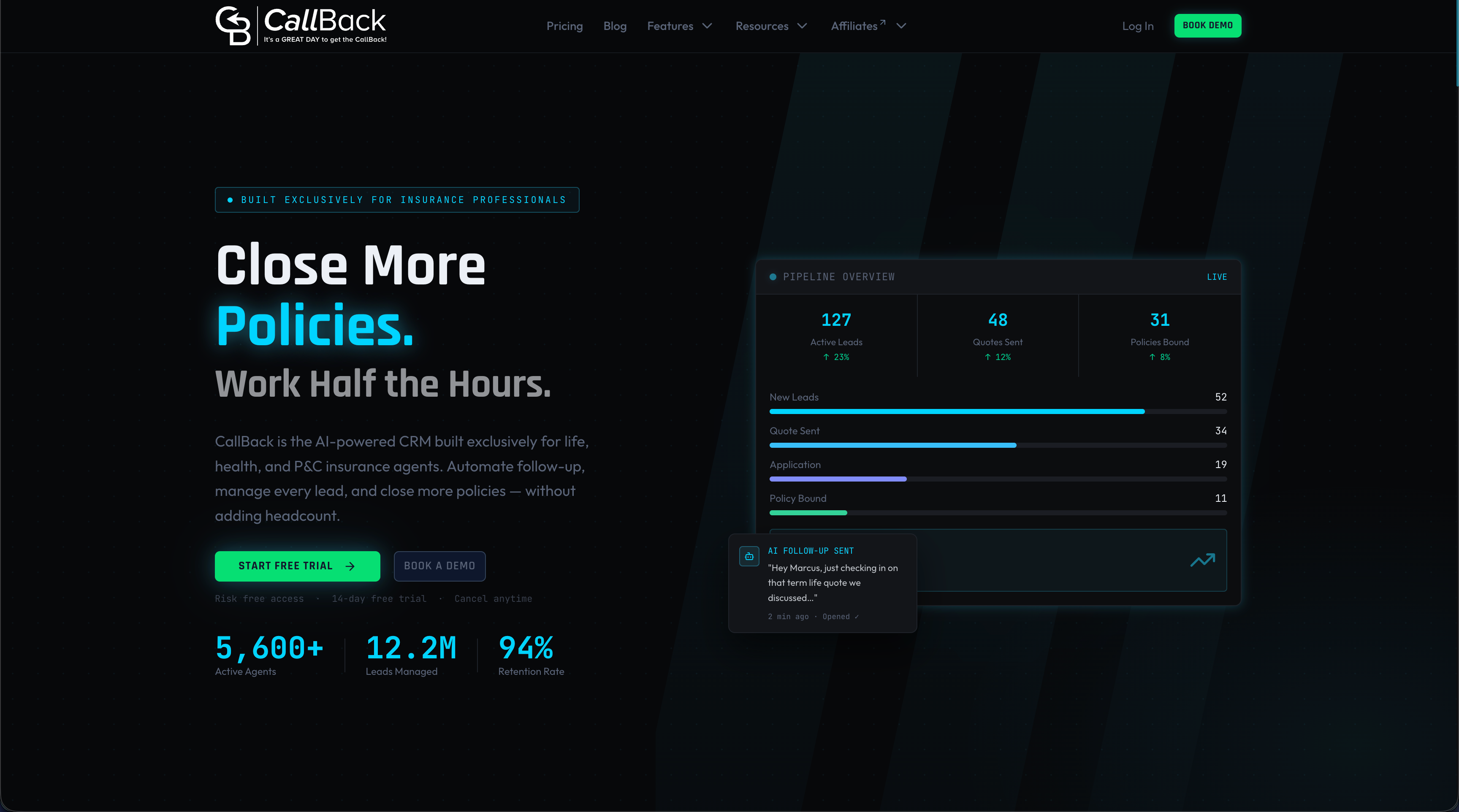
Specifically, our platform handles:
- Automatic call logging and tagging tied to the script or scenario you used.
- SMS triggers timed to fire minutes after a voicemail, not hours later.
- Scheduled callback tasks that land on your calendar without manual entry.
- A documented audit trail for consent and opt-out tracking, which matters given TCPA enforcement.
For agents who want this running end to end, our sales automation workflow guide walks through the setup, and our lead generation workflow tutorial shows how voicemail outreach ties into the rest of your pipeline. If you’re ready to see it running on your own leads, our Professional plan starts at $97 per month and includes the automation tools covered in this article.
FAQ
What is a good script for a professional voicemail?
A good professional voicemail identifies you by name and company in the first five seconds, states one clear reason for the call, and ends with a single next step, like a callback number or a text option. Keep it under 30 seconds and avoid repeating your phone number more than twice.
What are some catchy phrases for selling insurance in a voicemail?
Phrases built around curiosity work better than sales language, such as “I found something in your policy you’ll want to know about” or “I have an update that could change your rate.” These create a reason to call back without giving away the full pitch, which sales-voicemail guidance recommends over a direct pitch left on the message itself.
What are some good voicemail ideas for insurance agents?
Scenario-specific voicemails work best: one script for new leads, one for renewals, one for claims follow-up, and one for referral requests. Each should follow the same structure of identification, reason, value teaser, and a clear call to action.
What should my voicemail say professionally?
Your voicemail should say who you are, why you’re calling, and what you want the caller to do next, all within about 20 to 30 seconds. Guidance on business voicemail greetings recommends starting directly with your greeting and identity rather than a generic opener, since that reduces caller confusion.
How soon should I follow up after leaving a voicemail?
Sending a text within 5 to 15 minutes of the voicemail, while the call is still fresh in the recipient’s mind, tends to produce stronger reply rates than waiting until later in the day. Pairing the voicemail with an immediate text and a same-day email creates multiple chances for the lead to respond through whichever channel they prefer.