

Use SMS to get attention. Use email to deliver the substance. Send a short text first for anything time-sensitive, then follow with an email that carries the details, documents, and record. This sequencing holds for most insurance touchpoints, from a new lead to a renewal notice, as long as consent and compliance rules are followed for each channel.
TL;DR:
- Sending SMS first achieves higher response rates and faster attention for urgent tasks like reminders and quick follow-ups.
- Email provides a secure, detailed record for policy documents, disclosures, and legal notices that cannot be effectively delivered via text.
- Both channels must have properly recorded consent, with SMS requiring stricter approval because of FCC rules implemented in 2024.
- Sequencing should follow an automated pattern: SMS immediately after a trigger, then a detailed email after a few minutes or hours.
- Response behavior varies by client segment, with younger clients favoring texts and older or complex policyholders preferring email.
Table of Contents
- Core differences between SMS and email for insurance work
- Scenario-by-scenario recommendations for agents
- What the evidence says about open rates and sequencing
- How to build an SMS-first, email-second sequence
- Deliverability, recordkeeping, and consent controls
- Common mistakes agents make with SMS and email
- Running the sequence through an insurance CRM
- The bottom line on sequencing SMS and email
- Cost comparison and ROI for SMS versus email in insurance
- How customer preferences shape channel effectiveness
- Security and privacy considerations for each channel
- Where the sequencing advice has real limits
- Putting the sequence to work with less manual setup
- Sources
- FAQ
Core differences between SMS and email for insurance work
SMS and email solve different problems. A text message reaches a phone almost immediately and gets read within minutes for most recipients. Email allows longer content, attachments, and a permanent record that a compliance file or an agent can retrieve later.
These differences shape what each channel should carry:
- Speed: SMS is read faster and works for anything with a clock attached, like an appointment reminder.
- Payload: Email holds policy documents, quotes, and disclosures that a text cannot display properly.
- Perception: A text can feel intrusive if it arrives with no context or too often, while an unread email is easier to ignore without complaint.
- Compliance friction: Text marketing carries stricter one-to-one consent requirements, while commercial email operates under a different set of disclosure and opt-out rules.
The practical takeaway is that SMS earns the click or the answer, and email holds the proof. Mixing the two roles, like texting a full policy summary or emailing a time-critical appointment change with no text heads-up, is where most channel mistakes start.
Scenario-by-scenario recommendations for agents
Channel choice depends on the task, not a blanket rule. Here is a scenario breakdown agents can apply directly.
- New lead: Send an SMS within minutes acknowledging the inquiry (“Thanks for reaching out, [Name] - I’ll call you at [time].”), then follow with an email introducing yourself and outlining next steps.
- Appointment reminders: SMS is the primary channel, sent the day before and again an hour ahead; email works as a backup for those who opted out of texts.
- Quote ready: Text a short prompt (“Your quote is ready - check your inbox or click here [link]”), then send the full quote by email with pricing and coverage details.
- Policy documents: Email only. Documents require an audit trail and often exceed what a text can carry; a short SMS can point to the email if urgency matters.
- Renewals: Start with an email carrying the renewal details and any rate changes, then send an SMS reminder closer to the deadline if no action has been taken.
The best-evidenced order across these scenarios is SMS first for anything requiring quick attention, followed by an email that supplies the content and creates the record. For insurance email sequences, coordinating both channels around a single timeline keeps messaging consistent instead of fragmented.
What the evidence says about open rates and sequencing
A randomized experiment on prenotification found that SMS prenotifications produced a higher response rate than email prenotifications, and that pairing an SMS prenotification with a follow-up email invitation performed best of the combinations tested. That study, published in a peer-reviewed survey methodology journal, measured response rates in a web-based access panel, not an insurance sales pipeline, so the exact numbers should be read as evidence of a pattern rather than a guarantee for every insurance workflow.
| Metric | SMS prenotification | Email prenotification |
|---|---|---|
| Response rate | higher for SMS | lower for email |
| Relative odds of participation | higher | baseline |
Separate marketing research comparing SMS and email campaigns generally finds SMS produces faster responses, though it can also carry higher unsubscribe rates depending on audience and message relevance. One study describing one context is not a universal rule for every book of business, but the direction, SMS for speed and attention, email for depth, is consistent across the available evidence.
How to build an SMS-first, email-second sequence
A workable sequence follows a simple timing pattern that a CRM can automate.
- Trigger the SMS immediately after the event (lead form submitted, appointment booked, quote generated). Keep it to one sentence with a clear next step.
- Wait a short window, typically a few minutes to a few hours depending on the scenario, before sending the email.
- Send the detailed email with the subject line matching the SMS context, the relevant document or link, and a single clear call to action.
- Log consent and delivery for both messages, including timestamp and opt-in source, inside the CRM record.
Each message needs a few consistent elements: an identifiable sender name, one clear call to action, and a link to a portal or document rather than an attachment inside the text. Personalization tokens (first name, policy type, agent name) should match across both channels so the two messages read as one conversation rather than two disconnected touches. An email drip campaign built to follow the SMS trigger keeps the cadence predictable for both the agent and the recipient.
Pro Tip: Match the SMS wording and the email subject line so the recipient recognizes the follow-up as the same conversation, not a second unrelated message.
Deliverability, recordkeeping, and consent controls
Compliance is not optional for either channel, and the requirements differ. The FCC’s Second Report and Order adopted one-to-one prior express written consent rules for marketing texts, closing a loophole that had allowed a single consent to cover multiple sellers; key provisions took effect in 2024, with additional consent requirements effective January 27, 2025. Commercial email, meanwhile, falls under the CAN-SPAM Act, which requires accurate headers, a physical postal address, and a working unsubscribe mechanism, with opt-out requests processed within 10 business days.
Practical controls agents need in place:
- Store consent evidence for every SMS opt-in: the disclosure text, timestamp, phone number, and source.
- Maintain a suppression list that updates automatically when someone opts out of either channel.
- Honor revocation requests promptly, by any reasonable method the recipient uses to opt out.
- Keep email headers accurate and include a physical address in every commercial message.
Consent management is now an operational metric, not just a legal formality: complaints, blocks, and opt-outs measured per campaign reflect how well consent and suppression are handled, based on the FCC’s consent and revocation requirements.
Common mistakes agents make with SMS and email
Most channel complaints trace back to a small set of avoidable errors.
- Over-texting: Sending too many SMS messages in a short window drives opt-outs and complaints faster than almost any other mistake.
- Using SMS for content that needs an audit trail: Policy details, disclosures, and legal notices belong in email, not a text thread.
- Mismatched calls to action: A text pointing to one action and an email pointing to another confuses the recipient and lowers response.
- Fragmented content: Writing SMS and email copy separately, instead of as one sequence, produces messaging that feels disjointed.
Running the sequence through an insurance CRM
A CRM built for insurance workflows can centralize the consent capture, template library, and channel sequencing described above in one system rather than three disconnected tools.
- Consent capture: The opt-in disclosure, timestamp, and phone number are stored automatically at the point of signup.
- Automated sequence: Consent capture triggers an SMS acknowledgment, followed by an email carrying documents or quote details, with both actions logged to the contact record.
- Post-launch monitoring: Agents should track deliverability, opt-out rate, and complaint trends after any new sequence goes live, adjusting cadence when any of those numbers move in the wrong direction.
Pro Tip: Review opt-out rates by campaign monthly, not just overall, so a single overly aggressive sequence does not get lost in an average.
The bottom line on sequencing SMS and email
Lead with SMS for anything time-sensitive, follow with email for the details and the record. Pilot the sequence on a small segment first, track response time, conversion, and complaint rate, and scale once those numbers hold steady rather than rolling it out to the full book at once.

Cost comparison and ROI for SMS versus email in insurance
Email costs less per message to send than SMS in most CRM and marketing platforms, since carriers charge per text segment while email volume is typically bundled into a platform fee. That cost gap matters less than response quality for time-sensitive tasks: a faster reply on an appointment reminder or a quote follow-up can prevent a lost sale, which offsets the higher per-message cost of SMS. Agents evaluating ROI should weigh the task, not just the price per send. A renewal reminder that only needs to arrive and be read is a low-cost email job. A same-day appointment confirmation, where a missed message means a missed meeting, justifies the added cost of a text. Platforms that bill SMS and email at wholesale, usage-based rates, rather than bundling an inflated markup into a flat plan fee, make it easier to test both channels on a given workflow and measure the actual cost per response rather than the cost per send. The most efficient setup, based on the evidence above, is not choosing one channel over the other but assigning each channel to the task it performs best: SMS for the quick prompt that drives immediate action, email for the content that needs to last. That division keeps spend proportional to what each message actually needs to accomplish.

How customer preferences shape channel effectiveness
Not every client responds to SMS and email the same way, and preferences vary by age, comfort with technology, and how the client first engaged with the agency. Clients who signed up through a mobile-first form or a text-to-quote campaign tend to expect texts as the primary channel. Clients acquired through a website contact form or a referral often expect email first, treating an unsolicited text as more intrusive. Older clients and those managing more complex policies, such as life insurance or long-term coverage, are more likely to prefer email for anything involving documents, since it is easier to save and review at their own pace. Younger clients and those with simpler, transactional policies, such as auto insurance, tend to respond faster to text prompts. Rather than guessing, agents can track response patterns by client segment and adjust default channel assignment for each group. Offering a channel choice at intake, and honoring it consistently, avoids the mismatch that occurs when a client who prefers email gets frequent unsolicited texts, or when a client who wants quick text updates instead waits on an email that goes unread for days.
Security and privacy considerations for each channel
Email carries stronger built-in protections for sensitive insurance content than SMS in most standard setups. A policy document, medical questionnaire, or underwriting detail sent by email can be encrypted in transit and stored with access controls tied to a specific account. SMS messages are plain text by default, visible on a lock screen, and harder to secure once they leave the sending platform. That difference is the core reason policy documents and anything requiring an audit trail belong in email rather than SMS. Both channels carry a shared risk: sending to the wrong contact, or a stored number or address that no longer belongs to the client. A CRM that verifies email addresses and logs phone number changes reduces that risk. Neither channel is inherently unsafe when consent, recipient verification, and content rules are followed, but the sensitivity of insurance data, medical history, financial details, and coverage terms, favors email for anything beyond a short prompt or reminder.
Where the sequencing advice has real limits
Email-first or portal-first makes more sense for sensitive documents and legal disclosures, where an audit trail matters more than speed. SMS-first works best for prompts, not substance. Judgment on each case still matters more than a fixed rule.
— Kyle
Putting the sequence to work with less manual setup
Running SMS-first, email-second sequences by hand across separate tools gets messy fast, especially once consent logging and templates enter the picture. The platform centralizes communication channels, consent timestamps, opt-out handling, and reporting in a system designed for insurance workflows.
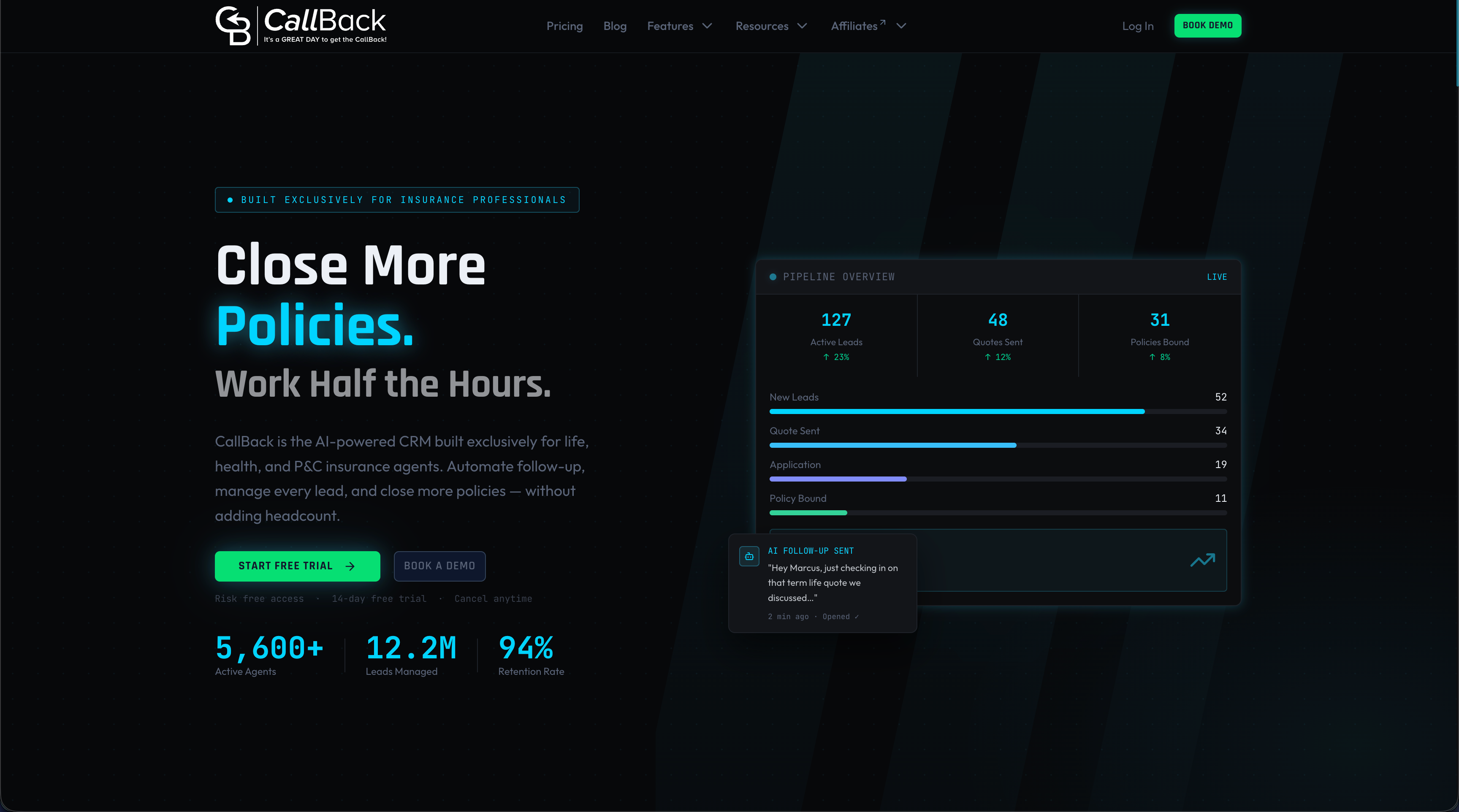
Agents can see how the SMS side works on the SMS marketing features page, or start directly with the Professional plan to test a full SMS-and-email sequence on a live book of business.
Sources
- Prenotification in Web-Based Access Panel Surveys: The Influence of Mobile Text Messaging Versus E-Mail on Response Rates and Sample Composition
- FCC Second Report and Order (targeting unlawful text messages and consent rules)
- CAN-SPAM Act: A Compliance Guide for Business | Federal Trade Commission
FAQ
Which is safer, SMS or email?
Email generally offers stronger built-in security for sensitive insurance content, since it supports encryption and account-level access controls that standard SMS does not. SMS is faster but travels as plain text, making it less suited to policy documents or anything requiring strict confidentiality.
What are the disadvantages of using SMS?
SMS has strict one-to-one consent requirements under FCC rules, and overuse drives opt-outs and complaints quickly. It also cannot carry attachments or long content, which makes it unsuitable for policy documents or detailed disclosures.
What’s the difference between SMS and email?
SMS is a short, fast text message typically read within minutes, best for time-sensitive prompts like appointment reminders. Email supports longer content, attachments, and a durable record, making it the better channel for quotes, policy documents, and renewal details.
Is SMS becoming obsolete?
No current evidence supports that claim. Regulatory attention on text marketing, including the FCC’s 2024 consent rules, points to SMS remaining a widely used and closely regulated channel rather than a fading one.