

TL;DR:
- An email marketing checklist for agents ensures every campaign step, from planning to analysis, is thorough and consistent. It emphasizes proper audience segmentation, domain authentication, compliance, and well-crafted content to improve deliverability and engagement. Focusing on core foundational tasks like authentication and segmentation leads to better results than overcomplicating campaigns with excessive steps.
An email marketing checklist for agents is a structured, repeatable workflow that covers every step from campaign planning to post-send analysis, so nothing gets missed and every email has a real shot at converting. Insurance agents face unique challenges here: compliance with CAN-SPAM and GDPR, deliverability across multiple ISPs, and the need to segment clients by policy type, renewal date, or lead status. Tools like Grammarly catch copy errors, while SPF, DKIM, and DMARC authentication protect your sender reputation. This guide walks you through each stage of a high-performing campaign checklist built specifically for insurance professionals.

1. Define your campaign goals and select the right KPIs
Every campaign starts with a clear objective. Are you nurturing new leads, cross-selling life insurance to existing auto clients, or re-engaging lapsed policyholders? Without a defined goal, you cannot measure success or make smart decisions after the send.
Once you set the goal, pick KPIs that actually reflect it. Open rates are unreliable because mailbox privacy features like Apple Mail Privacy Protection inflate them artificially. This means click-through rates, reply rates, and conversion rates give you a far more accurate picture of campaign performance. A scalable 7-step email strategy always starts with goal definition before touching audience or content, because the goal shapes every downstream decision.
2. Segment your audience into 4 to 5 focused groups
Audience segmentation is the single biggest lever for improving email relevance, but most agents over-complicate it. Start with 4 to 5 business-aligned segments rather than dozens of micro-lists. Over-segmentation creates automation gaps and inconsistent messaging that actually hurts engagement.
For insurance agents, practical segments include: new leads not yet quoted, active clients by policy type, clients with upcoming renewals, lapsed clients, and referral sources. Each group needs a different message, tone, and call-to-action. Segmenting by geography also helps you stay compliant with state-level regulations that vary in how they govern marketing communications. Partner resources on email segmentation strategies offer frameworks you can adapt directly to insurance use cases.
3. Write subject lines that clear the spam filter
Your subject line determines whether the email gets opened or deleted. Avoid trigger words like “free,” “guaranteed,” and “act now,” which spam filters flag consistently. Keep subject lines under 50 characters so they display fully on mobile screens.
CAN-SPAM law requires that subject lines accurately represent the email’s content. Misleading subject lines are a federal violation, not just a deliverability risk. Test at least two subject line variants before your full send to identify which framing resonates with each segment.
Pro Tip: Use a question or a specific number in your subject line. “Your auto policy renews in 30 days” outperforms “Important update about your policy” every time because it is specific and personal.
4. Optimize email design for mobile and readability
More than half of all emails are opened on mobile devices, so a desktop-only design is a campaign killer. Use a single-column layout, minimum 14pt body font, and buttons at least 44px tall so they are easy to tap. Keep your image-to-text ratio balanced. Heavy image use triggers spam filters and fails to render when images are blocked by default.
A 17-step checklist workflow from Omnisend confirms that content and design optimization is a non-negotiable pre-send step. This means previewing your email in both light and dark mode, checking that alt text describes every image, and confirming that your brand colors and logo load correctly across Gmail, Outlook, and Apple Mail.
5. Write a strong, specific call-to-action
Every email needs one primary CTA. Multiple competing CTAs split attention and reduce clicks. The CTA should tell the reader exactly what happens next: “Get your free quote,” “Schedule a 15-minute call,” or “Review your renewal options.”
Place your primary CTA above the fold so readers see it without scrolling. Repeat it once near the bottom of the email for readers who read all the way through. Button CTAs consistently outperform text links because they are visually distinct and easier to tap on mobile.
6. Authenticate your sending domain before anything else
Authentication is the gating step that most agents skip until they have a deliverability crisis. SPF, DKIM, and DMARC must be configured correctly on your sending domain before you send a single campaign. Misconfigured authentication wastes weeks of testing and can permanently damage your sender reputation.
Start DMARC at "p=noneto collect aggregate reports without blocking mail, then move top=quarantineand finallyp=reject` once you confirm all legitimate sending sources are authenticated. Monitor your domain reputation using Google Postmaster Tools, which shows your spam rate and domain health in real time. Detailed guidance on fixing deliverability issues covers the exact steps for each authentication record.
Pro Tip: Use a subdomain like mail.youragency.com for marketing emails and keep your root domain for transactional messages. Separating transactional and marketing emails via subdomains protects your root domain reputation if a campaign generates complaints.
7. Add one-click unsubscribe and a physical mailing address
This is not optional. CAN-SPAM requires every marketing email to include a physical mailing address, a working unsubscribe link, and an accurate subject line. You must honor opt-out requests within 10 business days. Failure to comply carries fines up to $51,744 per email.
Beyond legal compliance, one-click unsubscribe headers (specifically the List-Unsubscribe-Post header) are now required by Gmail and Yahoo for bulk senders. These headers reduce spam complaints because frustrated recipients unsubscribe instead of hitting the spam button. Fewer spam complaints means better inbox placement across your entire list.
8. Document your lawful basis for EU contacts
If you market to clients or leads in the European Union, GDPR applies regardless of where your agency is based. GDPR mandates that consent must be freely given, specific, informed, and unambiguous. Alternatively, you can use Legitimate Interest, but you must document a balancing test showing your interest does not override the individual’s rights.
Keep a record of when and how each EU contact opted in. This documentation is your defense in any enforcement action. Proving valid consent or a documented legitimate interest, combined with an easy unsubscribe path, is the core of GDPR compliance for email marketing.
GDPR enforcement actions in 2024 and 2025 have increasingly targeted small businesses that assumed they were too small to matter. Insurance agents handling EU client data are not exempt.
9. Build and test your automation sequences
Automation is where the email marketing process for insurance agents scales from manageable to genuinely powerful. A welcome sequence for new leads, a renewal reminder series, and a re-engagement flow for lapsed clients cover the three highest-value use cases for most agencies.
Welcome email sequences for insurance agents work best as multi-email nurture series triggered by specific actions, not as one-off newsletters. The first email should deliver immediate value: a policy comparison guide, a checklist of coverage gaps, or a short video introduction. Subsequent emails build trust before asking for a meeting or quote. Review your email automation workflows to confirm triggers, delays, and exit conditions are set correctly before activating any sequence.
10. Clean your list before every major campaign
List hygiene is not a one-time task. Removing hard bounces and suppressing unengaged subscribers improves deliverability and reduces the cost of your email platform, since most platforms charge by contact count. A clean list of 2,000 engaged subscribers outperforms a bloated list of 10,000 cold contacts every time.
Define “unengaged” with a specific threshold: contacts who have not clicked any email in the past 90 days are a reasonable starting point. Run a re-engagement campaign before suppressing them. If they do not respond to a direct “Do you still want to hear from us?” email, remove them. This protects your sender score and keeps your metrics meaningful.
11. Analyze performance and refine your next campaign
Post-send analysis closes the loop on your email campaign checklist. Pull your click-through rates, conversion rates, and reply rates within 48 hours of sending. Compare performance across segments to identify which audiences responded best and which messages fell flat.
Run A/B tests on subject lines, CTA copy, and send times systematically, not randomly. Change one variable per test so you know exactly what drove the difference. Feed these findings back into your next campaign brief. Agents who treat each campaign as a learning opportunity compound their results over time, while those who send and forget stay stuck at the same performance level.
| Metric | What it tells you |
|---|---|
| Click-through rate | Whether your content and CTA are compelling |
| Conversion rate | Whether your email drives the intended action |
| Reply rate | Whether your message feels personal and relevant |
| Unsubscribe rate | Whether your list is well-matched to your content |
| Bounce rate | Whether your list hygiene needs attention |
Key takeaways
A complete email marketing checklist for agents covers goal-setting, segmentation, authentication, compliance, content, automation, and post-send analysis as one connected system, not a series of isolated tasks.
| Point | Details |
|---|---|
| Authentication comes first | Configure SPF, DKIM, and DMARC before launching any campaign to protect deliverability. |
| Segment to 4 to 5 groups | Start with a manageable number of segments aligned to real business goals, not micro-lists. |
| CAN-SPAM is non-negotiable | Every email needs a physical address, working unsubscribe link, and accurate subject line. |
| Prioritize click-through over opens | Open rates are distorted by privacy features; clicks and conversions reflect true engagement. |
| List hygiene drives ROI | Removing hard bounces and inactive contacts improves both deliverability and platform costs. |
Why I think most agents skip the steps that matter most
I have reviewed email campaigns from dozens of insurance agents, and the pattern is almost always the same. The creative work gets done first. Subject lines get tested. Templates get polished. Then the campaign goes out and lands in spam because nobody set up DMARC. Or the list had 40% invalid addresses because it had never been cleaned. The checklist mindset exists precisely to prevent this sequence.
The agents who see consistent results are not the ones with the cleverest subject lines. They are the ones who treat deliverability and compliance as the foundation, not the afterthought. Getting your insurance email marketing infrastructure right once means every future campaign benefits from a clean sender reputation and a compliant list.
My honest advice: start with just the core items. Authentication, one clean segment, one clear goal, one CTA. Send that campaign, measure the click-through rate, and build from there. Agents who try to implement a 17-step checklist on day one usually implement none of it. Agents who nail three steps consistently outperform agents who attempt ten steps inconsistently. Consistency beats complexity every time in this business.
— Kyle
How Callbackcrm simplifies your email marketing workflow
Running through an email campaign checklist manually takes time most agents do not have. Callbackcrm brings campaign planning, audience segmentation, automation workflows, and compliance tools into one platform built specifically for insurance agents and agencies.
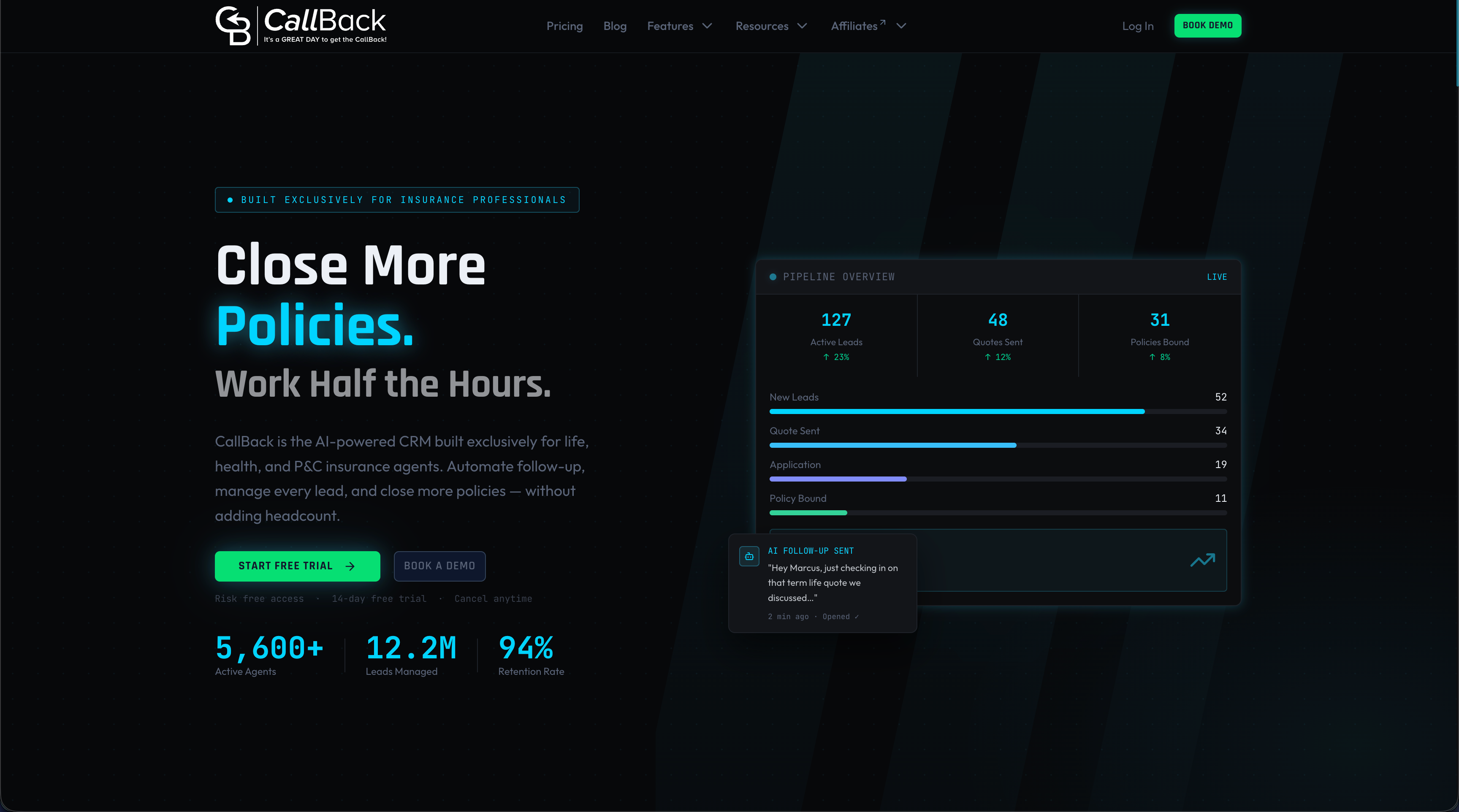
With Callbackcrm, you can build segmented lists, set up multi-step nurture sequences, and monitor deliverability metrics without switching between five different tools. The platform’s AI-powered features handle lead scoring, personalized outreach, and campaign automation so you can focus on closing policies instead of managing software. Integrated SMS marketing tools let you reinforce email campaigns with text follow-ups, which significantly improves response rates for renewal reminders and new lead outreach. Explore what Callbackcrm can do for your agency today.
FAQ
What is an email marketing checklist for agents?
An email marketing checklist for agents is a step-by-step workflow covering goal-setting, segmentation, authentication, compliance, content creation, and post-send analysis. It prevents common errors and produces consistent, measurable campaign results.
How many audience segments should insurance agents use?
Start with 4 to 5 segments aligned to your business goals, such as new leads, active clients, renewal prospects, lapsed clients, and referral sources. Over-segmentation creates automation gaps and inconsistent messaging.
What does CAN-SPAM require for insurance email campaigns?
CAN-SPAM requires every marketing email to include a physical mailing address, a working unsubscribe link, and an accurate subject line. Opt-out requests must be honored within 10 business days.
Why are open rates unreliable for measuring email performance?
Apple Mail Privacy Protection and similar features pre-load tracking pixels, which inflates open rate data. Click-through rates, reply rates, and conversion rates give a more accurate measure of actual engagement.
What is the most important technical step before sending a campaign?
Authenticating your sending domain with SPF, DKIM, and DMARC is the most critical technical step. Without proper authentication, even well-crafted emails will land in spam folders regardless of content quality.