

Email automation works best for insurance agencies when it handles three jobs: renewal reminders, new lead follow-up, and onboarding or transactional updates. Used this way, it shortens response times, keeps renewal rates steady, and frees agents from repetitive manual outreach. Below, we walk through the workflows, the implementation steps, the compliance rules, and a working example of how a dedicated platform puts all of it together.
TL;DR:
- Automated renewal sequences that begin 60 days before expiration improve response rates and help maintain steady renewal income.
- Personalization relies on key fields like policy number, coverage type, and renewal date to make sequences feel targeted and relevant.
- Compliance requires maintaining accurate consent records, honoring opt-out requests within 10 days, and following the CAN-SPAM Act and FCC rules for texts and calls.
- Successful implementation depends on integrating CRM, quoting tools, webforms, and calendars, and running thorough testing before scaling workflows.
- Using a dedicated insurance CRM with built-in automation features simplifies setup, enhances tracking, and reduces manual effort across outreach channels.
Table of Contents
- Why email automation matters for insurance agencies
- High-impact automation workflows with examples and templates
- How to implement email automation: tools, integrations, and a checklist
- Compliance and deliverability essentials for insurance email automation
- How a dedicated insurance CRM puts these automations to work
- Author Kyle’s perspective on realistic expectations and pitfalls
- Putting these workflows into CallBack CRM
- FAQ
- Sources
Why email automation matters for insurance agencies
Email remains the backbone of post-sale communication in insurance. Customers want a mix of channels, but they expect policy updates, renewal notices, and account changes to arrive by email first, with a person available when a situation gets complicated. Wavestone’s 2026 Customer Centricity Study found that customers accept automation and AI-backed outreach when it is transparent and tied to fast human escalation, not when it replaces contact entirely.
For agencies, automated email delivers a few concrete gains:
- Time saved on repetitive tasks like renewal reminders and document requests.
- Steadier retention, since reminders go out consistently instead of depending on staff bandwidth.
- More cross-sell opportunities, surfaced through triggered messages tied to policy milestones.
Not every message should be a sales pitch. A short note on a policy anniversary, a seasonal coverage tip, or a reminder about an underused benefit keeps the relationship active without asking for anything. Agencies that mix this kind of content with transactional emails tend to keep client attention longer than those that only email during renewal season.
High-impact automation workflows with examples and templates
Three workflows cover most of what an agency needs, plus a fourth for service updates.
- New lead sequence: send an email within minutes of form submission, follow with a second email at 24 hours, and a third at day 3 if there’s no response. Mix channels: email first, then a text or call prompt if the lead opens but doesn’t reply.
- Renewal reminder sequence: start at 60 days out with a plain notice, follow at 30 days with coverage options, then escalate to a phone call at 10 days if the client hasn’t confirmed.
- Onboarding sequence: a welcome email with policy documents attached, a second email walking through how to file a claim, and a third pointing to the client portal or agent contact information.
Claims and policy-change updates work differently. These should be short, factual, and routed to a live agent automatically whenever a client replies with a question or a negative sentiment word appears in the reply.
Sample lines agents can adapt:
- New lead: “Thanks for reaching out, [Name]. I’ll have a quote ready for you within one business day.”
- Renewal: “Your policy renews on [date]. Here’s what’s changing and what’s staying the same.”
- Onboarding: “Welcome aboard. Your documents are attached, and here’s how to reach us if anything looks off.”
Pro Tip: Keep the first email in any sequence under 100 words. Response rates drop sharply when the opener reads like a brochure.
How to implement email automation: tools, integrations, and a checklist
Before any sequence goes live, the plumbing has to work. Start with integration priorities:
- Connect the CRM so contact records sync both ways with the email platform.
- Link quoting or rating tools so renewal data updates automatically.
- Pull in webform submissions so new leads enter a sequence without manual entry.
- Sync the calendar so phone escalations create a task for the right agent.
Personalization depends on a small set of fields: policy number, coverage type, renewal date, assigned agent, and the next action required. These fields drive the conditional branching that makes a renewal sequence feel specific instead of generic.
Before rollout, run through a marketing automation checklist: step-by-step guide for SMBs:
- Send seed emails to test inboxes across Gmail, Outlook, and Yahoo to check placement.
- Run an A/B test on subject lines for the first send in each sequence.
- Confirm consent records are attached to every contact before the first automated send.
- Review opt-out links to make sure they actually unsubscribe the contact.
Once testing is clean, pilot one workflow, usually renewals or new-lead follow-up, measure results for a few weeks, then expand. Track open rate, click-to-quote rate, renewal conversion, and hours saved on manual follow-up. A workflow that doesn’t move at least one of these numbers needs a rewrite before it scales further.
Compliance and deliverability essentials for insurance email automation
Commercial email from an insurance agency falls under the CAN-SPAM Act, which requires accurate header information, a valid physical mailing address in every message, and a working opt-out link. Opt-out requests must be honored within 10 business days, and that clock applies even to automated sequences.
If automation extends to text messages or calls, the FCC’s one-to-one consent rule applies. It requires separate written consent for each seller before sending automated texts or calls, and it strengthens recordkeeping requirements around that consent. Agencies that layer SMS or voice reminders onto email sequences need a documented consent trail for each channel, not a single blanket opt-in.
Deliverability depends on a few standing practices:
- Set up SPF, DKIM, and DMARC on the sending domain.
- Clean the list regularly to remove bounces and inactive addresses.
- Send only to contacts who opted in, never to purchased lists.
Operationally, keep an audit log of consent for every contact and flag sensitive messages, like claims denials, for manual review before they go out.
How a dedicated insurance CRM puts these automations to work

A platform built specifically for insurance workflows typically bundles email and SMS marketing, prebuilt templates, a visual workflow builder, AI assistants for follow-up, and reporting on open and click rates, all connected to a shared CRM record. That combination cuts manual work because lead scoring and follow-up triggers run on the same data the renewal and onboarding sequences use, instead of living in separate tools.
Before signing up for any platform, verify in the demo:
- How many clicks it takes to build a renewal sequence from scratch.
- Whether consent and opt-out activity is logged automatically.
- How SMS and email usage is billed, and whether that billing is itemized.
Pro Tip: Ask the vendor to show a live consent log during the demo, not just a workflow builder screen.
Author Kyle’s perspective on realistic expectations and pitfalls
Automation speeds growth when it handles volume: lead follow-up, renewal nudges, document delivery. It hurts retention when every message feels automated and no human ever steps in. The most common mistakes we see are broken opt-out links, missing consent records, and skipping deliverability setup entirely. Pilot one workflow, measure it honestly, then scale.
— Kyle
Putting these workflows into CallBack CRM
We built our CRM platform around insurance sales workflows, with AI-powered follow-up, tailored pipelines, and automation that centralizes outreach across email, SMS, and voice instead of using separate tools. Onboarding is straightforward and pricing is clear, which matters when you’re trying to get a renewal workflow live quickly.
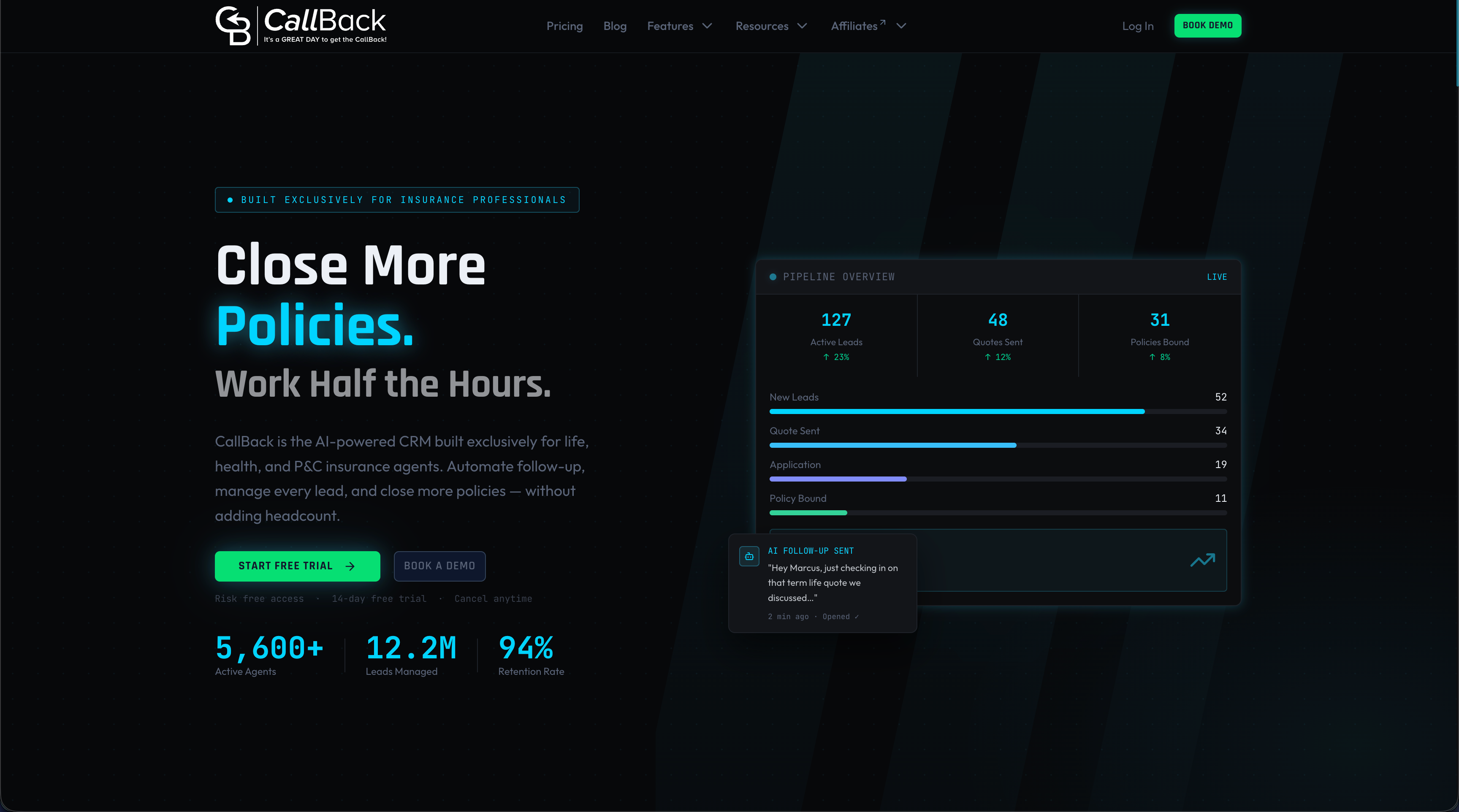
A practical first step is piloting a single renewal reminder workflow:
- Start with the Professional plan at $97 per month if you’re a small agency testing automation for the first time.
- Move to an Enterprise plan if you manage multiple agent accounts and need shared pipeline visibility.
- Check SMS and usage fees before adding text escalation to your sequences.
Run the pilot on renewals first, measure the conversion lift, then expand from there.
FAQ
Can you give me an example of email automation?
A common example is a renewal reminder sequence that sends a notice 60 days before a policy expires, a follow-up with coverage options at 30 days, and a phone escalation at 10 days if the client hasn’t responded. Another example is a new-lead sequence that emails within minutes of a form submission and follows up over the next few days.
What is the best CRM software for insurance agents?
The right choice depends on agency size and which channels you automate. CallBack CRM is built specifically for insurance sales workflows, combining CRM, email, SMS, and workflow automation in one platform, which makes it a strong option for agencies that want everything connected.
What are the top automation tools agents should consider?
Agents generally look for tools that combine CRM data with email and SMS automation, rather than standalone email senders, since renewal and lead data need to trigger messages automatically. Features like a visual workflow builder, templates, and consent logging matter more than the number of integrations a tool advertises.
What is automation in insurance?
Automation in insurance refers to using software to handle repetitive communication and data tasks, such as sending renewal reminders, routing claims updates, or scoring new leads, without manual intervention for each case. It’s typically layered on top of a CRM so that policy and contact data drive the triggers.
Does email automation help with insurance renewals?
Yes. A staged renewal sequence that starts weeks before expiration and escalates to a phone call if there’s no response keeps renewal communication consistent instead of depending on staff remembering to follow up manually.
Sources
- CAN-SPAM Act: A Compliance Guide for Business | Federal Trade Commission
- Targeting and Eliminating Unlawful Text Messages, Second Report and Order (FCC)
- Customer Centricity Study 2026 | Wavestone