

Insurance lead nurturing is the process of maintaining consistent, relevant contact with prospects who are not yet ready to buy, guiding them from initial interest to a purchase decision through timely and personalized communication. It is not the same as following up after a quote. Nurturing is a structured, ongoing effort that continues for weeks or months, matching the message to where the prospect actually stands in their decision process.
The business case is direct. Nurtured leads produce an increase in sales opportunities compared to non-nurtured leads. For insurance agents managing long enrollment cycles and complex coverage decisions, that gap is where revenue is won or lost.
Key aspects of insurance lead nurturing include:
- Delivering educational content that matches the prospect’s coverage questions and timeline
- Maintaining contact during off-season periods, not just during open enrollment
- Using CRM data to track every interaction and trigger the right follow-up at the right time
- Shifting the agent’s role from salesperson to trusted advisor
- Personalizing outreach by segment, coverage type, and relationship stage
What is insurance lead nurturing and why does it matter?
Lead nurturing is the process of cultivating prospects who are not yet ready to buy by providing relevant content and consistent communication until they reach purchase readiness. In insurance, this matters more than in most industries because the buying timeline is rarely short. A prospect who inquires about health coverage in March may not be eligible to enroll until November’s open enrollment period. Without a structured nurturing process, that lead goes cold and the opportunity disappears.
Insurance decisions are also more complex than most consumer purchases. Prospects often do not understand enrollment rules, subsidy eligibility, or the difference between plan tiers. Agents who provide clear, useful information during this confusion period build credibility that converts when the window opens. That is the core value of nurturing: it positions the agent as the expert the prospect already trusts by the time they are ready to act.
Lead nurturing is also distinct from insurance lead generation. Generation adds new contacts to the pipeline. Nurturing works the contacts already there, moving them progressively toward a decision. Both are necessary, but they serve different functions and require different tools and cadences.
How segmentation makes nurturing more effective
Segmenting insurance leads by enrollment timelines, coverage complexity, and relationship stage is the foundation of any nurturing program that produces results. Not every prospect should receive the same message on the same schedule. A prospect who missed the Special Enrollment Period needs a different sequence than one who is 60 days from a commercial policy renewal.
Practical segmentation categories for insurance agents include:
- Enrollment timeline: Open enrollment prospects, SEP-eligible prospects, and those who must wait for the next window
- Coverage type: Health, life, Medicare, commercial lines, and specialty coverage each carry different decision timelines and education needs
- Relationship stage: New inquiry, contacted but not quoted, quoted but not closed, and dormant leads who previously engaged
- Lead source: Referral leads often convert faster than cold inbound leads and warrant a different cadence
Tagging leads accurately in a CRM at the point of first contact makes every downstream communication more relevant. A prospect tagged as “missed OEP, revisit November” receives monthly educational emails through the off-season and a re-engagement call 30 days before open enrollment opens. That sequence is only possible when the segmentation is done correctly at the start.
Pro Tip: Set a task in your CRM at the moment you tag a lead as “nurture” so the next touchpoint is already scheduled. Leads tagged without a follow-up task tend to sit untouched until the opportunity has passed.

How to build an insurance lead nurturing campaign step by step
A structured campaign moves prospects through the pipeline without requiring a producer to manually track every touchpoint. The five steps below apply across health, life, Medicare, and commercial lines.
-
Identify and segment leads accurately. Pull every contact from your database and assign each one a segment based on coverage type, enrollment timeline, and current relationship stage. Leads without a segment cannot be nurtured effectively.
-
Develop content for each segment. Educational content outperforms sales pitches at every stage of the insurance buying process. A prospect in the awareness stage needs a plain-language explanation of how subsidies work. A prospect close to renewal needs a coverage comparison and a clear call to action. Match the content to the stage.
-
Set up multi-channel communication workflows. Email is the backbone of most nurturing sequences, but SMS and phone calls increase response rates at key moments. A typical sequence might include an immediate confirmation email, a follow-up call within 24 hours, and a series of educational emails spaced over several weeks. Automation workflows handle the scheduling so no touchpoint is missed.
-
Add behavioral triggers. Fixed-schedule drip sequences are a starting point, not the ceiling. When a prospect opens an email, clicks a link, or submits a form, that action signals intent. A triggered follow-up sent within minutes of that action reaches the prospect at the moment of highest engagement.
-
Measure and adjust. Track open rates, click rates, response rates, and conversion rates at each stage. Sequences that produce low engagement at a specific step need a content or timing adjustment. Iteration is what separates a campaign that improves over time from one that stagnates.
Pro Tip: Map your campaign flow on paper before building it in your CRM. A simple diagram showing the path from first inquiry to closed policy helps identify gaps in the sequence before they cost you a lead.
How automation and behavioral triggers improve lead nurturing
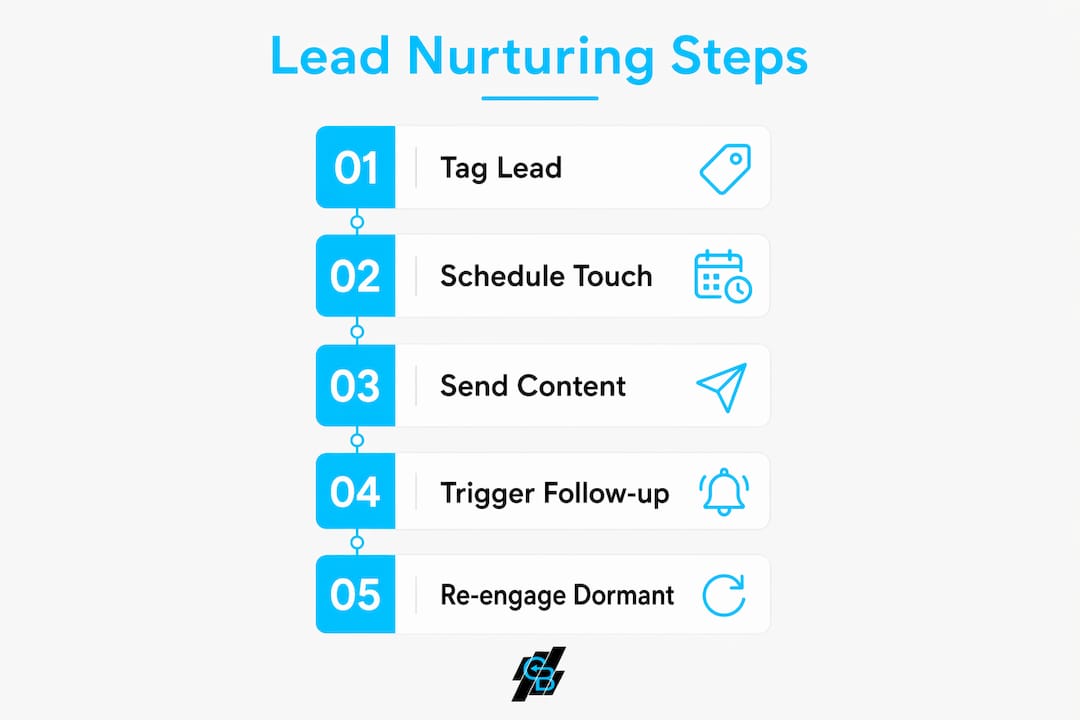
Automated nurturing workflows reduce missed opportunities and remove dependence on individual producer discipline. Insurance agencies that automate nurturing sequences maintain consistent follow-up even when producers are consumed by active service work or renewal surges.
The key distinction is between fixed-schedule drip sequences and behavioral triggers. A drip sequence sends messages on a calendar schedule regardless of what the prospect does. A behavioral trigger fires when the prospect takes a specific action, such as opening an email, clicking a link, or having their CRM status updated to “quote requested.” Behavioral triggers reach prospects at the exact moment of engagement, which is why they outperform calendar-based sequences in conversion.
Automated lead nurturing for insurance agencies is the practice of building a rule-based, multi-channel message sequence that keeps a prospect engaged, educated, and moving toward a quote, triggered by their own behavior, not by a producer remembering to call.
Benefits of automation in insurance lead nurturing:
- Sequences fire consistently regardless of producer workload or schedule
- Behavioral triggers respond to prospect actions in real time
- CRM status changes automatically advance the prospect to the next sequence stage
- Re-engagement sequences activate when a lead goes dormant for 14–30 days
- Every automated touchpoint is logged, creating a complete interaction record
Detailed CRM logging of every interaction, concern, and timeline milestone is what makes trigger-based automation possible. Without accurate CRM data, triggers have nothing to act on.
Pro Tip: Build a re-engagement sequence that fires automatically after 14 days of prospect inactivity. A short, direct message asking if the prospect’s situation has changed often restores contact with leads that would otherwise age out of the pipeline.
Best practices for running successful insurance lead nurturing campaigns
The agents who convert the most leads from nurturing programs follow a consistent set of practices. These are not complicated, but they require discipline and a system that supports them.
- Nurture year-round, not just during enrollment season. Leads nurtured with consistent educational content during the off-season show higher conversion rates when enrollment windows open. Pausing outreach between enrollment periods is one of the most common and costly mistakes agents make.
- Act as an advisor, not a salesperson. Prospects who receive useful information without constant sales pressure are more likely to return when they are ready to buy. The goal of each touchpoint is to add value, not to close.
- Log every interaction in your CRM. CRM discipline protects revenue by ensuring that no touchpoint, concern, or timeline milestone is lost when a producer changes focus or leaves the agency.
- Personalize by segment. A Medicare prospect and a small business owner shopping for group coverage need completely different content. Generic messages sent to a mixed list produce low engagement and damage the agent’s credibility.
- Track the right KPIs. Email open rates, click rates, lead-to-quote conversion ratios, and sales cycle length all indicate whether a nurturing sequence is working. Engagement rates tell you if the content is relevant. Conversion ratios tell you if the sequence is moving leads forward.
- Document consent. Prior express written consent is required before calling or texting a lead. Consent documentation must be captured, stored, and honored throughout the nurturing process. This is not optional.
Examples of successful insurance lead nurturing campaigns
Concrete campaign structures show how these principles work in practice across different insurance lines.
Health insurance: the long-cycle enrollment sequence
A prospect inquires about health coverage in March, outside the open enrollment period and without a qualifying life event. The agent tags the lead as “no SEP, revisit November” in the CRM and enrolls the contact in a monthly educational email sequence. Each email covers a different topic: how subsidies are calculated, what metal tiers mean for out-of-pocket costs, and what life events trigger a Special Enrollment Period. In October, the sequence shifts to pre-enrollment content with specific plan comparison guidance. By the time open enrollment opens in November, the prospect has received eight months of useful information from the same agent. The conversion rate on this type of long-cycle sequence is substantially higher than cold outreach at enrollment time because the relationship already exists.
Commercial lines: the renewal-cycle cadence
An agency quotes a commercial account that is locked into its current policy for eleven months. Rather than waiting, the producer logs the renewal date in the CRM and sets a structured outreach calendar. The sequence includes a value-delivery email shortly after the initial conversation, an industry-relevant insight at the six-month mark, a coverage benchmarking discussion at nine months, and a formal proposal process launched 60 days before renewal. Five meaningful interactions over a year, none of which feel like pressure, keep the agency positioned as the obvious choice when the renewal conversation begins.
Re-engagement: dormant lead recovery
A lead goes 21 days without any activity after receiving an initial quote. An automated re-engagement sequence fires, sending a short message asking if the prospect’s situation has changed and offering a direct link to schedule a call. This type of sequence, triggered by inactivity rather than a calendar date, recovers a portion of leads that would otherwise be written off. The lead nurturing strategies that produce the best results combine this kind of behavioral trigger with a clear, low-pressure call to action.
Common challenges in insurance lead nurturing and how to overcome them
Most agencies encounter the same set of problems when building nurturing programs. Recognizing them early makes them easier to fix.
Inconsistent follow-through. Producers prioritize active service work and new submissions over long-cycle prospects. The solution is automation. When sequences run automatically based on CRM triggers, follow-up happens regardless of producer workload. Agencies that rely on producer memory to manage nurturing lose opportunities consistently.
Poor segmentation at intake. Leads loaded into a CRM without accurate tags receive generic messages that do not match their situation. The fix is a defined intake process that captures coverage type, enrollment timeline, and lead source at the point of first contact. Even a basic tagging system produces better results than no segmentation at all.
Stopping outreach between enrollment periods. Agents who go quiet during the off-season lose the relationship they built during enrollment. Continuous contact through the off-season with educational content keeps the agent top of mind and significantly improves conversion when the next enrollment window opens.
Compliance gaps. Calling or texting leads without documented prior express written consent creates legal exposure. Every nurturing workflow that includes SMS or outbound calls must have a consent capture step built in before the sequence starts.
No measurement system. Agents who do not track open rates, response rates, or conversion ratios cannot identify which parts of their sequence are underperforming. Setting up basic reporting in a CRM or marketing platform takes less time than most agents expect and pays for itself quickly.
Tools and software for insurance lead nurturing
The right tools make the difference between a nurturing program that runs consistently and one that depends entirely on producer discipline.
CRM platforms are the operational core of any nurturing program. A CRM tracks lead status, logs every interaction, stores consent records, and triggers automated sequences based on field changes. For insurance agents, the CRM must support custom fields for enrollment timelines, coverage types, and policy renewal dates. Without this structure, trigger-based nurturing is not possible.
Email marketing and automation platforms handle the sequencing and delivery of nurturing content. The most effective platforms connect directly to the CRM so that lead status changes automatically update which sequence a prospect receives. Agents who manage email separately from their CRM often experience gaps where leads fall between systems.
SMS marketing tools add a high-engagement channel to the nurturing mix. Text messages reach prospects faster than email and produce higher open rates, making them effective for time-sensitive communications like enrollment deadline reminders. Consent documentation is mandatory before any SMS outreach begins.
All-in-one platforms built for insurance combine CRM, email, SMS, automation workflows, and reporting in a single system. Callbackcrm is built specifically for insurance agents and agencies, offering AI-powered lead scoring, automated nurturing workflows, SMS marketing, and CRM management in one platform. This eliminates the integration gaps that occur when agents piece together separate tools. Callbackcrm also supports lead generation workflows that connect directly to nurturing sequences, so new leads enter the pipeline already assigned to the right campaign.
The choice of tool depends on agency size and complexity. Solo agents often start with a basic CRM and a single email sequence. Larger agencies and IMOs benefit from platforms that support multi-producer pipelines, role-based access, and reporting across the full book of business.
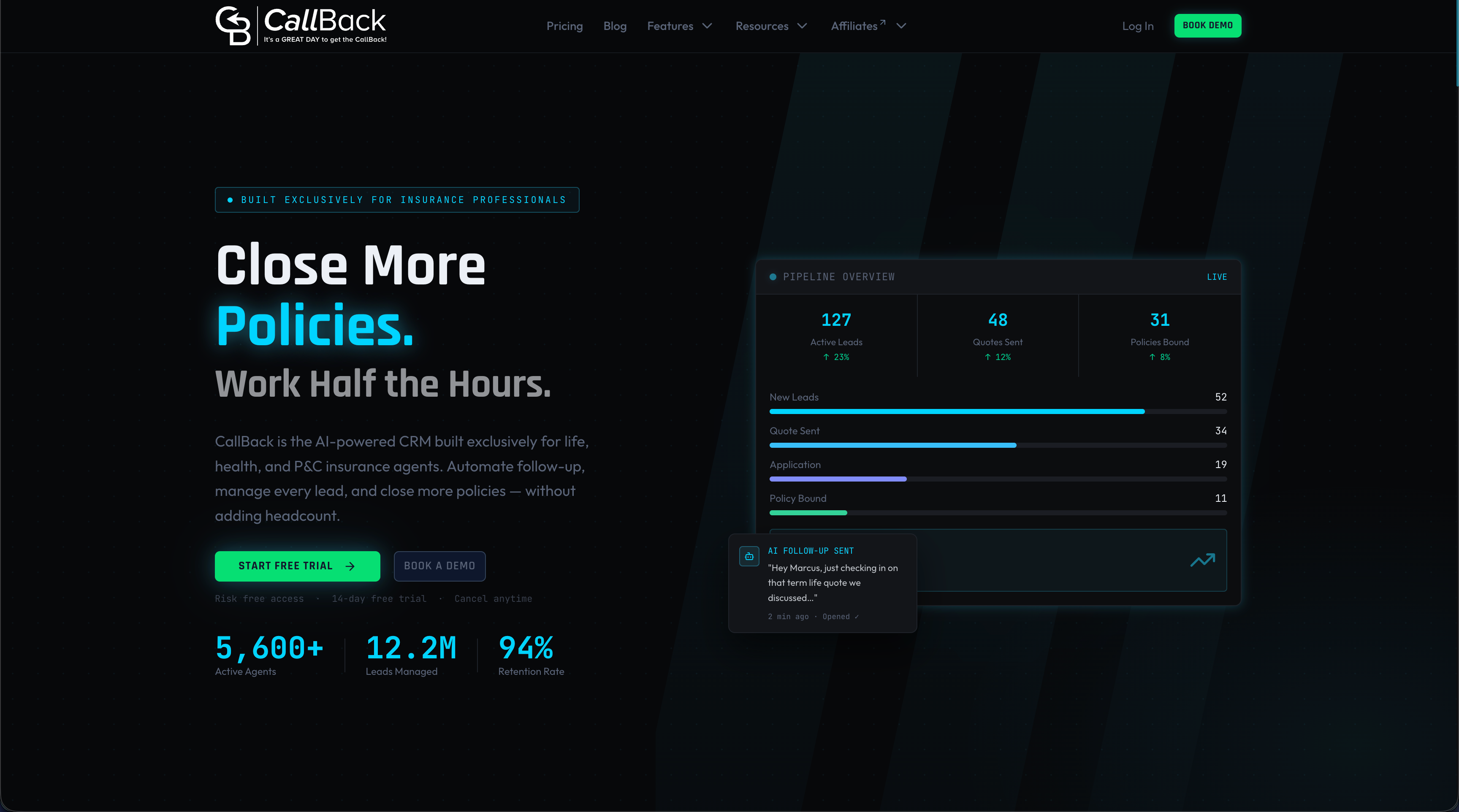
Callbackcrm gives insurance agents and agencies the automation, CRM, and multi-channel communication tools needed to run consistent nurturing campaigns without adding manual workload. From behavioral triggers to SMS outreach and AI-powered lead scoring, the platform handles the operational work so producers can focus on closing. Explore the full platform and see how it fits your agency’s workflow.
Key Takeaways
Insurance lead nurturing produces a 20% increase in sales opportunities compared to non-nurtured efforts, making it one of the highest-return activities an insurance agency can build.
| Point | Details |
|---|---|
| Nurturing vs. follow-up | Nurturing is a structured, multi-month process; follow-up is the first few days of outreach after initial contact. |
| Segmentation drives results | Tagging leads by enrollment timeline, coverage type, and relationship stage makes every message more relevant and timely. |
| Behavioral triggers outperform drip sequences | Triggers fired by prospect actions reach leads at the moment of highest intent, improving conversion over fixed-schedule emails. |
| Year-round contact is required | Stopping outreach between enrollment periods loses the relationship; consistent off-season contact significantly boosts eventual conversion. |
| CRM discipline protects revenue | Logging every interaction and policy timeline in a CRM is what makes automated, trigger-based nurturing possible at scale. |