

A compliant Medicare lead nurturing program pairs a segmented, multi-touch education sequence with CRM automation, typically running several weeks across multiple touches. Agents who run this kind of structured nurture tend to see better conversion and more efficient cost per enrollment compared to relying on one-off outreach. Two things make it work: consistent compliance controls and automated follow-up that keep leads engaged.
TL;DR:
- Automated, multi-touch Medicare lead nurturing yields higher conversions, better retention, and lower costs by building trust through repeated, compliant engagement.
- Segments based on behavior and decision stage enable personalized content, with aging-in, reviewing coverage, and switchers each requiring different messaging and pacing.
- Combining email, SMS, direct mail, and phone contacts strategically, with strict touch frequency limits, maximizes engagement without overwhelming prospects.
- A dedicated CRM with consent tracking, behavior scoring, escalation, and audit logs ensures compliance and streamlines lead management.
- Focusing on key KPIs like time-to-close and cost per enrollment, along with consistent follow-up, improves acceleration of leads to actual Medicare policy sign-ups.
Table of Contents
- Why Nurturing Outperforms One-Off Outreach
- How Do You Segment Medicare Leads by Journey Stage?
- Building Compliant Multi-Touch Sequences Across Channels
- The CRM Backbone: Automation Features and Setup Checklist
- What KPIs Actually Predict Medicare Enrollments?
- A Sample 30 to 90 Day Nurture Cadence
- Compliance Checklist: CMS and TCPA Basics
- Handling Objections During the Nurture Sequence
- Connecting Nurture Automation to Live Sales Follow-Up
- What Successful Medicare Nurture Programs Look Like in Practice
- The Advisor Mindset Behind Every Good Sequence
- Automate the Compliant Parts, Keep the Human Parts Human
- Sources
Why Nurturing Outperforms One-Off Outreach
A single phone call converts only a small portion of Medicare leads. Most prospects need to see the same agent, or the same agency, multiple times before they trust that agent with a decision this personal, rather than relying on just one contact. That repetition is the entire point of nurturing: it turns a stranger’s phone number into a relationship built on education rather than pressure.
The tradeoff is real. Chasing volume alone burns through lead lists and budget without building the kind of trust that gets a 68-year-old on Medicare to actually pick up the phone. Nurture systems that combine technology, content, and process move prospects from initial curiosity to enrollment while keeping compliance intact at every step. Aged leads, often written off as dead weight, frequently outperform fresh leads once they’re worked with a real cadence instead of a single cold call.
The payoff shows up in more places than the enrollment number:
- Higher retention, since clients who felt educated rather than sold stay longer
- More referrals, because trusted advisors get recommended to spouses and neighbors
- Lower cost per lead over time, since nurtured aged leads need less new spend
- Fewer chargebacks from confused enrollments, since informed clients pick plans that actually fit
How Do You Segment Medicare Leads by Journey Stage?
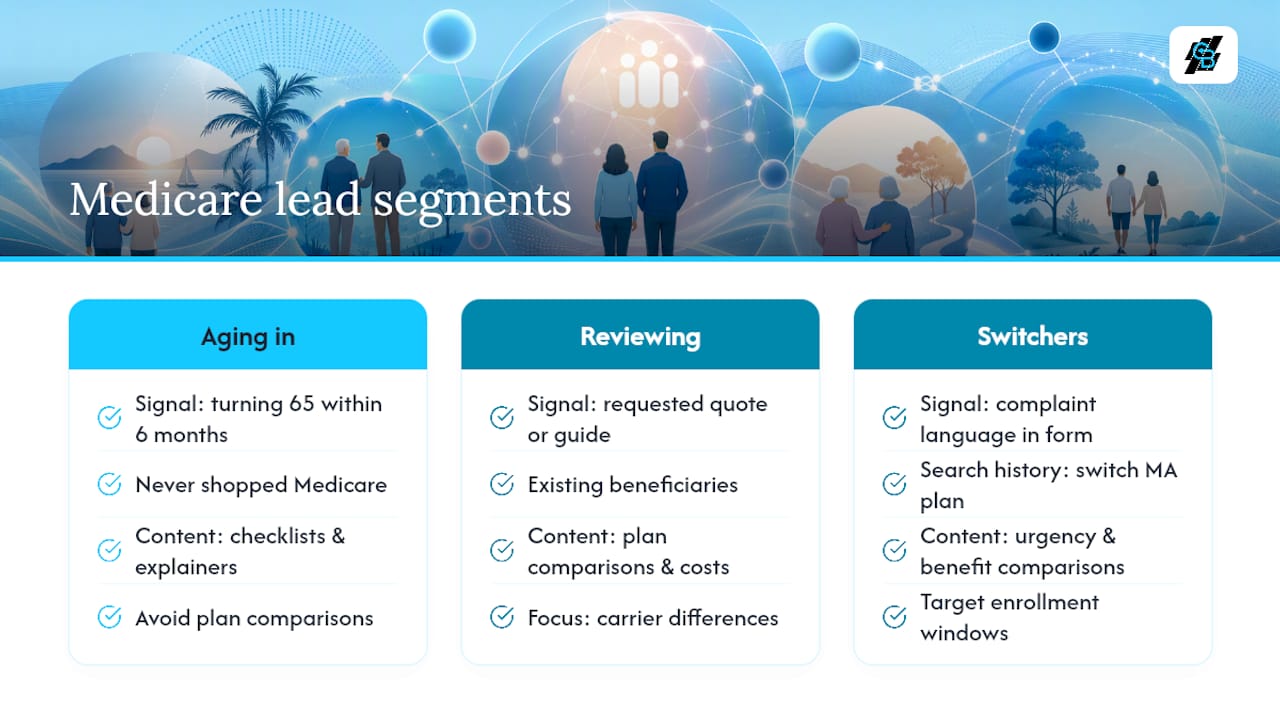
Not every lead is at the same decision point, and treating them all the same is the fastest way to waste a nurture budget. Three segments cover most of the Medicare funnel, each triggered by different signals.
Aging in. These prospects are turning 65 within the next six months. They’ve likely never shopped for Medicare and need foundational education: what Parts A, B, C, and D actually mean, and how enrollment deadlines work. Content here should be checklists and plain-language explainers, not plan comparisons. Educational formats consistently outperform hard-sell messaging with this group.
Reviewing coverage. Existing beneficiaries who requested a quote or downloaded a comparison guide during open enrollment. They already understand the basics, so content should focus on plan comparisons, cost breakdowns, and specific carrier differences.
Switchers. Leads showing frustration signals, complaint language in a form submission, or a search history around “switch Medicare Advantage plan.” These prospects respond to urgency around enrollment windows and direct benefit comparisons.
Score leads by behavior, not just demographics, including email engagement and direct contact requests to prioritize follow-up.
Building Compliant Multi-Touch Sequences Across Channels
Each channel does something different in a Medicare sales funnel, and treating them interchangeably wastes both budget and goodwill. The strongest nurture sequences layer channels so no single touch feels like a sales call.
- Email carries the bulk of the education. Segmented, mobile-optimized emails that follow CAN-SPAM and CMS compliance rules work best as short explainers, not long sales letters. A welcome email, a plan-type breakdown, and a deadline reminder cover most of the early sequence.
- SMS works for short, time-sensitive nudges: appointment confirmations, deadline reminders, or a simple “reply YES to schedule a call.” Every message needs a clear opt-out instruction.
- Direct mail still lands well with this age group, particularly for aging-in prospects who may not check email daily. Use it for a physical checklist or a personalized appointment invitation.
- Phone remains the highest-conversion channel once a lead has warmed up. Pay-per-call leads paired with CRM qualification filters convert faster because the intent signal is already strong.
- Webinars work well for reviewing-coverage and switcher segments who want plan comparisons without a one-on-one sales conversation yet.
Pro Tip: Space touches so no lead gets more than one outbound contact per day across all channels combined. Stacking an email, a text, and a call on the same day is the fastest way to generate a complaint, even when every individual message is compliant on its own.
The CRM Backbone: Automation Features and Setup Checklist
Manual follow-up cannot scale to hundreds of leads across multiple segments and channels, which is exactly why marketing automation is reshaping Medicare open enrollment season. Centralizing pre-approved content and permissions inside a single platform speeds time-to-market and keeps every touch on-message, whether it comes from a solo agent or a 40-person agency.
A Medicare nurture CRM needs specific features, not generic marketing tools:
- Consent capture fields tied directly to each lead record, timestamped for audit purposes
- A pre-approved template library so no agent improvises language that triggers a CMS violation
- Behavior-based scoring rules that move leads between segments automatically
- Escalation webhooks that route a hot lead to a live agent the moment they click pricing
- Audit logs and reporting dashboards that show exactly what was sent, when, and to whom
The basic workflow runs capture, score, nurture, route. A lead enters the CRM, gets scored on initial signals, drops into the right nurture sequence, and escalates to a human the moment behavior indicates readiness. Platforms built on HIPAA, PCI, and SOC2 compliant infrastructure reduce the regulatory exposure that comes with handling sensitive enrollment data across digital and physical channels. Agents building this from scratch can start with CRM configuration steps built for CMS compliance rather than reinventing consent tracking on their own.
What KPIs Actually Predict Medicare Enrollments?
Open rates feel good to report but rarely predict revenue on their own. Track metrics that tie directly to enrollment:
- Time-to-close, from first touch to signed application, tells you if your cadence length matches reality
- Conversion rate by segment, since aging-in and switcher leads convert at different speeds and comparing them head-to-head hides real signal
- Cost per enrollment, not cost per lead, since a cheap lead that never converts costs more than an expensive one that does
Run tests that matter: subject line variations for open rate, send-time shifts for engagement, and CTA phrasing (“Schedule a call” versus “Get your comparison”) for click-through. Channel mix tests, comparing email-first versus SMS-first sequences, often reveal more than any single-channel tweak.
Pro Tip: Give any test at least 200 leads per variant before drawing conclusions. Medicare nurture volumes are often small enough that early results look dramatic and turn out to be noise once the sample grows.
A Sample 30 to 90 Day Nurture Cadence
A concrete sequence beats a vague plan every time. Here’s a workable structure for a reviewing-coverage segment:
- Day 1, email: Welcome message. “Thanks for requesting information on Medicare plans in your area. Here’s what to expect over the next few weeks.”
- Day 3, SMS: Confirm receipt. “This is [Agency]. We sent your Medicare guide by email. Reply STOP to opt out.”
- Day 7, email: Plan-type explainer covering Original Medicare versus Medicare Advantage.
- Day 12, direct mail: Printed comparison checklist for prospects who haven’t opened email.
- Day 18, phone call: Live check-in. “I wanted to see if you had questions about the guide we sent.”
- Day 25, email: Cost breakdown specific to their state or county.
- Day 35, webinar invite: “Join our 20-minute plan comparison session this Thursday.”
- Day 50, SMS: Deadline reminder tied to the relevant enrollment period.
- Day 65, email: Case-style example of a similar client’s plan choice and reasoning.
- Day 80, phone call: Final check-in before enrollment window closes.
Escalate to a live agent promptly whenever a lead shows strong engagement signals such as clicking pricing links, replying to SMS, or requesting callbacks. Warm leads always jump the line ahead of scheduled touches.
- Aging-in leads often need the full 90-day arc since they’re learning from scratch
- Switchers can compress to 30 to 45 days since urgency is already present
Compliance Checklist: CMS and TCPA Basics
Every SMS and email touch needs a clear opt-out and documented consent, since TCPA violations carry real financial exposure that a single automated blast can trigger across thousands of contacts. Avoid pressure language like “limited time” or “final notice” tied to enrollment deadlines; state the actual deadline instead. Never imply endorsement by a government agency.
- Capture and timestamp consent at the point of lead intake, not after the fact
- Include agency name, purpose, and opt-out instructions on every SMS and voicemail
- Store pre-approved templates centrally so no individual agent improvises language
- Keep audit logs of every send for at least the CMS-required retention period
Handling Objections During the Nurture Sequence
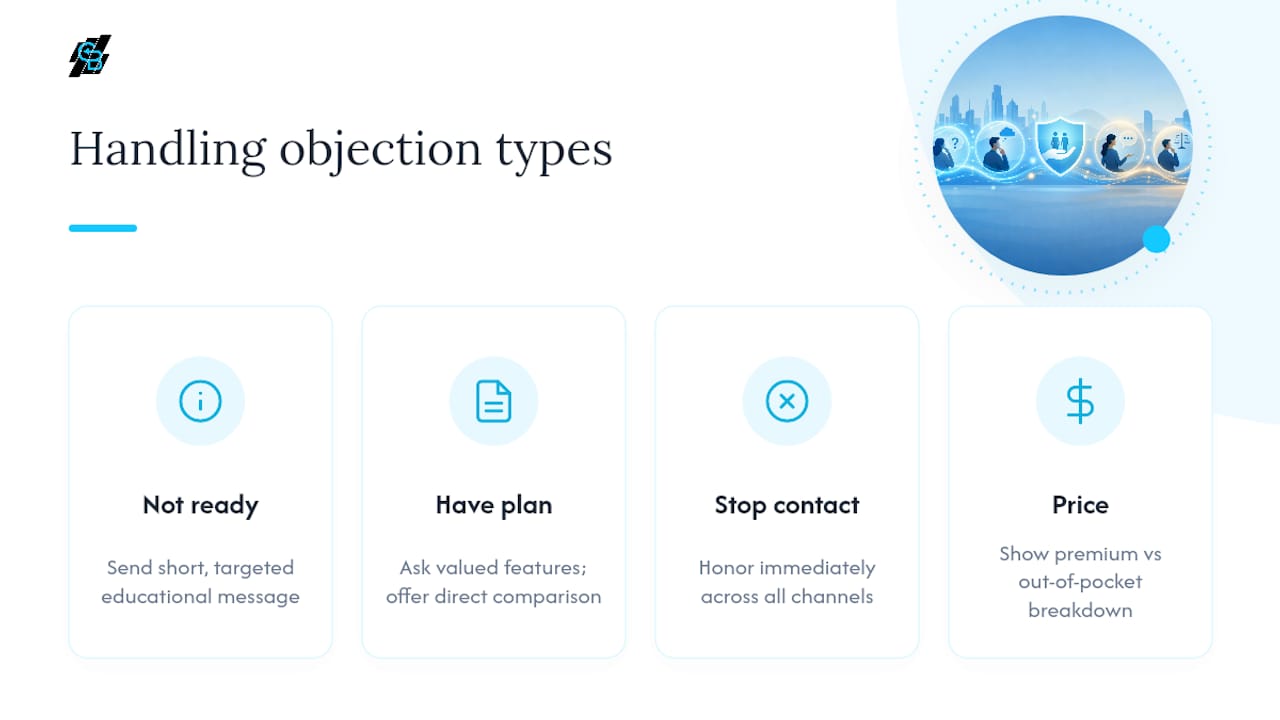
Objections during a Medicare nurture sequence rarely mean the lead has lost interest. More often, they mean the lead needs a different kind of information than what’s already been sent.
“I’m not ready to decide” usually signals confusion, not disinterest. The right response is another educational touch, not a harder pitch. Send a shorter, more specific explainer targeting whatever question triggered the hesitation, rather than repeating the same general overview.
“I already have a plan I like” from a reviewing-coverage lead deserves a direct comparison, not a dismissal. Ask what they value most about their current plan, then show where an alternative might genuinely do better on that exact point. If it doesn’t, say so. Agents who admit when a switch isn’t worth it earn the referral even when they lose the sale.
“Stop contacting me” must be honored immediately and permanently across every channel, not just the one the request came through. A CRM that doesn’t sync opt-outs across email, SMS, and phone lists creates both a compliance problem and a trust problem.
Price objections almost always mean the prospect doesn’t yet understand what they’re comparing. A side-by-side breakdown of premium versus out-of-pocket maximum usually resolves more confusion than a discount ever could, since Medicare plans rarely compete on price alone.
Connecting Nurture Automation to Live Sales Follow-Up
Automation should never operate in isolation from the humans doing the closing. The handoff point between a CRM sequence and a live agent’s phone call is where most Medicare sales funnels either work or quietly fail.
The cleanest integration uses behavior as the trigger, not a calendar date. Behavior-triggered escalation, routing a lead to a live agent the moment they click a pricing link or request a call, keeps human time focused on the leads most likely to close instead of spreading attention evenly across a list.
Sales teams need visibility into what automation already sent before they call. An agent who dials a lead without knowing that lead just received a plan comparison email looks unprepared and repeats information the prospect already has. Shared CRM records solve this by giving the live agent a full touch history before the call connects.
Set a service-level expectation for response time once a lead escalates. A hot lead who clicks pricing at 2 p.m. and doesn’t hear from a human until the next morning has often already called a competitor. Same-day, ideally same-hour, follow-up on escalated leads should be a hard rule, not an aspiration.
What Successful Medicare Nurture Programs Look Like in Practice
Agencies that build Medicare sales funnels around staged, multi-touch nurture rather than single blasts consistently report smoother open enrollment seasons. The pattern that shows up across documented Medicare lead funnel builds is straightforward: agents who map content to funnel stage and automate the repetitive parts free up their calling time for leads that are actually ready.
One recurring example involves aged leads that agencies had previously written off. Rather than discarding leads older than 30 days, agencies that route them into a full educational sequence, starting from the aging-in content track regardless of original purchase date, often see those aged leads convert at rates close to fresh leads. The difference isn’t the lead’s age. It’s whether anyone bothered to nurture it properly the first time.
Another pattern involves webinar-driven nurture for the reviewing-coverage segment. Agencies that add a mid-cadence webinar invite, positioned as a low-pressure comparison session rather than a sales pitch, report stronger engagement from prospects who had gone cold on email alone. The webinar format works because it lets prospects self-select into a deeper conversation on their own timeline, rather than forcing a phone call they weren’t ready for.
The Advisor Mindset Behind Every Good Sequence
Nurturing works because it treats Medicare decisions as genuinely confusing, not because it’s a clever marketing trick. Patience on the phone, and a willingness to say “let’s slow down” when a prospect sounds overwhelmed, builds the kind of trust that turns into referrals for years.
On calls, ask more than you tell. “What’s confusing you most about this?” gets better answers than any script. Automation should handle the repetitive education so human time goes toward listening, not reciting the same explainer a text message already covered.
— Kyle
Automate the Compliant Parts, Keep the Human Parts Human
Building the CRM backbone described above from scratch, consent tracking, scoring rules, escalation webhooks, and an audit-ready template library, takes most agencies months to piece together from separate tools. This kind of infrastructure for Medicare and senior-market agents is often assembled from multiple subscriptions, which can delay implementation.
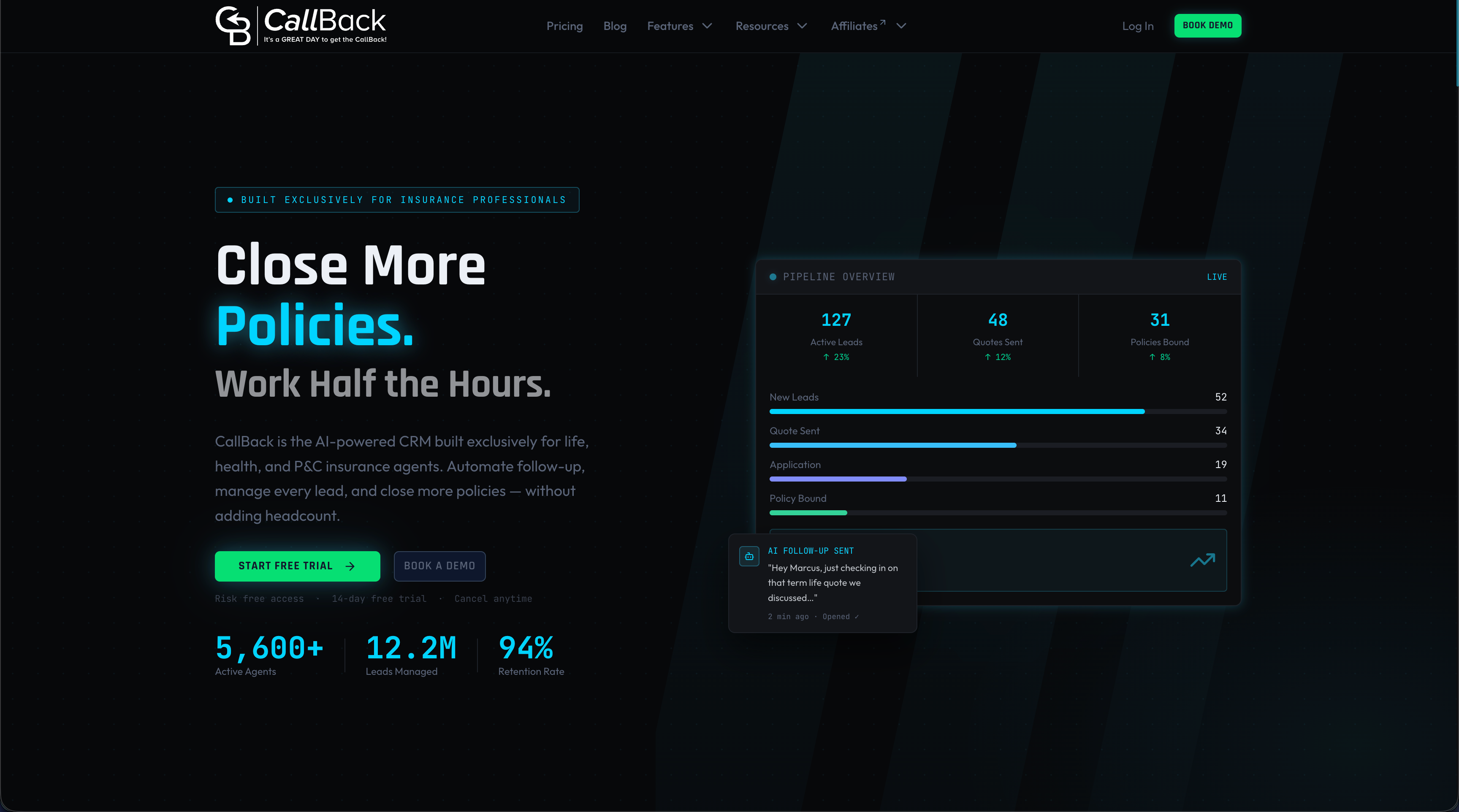
The platform automates the pieces that create the most compliance exposure when handled manually: consent capture tied to each lead record, pre-approved drip sequences across email and SMS with built-in opt-in and opt-out handling, behavior-based scoring, and reporting dashboards that keep every send auditable. Centralized template management helps prevent individual agents from improvising language during busy enrollment windows.
If the sample cadence and checklist above sound like the right playbook but more than you want to build manually, consider using a trial of a suitable platform to get started before your next enrollment surge.
Sources
- How marketing automation is transforming Medicare open enrollment season
- How to Build a Medicare Lead Nurturing System That Converts
- Medicare Leads Guide | MADLeadFlow