

Yes. U.S. agencies and agents texting customers from 10-digit local numbers must register a Brand and Campaign with the 10DLC system before sending. The first step is to inventory your message templates and decide who the Brand legal entity will be, your agency’s EIN or your carrier’s. From there, registration runs through The Campaign Registry, a Campaign Service Provider (CSP), and TCPA consent standards.
TL;DR:
- Operational consent does not authorize marketing; promotional messages and quote responses require prior express written consent, and agencies should retain records of each authorization.
- Register separate campaigns for claims and service, billing, and marketing, with sample wording that matches the Brand name customers recognize to reduce rejection risk.
- U.S. brand registration and vetting take 1 to 2 business days each; campaign review can take four weeks, and number association up to 10 days.
- Keep health details out of message bodies, use secure links and partial policy numbers when needed, and process STOP and HELP requests immediately.
- Sync STOP and suppression lists across CRM, call center, and carrier feeds before submission, then run a small batch test before full launch.
Table of Contents
- A one-page checklist to get started
- What 10DLC is and who has to register
- Brand vs. Campaign: what insurers need to submit
- Consent and TCPA considerations for insurance texting
- Packaging campaign submissions with carrier-friendly samples
- Fees, timelines, and vetting for U.S. registrations
- Step-by-step implementation for your agency
- Why insurance-specific tools cut compliance friction
- How CallBack supports 10DLC registration and compliant sending
- FAQ
- Sources
A one-page checklist to get started
Before you touch a registration form, get your internal house in order. Carriers reject more submissions for mismatched or vague documentation than for anything else.
- Inventory and classify every SMS template as operational or marketing.
- Gather Brand documents: legal name, EIN, website, compliance contact, and proof of consent collection.
- Draft carrier-friendly sample messages that include STOP language and no sensitive data in plain text.
- Choose a CSP or platform and map out the Brand to Campaign to number attach sequence.
- Sync STOP and suppression lists across your CRM, call center, and carrier feeds.
Pro Tip: Build your suppression list sync before you submit a single campaign. Carriers check for consistent opt-out handling during review, not just at launch.
What 10DLC is and who has to register
10DLC stands for “10-digit long code.” It is the carrier-sanctioned channel for application-to-person (A2P) texting from standard 10-digit U.S. phone numbers. The Campaign Registry centralizes Brand and Campaign registration for this channel, and CSPs submit that information on a sender’s behalf. TCR itself does not approve or deny campaigns; CSPs and carriers perform that review.
Any business, including a one-agent insurance practice, that sends A2P texts from a local 10-digit number falls under this requirement. Short codes and toll-free numbers follow separate provisioning rules with their own application processes, but they are not substitutes for 10DLC registration if you are texting from a standard local number.

Brand vs. Campaign: what insurers need to submit
A Brand record identifies the business sending messages. A Campaign record describes what those messages are for. Both need to be accurate and consistent with what your customers actually see.
- Brand fields: legal entity name, EIN, business address, website, a compliance point of contact, and a short business description.
- Campaign fields: a precise use case description, target recipients, expected message frequency, sample messages, proof of opt-in, and supporting URLs.
Agencies commonly register separate campaigns for claims and service messages, billing notices, and marketing, rather than lumping everything into one submission. Keeping sample messages aligned with the business name customers recognize reduces mismatches that trigger manual review or rejection.
Consent and TCPA considerations for insurance texting
Consent standards differ by message type, and insurance agencies handle both operational and promotional content, often for the same customer.
- Operational messages, like claims updates, appointment confirmations, and billing notices, rely on purpose-specific consent tied to an existing policy or service relationship.
- Marketing messages and quote follow-ups generally require prior express written consent under TCPA rules: document and retain every opt-in.
- Keep protected health information out of message bodies. Use secure links and reference only a partial policy number when needed.
- Process STOP and HELP requests immediately, and make sure suppression updates propagate across every connected system.
Pro Tip: Never reuse consent collected for an operational text, like a claims update, to justify sending that same contact a marketing message later. Our guide to building a TCPA-compliant texting audit trail walks through how to document this separation.
Packaging campaign submissions with carrier-friendly samples
Carriers and CSPs approve campaigns faster when sample messages are specific, honest about content, and free of sensitive details. A few examples that fit common insurance use cases:
- Claim status: “Your claim [claim number] has been reviewed. Reply HELP for questions or STOP to opt out.”
- Renewal reminder: “Your policy is coming up for renewal. Call us with questions. Reply STOP to unsubscribe.”
- Payment due: “A payment is due on your account by the stated due date. Reply STOP to opt out.”
- Quote follow-up: “Thanks for requesting a quote. Reply YES to schedule a call, or STOP to opt out.”
- Promotional cross-sell: “Ask us about bundling home and auto for savings. Reply STOP to unsubscribe.”
Label each sample clearly as operational or marketing, and attach matching opt-in proof for marketing campaigns. Submissions that mix promotional language into an operational template, reference health conditions, or use a business name that does not match the Brand record are common rejection triggers.
Fees, timelines, and vetting for U.S. registrations
Brand registration carries a one-time application fee, and campaigns carry recurring monthly charges that vary by volume and vetting status, according to 2talk’s 10DLC documentation.
For U.S. companies, brand registration and vetting typically complete in 1-2 business days each, campaign registration can take up to four weeks, and number association can take up to 10 days, according to AWS’s 10DLC registration documentation. Vetting is a separate one-time charge that raises your throughput eligibility, meaning you can send more messages per minute once it clears.

If your agency expects seasonal volume spikes, like open enrollment or renewal season, budget for vetting ahead of time rather than waiting until throughput limits slow your campaigns down.
Step-by-step implementation for your agency
- Inventory every SMS template, classify each by use case, and gather existing opt-in proof by following this marketing automation checklist for SMBs.
- Decide who the Brand owner is, collect EIN and legal documents, and designate a compliance contact.
- Draft campaign packages with sample messages for each use case, then submit through your CSP or platform.
- After approval, attach phone numbers, run soak tests, monitor carrier rejection codes, and confirm STOP handling works end to end.
- Schedule periodic audits, re-vet when your volume grows, and keep consent logs current.
Pro Tip: Run a soak test with a small batch of real numbers before you turn on full volume. It catches STOP-handling or formatting issues while the stakes are still low. Our sales automation checklist for insurance agents covers the broader rollout sequence these steps fit into.
Why insurance-specific tools cut compliance friction
Generic texting tools were not built with claims, billing, and marketing campaigns in mind as distinct categories. Insurance workflows group templates, consent records, and suppression lists into one system, which simplifies what gets submitted to TCR for Brand and Campaign approval.
Features like message hashing, libraries of carrier-approved wording, and centralized STOP handling reduce the odds that a submitted sample does not match what customers actually receive, a common source of rejection. Agencies still need to coordinate directly with their CSP to confirm the Brand identity filed with TCR matches what appears on every customer-facing message.
How CallBack supports 10DLC registration and compliant sending
We built our SMS tools around the way insurance agencies actually operate.
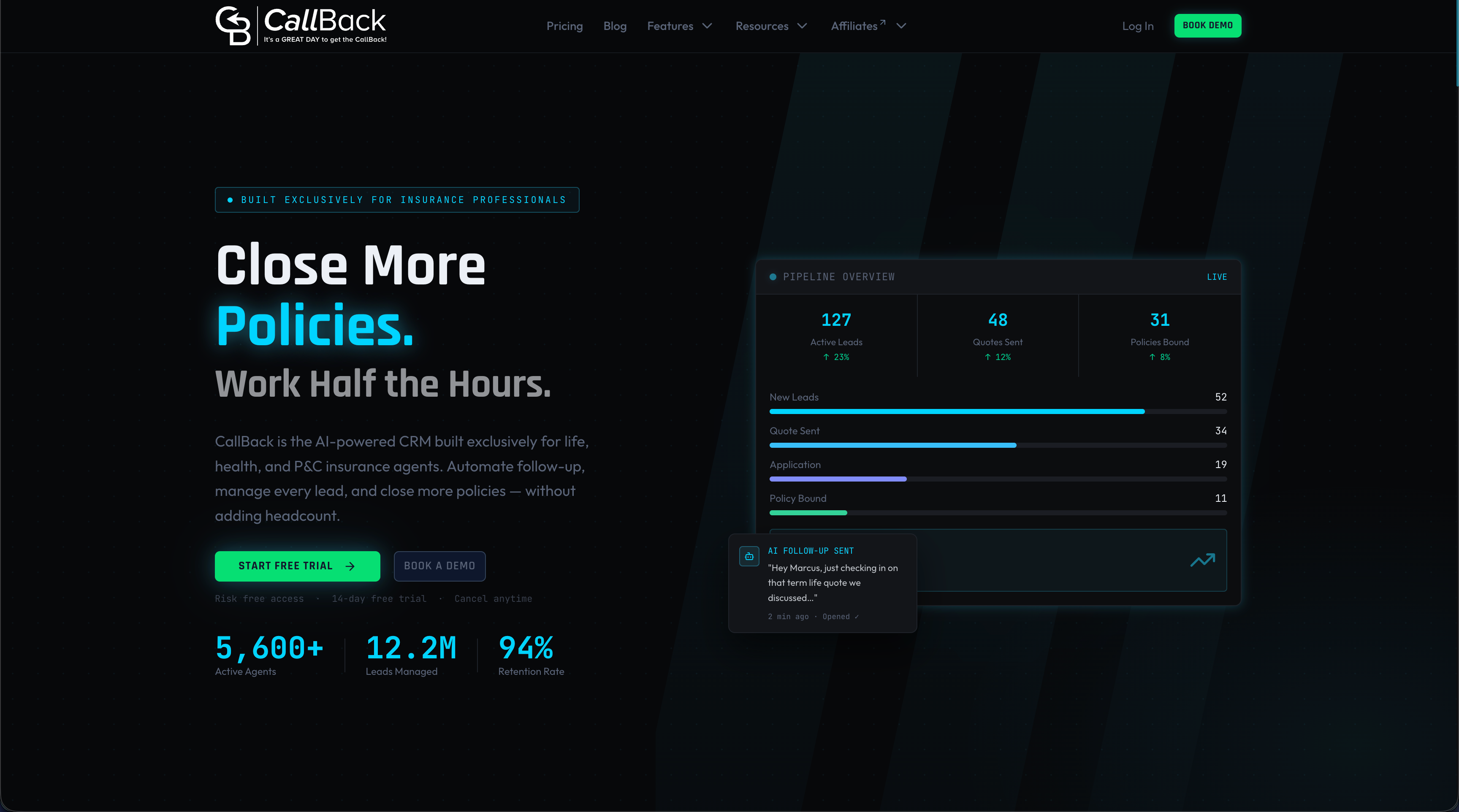
Our SMS features page outlines the texting tools included on the platform, including unique message hashing and carrier-approved verbiage support. Agencies ready to centralize registration workflows alongside their CRM can start on the Professional plan at $97 per month, or review Enterprise options for larger teams. SMS fees are billed separately and listed on our fees page.
This article is general information, not a substitute for advice from a qualified lawyer. Consult a qualified legal professional about your own circumstances before acting on anything here.
FAQ
Is 10DLC registration required?
Yes, if you send application-to-person text messages from a standard 10-digit U.S. number, carriers require Brand and Campaign registration through The Campaign Registry. Short code and toll-free numbers follow different provisioning paths but do not exempt you from registering if you are texting from a local long code.
How do I register for 10DLC?
You register through a Campaign Service Provider, which submits your Brand information (legal name, EIN, address, contact) and then your Campaign details (use case, sample messages, opt-in proof) to TCR. For U.S. companies, brand registration and vetting often clear within 1-2 business days each, while campaign review can take up to four weeks.
What are the main 10DLC rules agencies should know?
Agencies need to classify messages as operational or marketing, document consent appropriately for each type, and avoid sensitive data like health details in message text. Insurance senders should also separate claims and billing campaigns from marketing campaigns and keep STOP handling synced across every system that sends texts.
What does 10DLC approval actually confirm?
Approval means a CSP and carrier have reviewed your Brand and Campaign information and cleared you to send A2P messages at an assigned throughput level. It does not mean TCR itself evaluated the submission, since TCR centralizes the registry but CSPs and carriers perform the actual review.
Sources
- THE CAMPAIGN REGISTRY ™
- United States 10DLC registration
- 10DLC for Insurance: Claims, Renewal & Agent SMS (2026)
- SMS - 10DLC - 2talk Business Communications