

High-performing policyholder cross-sell campaigns use trigger-driven outreach prioritized by customer lifetime value and churn risk, sequence that outreach across email, SMS, direct mail, and agent touchpoints, and measure results against holdout groups rather than guesswork. The combination produces measurable retention gains and cross-sell conversion, not just more messages sent. Campaigns that skip the prioritization and testing steps tend to annoy policyholders instead of converting them.
TL;DR:
- Prioritize recent home purchases, new household drivers, claims, policy changes, and renewal windows, then route high value, high risk policyholders to agents.
- Send the top 10–15% of policyholders by propensity score to agents; space contacts three to five days apart and cap sequences at four touches.
- A controlled pilot reported a 3.3% retention increase and 47% cross sell lift; measure your own results against a random holdout group.
- Clean household identity records before expanding channels, and ensure commercial emails identify ads, provide a working opt out, and include a postal address.
- A focused MVP can launch in 4–6 weeks; start with two or three triggers, such as home purchases and claims, before expanding.
Table of Contents
- Why cross-selling policyholders builds retention, not just revenue
- Triggers and segmentation: what signals matter and how to prioritize them
- Choosing channels and creative that match the trigger
- Automation and tech stack requirements for reliable campaigns
- Compliance and data governance checklist for cross-sell messages
- Measuring cross-sell success with the right KPIs and tests
- Implementation playbook: launching and scaling an MVP campaign
- Mapping the playbook to automation platform features
- Where campaigns succeed or stall: scale, personalization, and alignment
- Putting cross-sell automation to work with CallBack CRM
- FAQ
- Sources
Why cross-selling policyholders builds retention, not just revenue
Multi-line policyholders stay longer and spend more than policyholders with a single policy. Retention analytics show that adding a line of coverage increases both retention and share of wallet, which is why cross-selling functions as a retention lever as much as a growth one, according to retention research from SAS. A household with auto and home coverage has more reasons to stay with a carrier through a price increase or a rough claims experience than a household with one policy.
This changes how cross-sell budgets should be framed. Treating cross-sell spend as a retention investment, funded alongside renewal and loyalty programs rather than competing against new-business acquisition budgets, reflects where the return actually shows up.
AI-assisted retention intelligence has shifted the work from periodic campaigns to continuous optimization:
- Retention intelligence engines score every policyholder on value and churn risk on an ongoing basis, not just at renewal.
- Always-on retention models from BCG combine CLV, churn propensity, and promotion response to decide who gets contacted and when.
- Event-driven systems built this way outperform periodic blast campaigns because they react to what a policyholder is actually doing.
Triggers and segmentation: what signals matter and how to prioritize them
Not every policyholder deserves the same outreach, and timing matters as much as targeting. A new homeowner who just closed on a house is a far better cross-sell candidate this week than a policyholder who has carried the same auto policy unchanged for six years.
The highest-value triggers worth building workflows around:
- New home purchase or mortgage event, which signals a likely need for homeowners or umbrella coverage.
- New driver added to a household, often a teenager, which opens a conversation about auto bundling or liability limits.
- A recent claim event, which creates a natural opening for a coverage review rather than a sales pitch.
- A policy change or endorsement, which often reveals gaps in other lines.
- Renewal windows, which combine urgency with a legitimate reason to reach out.
Triggers alone are not enough. Combining CLV, churn propensity, and promotion response, the same three variables used in always-on retention models, lets a team rank who gets a phone call from an agent versus an automated email. High CLV and high churn risk should route to a live agent. High CLV and low churn risk can run through automation with a lighter touch. Low CLV segments can still receive automated offers, just without agent time attached.
Pro Tip: Route the top 10 to 15% of propensity-scored policyholders to agents first; let automation handle the rest.

Choosing channels and creative that match the trigger
The channel should match the urgency and complexity of the trigger, not just whatever is easiest to automate. A claim-triggered coverage review deserves a different approach than a renewal reminder.
- Email works for scale and personalization, carrying detailed coverage comparisons or renewal summaries.
- SMS fits urgent, short nudges, such as a reminder that a quote is about to expire.
- Direct mail still carries credibility for higher-value offers like umbrella or life policies, especially with older policyholder segments.
- Agent outreach handles complex conversions where a policyholder has questions that a template cannot answer.
Hooks that perform well share a common trait: they lead with value instead of a pitch. A complimentary coverage review framed around a recent life event, an unexpected savings discovery from a rate comparison, or a targeted bundle offer tied to a specific trigger all outperform generic “add a policy” messaging, a pattern our customer outreach workflow guide walks through in more detail.
Sequencing matters as much as the message. A reasonable cadence spaces touches three to five days apart, caps total touches per trigger at three or four, and stops the sequence the moment a policyholder responds or opts out, so no one receives an email and a text about the same offer on the same day.
Automation and tech stack requirements for reliable campaigns
Running cross-sell at scale requires a specific set of connected pieces, not just an email tool bolted onto a spreadsheet.
- A unified customer data layer that merges policy, claims, and contact data into one profile per household.
- An event or trigger layer that listens for the signals described above and fires in near real time.
- A propensity or next-best-action model that scores and ranks opportunities, similar to the retention intelligence engines described by BCG.
- An orchestration engine that sequences channels and respects contact frequency limits.
- Channel connectors for email, SMS, direct mail vendors, and agent notification systems.
Integration typically runs through policy system webhooks for real-time events, claims feeds for claim-triggered workflows, CRM syncs to keep agent records current, and API connectors for email, SMS, and print vendors. Workflow examples that map these pieces together are covered in our CRM workflow breakdown.
The most common failure points are not creative or offer related. Data latency between the policy system and the trigger layer means offers arrive too late to matter. Identity resolution errors create duplicate or mismatched household profiles, leading to the same policyholder getting two different offers. Poor attribution makes it impossible to tell which channel or message actually drove a conversion.
Pro Tip: Fix identity resolution before adding more channels. A clean household record matters more than a sixth touchpoint.
Compliance and data governance checklist for cross-sell messages
Compliance is not optional overhead. It is a condition of running any commercial email campaign in the United States.
- Every commercial message needs clear identification that it is an advertisement, a working opt-out mechanism, and a valid postal address, as required under the CAN-SPAM Act.
- Headers and subject lines must be truthful; disguising a cross-sell email as a service notice violates the law.
- Both the sender and the initiator of a message can be held responsible for compliance, which matters when working with co-marketing partners or third-party vendors.
- Keep consent records, suppression lists, and audit trails current, since these are what demonstrate compliance if a complaint arises.
Measuring cross-sell success with the right KPIs and tests
The KPIs that matter for cross-sell campaigns go beyond open rates and clicks. Track policies per household, cross-sell conversion rate, incremental revenue per campaign, retention lift among contacted policyholders, and CLV uplift over time.
A pilot program analyzed in a LexisNexis Risk Solutions case study produced a 3.3% retention increase and a 47% cross-sell lift versus a control group using targeted, event-driven multi-touch outreach. That gap between treatment and control is the number that justifies continued investment, not the raw conversion rate on its own.
To get a trustworthy version of that number, build experiments the right way:
- Hold out a random control group from every major campaign so lift can be measured against policyholders who received no outreach.
- Run A/B tests on offer and sequencing, not just subject lines, since the order of channels affects response as much as the message itself.
- Use sequential testing when comparing channel order, since the first touch in a sequence often gets credited with conversions it did not cause.
Report results on a consistent cadence, monthly at minimum, and attribute conversions to the full sequence rather than the last touch alone to avoid double-counting the same conversion across channels. Partner research on marketing analytics and ROI reinforces the same point: campaigns measured against a clear baseline consistently outperform those judged on raw output alone.
Implementation playbook: launching and scaling an MVP campaign
Turning this into a working campaign does not require a full platform rebuild. A focused MVP can launch in a matter of weeks with the right sequence of steps.
- Define KPIs and success thresholds before building anything, so the team agrees in advance what counts as a win.
- Ingest and clean policy, claims, and contact data into a single household record.
- Build two or three high-value triggers first, such as new home purchase and claim events, rather than trying to cover every signal at once.
- Design the journey for each trigger, including channel order, timing, and stop conditions.
- Automate the workflow and QA it against test records before it touches real policyholders.
- Launch with a holdout group built in from day one.
- Review results and iterate, expanding to additional triggers once the first ones are stable.
Guardrails matter as much as the steps themselves:
- Cap total touches per policyholder per month across all active campaigns.
- Route high-value or complicated cases to an agent rather than letting automation handle them alone.
- Avoid discount-led offers as the default hook, since discount-first tactics tend to erode margin over time, a pattern LatentView’s retention research warns against directly.
A realistic MVP timeline runs four to six weeks with a small team: one person owning data and triggers, one owning creative and compliance, and one owning measurement. Our cross-sell automation playbook walks through this build sequence in more operational detail.
Mapping the playbook to automation platform features
Each step above maps to a specific set of tools rather than a custom build. CRM records serve as the unified household data layer. Workflow automation handles the trigger and orchestration logic. AI assistants support lead scoring and next-best-action recommendations. Email and SMS tools execute the sequenced outreach, and reporting dashboards track the KPIs that matter.
- Policy-triggered email sequences that fire automatically when a claim or renewal event occurs.
- Agent notification workflows that alert a live agent the moment a high-value policyholder is ready for outreach.
- Multi-touch cadences that combine email, SMS, and agent tasks into one sequence instead of three disconnected tools.
Agencies that consolidate these pieces into one connected system, rather than stitching together separate email, SMS, and CRM tools, typically reach a working MVP faster because the data and triggers do not require manual syncing between platforms.
Where campaigns succeed or stall: scale, personalization, and alignment
Rule-based triggers work well for straightforward events like renewal dates. AI decisioning earns its cost when the number of variables grows, such as ranking hundreds of policyholders by CLV and churn risk simultaneously. Starting with simple rules and adding scoring models once volume justifies them avoids overbuilding early.
Discount-first offers are the easiest cross-sell tactic to launch and the fastest one to erode margin. Leading with a coverage review or an advisory conversation protects pricing power in a way a percentage-off offer never does.
The campaigns that hold up over time are not the ones with the cleverest offer. They are the ones with clear ownership, aligned incentives between marketing and agents, and a testing habit that never stops.
— Kyle
Putting cross-sell automation to work with CallBack CRM
We built CallBack CRM around the exact workflow described above: unified policyholder records, trigger-based automation, and multi-channel outreach in one connected system instead of several disconnected tools. Our CRM, workflow automation, AI assistants, and email and SMS tools handle the trigger detection, sequencing, and agent routing that a cross-sell program depends on, with reporting built in to track the KPIs that matter.
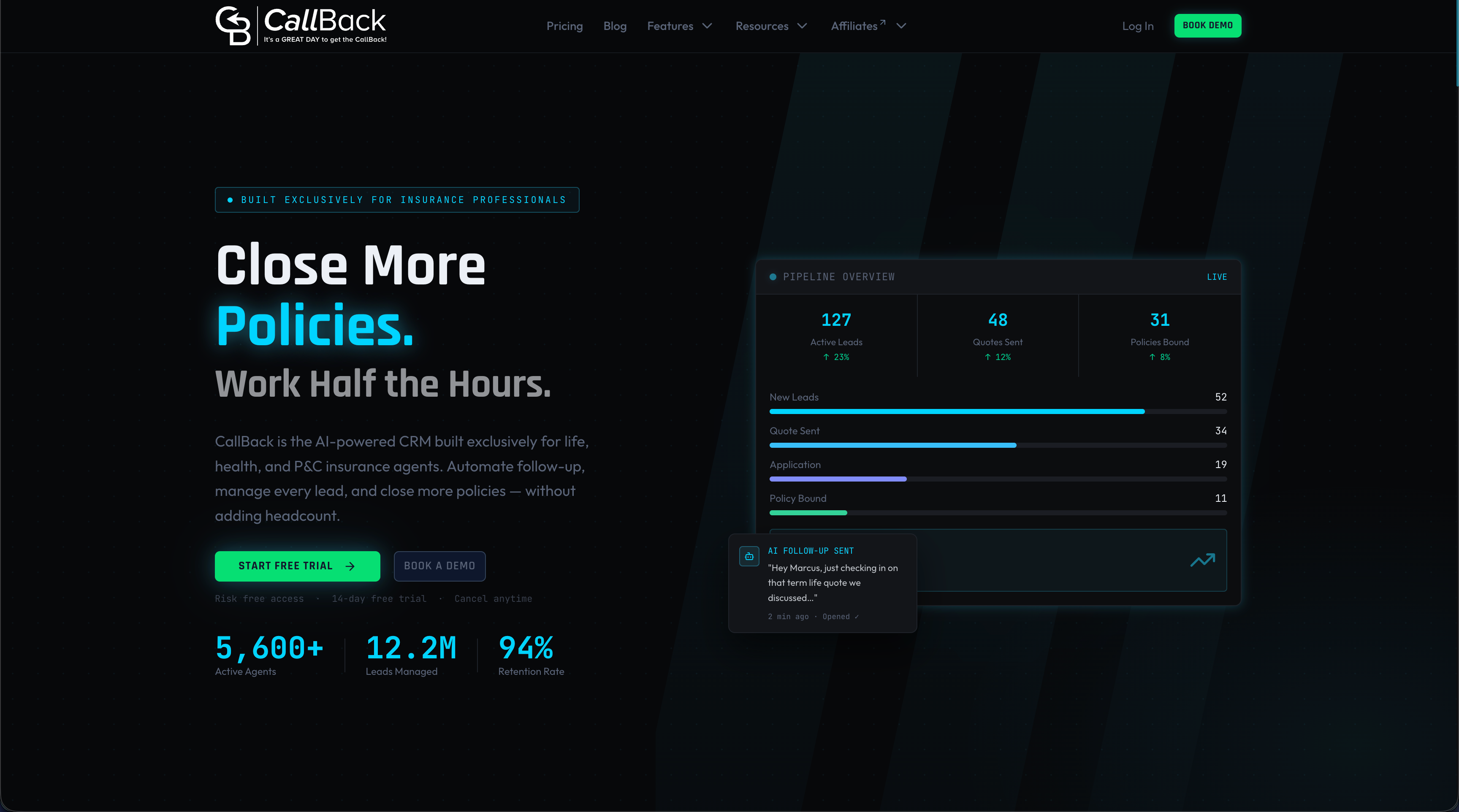
For agents and smaller agencies getting started, our Professional plan runs $97 per month. Agencies and IMOs managing larger teams can review our Enterprise plans, which scale from 10 to 60 full CRM accounts. Additional usage, including phone numbers, messaging, and AI features, is billed separately and detailed on our fees page. Our email automation tools are ready to connect to the triggers and journeys covered in this guide, and support is available if your team needs help mapping an existing workflow into the platform.
FAQ
What are good examples of cross-selling in insurance?
Common examples include offering homeowners coverage to an existing auto policyholder after a home purchase, suggesting umbrella coverage after a life event like a new teen driver, and recommending a bundled policy review after a claim. Each works best when tied to a specific trigger rather than sent as a generic offer.
What does cross-selling mean in insurance?
Cross-selling in insurance means offering an existing policyholder an additional line of coverage they do not currently hold, such as adding home coverage to an auto policy. It differs from upselling, which increases coverage within an existing policy rather than adding a new one.
What are the 7 P’s of the insurance marketing mix?
The marketing mix framework commonly applied to insurance includes product, price, place, promotion, people, process, and physical evidence, though exact definitions vary by source. In practice, cross-sell campaigns touch most of these at once, from the product being offered to the process that triggers outreach.
What does cross-selling mean in marketing?
In marketing broadly, cross-selling means offering a customer a related product alongside one they already own or are buying, based on what their existing purchase suggests they might need. In insurance, that typically means using policy, claims, or life-event data to decide which additional coverage to recommend.
How do you measure whether a cross-sell campaign is working?
Track policies per household, cross-sell conversion rate, and retention lift among contacted policyholders compared to a random holdout group that received no outreach. A pilot documented in a LexisNexis Risk Solutions case study showed a 3.3% retention increase and a 47% cross-sell lift using this kind of controlled measurement.
Sources
- Always-On Retention: How AI Is Rewiring Insurance | BCG
- Insurance customer retention in the AI age | SAS
- CAN-SPAM Act: A Compliance Guide for Business | Federal Trade Commission
- Casestudies
- Insurance Customer Retention: A Carrier’s Guide | LatentView