

A high-converting health insurance landing page is a focused conversion system built for one customer journey, not a general brochure. It matches a single ad message to a single offer, uses a short qualified form, and shows visible compliance signals such as Google Ads healthcare certification and CMS Marketplace guidance. Agents can build this in a template tool or wire it through a platform like CallBack CRM. The checklist: one offer, ad-to-page match, short form, compliance signals, mobile-first layout.
TL;DR:
- Matching each product and audience with a dedicated landing page that reflects the ad message significantly improves conversion rates.
- Building a single headline and call to action above the fold, combined with trust signals like logos and proof points below the hero, keeps visitor focus.
- Using short, mobile-optimized forms with a clear outcome description and immediate acknowledgment reduces drop-off and encourages submissions.
- Ensuring ad and landing page claims align, displaying enrollment dates, and including trusted credentials prevent policy violations and disapprovals.
- Rapid follow-up workflows that route leads instantly for callbacks or messaging within minutes are crucial for turning submissions into signed policies.
Table of Contents
- Design patterns and templates worth copying
- Pairing ad campaigns with the right landing page
- Forms, CTAs, and mobile interactions that reduce drop-off
- Compliance and ad policy essentials to get right
- Measurement and testing: what to track and how
- Turning landing page leads into bound policies faster
- What agents get wrong first, and a week to fix it
- Getting your landing pages built and connected
- Where to check policy pages and templates
- Sources
- FAQ
Design patterns and templates worth copying
The top of the page carries the most weight. A concise headline, one supporting benefit line, a single primary call to action, and a supporting visual are enough. Extra navigation links or multiple offers on the same page pull attention away from the one action you want.

Below the fold, a trust strip does the work of reassurance: a row of carrier or partner logos, one or two short testimonials, and a proof bullet such as average response time. Segmented pages shift by audience. A Medicare page leans on plan comparison language and enrollment period dates. An ACA page needs subsidy and eligibility framing. An employer-sponsored page speaks to HR buyers instead of individual shoppers.
These landing page patterns apply across product lines with small copy changes.
- Use a single headline and one CTA above the fold, no competing offers.
- Place a trust strip with logos or short proof points directly below the hero.
- Build one template variant per product line (Medicare, ACA, employer) rather than one generic page.
- Pull hero graphics from editable template libraries when a custom design isn’t in budget.
Custom builds make sense once a template proves itself in testing. Before that, an off-the-shelf asset saves time without hurting conversion.
Pairing ad campaigns with the right landing page
One page per product and audience combination outperforms a shared page because the message stays consistent from click to conversion. A Medicare Advantage search ad that lands on a general “health insurance” page loses the visitor’s attention in the first few seconds.
- Build a dedicated page for each product-audience pair: Medicare, ACA, employer group, and so on.
- Match the ad headline word for word, or close to it, on the landing page headline.
- Choose channels by intent: search ads for people actively comparing plans, Meta audience targeting for awareness, local SEO for service-area visibility, and remarketing for visitors who didn’t convert the first time.
- Use progressive profiling so the first form only asks for contact details, with eligibility questions appearing after the initial submission.
This lead generation approach keeps the top-of-funnel form short while still collecting the data an agent needs to qualify a lead later in the conversation.
Forms, CTAs, and mobile interactions that reduce drop-off
Form order matters. Ask for name, phone, and email first. Save eligibility questions like age, ZIP code, or current coverage status for a second step or a conditional field that only appears when relevant.
CTA copy should describe the outcome, not the mechanism: “Get my quote” or “Check my eligibility” perform better than “Submit” or “Learn more.” Keep one primary CTA per page, with short microcopy underneath explaining what happens next, such as “An agent will call within minutes.”
- Use single-column form layouts on mobile, never side-by-side fields.
- Keep buttons and inputs large enough for thumb taps, with generous spacing.
- Avoid full-screen modal forms that block the page content.
- Place TCPA consent language directly under the submit button in plain text, not buried in a footer link.
Clear, well-placed CTA design choices reduce hesitation at the exact moment a visitor decides whether to submit.
Pro Tip: Test one form field change at a time. Removing two fields at once makes it hard to tell which change moved the needle.
Compliance and ad policy essentials to get right
Any advertiser running health insurance ads must hold Google’s G2RS certification, and advertisers promoting ACA-compliant plans need an additional ACA certificate. Government advertisers are exempt from G2RS but still go through Google’s approval process. Separately, Google’s healthcare and medicines policy covers location eligibility and product scope, including Medicare Advantage, Medigap, and Medicaid.
A landing page must match the claims made in its ad. A mismatch between ad copy and page content is a common cause of policy enforcement action.
For Marketplace and ACA pages, CMS guidance recommends displaying enrollment period dates and linking to official navigator assistance programs as trust signals. A practical checklist: match every claim on the page to the ad that sent the visitor, show contact details and any relevant credentials, and include explicit consent language wherever it’s legally required. When a disapproval happens, the fastest fix is usually editing the page copy to match the ad exactly, rather than appealing the decision first.
Measurement and testing: what to track and how
Track conversion rate, qualified lead rate, cost per qualified lead, and time-to-bind when that data is available. Set up a UTM taxonomy before launch, add hidden form fields for source and campaign, configure GA4 events for form starts and completions, and tag each lead in the CRM by source.
- Test headline wording first: it has the largest effect on above-the-fold conversion.
- Test CTA phrasing second, comparing two or three verb-led options.
- Test form length third, comparing a two-field form against a four-field version.
- Test social proof placement last, moving the trust strip above or below the fold.
Route high-scoring leads to immediate automated outreach, and reserve manual contact for leads that need more context, such as employer-sponsored inquiries with multiple decision-makers.
Turning landing page leads into bound policies faster
A landing page is only half the system. What happens in the first few minutes after a form submission often decides whether a lead becomes a client. A typical workflow: an instant SMS or email acknowledgment fires, the lead gets scored, it routes to the right agent, and a callback attempt happens promptly after submission, ideally within minutes.
- Map landing page fields directly to CRM fields, including product type and campaign source as tags.
- Use funnels and reporting to track qualified-leads-to-bind rate over time, not just raw form fills.
- Keep hosted forms and data handling secure, with consent captured at the point of submission.
- Route ACA and Medicare leads differently, since each has its own compliance language and follow-up cadence.
This kind of workflow wiring turns a form submission into a scheduled conversation instead of a lead sitting untouched in an inbox.
What agents get wrong first, and a week to fix it
The biggest mistake is running one page for every product. Fix that first, then A/B test the headline and CTA together, then add TCPA and privacy microcopy that’s currently missing or buried. A 7-day plan: days 1 to 2 for page design and copy, days 3 to 4 for form and tracking setup, days 5 to 6 for compliance review, day 7 for launching the automation and watching the first batch of leads move through it. Measure weekly, adjust, and keep a record of what changed each time.
— Kyle
Getting your landing pages built and connected
Building a compliant, well-tested landing page is one project. Connecting it to a follow-up system that responds in minutes is another, and that second part is where most agencies fall behind. CallBack CRM combines a funnel and website builder with form-to-CRM wiring, SMS and email automation, lead routing, and reporting, all built around insurance sales workflows rather than generic sales pipelines.
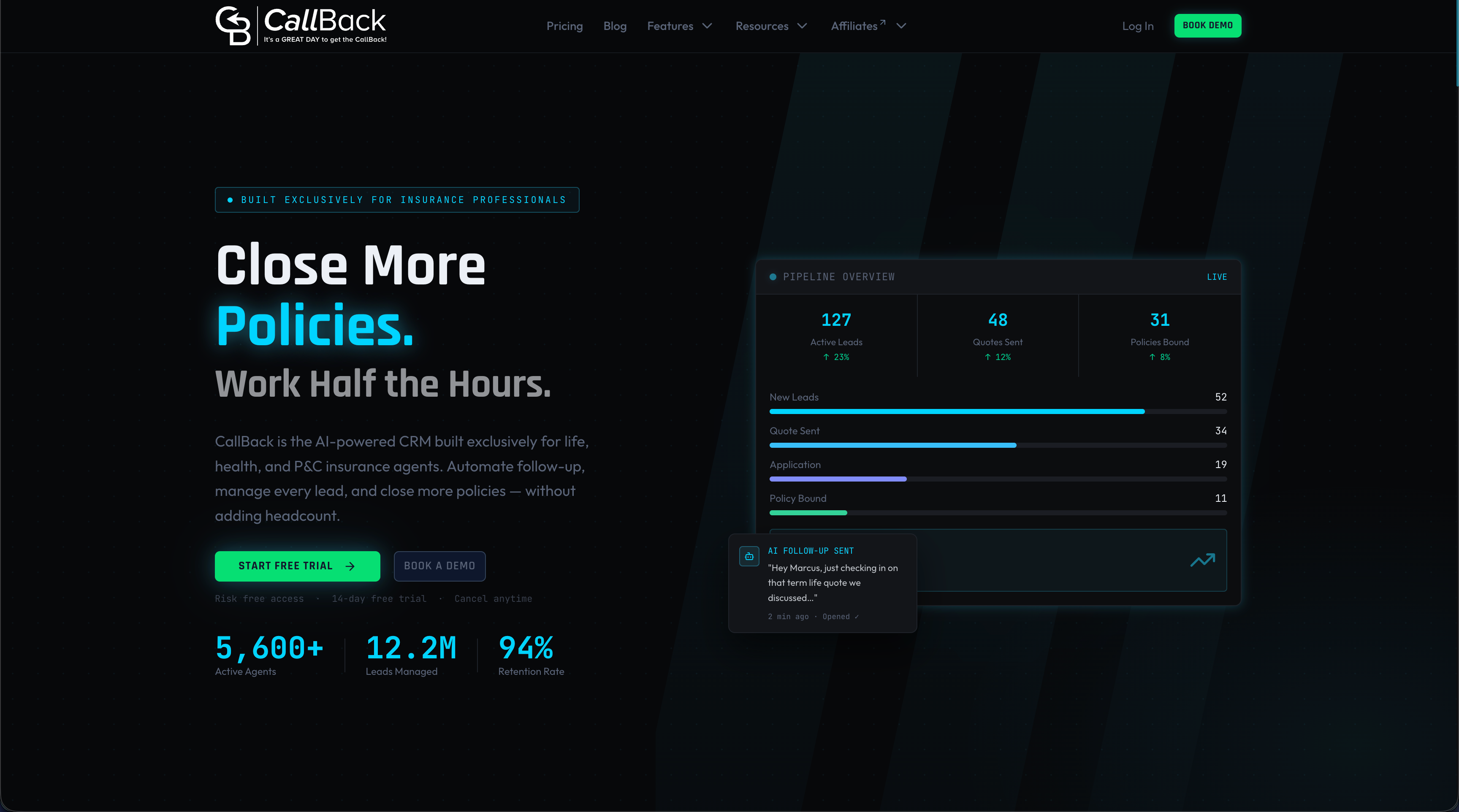
- Pick a landing page template inside the funnel and website builder and adjust it for your product line.
- Connect the form to a lead-scoring workflow so new submissions route to the right agent automatically.
- Turn on instant SMS acknowledgment through SMS automation so leads hear back within minutes, not hours.
A Professional plan is available, with Enterprise options for agencies running multiple accounts.
Where to check policy pages and templates
- Google’s health insurance advertising policy covers G2RS and ACA certification requirements.
- CMS’s Open Enrollment fact sheet lists enrollment dates and navigator resources.
- Template marketplaces such as Vecteezy and design boards on Pinterest offer editable layouts and inspiration.
Sources
- Health insurance - Advertising Policies Help
- Marketplace 2025 Open Enrollment Fact Sheet | CMS
- Health insurance landing page template Insurance concept …
FAQ
What makes a health insurance landing page convert well?
A page converts well when it targets one product and audience, matches its ad’s message exactly, and uses a short form with a single clear call to action. Visible compliance signals, like CMS-recommended enrollment dates or navigator links, also build the trust needed to complete a form.
Do I need special certification to run health insurance ads?
Yes. Advertisers must hold Google’s G2RS certification to run health insurance ads, and an additional ACA certificate is required for ACA-related keywords. Government advertisers are exempt from G2RS but still complete Google’s standard approval process.
How short should a health insurance lead form be?
Keep the first form to two or three fields, typically name, phone, and email, and collect eligibility details afterward through conditional fields or a follow-up step. This progressive approach keeps completion rates high while still gathering the information an agent needs to qualify the lead.
How quickly should a lead be contacted after submitting a form?
Fast follow-up matters. A common workflow sends an instant SMS or email acknowledgment, scores the lead, and routes it to an agent for a callback attempt within a few minutes of submission.
What does CallBack CRM cost for building insurance landing pages?
The Professional plan and Enterprise plans with multiple full CRM accounts are offered; current prices are on the pricing page. Additional usage fees apply for phone numbers, SMS, and AI features, listed on the pricing and fees page.