

TL;DR:
- Effective insurance lead generation combines paid leads, referrals, and content marketing for strong long-term results.
- Agents should contact new leads within five minutes to maximize connection and conversion rates, with technology supporting rapid outreach.
Insurance lead generation is defined as the process of identifying and attracting prospective clients who have a demonstrated need for coverage. Insurance lead CPC ranges from $5 to $55 depending on the line of business, which means your cost structure varies dramatically before a single conversation happens. Agents who grow consistently do not rely on one channel. They build a tiered system that combines purchased leads for immediate pipeline, referral networks for high-conversion volume, and content marketing for long-term organic growth. This guide breaks down exactly how to execute that system, from day one through month twelve and beyond.
How to generate insurance leads across the most effective channels
The most productive insurance lead generation strategies separate channels by cost, quality, and timing. No single source works for every agency at every stage, so knowing what each channel delivers is the starting point.

Purchased exclusive leads and live transfers give you the fastest pipeline. Exclusive leads go to one agent only, which removes the race-to-call problem that kills conversion on shared leads. Live transfers deliver close rates of 15–30%, the highest of any channel. That performance comes at a price, but for agents who need revenue now, the math often works.
Referral networks are the most underrated channel in the industry. Referral leads close at 30–50% and cost almost nothing to acquire. The catch is scalability. You cannot build a referral network in 30 days. It requires consistent relationship-building with mortgage brokers, real estate agents, CPAs, and estate planning attorneys who serve the same clients you do.
Content marketing and SEO take the longest to produce results but deliver the lowest cost per acquisition over time. Content-driven inbound marketing reduces customer acquisition costs by 34%, according to McKinsey analysis. Following a solid SEO best practices checklist helps agents rank for local and product-specific searches that signal buying intent.
Community engagement fills the gap between paid and organic. Sponsoring local events, joining chamber of commerce groups, and hosting free financial literacy workshops all generate warm introductions that convert far better than cold outreach.
| Channel | Cost | Lead quality | Scalability | Time to results |
|---|---|---|---|---|
| Exclusive purchased leads | Medium to high | High | High | Immediate |
| Live transfers | High | Very high | Medium | Immediate |
| Referrals | Near zero | Very high | Low | 3–6 months |
| Content marketing / SEO | Low ongoing | High | Very high | 6–12+ months |
| Community engagement | Low | Medium to high | Low to medium | 1–3 months |
- Match your channel mix to your current revenue stage. New agents need immediate pipeline, so start with purchased leads and live transfers.
- Build referral relationships in parallel, even when you are focused on paid leads.
- Invest in content only after you have a stable monthly revenue base.
Pro Tip: Request a sample batch from any lead vendor before committing to volume. Evaluate contact rate and close rate over at least 50 leads before scaling spend.
How should you set up your CRM and sales technology for lead management?
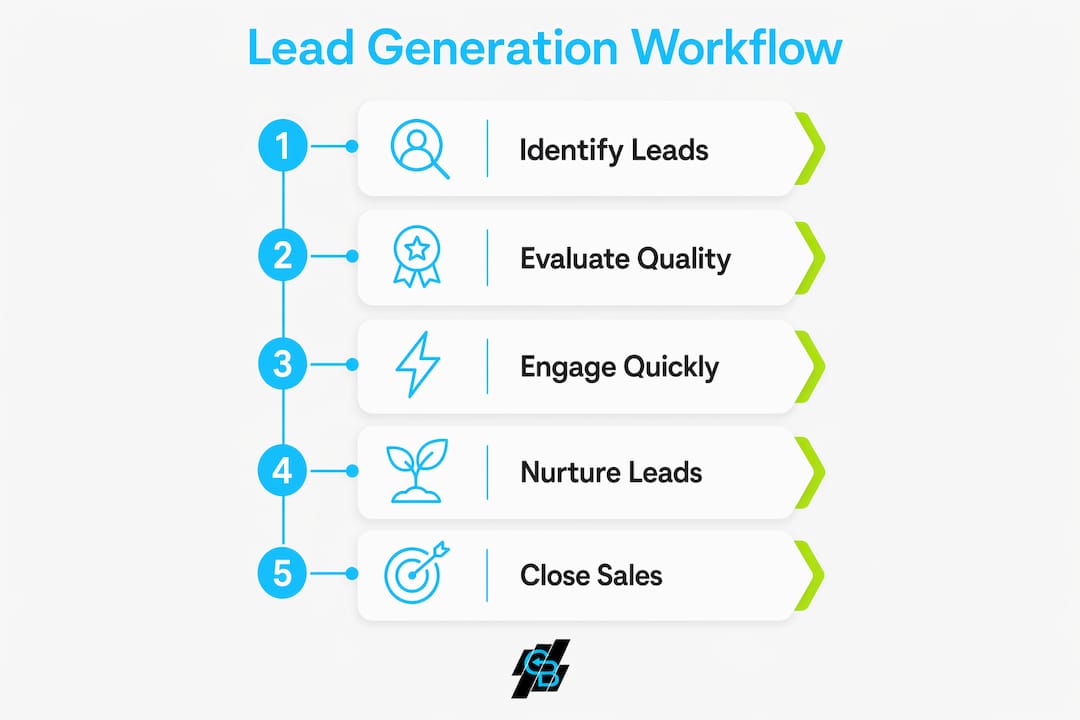
A well-configured CRM is the operational backbone of any insurance lead management system. Without it, even high-quality leads leak out of the pipeline before agents ever reach them.
Every lead record needs mandatory fields: full contact information, lead source, consent token, timestamp of opt-in, and a call recording link with at least 90-day retention. These fields are not optional. They protect you under TCPA and Do Not Call regulations, and they give you the data to coach agents accurately.
Dialer integration is the second critical component. A predictive dialer increases call volume per agent per hour, but it must route leads by priority. Fresh leads go to the top of the queue automatically. Aged leads get a separate cadence. Speed to lead contact improves connection rates by 100x when you reach a prospect within five minutes of their inquiry. That number is not a typo. It reflects how quickly buying intent fades.
Lead conversion rates increase by up to 400% when agents engage within the first five minutes. This single metric justifies the entire investment in dialer technology and automated lead routing.
Disposition codes determine the quality of your reporting. Using 12–18 disposition codes maximizes both reporting accuracy and training effectiveness. Too few codes and you lose diagnostic detail. Too many and agents skip them entirely.
Pro Tip: Track dials, contacts, and presentations as three separate funnel stages in your CRM. Blending them into one “activity” metric hides exactly where your pipeline breaks down.
| CRM requirement | Why it matters |
|---|---|
| Consent token field | TCPA compliance and audit trail |
| Call recording (90-day retention) | Agent coaching and dispute resolution |
| Lead source tagging | Attribution and channel ROI tracking |
| Auto-dialer integration | Speed-to-contact under five minutes |
| 12–18 disposition codes | Accurate reporting and pipeline diagnosis |
| Separate funnel stage tracking | Identifies where leads drop out |
Automation should handle compliance routing and follow-up scheduling. It should not replace the agent’s judgment on when to push for a close or when to back off. The technology sets the table. The agent closes the deal.
What does a step-by-step insurance lead generation workflow look like?
A phased workflow prevents the common mistake of chasing every channel at once and mastering none. Structure your first 12 months around three distinct phases.
Phase 1: Months 0–3, building immediate pipeline
- Select one or two exclusive lead vendors and purchase a test batch in your primary line of business.
- Configure your CRM with all mandatory fields and connect your dialer before the first lead arrives.
- Set a five-minute contact rule as a non-negotiable team standard.
- Call every new lead at least six times across the first 72 hours before moving it to a nurture sequence.
- Track your contact rate, presentation rate, and close rate separately from day one.
Phase 2: Months 3–6, building referral and community presence
- Identify five to ten referral partners in adjacent professions: mortgage brokers, real estate agents, CPAs, and estate attorneys.
- Schedule monthly check-ins with each partner and bring them something useful, a market update, a referral of your own, or a co-hosted client event.
- Join two local business organizations and attend consistently. Sporadic attendance produces zero results.
- Ask every closed client for one specific referral, not a general “send me anyone you know.”
Phase 3: Months 6–12+, building organic lead flow
- Publish two to four educational articles per month targeting local and product-specific search terms.
- Build a lead capture page for each major product line with a clear offer, a free quote or a downloadable guide.
- Run retargeting ads to website visitors who did not convert on the first visit.
- Review your lead generation workflow quarterly and cut any channel that has not produced a positive return after 90 days.
Pro Tip: Your follow-up cadence should include at least five touches across phone, email, and SMS before you mark a lead as unresponsive. Single-channel follow-up misses prospects who simply prefer a different contact method.
Multi-channel follow-up is not about being aggressive. It is about being present on the channel the prospect actually uses. An agent who calls twice and gives up leaves money on the table that a disciplined competitor will collect.
How do you measure and improve your lead generation performance?
Measurement separates agents who grow from agents who stay flat. The metrics that matter most are cost per lead, cost per acquisition, contact rate, and close rate by channel.
- Cost per lead tells you what you paid to get a prospect into your pipeline. Compare it across channels monthly.
- Cost per acquisition tells you what you paid to write a policy. This is the number that determines whether a channel is actually profitable.
- Contact rate reveals whether your dialer setup and timing are working. A contact rate below 30% usually signals a speed-to-lead problem.
- Close rate by channel shows which lead sources produce buyers versus browsers. Referral leads should close at 30–50%. Purchased leads typically close at 5–15% depending on exclusivity and line of business.
Attribution is where most agents get sloppy. Every lead record must link back to its source, and every issued policy must link back to its lead. Without that connection, you cannot make confident budget decisions. Use your CRM’s lead source field and run a monthly attribution report that ties policies issued to the channel that generated the original inquiry.
The most common optimization mistake is cutting a channel too early. Give any new source at least 90 days and a minimum of 50 leads before drawing conclusions. Conversion cycles in insurance are long, and a lead that does not close in week one may close in week six.
Tracking contact funnel stages separately, meaning dials, contacts, and presentations, is the fastest way to diagnose where your pipeline breaks. If dials are high but contacts are low, your timing or dialer setup is the problem. If contacts are high but presentations are low, your opening script needs work. If presentations are high but closes are low, your proposal process needs attention.
Key Takeaways
A multi-channel approach combining purchased leads, referrals, and content marketing produces the highest long-term ROI for insurance agents.
| Point | Details |
|---|---|
| Speed to contact is critical | Reaching a lead within five minutes increases conversion rates by up to 400%. |
| Referrals close best | Referral leads close at 30–50% and cost almost nothing, but require consistent relationship-building. |
| CRM setup determines pipeline health | Mandatory fields, disposition codes, and dialer integration are non-negotiable for accurate tracking. |
| Phase your channel investment | Start with purchased leads for immediate revenue, then build referrals and organic over 6–12 months. |
| Measure cost per acquisition, not just cost per lead | Attribution to issued policies is the only metric that confirms a channel is actually profitable. |
What I have learned about balancing technology and human judgment in lead generation
The agents I have seen grow the fastest share one trait: they treat technology as infrastructure, not as a sales strategy. They configure their CRM correctly, set up their dialer, and automate their follow-up sequences. Then they get on the phone and sell.
The mistake I see constantly is agents who spend weeks perfecting their automation and almost no time improving their conversations. A perfectly timed automated text cannot close a policy. It can only create the opening for an agent to do that.
The 2026 insurance market is more competitive than it was three years ago. Lead costs are up, and prospects have more options. The agents who win are the ones who respond fast, follow up consistently, and build genuine referral relationships that no algorithm can replicate. Paid leads give you volume. Referrals give you margin. Content gives you compounding returns. You need all three, in the right sequence, at the right investment level for your current stage.
My honest advice: do not wait until your organic strategy is producing before you build your referral network. Those two tracks run in parallel. The lead generation tips that actually move the needle are rarely the flashy ones. They are the boring, disciplined ones: call fast, follow up often, and track everything.
— Kyle
How Callbackcrm supports your insurance lead generation system
Callbackcrm is built specifically for insurance agents, agencies, and IMOs who need a single platform to manage leads, automate follow-up, and track pipeline performance without stitching together five different tools.
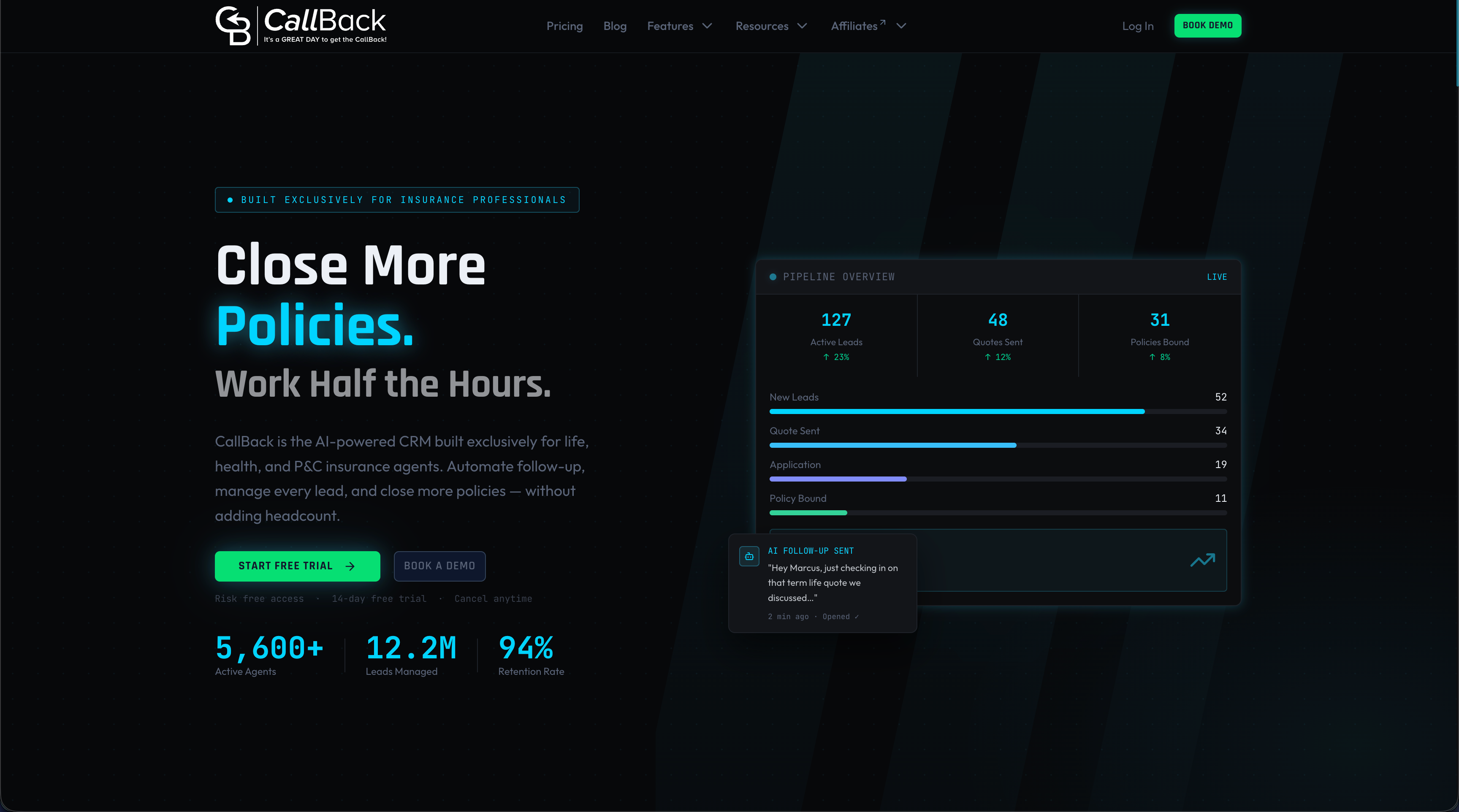
The platform handles lead capture, auto-dialing, and disposition tracking in one place. Its email marketing automation lets agents run TCPA-compliant multi-channel campaigns across email and SMS without manual scheduling. AI-powered lead scoring surfaces the highest-priority prospects in your pipeline so agents spend time on the leads most likely to close. Callbackcrm integrates with the tools insurance professionals already use, runs on Google Cloud for secure data handling, and includes 24/7 support. If you are serious about building a lead generation system that scales, it is worth a closer look.
FAQ
What is the fastest way to get insurance leads?
Purchasing exclusive leads or live transfers produces the fastest pipeline. Live transfers deliver close rates of 15–30%, making them the highest-converting immediate source.
How much does it cost to generate insurance leads?
Insurance lead CPC ranges from $5 to $55 depending on the line of business. Cost per acquisition varies further based on your contact rate, close rate, and the exclusivity of the leads you purchase.
How quickly should I contact a new insurance lead?
Contact every new lead within five minutes of their inquiry. Research shows connection rates improve by 100x at that speed, and conversion rates increase by up to 400% compared to delayed outreach.
How do referral leads compare to purchased leads?
Referral leads close at 30–50% and cost almost nothing to acquire, but they are difficult to scale. Purchased leads are scalable but close at lower rates, typically 5–15% for exclusive leads.
What CRM features do insurance agents need for lead management?
At minimum, your CRM needs consent token fields, call recording with 90-day retention, lead source tagging, dialer integration, and 12–18 disposition codes for accurate pipeline reporting.