

TL;DR:
- Sales forecasting estimates future revenue using historical data, pipeline activity, and market trends. It provides visibility for better planning but is not a sales target and depends heavily on data quality. Regular reviews and accurate pipeline updates help teams make informed decisions and adapt strategies proactively.
Sales forecasting is defined as the data-driven process of estimating future revenue over a specific period by analyzing historical sales data, pipeline activity, market trends, and seasonality. It gives sales managers and business professionals the forward visibility needed to make confident decisions about hiring, budgeting, and resource allocation. A forecast is not a sales goal. Forecasts predict likely outcomes; goals define targets. That distinction matters because confusing the two leads to poor planning and missed opportunities. Done well, sales forecasting turns raw CRM data and pipeline signals into a clear picture of where revenue is heading.
What is sales forecasting and how does it work?

Sales forecasting is the practice of using available data to estimate what your team will sell within a defined timeframe, whether that is a month, a quarter, or a full year. The inputs vary by method, but the core logic is consistent: past sales data, pipeline activity, and market conditions combine to produce a revenue estimate. That estimate then drives decisions across sales, finance, and operations.
The forecasting process typically starts with pulling data from your CRM, reviewing open deals by stage, and applying a probability weight to each. A deal at the proposal stage might carry a 60% close probability, while a deal at contract review might carry 90%. Multiply those probabilities across your pipeline, and you get a weighted revenue estimate for the period.
Accuracy depends entirely on data quality. A CRM filled with stale contacts, missing deal stages, or inconsistent rep updates produces unreliable forecasts. Clean, current data is the foundation every method builds on.
What are the main sales forecasting methods?
Sales managers use several forecasting methods, and the right choice depends on your data maturity, sales cycle length, and business environment.
| Method | How it works | Best for | Watch out for |
|---|---|---|---|
| Historical forecasting | Uses past sales data and seasonal patterns | Stable, mature businesses | Misses sudden market shifts |
| Pipeline forecasting | Weights deals by stage and close probability | Active sales teams with CRM data | Requires consistent pipeline hygiene |
| Top-down forecasting | Starts with market size, works down to team targets | New markets or product launches | Can disconnect from ground-level reality |
| Bottom-up forecasting | Builds from individual rep estimates upward | Teams with strong rep accountability | Prone to optimism bias |
| AI-driven forecasting | Uses machine learning on historical and engagement data | High-volume pipelines with rich data | Requires high-quality data inputs |
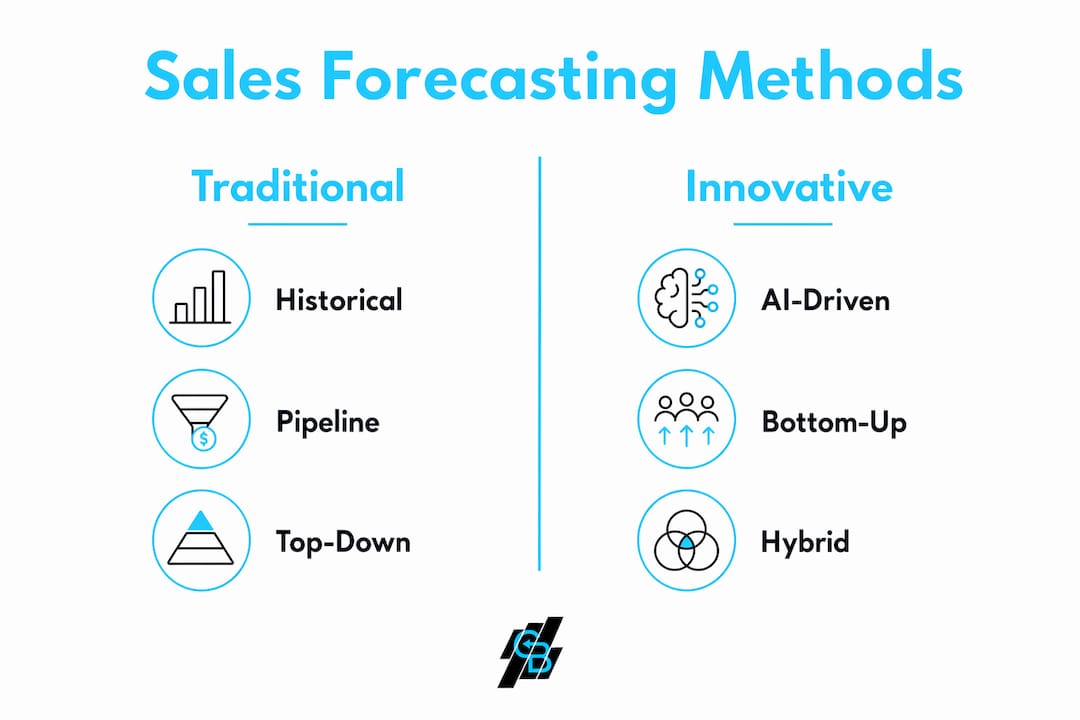
Historical forecasting relies on past sales data and seasonal trends to project future performance. It works well in stable environments where buying patterns repeat. A team that closes 40 policies every october can reasonably project similar numbers next october, adjusted for growth rate.
Pipeline forecasting uses current deal stages and close probabilities for a forward-looking estimate. It is the most widely used method for active sales teams because it reflects what is actually happening in the pipeline right now.
AI-driven forecasting applies machine learning to past data and engagement signals to predict deal outcomes. It reduces human bias and can surface patterns a manager would miss. The catch is that AI forecasts depend on high-quality data inputs to stay accurate.
Pro Tip: Run both a historical forecast and a pipeline forecast in parallel. Where they diverge, investigate. That gap often reveals a pipeline problem or a market shift before it hits your revenue.
Why is sales forecasting important for business success?
Accurate sales forecasting enables better resource allocation, budgeting, and strategic planning across every department. That means finance can model cash flow with confidence, HR can plan hiring timelines, and marketing can allocate spend where it will have the most impact.
The consequences of getting it wrong cut both ways. Overestimating sales leads to premature spending on headcount, inventory, or marketing before the revenue arrives. Underestimating causes missed growth opportunities and stock shortages that frustrate customers and damage retention. Neither outcome is neutral.
Consider a concrete example. An insurance agency forecasts 200 new policies in Q2 but actually closes 120. The agency has already hired two new account managers and ordered onboarding materials for 200 clients. That gap between forecast and reality creates direct financial waste. The reverse scenario, forecasting 100 policies and closing 200, leaves the team understaffed and unable to service new clients properly.
Sales forecasting also helps spot gaps, manage risk, and improve staffing decisions before they become crises. A forecast that shows Q3 revenue trending 20% below target gives leadership time to adjust quotas, shift marketing spend, or accelerate pipeline development. Without that signal, the shortfall only becomes visible after the quarter closes.
The four core business functions forecasting directly supports:
- Budgeting: Finance teams set spending limits based on projected revenue, not hope.
- Staffing: HR plans hiring cycles around projected sales volume and onboarding lead times.
- Inventory and capacity planning: Operations teams match supply to projected demand.
- Quota setting: Sales leaders set realistic, data-backed targets instead of arbitrary numbers.
Common challenges in sales forecasting and how to fix them
The most common reason forecasts fail is poor data quality in the CRM. When sales reps skip updating deal stages, log incomplete contact records, or leave close dates blank, the pipeline data feeding the forecast becomes unreliable. A clean, updated CRM with consistent data input from every rep is the single most important operational requirement for accurate forecasting.
The second major problem is optimism bias. Reps tend to overestimate their close rates, especially on deals they are emotionally invested in. Managers often compound this by accepting rep estimates without scrutiny. The result is a forecast that looks healthy on paper but consistently misses actuals.
- Define measurable stage criteria. Each pipeline stage should have a clear, observable action that moves a deal forward, not just a rep’s gut feeling.
- Audit your pipeline weekly. Remove stale deals that have not moved in 30 or more days. Dead weight inflates your forecast and misleads planning.
- Separate forecast from target. Never let quota pressure push reps to inflate their pipeline estimates.
- Build cross-functional review cycles. Regular forecast reviews with sales, finance, and marketing catch discrepancies before they become surprises.
- Track forecast accuracy over time. Compare each forecast to actual results. Teams that measure their own accuracy improve it faster.
Collaboration is underrated in forecasting. Finance brings budget constraints, marketing brings campaign data, and sales brings pipeline reality. When those three perspectives align, the forecast becomes a shared commitment rather than a sales team document that other departments ignore.
Pro Tip: Set a monthly “forecast vs. actuals” review. Bring the data from the previous period and ask one question: where were we wrong, and why? That single habit builds forecasting discipline faster than any tool.
For teams using sales pipeline automation, consistent stage updates become easier because the system prompts reps at each transition rather than relying on manual memory.
How to use sales forecasting to improve sales strategy
A forecast is only useful if you act on it. The most effective sales managers treat their forecast as a decision-making instrument, not a reporting exercise.
Optimize resource allocation. When your forecast shows strong Q3 pipeline in one territory and weak pipeline in another, you can shift rep attention, marketing spend, or lead generation budget before the quarter starts. Analytics-driven marketing decisions consistently outperform gut-based allocation, and forecasting gives you the data to make that call.
Adjust quotas in real time. A mid-quarter forecast showing a 15% shortfall is a signal to revisit quotas, accelerate outreach, or pull forward deals that were planned for next quarter. Waiting until the quarter closes removes every option.
Integrate CRM data for real-time visibility. Static spreadsheet forecasts go stale within days. Teams that connect their CRM data to pipeline insights get a live view of revenue probability that updates as deals move. That real-time signal is what separates reactive teams from proactive ones.
Use forecasts to align sales and marketing. When sales forecasts show a gap in a specific product line or customer segment, marketing can redirect campaigns to fill that gap. Integrating sales and marketing data around a shared forecast removes the friction that typically exists between the two teams.
Automation plays a growing role here. AI-powered platforms can flag deals at risk of stalling, score leads by close probability, and surface the next best action for a rep, all without manual analysis. That kind of automation turns forecasting from a weekly reporting task into a continuous operational signal.
Key Takeaways
Accurate sales forecasting requires clean CRM data, a defined sales process, and regular cross-functional reviews to translate pipeline signals into reliable revenue predictions.
| Point | Details |
|---|---|
| Forecasting vs. goals | Forecasts predict likely outcomes; goals define targets. Confusing them leads to poor planning. |
| Data quality is foundational | A CRM with stale or incomplete data produces unreliable forecasts regardless of the method used. |
| Method selection matters | Choose between historical, pipeline, or AI-driven forecasting based on your data maturity and sales cycle. |
| Act on the forecast | Use forecast signals to adjust quotas, reallocate resources, and align marketing spend before the quarter closes. |
| Review and refine | Monthly forecast-vs.-actuals reviews build accuracy over time and surface process problems early. |
Sales forecasting is like weather prediction. Here is what that means for your team.
Sales forecasting resembles weather forecasting more than most managers want to admit. Both disciplines use available variables to predict an outcome that can change rapidly. A meteorologist does not stop forecasting because the weather is unpredictable. They refine their models, update their inputs, and communicate uncertainty clearly. Sales managers need the same mindset.
The teams I have seen struggle most with forecasting share one trait: they treat the forecast as a commitment rather than an estimate. That creates pressure to inflate numbers, hide pipeline problems, and avoid honest conversations about deal risk. The forecast becomes a political document instead of a planning tool.
The teams that get it right treat forecasting as a discipline, not an event. They update their pipeline data consistently, run structured reviews, and measure their own accuracy without ego. They also accept that a forecast will never be perfect. The goal is not perfection. The goal is to be directionally right often enough that your decisions improve.
If your team is starting from scratch, focus on two things first: clean your CRM data and define your pipeline stages with measurable criteria. Everything else, method selection, review cadence, AI tools, builds on that foundation. A sophisticated forecasting model fed bad data produces a sophisticated wrong answer.
— Kyle
How Callbackcrm supports accurate sales forecasting
Reliable forecasting starts with clean, current sales data, and that requires a platform built to keep your pipeline organized and your outreach consistent.
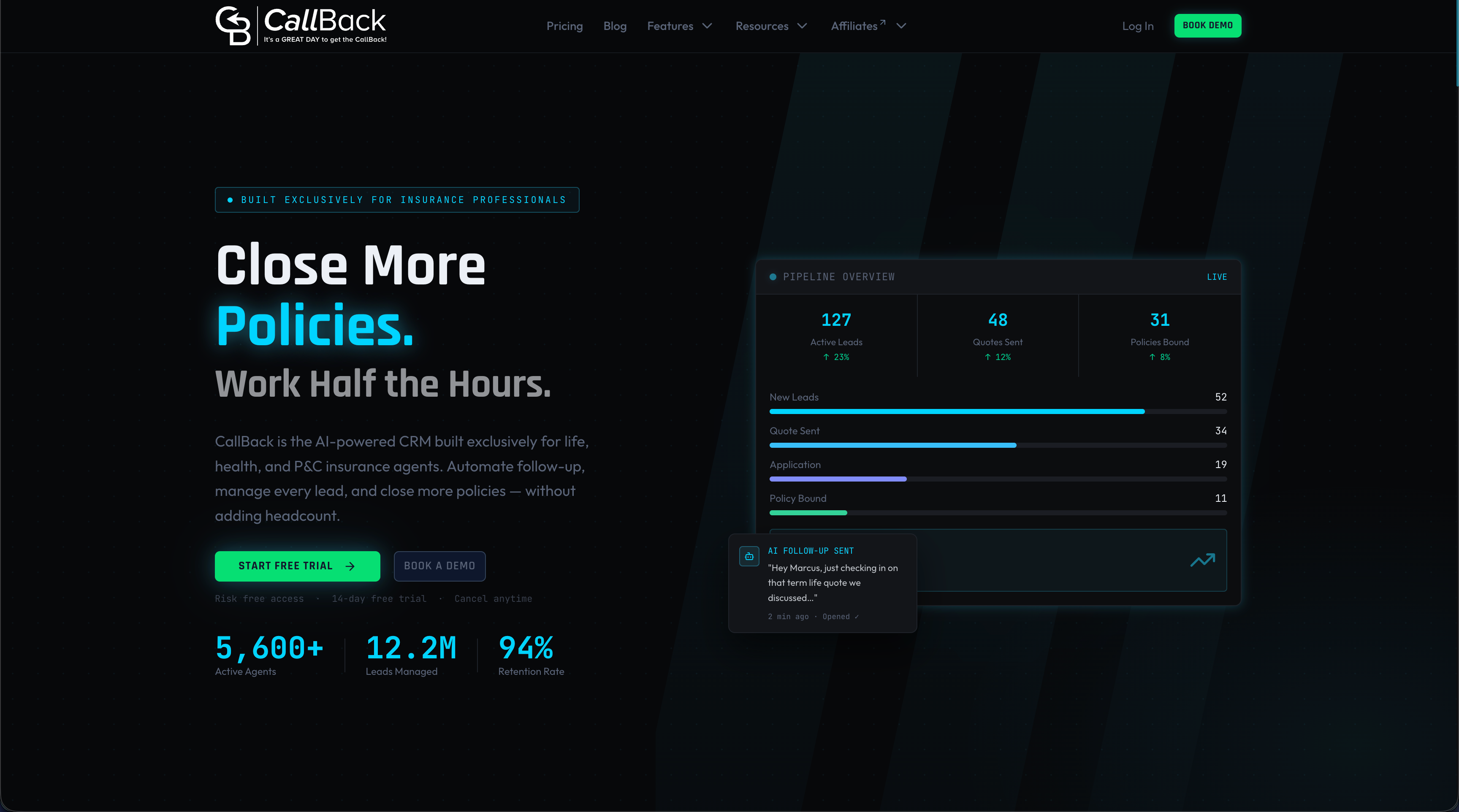
Callbackcrm gives insurance agents and sales teams the CRM management, automation workflows, and SMS marketing tools needed to maintain the data quality that forecasting depends on. Automated lead scoring, pipeline stage tracking, and AI-driven outreach reduce the manual data entry that causes CRM records to go stale. The platform’s website and funnel builder also feeds new lead data directly into your pipeline, giving your forecast a continuous stream of current, qualified activity to work from.
FAQ
What is a sales forecast in simple terms?
A sales forecast is an estimate of how much revenue a business expects to generate over a specific period. It is based on historical data, current pipeline activity, and market conditions.
How is sales forecasting different from setting sales goals?
Forecasts predict the most likely revenue outcome based on available data. Goals define the target a team is working toward. A forecast can fall short of a goal, and that gap is a signal to adjust strategy.
What are the most common sales prediction methods?
The most widely used methods are historical forecasting, pipeline forecasting, top-down forecasting, bottom-up forecasting, and AI-driven forecasting. Each suits different data environments and sales cycle lengths.
Why does CRM data quality affect forecast accuracy?
Forecast accuracy depends on data quality because every method uses CRM records as its primary input. Stale deal stages, missing close dates, and incomplete contact records all produce unreliable estimates.
How often should sales teams review their forecasts?
Sales teams should review forecasts at least monthly, with a weekly pipeline health check for active quarters. Dynamic adjustments reflecting market and pipeline changes consistently produce better outcomes than static, set-and-forget forecasts.