

TL;DR:
- Insurance sales automation uses AI-powered workflows to replace manual tasks and boost agency efficiency. It saves time, reduces errors, increases revenue, and enhances client retention through faster, more accurate communication. Combining AI with human agents results in higher conversion rates and better overall agency performance.
Insurance sales automation is defined as the use of AI-powered workflows and integrated software to replace manual, repetitive tasks across the full sales cycle. Agencies that automate 10 or more core processes save 20–35 hours weekly, reduce errors by 70%, and increase revenue per employee by 25–35%. Those numbers are not marginal gains. They represent the difference between an agency that grows and one that stagnates under administrative weight. Understanding why automate insurance sales is the right question for any producer serious about competing in 2026.
What are the primary benefits of automating insurance sales?
The core benefit of insurance sales automation is time recovery. Agents spend a significant portion of their week on tasks that software can handle faster and more accurately. Quote follow-ups, renewal reminders, certificate issuance, and data entry are all prime candidates.

Automating at least five workflows reduces administrative labor costs by 31% and improves client retention by 12–18 percentage points. That retention gain alone justifies the investment for most mid-size agencies. Clients who receive consistent, timely communication stay longer and buy more.
The advantages of insurance automation extend beyond cost savings:
- Speed: Automated outreach responds to leads within seconds, not hours.
- Accuracy: Removing manual data entry cuts error rates dramatically across policy documents and compliance records.
- Consistency: Every prospect receives the same quality of follow-up, regardless of how busy the team is.
- Revenue lift: Agencies using AI-powered lead scoring tools prioritize high-intent prospects instead of cold-working undifferentiated lists, which directly improves close rates.
Pro Tip: Track your team’s time on non-revenue tasks for two weeks before implementing any automation. That baseline makes it easy to measure real gains after go-live.
The impact of automation on insurance agencies also shows up in producer satisfaction. AI sales enablement reduces administrative burdens and gives producers clearer daily priorities. Agents who spend less time on paperwork spend more time closing.
How does AI compare to human sales roles in insurance?
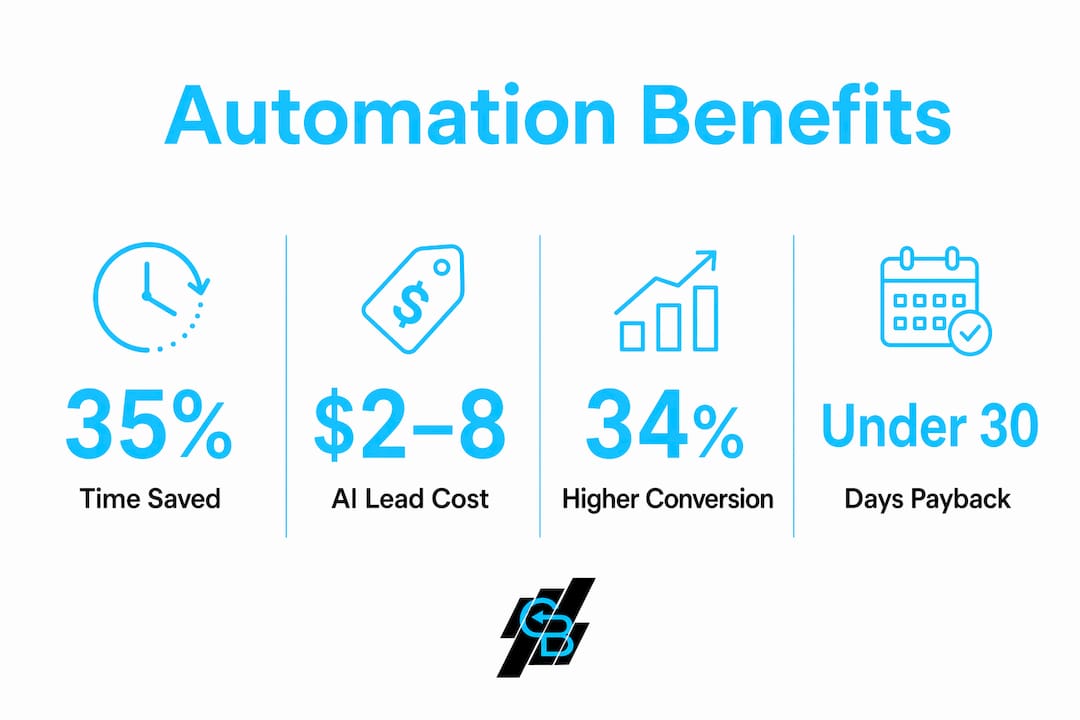
AI and human agents serve different functions in the sales process. Neither replaces the other at peak performance. The agent who responds first to a quote request wins 78% of the time. AI tools respond within 12–45 seconds. Human agents typically take 5–47 minutes. That gap costs agencies real revenue every day.
Cost per lead tells a similar story. AI sales agents engage insurance leads at $2–$8 per lead versus $25–$75 for human SDRs. AI also recovers 15–25% of quotes that would otherwise go cold. That recovery rate alone can add meaningful commission volume to an agency’s monthly output.
| Metric | AI agent | Human SDR |
|---|---|---|
| Response time | 12–45 seconds | 5–47 minutes |
| Cost per lead | $2–$8 | $25–$75 |
| Best use case | High-volume initial outreach | Complex consultations, trust-building |
| Quote recovery | 15–25% of cold leads | Dependent on capacity |
| Conversion strength | Speed and consistency | Relationship and nuance |
Human agents remain irreplaceable for complex coverage consultations, policy restructuring, and any situation where a client needs to trust the person on the other end of the conversation. AI handles volume. Humans handle depth.
Hybrid sales models combining AI and human agents convert 34% more leads than either approach alone. That figure makes the case for a blended team structure better than any theoretical argument. The math is clear: use AI to open the door, then send in a human to close it.
Pro Tip: Assign AI to all inbound web leads for the first 24 hours of contact. Route only engaged, responsive prospects to your human producers. Your team’s time goes further, and your close rate goes up.
Which insurance workflows yield the highest ROI from automation?
Certificate issuance is the single highest-ROI automation target in most agencies. Automating certificate issuance saves 8–12 hours weekly, reduces errors by 90%, and delivers payback in under 30 days. No other workflow comes close on that combination of speed and return.
Quoting is the second major target. Automated quoting workflows convert 28% more prospects and deliver proposals 73% faster than manual processes. Faster proposals mean fewer prospects who shop elsewhere while waiting.
Other high-return workflows include:
- Renewal management: Automated renewal reminders reduce lapse rates and free producers from calendar-watching.
- Document generation: Policy summaries, endorsements, and coverage confirmations generated automatically cut turnaround from days to minutes.
- Lead nurture sequences: Automated email and SMS follow-ups keep prospects engaged between touchpoints without agent involvement.
- Cross-sell triggers: Behavioral data flags clients ready for additional coverage, prompting outreach at the right moment.
Agencies that want to understand customer retention strategies alongside automation will find that consistent, automated communication is the single most reliable driver of renewal rates. Clients do not leave agencies that stay in touch.
The cumulative effect of automating multiple workflows compounds quickly. Each hour saved per week across five workflows adds up to hundreds of hours annually. That time converts directly into producer capacity for new business.
How to implement insurance sales automation effectively
Start with personal lines web leads. High-volume, low-complexity leads build operational confidence before you scale to commercial lines or specialty coverage. Personal lines give you enough data volume to calibrate AI scoring models quickly and enough repetition to spot workflow failures early.
Follow these steps to build a reliable automation foundation:
- Audit your current workflows. Map every manual task that happens more than ten times per week. Those are your first automation targets.
- Integrate your AMS with native connectors. Native direct-connector AMS integration lowers total cost of ownership and reduces maintenance compared to middleware solutions. Middleware adds failure points. Native connectors remove them.
- Trigger workflows from data events, not manual input. API and webhook-triggered automations deliver 100% reliability. Manual entry triggers fail when agents forget to update records. Data-change triggers fire automatically.
- Calibrate AI lead scoring iteratively. Run your scoring model for 30 days, then compare predicted scores against actual conversion outcomes. Adjust thresholds based on real results, not vendor defaults.
- Keep humans in the loop for complex sales. Automation handles volume. Human judgment handles complexity. Define clear handoff criteria so producers know exactly when to step in.
Pro Tip: Build your first automation around a single, measurable outcome, such as reducing quote response time to under two minutes. One clear win creates internal buy-in for the next phase of rollout.
Agencies that try to automate everything at once typically automate nothing well. Phased implementation produces better outcomes and fewer costly rollbacks.
What results can agencies expect from automation in 2026?
The quantifiable outcomes of insurance sales automation are well documented. Agencies that commit to the process see results across every major performance metric.
Key outcomes agencies report after full automation adoption:
- Time savings: 20–35 hours per week recovered from administrative tasks, freeing producers for revenue-generating work.
- Labor cost reduction: A 31% drop in administrative labor costs when five or more workflows are automated.
- Quote conversion: A 28% increase in prospect conversion through automated quoting, with proposals delivered 73% faster.
- Client retention: A 12–18 percentage point improvement in retention driven by consistent, automated communication.
- Lead cost: AI-powered outreach drops cost per engaged lead to $2–$8, compared to $25–$75 for manual SDR activity.
The benefits of sales automation for insurance agents also include a measurable lift in producer morale. Agents who spend their day selling rather than filing are more productive and less likely to leave. That retention benefit has real dollar value in recruitment and training costs avoided.
Agencies using AI customer engagement tools report faster ramp times for new producers as well. When the system handles initial outreach and lead qualification, new agents can focus on closing from day one rather than learning prospecting from scratch.
The ROI case for automation in 2026 is not speculative. The data from agencies already running hybrid AI-human models shows consistent, repeatable gains across size, geography, and product line.
Key Takeaways
Automating insurance sales with a hybrid AI-human model delivers the highest conversion rates, lowest cost per lead, and greatest time savings of any sales structure available to agencies in 2026.
| Point | Details |
|---|---|
| Automation saves significant time | Agencies automating 10+ processes recover 20–35 hours weekly for revenue-generating work. |
| AI cuts lead costs dramatically | AI outreach costs $2–$8 per lead versus $25–$75 for human SDRs, with faster response times. |
| Hybrid models outperform either alone | Combining AI and human agents converts 34% more leads than using either approach by itself. |
| Start small and scale deliberately | Begin with personal lines web leads and native AMS integration before expanding to complex workflows. |
| Retention improves with consistency | Automating five or more workflows boosts client retention by 12–18 percentage points. |
The part of automation no one talks about honestly
The conversation around automating insurance sales almost always focuses on efficiency metrics. Hours saved. Cost per lead. Conversion rates. Those numbers are real, and they matter. But the part that rarely gets discussed is what automation does to the culture of a sales team.
I have watched agencies implement AI tools and immediately expect producers to perform like machines. The technology handles volume, so the assumption becomes that humans should handle everything else at the same pace. That is a mistake. Automation should create breathing room, not just more pressure.
The agencies I have seen get this right treat automation as a way to give their best producers more time for the work that actually requires a human. Complex commercial accounts. High-net-worth clients. Situations where a client is confused, scared, or grieving. Those moments cannot be automated, and they should not be. They are where experienced agents earn their value.
The other honest observation: most agencies underestimate how long it takes to calibrate AI lead scoring well. The first 60–90 days of any automation rollout involve a lot of adjustment. Scores that look right in theory often miss in practice. Agencies that commit to iterative refinement come out ahead. Agencies that set it and forget it end up frustrated.
The productivity gains from AI for agencies are real, but they require active management to sustain. Automation is not a one-time project. It is an ongoing practice.
— Kyle
Callbackcrm: built for insurance sales automation
Insurance agents who want to move from manual follow-up to automated, AI-driven outreach have a direct path forward with Callbackcrm.
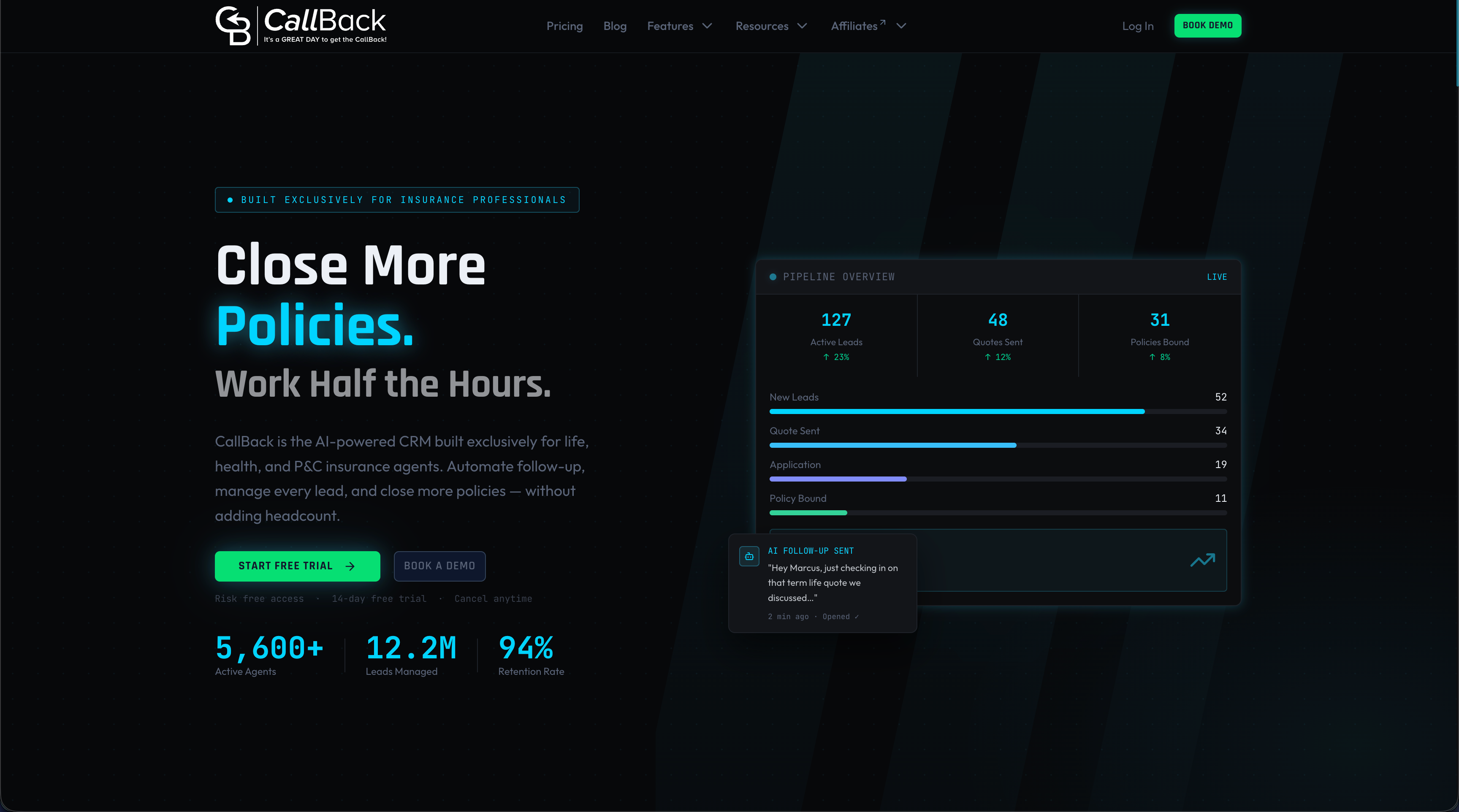
Callbackcrm combines AI-powered lead scoring, automated email and SMS marketing tools, CRM management, and funnel builders into one platform built specifically for insurance agents, agencies, and IMOs. The platform handles lead qualification, follow-up sequencing, and renewal outreach automatically, so producers spend their time on conversations that close. Callbackcrm also supports website and funnel building to capture and nurture web leads from the first click. For agencies ready to replace cold calling with intelligent, data-driven outreach, Callbackcrm provides the tools to do it at scale.
FAQ
Why automate insurance sales instead of hiring more agents?
Automation handles high-volume, repetitive tasks at a fraction of the cost of additional headcount. AI outreach costs $2–$8 per lead versus $25–$75 for a human SDR, and responds within seconds rather than minutes.
How long does it take to see ROI from insurance sales automation?
Certificate issuance automation alone delivers payback in under 30 days. Broader workflow automation typically shows measurable labor cost reductions and retention improvements within the first 90 days of consistent use.
What is the best workflow to automate first in an insurance agency?
Start with personal lines web leads. High volume and low complexity make them the easiest workflows to automate reliably, and the results build confidence for scaling to more complex lines.
Does automation replace insurance agents?
Automation does not replace agents. It handles initial outreach and administrative tasks so agents can focus on complex consultations and relationship-based selling. Hybrid AI-human teams convert 34% more leads than either approach alone.
What technology do agencies need to automate insurance sales effectively?
Agencies need an AMS with native connector integration, API or webhook-triggered workflows, and an AI-powered CRM that supports lead scoring and automated outreach sequences. Middleware-based setups add failure points and long-term maintenance costs.