

Auto insurance is a legal requirement in nearly every state, and shoppers who ask for a quote usually talk to several agents in the same hour. The agent who explains coverage clearly and follows up fast tends to be the one who writes the policy. This guide covers what a policy includes, how state minimums and premiums work, how to compare quotes on equal terms, and how to set up follow-up so no auto lead goes cold. CallBack CRM is built for insurance agents and runs automated follow-up by SMS, email and voicemail.
TL;DR
- Every state except New Hampshire requires auto insurance to drive legally, and each state sets its own minimum limits.
- A policy is a set of separate coverages. There is no single “full coverage” product, so quotes only compare when the coverages match.
- Premiums depend on driving record, credit history, location, vehicle and more. Rates rose sharply from 2023 to 2025 and kept rising in 2026.
- Auto buyers shop around, so fast and consistent follow-up decides many sales.
- CallBack CRM automates that follow-up for insurance agents, starting at $97 per month on the Professional plan.
Table of Contents
- Why drivers buy auto insurance
- What a policy covers
- State minimum limits
- What drives premiums
- Comparing quotes on equal terms
- Why follow-up decides auto sales
- Promo: CallBack CRM for auto follow-up
- Our perspective
- FAQ
- Sources
Why drivers buy auto insurance
The California Department of Insurance notes that every state except New Hampshire requires auto insurance in order to legally drive. The Missouri Department of Insurance lists three reasons to buy: the law, a lender’s requirement when the car is financed, and protection of personal assets from bodily injury and property damage claims.
These three reasons are useful in a sales conversation. A buyer who only wants the cheapest legal policy is answering the first reason. A buyer with a car loan has a lender with its own requirements. A buyer with a home, savings or a business has assets at risk, and that buyer needs a conversation about limits, not only price.
What a policy covers
An auto policy is built from separate coverages. The NAIC, the association of state insurance regulators, states that there is no such thing as a “full coverage” policy. The term is common in the market, but it means different things on different quotes.
The core coverages, as the NAIC describes them:
- Bodily injury liability pays for injuries you cause to someone else.
- Property damage liability pays for damage you cause to another person’s car or to objects and structures you hit.
- Uninsured motorist coverage reimburses the policyholder when an uninsured or hit-and-run driver causes the loss.
- Underinsured motorist coverage pays when the at-fault driver does not carry enough insurance to cover the loss in full.
Bodily injury and property damage liability are required in most states. Collision and comprehensive are the two coverages that protect the insured car itself. NerdWallet explains that collision pays for damage to your car after an accident regardless of fault. Comprehensive pays for theft and for damage from causes other than a crash, such as storms, floods, falling objects, vandalism or hitting an animal.
Medical payments and personal injury protection (PIP) are the other common coverages. Medical payments covers initial medical expenses for the insured after an accident regardless of fault. Which of these are required or offered varies by state, so check the state’s insurance department before quoting a new market.
What a standard policy does not cover
Clients are often surprised by exclusions. Progressive lists several items a standard policy does not cover: routine maintenance, wear and tear, mechanical failure, people who regularly drive the car but are not on the policy, and driving on a ridesharing platform. Telling the client this at quote time prevents a bad conversation at claim time.
State minimum limits
Each state sets its own minimum liability limits. These are written as three numbers: bodily injury per person, bodily injury per accident, and property damage per accident, in thousands of dollars. CNBC Select’s 2026 table shows how much they differ:
| State | Minimum limits | Meaning |
|---|---|---|
| New York | 25/50/10 | $25,000 per person, $50,000 per accident, $10,000 property damage |
| Texas | 30/60/25 | $30,000 per person, $60,000 per accident, $25,000 property damage |
| California | 30/60/15 | $30,000 per person, $60,000 per accident, $15,000 property damage |
The Missouri Department of Insurance requires 25/50/25 liability plus uninsured motorist coverage of $25,000 per person and $50,000 per accident. Missouri also requires drivers to keep proof of insurance in the vehicle at all times, or risk a ticket.
Minimums also change. The New Jersey Department of Banking and Insurance set the second phase of its increase to take effect January 1, 2026, for new and renewal policies. Minimum liability limits rose to $35,000 per person and $70,000 per accident. Property damage stayed at $25,000. Agents with New Jersey renewals should confirm that clients’ limits meet the new floor.

Advising above the minimum
The NAIC advises consumers to buy as much liability coverage as they can reasonably afford, because minimums differ by state and crashes happen even to careful drivers. A client who causes a serious accident can be responsible for costs above their limits. Raising limits is often the most valuable advice an agent gives on an auto policy, and it is a conversation that works best when the agent has time to have it. Quick, automated follow-up creates that time.
What drives premiums
Premium questions come first in almost every auto call. The Maryland Insurance Administration lists the criteria insurers consider: age, gender, marital status, annual miles driven, driving record, credit history, business or pleasure use, the type of vehicle, and where the vehicle is garaged. Which factors are allowed varies by state.
Figures that help explain a quote to a client:
- CarInsurance.com’s 2026 report puts the average full-coverage policy at $2,578 per year in 2026. That is 2.6% above the prior year, on top of a 32.5% rise from 2023 to 2025.
- MarketWatch’s 2025 report put the average full-coverage policy at $2,433 per year, or $203 per month. Louisiana was the highest at $3,481 per year and Vermont the lowest at $1,624.
- A WSJ analysis from June 2026 found drivers with poor credit pay an average of 189% more than drivers with very good or excellent credit. A speeding ticket raised premiums an average of 32% at renewal, and causing an accident raised them 59%.
These are published averages for their reporting periods, and each publisher updates its figures. Use them to set expectations, not to promise a price. Repair costs are one reason rates climbed: the CarInsurance.com report notes that modern cars carry sensors, cameras and safety systems that are expensive and slow to repair.
For a client who asks whether $200 a month is a lot, the averages above give context, but state, vehicle and record matter more than any national number. The honest answer is a quote built on their details.

Discounts to ask about
The NAIC shopping tool lists several discount routes: more than one policy with the same insurer, keeping a car insured without a gap, good-student discounts, defensive driving training, and group memberships such as alumni associations, unions or purchasing groups. Build these into your intake questions so every quote starts with the full picture.
Comparing quotes on equal terms
A price comparison is only valid when the coverage matches. Because “full coverage” has no fixed definition, a $140 quote and a $210 quote may describe different policies. A consistent comparison routine looks like this:
- Fix the liability limits. Choose one set, such as 100/300/100, and quote every carrier at it. Do not set a state-minimum quote beside a higher-limit quote.
- Fix the deductibles. Use the same collision and comprehensive deductibles on every quote.
- Match the optional coverages. Uninsured and underinsured motorist, medical payments or PIP, rental reimbursement and roadside help should appear on every quote or on none.
- Match the drivers and vehicles. Every household driver and every vehicle must be listed the same way, including the garaging address.
- Apply the same discounts. Record which discounts each quote includes and what the client must do to keep them.
- Write the comparison down. A one-page summary with the same rows for every carrier lets the client decide without calling you back to ask what differs.
The step where this usually breaks is time. Quotes take effort, and the client has often moved on by the time the summary is ready. A follow-up sequence that sends the summary and a short reminder keeps the conversation open.
Why follow-up decides auto sales
Auto insurance is one of the most searched insurance topics, and the shoppers behind those searches request several quotes at once. The shopper who gets a clear message in the first minutes, and a useful reminder two days later, stays in the conversation longer than one who hears from an agent once.
The work involved is repetitive: first reply, quote request reminder, quote delivered, renewal date check, policy-anniversary review. Done by hand it competes with every other task in the day. This is the kind of work that automation handles well.
A sound auto pipeline has these stages:
- New lead or inbound request
- Contacted
- Information collected (drivers, vehicles, current coverage, renewal date)
- Quote delivered
- Follow-up and objections
- Bound
- Renewal and cross-sell review
Each stage can trigger a message or a task. CallBack’s guides on insurance CRM workflows worth automating first and sales automation workflows for insurance agents show how to build these sequences. For lead sources, see the guide to lead generation tips for insurance agents.
Renewal and cross-sell
The NAIC notes that rates can be lower when a client holds more than one policy with the same insurer. That makes every auto client a prospect for home, renters or life coverage. A workflow tied to the renewal date can prompt a review before the client starts shopping elsewhere. Agents who write final expense, mortgage protection, term or whole life, Medicare or annuity business can use the same pipeline to introduce those products to auto clients.
Promo: CallBack CRM for auto follow-up
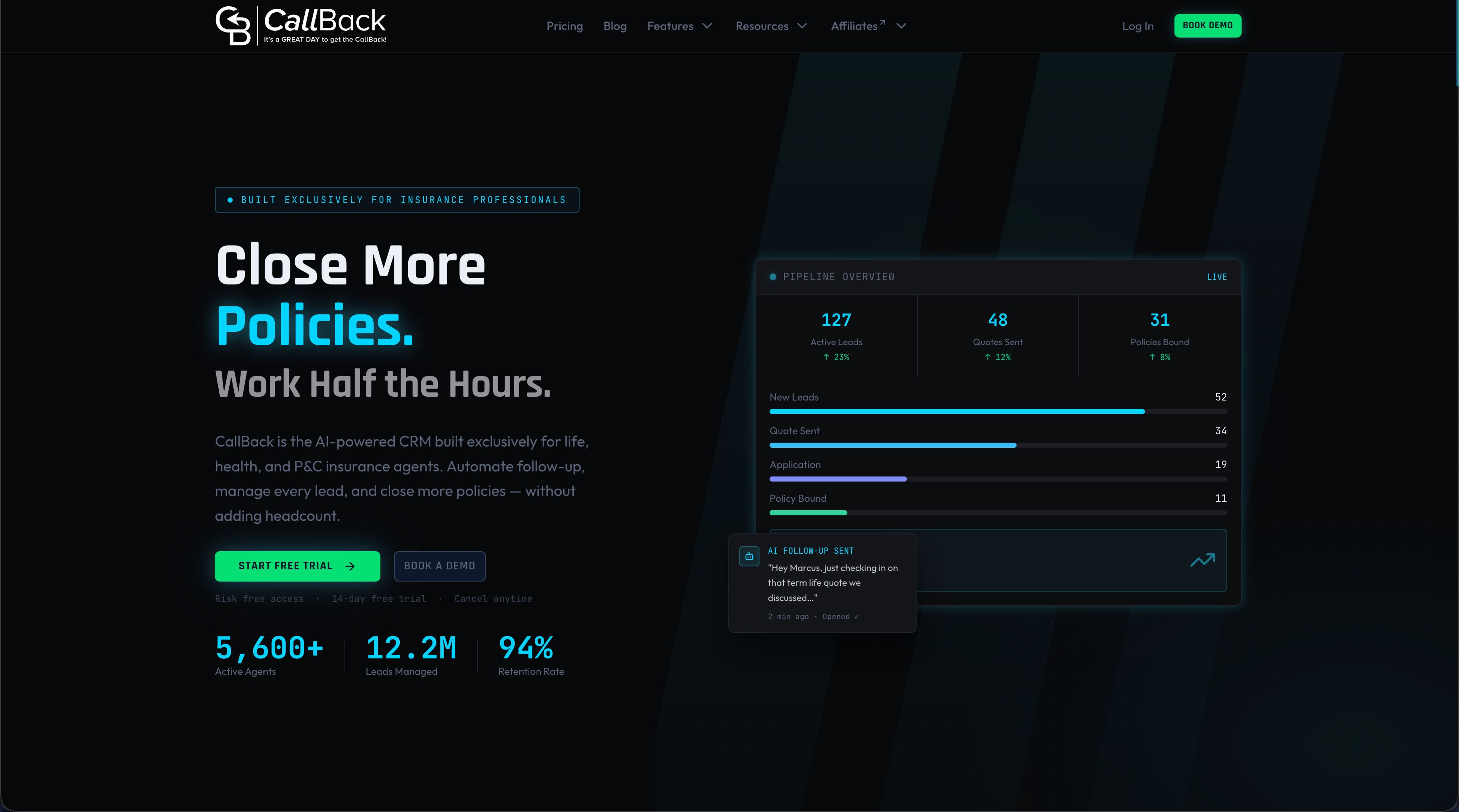
CallBack CRM is an AI-powered CRM and sales automation platform built for insurance agents, agencies and IMOs. It includes pipeline management, automated follow-up by SMS, email and voicemail, email and SMS marketing, funnel and website builders, AI assistants, workflow automation, reputation management, and proposal and contract tools. It runs on mobile and desktop and connects with dialers, calendars and websites.
For message deliverability, CallBack uses unique message hashing, iMessage deliverability and phone-carrier-approved verbiage.
The Professional plan is $97 per month. Enterprise plans cover agencies: $297 per month for 10 full CRM accounts, $397 for 25 and $497 for 60, on the Enterprise signup page. An Unlimited AI Employee Bundle is $127 per month, and phone numbers are $2.30 per month per number. SMS, email and AI usage are billed at wholesale rates, listed on the fees page.
Our perspective
Auto insurance is a volume business built on speed. The client who asks for a quote today is asking three or four other agents as well, and the coverage conversation only happens if you are still in contact when it matters.
We built CallBack for insurance workflows so agents do not have to adapt a generic tool. Pipelines, follow-up and messaging are set up for insurance sales, which reduces manual work and speeds up follow-up. Agents spend less time on data entry and reminders, and more time explaining liability limits, uninsured motorist coverage and discounts.
Our view is that the best use of automation is routine work: the first reply, the reminder, the renewal check. The advice stays with the agent, and the routine runs on its own.
Kyle
FAQ
Is there a “full coverage” auto policy?
No. The NAIC states that no such policy exists, because a policy is made up of different coverages. When a client asks for full coverage, confirm the liability limits, deductibles and optional coverages, then quote each carrier the same way.
Do all states require auto insurance?
Every state except New Hampshire requires it, according to the California Department of Insurance. Minimum limits differ by state and change over time, as New Jersey’s 2026 increase shows. Check the state insurance department for current limits.
How do I explain why a client’s rate is high?
Walk through the rating factors: driving record, credit history where permitted, location, vehicle type and annual mileage. Published 2026 averages show rates have risen with repair costs, so a higher renewal does not always reflect the client’s own record. Then offer a re-quote with discounts applied.
Can a CRM automate auto quote follow-up?
Yes. CallBack CRM sends follow-up by SMS, email and voicemail based on pipeline stage, and its workflow automation can trigger reminders before a renewal date. Plans start at $97 per month on the Professional plan.
Sources
- California Department of Insurance: Auto Insurance Basics
- Missouri Department of Insurance: Consumer Guide to Auto Insurance
- NAIC: A Shopping Tool for Auto Insurance
- NAIC: What does auto insurance cover?
- NerdWallet: Types of car insurance
- Progressive: What is car insurance and how does it work?
- CNBC Select: State auto insurance requirements for 2026
- New Jersey DOBI Bulletin No. 25-06
- Maryland Insurance Administration: Consumer Guide to Auto Insurance
- CarInsurance.com: State of Auto Insurance in 2026
- MarketWatch: 2025 Auto Insurance Report
- WSJ: What factors affect car insurance cost?