

SMS deliverability is the share of sent text messages that reach the recipient’s phone. In the United States, it depends on four things: consent, sender registration, message content and list quality. A sender that handles all four gets more messages delivered. A sender that ignores them gets filtered, delayed or blocked by carriers. This guide explains how delivery rate is measured, why texts fail, how 10DLC and short codes differ, and what insurance agents and agencies can do to keep messages reaching leads and clients.
TL;DR
- Delivery rate is delivered messages divided by messages sent, multiplied by 100. A 9,520 delivered out of 10,000 sent is 95.2%.
- No carrier guarantees delivery. Failures come from device problems, network traffic, carrier filtering and missing consent or registration.
- U.S. business texts on local 10-digit numbers must be registered through the 10DLC process. Short codes are a separate, higher-volume option.
- Written consent, easy opt-out, clean lists and plain, specific wording protect delivery and lower legal risk.
- CallBack CRM is designed around carrier-approved wording, unique message hashing and iMessage deliverability for insurance sales teams.
Table of Contents
- What SMS deliverability means
- Do SMS texts always get delivered?
- Why texts fail or arrive late
- The U.S. rules that shape deliverability
- Short code vs 10DLC
- How to measure and diagnose deliverability
- Practical ways to improve SMS deliverability
- Perspective
- Using CallBack for insurance text outreach
- FAQ
- Sources
What SMS deliverability means
Deliverability describes whether a message makes it through the carrier network and onto the handset without being discarded, filtered or blocked. It is often confused with a related idea, the delivery rate, which is the number used to measure it.
The standard formula is simple: delivered messages divided by total messages sent, multiplied by 100. Omnisend’s example shows 9,520 delivered messages out of 10,000 sent, which equals a 95.2% delivery rate.
Two points matter when reading that number:
- A message marked as sent is not the same as a message delivered. “Sent” means the platform handed the text to a carrier. “Delivered” means the carrier confirmed it reached the device.
- Delivered does not mean read or answered. Deliverability stops at the handset. Response rate is a separate measure.
How long delivery confirmations take
Confirmations are not always instant. Bluecore’s mobile documentation says major carriers may take up to 24 hours to return delivery confirmations, and smaller or regional carriers up to 72 hours. A delivery rate checked an hour after a campaign can look lower than the final figure. Reports are more reliable after a full three days.
Do SMS texts always get delivered?
No. Carriers do not promise delivery. Verizon states in its text messaging terms that it cannot guarantee messages will be received, and that it deletes messages that stay undelivered after five days.
That means a share of any campaign will fail or arrive late even when everything is configured correctly. The goal is to remove avoidable failures, not to reach 100%.
Why texts fail or arrive late
Failures fall into two groups: problems at the handset or network, and problems with the sender.
Handset and network causes
Amazon’s SMS troubleshooting guidance lists the common reasons a message is delayed:
- Full device storage or low signal
- A temporary lack of coverage
- Roaming
- Heavy traffic on the carrier network
- The phone being switched off when delivery is attempted
These are outside a sender’s control. They explain why a small percentage of messages is always delayed, and why a single failed text to one contact does not signal a deliverability problem.
Sender-side causes
These are the causes a sender can fix:
- Unregistered numbers. Business traffic on local numbers without 10DLC registration is exposed to heavy filtering.
- No consent or weak consent. Contacts who did not agree to receive texts report them as spam, which damages the sending number’s reputation.
- Ignored opt-outs. Continuing to text someone who replied STOP leads to complaints and blocks.
- Dirty lists. Old, mistyped or landline numbers produce failures that drag the delivery rate down.
- Risky content. Messages that look like mass spam, use shortened or disguised links, or mix unrelated topics get flagged.
- Grey routes. CTIA’s messaging principles tell senders not to use grey routes, which it defines as unauthorized paths for non-consumer messaging.
The U.S. rules that shape deliverability
Deliverability and compliance overlap more in the U.S. than in most markets. Carriers filter heavily because federal rules and industry codes make them responsible for unwanted traffic.
Consent
The FCC’s 2015 TCPA order says autodialed texts to wireless numbers need prior express consent, and telemarketing texts need prior express written consent. Recipients may revoke consent by any reasonable method.
The same document sets out what written consent for telemarketing texts must contain:
- It must be in writing.
- It must identify the recipient’s phone number.
- It must authorize the seller to send autodialed advertising texts.
- It must disclose that consent is not a condition of purchase.
- It must be signed by the recipient.
An FCC public notice from 2016 confirms that autodialed texts to wireless numbers fall under the TCPA prohibition absent prior express consent, with narrow exceptions such as emergencies.
For insurance agents, this means a purchased lead list is a risk for both delivery and law. CallBack’s guide to a TCPA-compliant audit trail for insurance texting covers how to keep records of when and how each contact opted in.
Opt-out handling
Honoring opt-outs is both a legal and a deliverability matter. Any reasonable revocation counts, so STOP, UNSUBSCRIBE, “don’t text me” and similar replies should all end messaging. Automated opt-out processing prevents a manual miss from becoming a complaint.
Registration
U.S. businesses that send application-to-person (A2P) messages from local 10-digit numbers register their brand and campaign through The Campaign Registry. Its August 2025 overview says all U.S. mobile network operators listed there require the registry for 10DLC business messaging.
Registration makes U.S. deliverability partly a question of identity. Carriers can see who is sending and what the campaign is for. Unregistered or mislabeled traffic is easier to treat as spam.
Insurance senders should be careful about how campaigns are described. Mixing unrelated message types in one registration can cause rejections. CallBack’s article on 10DLC registration for insurance SMS explains why claims and billing messages should not be bundled with sales outreach.

Short code vs 10DLC
Two sender types dominate U.S. business texting: 10DLC numbers and short codes. The right one depends on volume, speed and budget.
The Campaign Registry describes 10DLC as the sanctioned U.S. standard for non-consumer A2P messaging over ordinary 10-digit numbers. The same number can also carry voice calls, and carriers get visibility into the sender and campaign.
CTIA defines a common short code as a five- or six-digit number used to send and receive messages with consumers of participating wireless providers. CTIA also says short codes were developed for higher-volume traffic with upfront consumer protections and procedures meant to prevent unwanted messaging.
| Factor | 10DLC | Short code |
|---|---|---|
| Number format | Standard 10-digit local number | Five or six digits |
| Registration | Brand and campaign through The Campaign Registry | Program review under CTIA short-code rules |
| Voice on the same number | Yes | No, as described by the sources reviewed |
| Volume focus | Business messaging with throughput limits by carrier | Higher-volume traffic |
| Personal feel | Looks like a regular local number | Looks like a mass program number |
| Typical fit | Agents and agencies texting leads and clients | Large-scale alerts and notifications |
Throughput limits on 10DLC
Throughput is where 10DLC senders feel the limits. The Campaign Registry’s October 2025 guide explains that AT&T assigns throughput per campaign, while T-Mobile assigns a daily allowance to the brand and shares it across that brand’s campaigns.
The same guide lists AT&T standard throughput from 240 to 4,500 SMS per minute, depending on use case and vetting score. T-Mobile standard daily caps run from 2,000 to 200,000 messages, depending on brand tier.
For most independent agents and agencies, these limits are far above daily needs. A team sending follow-ups to a few hundred leads a day stays well inside them. An IMO or call center sending very large blasts should review its brand tier and campaign setup first.
Short code requirements
CTIA’s short-code handbook requires a clear call to action, applicable consent, opt-in confirmation, and acknowledgment and honoring of opt-outs. These are strict, and the handbook says its aim is to protect consumer trust in short-code programs.
Which one fits an insurance agent
Insurance sales rely on one-to-one conversations: quote follow-ups, appointment reminders, policy anniversary check-ins. A local number on 10DLC supports that style. Contacts see a normal number, can reply to a person and can also receive calls from it. Short codes suit one-way, high-volume alerts, which are a smaller part of insurance prospecting.
How to measure and diagnose deliverability
Track a few numbers for every campaign, not only the overall rate.
- Delivery rate. Use the formula above, and check it after the carrier confirmation window has passed.
- Failure codes. Group failures by reason: invalid number, landline, carrier block, unreachable handset. Each points to a different fix.
- Opt-out rate. A spike after one campaign means the message, timing or list source needs attention.
- Delivery by carrier. If one carrier shows a much lower rate, check registration status and campaign description for that carrier.
- Reply rate. Falling replies with steady delivery usually means content or timing, not filtering.
When the rate drops suddenly, work through the causes in order: registration status, recent content changes, list source, opt-out processing, then link domains.
Practical ways to improve SMS deliverability
Build the list on consent
Collect consent through a web form, a funnel opt-in or a documented reply. Store the date, the source and the wording shown. Do not text numbers from lists bought or scraped elsewhere.
Register before sending
Complete brand and campaign registration before launching outreach on a local number. Describe the real use case accurately, and keep sales, service and billing traffic separate.
Keep content plain and specific
- Identify the agent or agency by name in the first message.
- Say why the contact is receiving the text.
- Use one clear call to action.
- Include opt-out language in the first message of a sequence.
- Avoid disguised links and avoid repeating identical text to thousands of numbers.
- Write in carrier-approved wording and avoid phrases that look like spam.
Length also affects cost. Longer messages split into multiple segments, and each segment is billed. CallBack’s SMS segment calculator shows how many segments a draft will use before sending.
Clean the list regularly
Remove numbers that fail repeatedly, landlines, and contacts who have opted out. Smaller, cleaner lists produce a better delivery rate and fewer complaints than large, stale ones.
Pace the sequence
Spread messages over time instead of sending one burst. Structured follow-up works better than a flood. The guide to SMS drip campaigns for insurance agents covers setup and rules for sequences.
Pair text with other channels
SMS is one channel among several. Email has its own set of delivery factors, and a review of email marketing platforms for agencies shows what influences delivery on that side. CallBack’s comparison of SMS and email for insurance agents explains how to split messages between the two to cut opt-outs.
Review AI-written messages
AI tools speed up drafting, but every message still needs a human check for accuracy, wording and compliance. See the steps for AI SMS writing with an audit trail.
Perspective
Deliverability is where an insurance texting program succeeds or quietly fails. A message that never arrives costs the agent a lead and gives no warning.
Our view is that deliverability should be built into the platform and not left to each agent to manage by hand. CallBack applies unique message hashing, so repeated messages are not sent as identical text. It supports iMessage deliverability. It uses phone carrier approved verbiage in its messaging. These practices are meant to keep outreach inside the rules carriers set.
We also believe that automation and compliance belong together. Follow-up that runs on triggers, with opt-outs handled automatically and consent kept on record, is easier to defend and easier to scale than manual texting from a phone. Agents selling final expense, Medicare, mortgage protection or annuities do not have time to monitor carrier filters. Their time belongs with clients.
For that reason, CallBack is built for insurance workflows: pipelines, follow-up by SMS, email and voicemail, and reporting in one place, so delivery results are visible next to sales results.
Kyle
Using CallBack for insurance text outreach
CallBack CRM is an AI-powered CRM and automation platform for insurance agents, agencies and IMOs. It combines pipeline management, automated follow-up by SMS, email and voicemail, funnel and website builders, workflow automation and reporting. Its deliverability approach centers on unique message hashing, iMessage deliverability and carrier-approved wording.
The Professional plan costs $97 per month. Enterprise plans cost $297 per month for 10 full CRM accounts, $397 per month for 25 and $497 per month for 60. The Unlimited AI Employee Bundle costs $127 per month, and phone numbers cost $2.30 per month per number. Usage such as texts, email and AI is billed separately, and the fees page lists the categories. Agents can start from the Professional plan, and larger agencies can review the Enterprise plans.
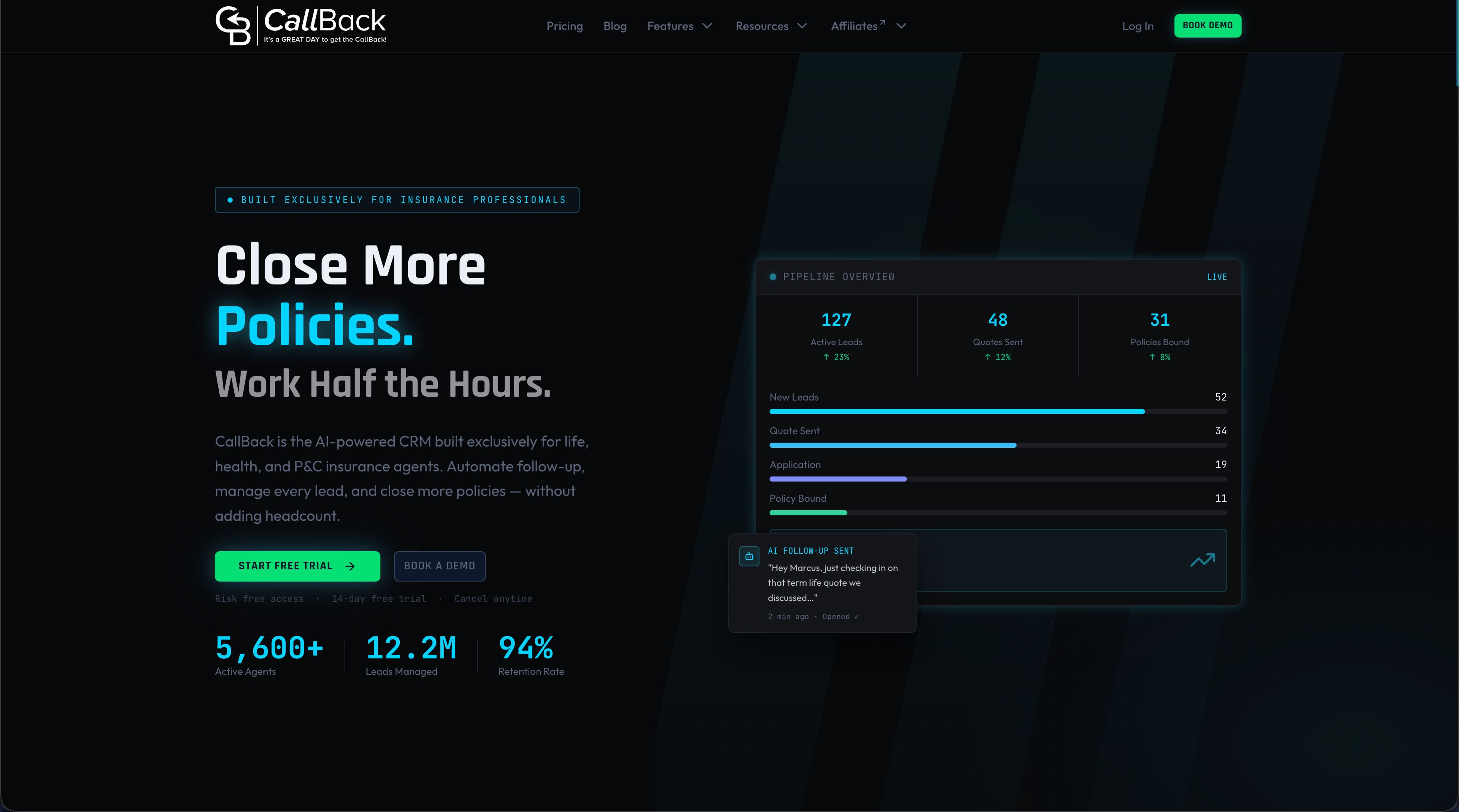
More detail on the platform is on the CallBack CRM home page.
FAQ
What is a good SMS delivery rate?
There is no single official benchmark in the sources reviewed. The rate is calculated as delivered messages divided by messages sent, multiplied by 100, and the example of 95.2% is a typical way to read it. Check results after the 24 to 72 hour confirmation window, and compare each campaign against the sender’s own history.
Is SMS text blasting illegal?
Not by itself, but texting without the required consent is. The FCC says autodialed texts to wireless numbers need prior express consent, and telemarketing texts need prior express written consent. Recipients can revoke consent by any reasonable method, and the sender must honor it.
What causes a delay in delivering SMS messages?
Common causes are low signal, full device storage, roaming, a phone that is switched off and heavy carrier network traffic. Smaller carriers can also take up to 72 hours to confirm delivery. Delays across many numbers at once can point to a registration or filtering issue.
Should an insurance agent use a short code or 10DLC?
Most agents and agencies sending personal follow-up use 10DLC, because it works on a normal local number that can also take calls. Short codes are built for higher-volume programs and follow separate CTIA rules. The choice depends on message volume and the style of outreach.
Sources
- Omnisend: What is SMS Deliverability
- Verizon: Text Messaging terms
- AWS re:Post: Troubleshoot SMS delivery delays
- Bluecore: Deliverability in Mobile
- FCC 2015 TCPA order
- FCC 2016 public notice
- The Campaign Registry overview, August 2025
- The Campaign Registry introduction to 10DLC
- The Campaign Registry user guide, October 2025
- CTIA Messaging Principles and Best Practices
- CTIA Short Code Monitoring Handbook
- Email marketing platforms for agencies