

TL;DR:
- Health agents should focus on one or two social media platforms, posting regularly and utilizing a balanced content mix. Rapid, automated responses within 60 seconds significantly increase lead conversions, and compliance with HIPAA guidelines is essential for ethical marketing. Consistent year-round content targeting life events and establishing local partnerships create a sustainable pipeline outside peak enrollment periods.
Social media strategies for health agents are most effective when they combine focused platform selection, educational content, and AI-powered lead response to convert prospects before competitors do. Health insurance agents who treat social media as a structured system rather than an occasional activity generate more qualified leads, build stronger client trust, and maintain a year-round pipeline. The platforms, content mix, and automation tools you choose determine whether your social presence produces real revenue or just likes. Facebook, Instagram, and LinkedIn each offer distinct advantages, and knowing which one fits your audience is the first decision that matters.
1. Which social media platforms work best for health agents?
Choosing the right platform is the single most important decision in your social media plan. Healthcare organizations see better results focusing on one or two primary platforms with high-quality content posted three to four times weekly. Spreading yourself across five platforms with thin content produces worse results than owning one platform with consistent, high-value posts.
Here is how the top three platforms break down for health agents:
- Facebook: The strongest platform for community building and referral-driven lead generation. Facebook Groups let you create a local health and wellness community where you become the trusted expert. Facebook Ads also allow granular geographic and demographic targeting, which suits agents working specific counties or employer groups.
- Instagram: Best for visual storytelling and reaching adults aged 25 to 45. Instagram Reels showing quick myth-busting clips or “what does this plan actually cover?” explainers consistently outperform static posts. Short-form video builds familiarity faster than any other format.
- LinkedIn: The right choice if you target small business owners, HR managers, or self-employed professionals. LinkedIn positions you as a credentialed professional rather than a salesperson, which matters enormously in health insurance where trust drives every decision.
Pick one primary platform based on where your ideal clients spend time, then add a secondary platform only after you have a consistent posting rhythm established.
2. What content mix drives real engagement for health agents?
The 70/20/10 content rule defines the most effective ratio for health agents: 70% educational or health tips, 20% relationship-building content like team stories and community involvement, and 10% promotional posts about your services. This ratio keeps your audience engaged without triggering the “this is just an ad” response that causes unfollows.

Your 70% educational content should answer the questions your clients actually ask. Posts like “What is the difference between an HMO and a PPO?” or “Three things Medicare does not cover that most people assume it does” perform consistently well because they solve real confusion. Successful healthcare social strategies blend education and entertainment to maximize engagement and trust without compromising professionalism. Think of it as “edutaining”: the information is genuinely useful, but the delivery is human and approachable.
Your 20% relationship content is where personality wins. Behind-the-scenes posts, client appreciation moments, and community event participation show that a real person runs your business. This content earns the trust that makes your 10% promotional posts land instead of getting scrolled past.
Pro Tip: Video testimonials with documented client consent generate 3x more engagement than standard image posts. Always obtain written consent before publishing, and include a compliance disclaimer directly on the post, not just on your landing page.
3. How to optimize lead generation with automation and rapid response
Speed is the variable most health agents underestimate. Leads contacted within 60 seconds of a social media inquiry convert at seven times the rate of leads contacted later. That gap does not close with effort alone. It requires automation.
Here is a practical workflow for capturing and converting social media leads at speed:
- Set up an automated DM or comment response. When someone comments “interested” on a Facebook post or sends a DM on Instagram, an automated reply should acknowledge them within seconds and ask one qualifying question, such as whether they are looking for individual or family coverage.
- Route qualified leads to your CRM immediately. Every lead from social media should enter your CRM the moment they engage. Manual data entry creates delays that kill conversion. Tools like SynaBot use AI-driven qualification to score and route leads without human intervention.
- Trigger an SMS follow-up within the first minute. AI-driven lead qualification and auto-responses can improve conversion rates by 15 to 37%. An SMS that reads “Hi, I saw you had a question about health coverage. I have a quick answer for you. Is now a good time?” outperforms any cold call script.
- Capture explicit consent at the point of inquiry. Your automated response should include a brief consent statement before collecting any personal information. This protects you legally and builds immediate credibility with the prospect.
- Assign a nurture sequence for leads who do not convert immediately. Most people who inquire are not ready to buy that day. A pre-built email and SMS sequence that delivers value over two to four weeks keeps you top of mind until they are ready.
Pro Tip: Integrate your social media lead capture directly with your CRM so that every inquiry, comment, and DM automatically enters a lead nurture sequence without manual input. This is the difference between a system and a habit.
4. Compliance and ethical guidelines health agents cannot ignore
HIPAA compliance on social media is not optional, and the violations that cost agents the most are rarely intentional. Agents must avoid targeting criteria that infer health status, and patient consent plus inline disclaimers are mandatory for any testimonial content. The rules are specific, and ignorance is not a defense.
Follow these non-negotiable compliance practices:
- Never confirm client or patient status publicly. If someone comments “I’m your client and I have a question,” your public reply must be generic. Use generic response templates like “Thanks for reaching out. Please send us a direct message so we can help you personally.” This prevents inadvertent HIPAA violations in comment sections.
- Obtain written consent before any testimonial post. Document the consent with a signed release that specifies exactly what content will be used and where. Store these records in your CRM.
- Place disclaimers on the post itself, not just the landing page. Compliance requires that disclaimers appear where the claim is made. A disclaimer buried on a linked page does not satisfy this requirement.
- Avoid ad targeting that infers health conditions. Facebook and Instagram prohibit targeting based on health status. Targeting by age, geography, and life events like “recently moved” or “new job” is compliant. Targeting by implied health condition is not.
- Review all AI-generated content before publishing. AI tools can produce inaccurate benefit descriptions or inadvertently make claims that violate insurance advertising regulations. Human review is mandatory before any AI-drafted post goes live.
5. How to build a year-round lead pipeline with content timing
Most health agents spike their social media activity during Open Enrollment and go quiet the rest of the year. That pattern leaves ten months of potential leads untouched. Agents should focus on Special Enrollment Periods from March through October for lead generation outside peak Open Enrollment, and life-event triggers are the most reliable source of year-round demand.
Life events that signal immediate health insurance need include job loss, marriage, divorce, a new baby, turning 26 and aging off a parent’s plan, and small business owners adding their first employee. Each of these events creates a narrow window where the prospect is actively searching for coverage. Content that speaks directly to these moments, such as “Just started a new job? Here is what to know about your coverage gap,” captures intent at exactly the right time.
Over 60% of consumer searches happen on mobile devices, which means every post, landing page, and lead form must be optimized for a phone screen. A lead who clicks your Instagram ad and lands on a desktop-formatted page with a 12-field form will leave immediately.
Here is a comparison of the two primary lead generation windows health agents should plan around:
| Period | Strategy focus |
|---|---|
| Open Enrollment (Nov–Jan) | High-volume paid ads, urgency-driven content, rapid follow-up automation |
| Special Enrollment (Mar–Oct) | Life-event targeting, educational content, referral partnerships, local SEO |
Referral partnerships with local HR consultants, divorce attorneys, and small business accountants extend your reach into life-event moments without paid advertising. A post shared by a trusted referral partner carries more weight than any ad you could run. Social media advertising for healthcare works best when it is paired with local community relationships rather than treated as a standalone channel.
Key takeaways
Effective social media for health agents requires a focused platform, a disciplined content ratio, and automated lead response within 60 seconds to maximize conversion.
| Point | Details |
|---|---|
| Platform focus beats platform volume | Choose one or two platforms and post three to four times weekly rather than spreading thin across many. |
| The 70/20/10 content rule works | Seventy percent educational, twenty percent relational, and ten percent promotional keeps audiences engaged. |
| Speed determines lead conversion | Responding within 60 seconds increases conversion sevenfold. Automation is the only reliable way to hit that window. |
| Compliance is non-negotiable | Use generic response templates, obtain written consent for testimonials, and place disclaimers on the post itself. |
| Year-round pipeline beats seasonal spikes | Life-event triggers and Special Enrollment Periods provide consistent lead flow outside Open Enrollment. |
The most overlooked social media move health agents make
Most agents I talk to treat social media like a campaign. They go hard during Open Enrollment, post daily for six weeks, burn out, and disappear until next November. Then they wonder why their follower count never grows and their DMs stay empty.
The agents who actually build a book of business through social media treat it like an operating system. They post three times a week, every week, regardless of enrollment season. They have templates for compliance responses. They have automated workflows that respond to leads at 11 PM on a Sunday. They are not doing more work. They are doing consistent work backed by tools that handle the repetitive parts.
The other thing most agents get wrong is separating compliance from creativity. Compliance does not mean boring. You can be funny, personal, and memorable while still using a generic response template in your comments. The agents who figure this out early build audiences that refer clients without being asked. That is the real ROI of AI-powered social media done right.
— Kyle
How Callbackcrm helps health agents convert social leads faster
Health agents who rely on manual follow-up lose leads to agents who have automated the first 60 seconds of every inquiry. Callbackcrm is built specifically for insurance agents who need that speed without adding hours to their day.
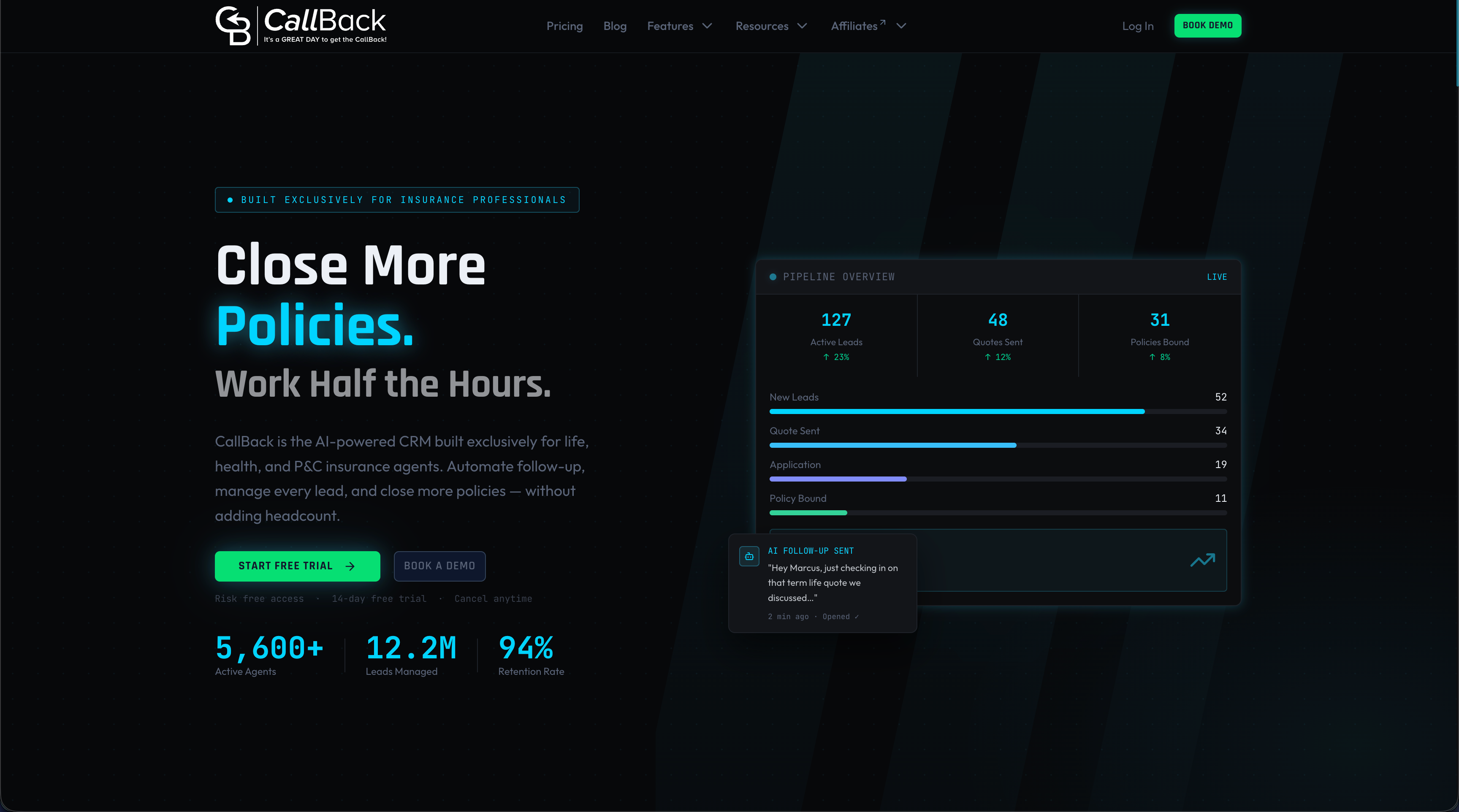
Callbackcrm’s AI-powered features include automated lead qualification, CRM routing, SMS marketing, and social media management tools that work together as one system. When a prospect engages with your post, Callbackcrm captures the lead, scores it, and triggers a personalized SMS follow-up before a competitor even sees the notification. The SMS marketing tools are optimized for mobile lead capture, which matters when more than 60% of your prospects are searching on their phones. Try a demo and see how much faster your pipeline moves when the follow-up runs itself.
FAQ
What platforms work best for health insurance agents?
Facebook and LinkedIn are the top two platforms for most health agents. Facebook excels at community building and local lead generation, while LinkedIn is best for reaching small business owners and HR professionals.
How often should health agents post on social media?
Post three to four times per week on your primary platform. Consistency matters more than frequency. Posting daily for two weeks and then disappearing produces worse results than a steady three-post weekly schedule maintained year-round.
What is the 60-second rule for social media leads?
Leads contacted within 60 seconds of inquiry convert at seven times the rate of later contacts. Automated CRM workflows and SMS tools make this response time achievable without manual monitoring.
How do health agents stay HIPAA compliant on social media?
Never confirm client status publicly, use generic response templates for all public comments, and obtain written consent before posting any testimonial. Place compliance disclaimers directly on the post, not only on linked pages.
What content ideas work best for health agents year-round?
Myth-busting posts, FAQ explainers, life-event-triggered content like “just turned 26?” or “starting a new job?”, and behind-the-scenes team content all perform well. Follow the 70/20/10 content rule to maintain the right balance between education, relationship building, and promotion.