

We recommend integrating Google Ads lead forms through a webhook or the Google Ads API for near-real-time delivery to a CRM. Zapier or similar middleware works as a no-code fallback when engineering resources are limited. Whichever method we choose, Google stores leads for only 60 days, deduplication by lead_id is required, and a privacy policy link on the form is mandatory.
TL;DR:
- Use a webhook for near-instant lead delivery with full control, but ensure it runs over HTTPS and handles retries securely.
- The Google Ads API retrieves leads on a schedule for multiple accounts and offers up to 60 days of retrievable data, suitable for centralized reporting.
- Zapier provides quick setup for no-code integration but introduces some latency and less precise field mapping, making it ideal for low-volume needs.
- Always deduplicate leads by lead_id, include secondary keys like gclid or order_id, and implement enhanced conversions to improve bidding accuracy.
- Regularly test the entire pipeline by sending test payloads, verifying tags, and filtering dummy data to maintain lead quality and optimize automation.
Table of Contents
- Comparing webhook, API, Zapier, and CSV delivery methods
- Setting up and testing a lead form webhook
- Google Ads API lead export: when it beats a webhook
- Running lead capture through Zapier when you lack a developer
- Protecting lead quality and bidding performance
- Testing and validating the full lead pipeline
- Fixing the most common integration failures
- What insurance agencies get wrong about lead routing
- A faster way to put Google Ads leads to work
- FAQ
- Sources
Comparing webhook, API, Zapier, and CSV delivery methods
Each delivery method fits a different stage of operational maturity. A webhook pushes lead data to a CRM endpoint the moment a form is submitted, giving near-instant routing with full control over parsing and validation. The Google Ads API pulls lead data on a schedule or on demand, which suits teams managing multiple accounts or building centralized reporting. Zapier and similar middleware connect Google Ads to a CRM or inbox without custom code, trading some latency and field-mapping precision for speed of setup. CSV exports and email notifications remain available but require manual handling and do not scale well.
- Webhook: lowest latency, highest control, requires development work.
- Google Ads API: best for multi-account retrieval and scheduled reporting.
- Zapier or middleware: fastest to launch, limited field mapping and added subscription cost.
- CSV or email: no setup cost, but manual and prone to delay.
Before choosing a method, confirm the lead form meets eligibility rules for campaign type and bidding strategy, since not every account qualifies for lead form assets.
Setting up and testing a lead form webhook
A webhook is the most direct path from form submission to CRM record. Follow this sequence when building one.
- In the Google Ads lead form asset, enter the webhook URL and the webhook key Google generates for verification.
- Confirm the endpoint runs over HTTPS and rejects any request that fails the key check.
- Parse the incoming payload’s
user_column_dataarray and map eachcolumn_idto the matching CRM field. - Store
lead_idas the deduplication key, since Google notes a single lead may be delivered more than once. - Add
gclidororder_idas a secondary match key where available, for tighter attribution. - Build idempotent write logic so repeated deliveries update rather than duplicate a record.
- Implement retry handling with exponential backoff and log every delivery attempt with timestamp and response code.
- Send a test payload through Google’s webhook testing tool and confirm the endpoint returns HTTP 200.
- Flag or ignore any payload marked as a test to keep dummy data out of the live pipeline.
Pro Tip: Log the raw payload for every webhook call, even successful ones, so a parsing bug discovered later can be traced back to the exact data that caused it.
Security review matters as much as the parsing logic. Verify the Google-provided key on every request, never trust an unauthenticated payload, and treat the endpoint as a public-facing surface that needs the same hardening as any other API route.

Google Ads API lead export: when it beats a webhook
The Google Ads API suits teams that manage several accounts or need leads pulled into a reporting layer on a fixed schedule rather than pushed instantly. It also gives a backup retrieval path if a webhook endpoint goes down temporarily, since leads remain retrievable for up to 60 days.
- A developer token and, in most cases, a manager account structure are required before any lead data can be queried.
- Retrieval covers up to 60 days of lead history, so a missed webhook delivery can still be recovered.
- Use
lead_idto deduplicate records pulled through the API against anything already received by webhook. - Watch polling cadence against rate limits; pulling too frequently wastes quota without adding useful freshness.
- Authentication errors are the most common failure point: expired tokens, missing scopes, or a developer token still pending basic access approval.
Choose the API when centralized retrieval across accounts matters more than instant delivery, and reserve webhooks for single-account setups that need the fastest possible routing.
Running lead capture through Zapier when you lack a developer
Zapier offers prebuilt templates that connect Google Ads lead forms directly to Gmail, CRMs, and spreadsheets without writing code. Authorize the Google Ads connection, select the lead form asset, and map each field to the destination action, whether that is a new CRM contact or an email alert.
- Field mapping in Zapier is less granular than a custom webhook, so confirm every column lands in the right CRM field before going live.
- Delivery can lag by a few minutes depending on polling frequency, and higher-volume plans carry added subscription cost.
- Run a small batch of test leads through the full chain and check the CRM record, not just the Zapier task history, before trusting it with live traffic.
Protecting lead quality and bidding performance
Clean data flow protects both the sales pipeline and Smart Bidding performance. Google stores lead form submissions for 60 days, so any integration that pulls data on a delay still has a recovery window, but back up leads on a regular schedule rather than relying on that window as a safety net.
- Deduplicate every incoming lead by
lead_id, and addorder_idorgclidas a secondary key when present. - Set up enhanced conversions for leads, which require SHA-256 hashing and normalized formatting, lowercase emails and E.164 phone numbers, before upload.
- Feed qualified or value-based conversion events back into Google Ads rather than raw form submissions alone, since accurate signals improve how Smart Bidding allocates spend.
- Mark offline conversions correctly so a closed sale is distinguished from a raw lead in reporting.
- Keep a visible privacy policy link on every lead form, a requirement tied to Google’s Customer Data Terms.
Testing and validating the full lead pipeline
Treat testing as a repeatable checklist, not a one-time check before launch — for an operational overview, see our Marketing Automation Checklist: Step-by-Step Guide for SMBs.
- Use the webhook test button in Google Ads and confirm both an HTTP 200 response and correct parsing on the CRM side.
- Check that the Google tag and enhanced conversions fire correctly using Google Tag Assistant or browser developer tools.
- Run a small-budget live campaign and watch the enhanced conversions diagnostics report for match rate issues.
- Confirm the integration correctly filters or flags test payloads so dummy leads never reach the live pipeline.
Pro Tip: Keep a dedicated test lead form running at all times so a code change can be verified without touching the production form.
Fixing the most common integration failures
- Missing leads: check form eligibility, account verification status, and user permissions on the lead form asset.
- Duplicate deliveries: confirm idempotent writes are working and check logs for repeated retry attempts.
- Malformed payloads: verify
column_idmappings match the current form fields, including optional fields. - Authorization failures: confirm the webhook key is current and the API developer token has active access.
What insurance agencies get wrong about lead routing
Speed matters more than most agencies assume. A lead sitting in an inbox for an hour has already cooled, while automated routing into a CRM with immediate SMS or email follow-up keeps the prospect engaged while the ad is still fresh in mind, a pattern visible in how insurance agents using automated routing shorten their lead-to-sale cycle. Prioritize phone number, coverage type, and zip code as the fields worth normalizing first, since those drive routing and compliance decisions before anything else does.
— Kyle
A faster way to put Google Ads leads to work
Building and maintaining a webhook takes ongoing engineering attention that many insurance agencies and agents do not have in-house. We built an AI-powered CRM platform to take that weight off the plate: leads come in, automated SMS and email follow-up start immediately, and the pipeline view shows exactly where each prospect stands without anyone touching a spreadsheet.
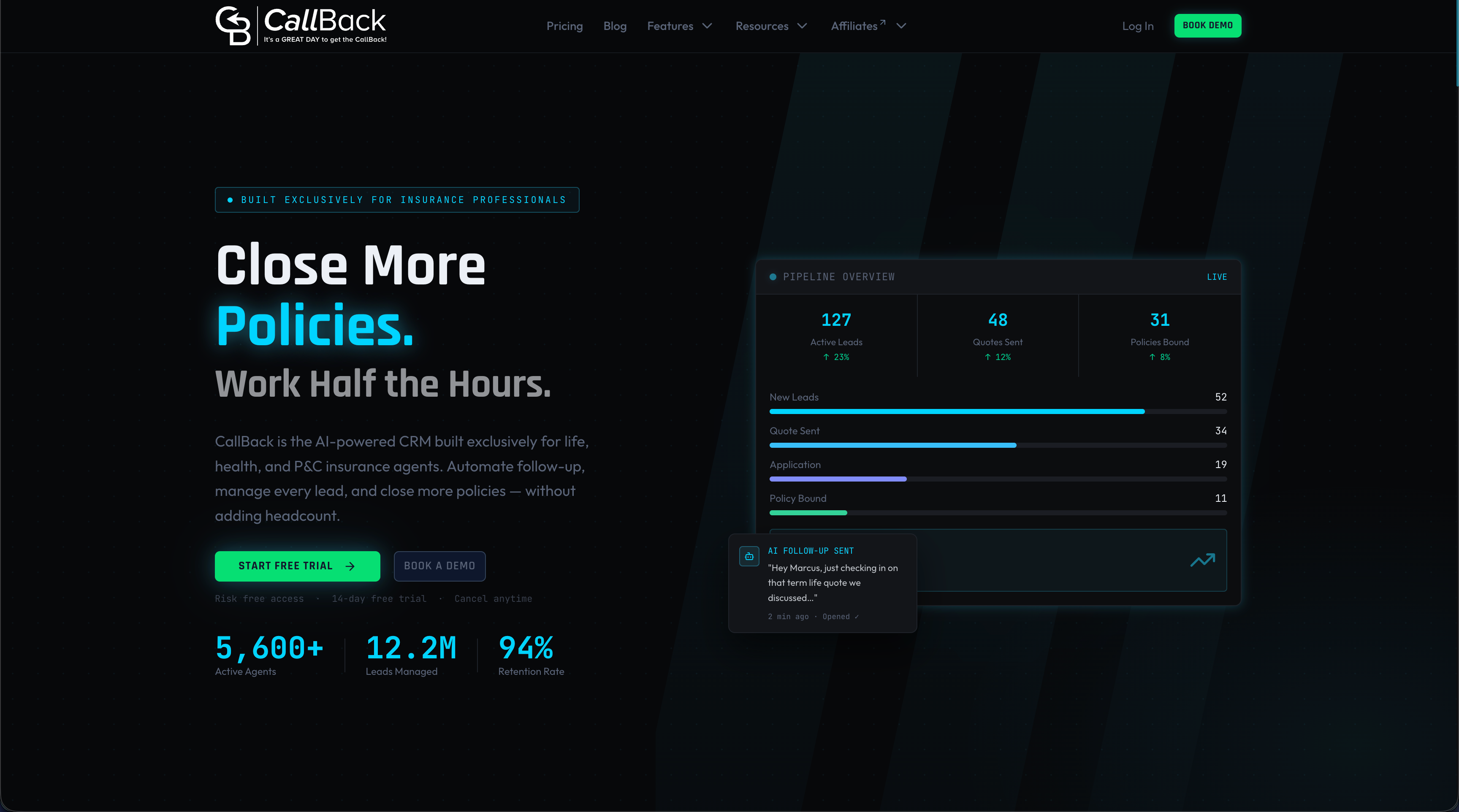
Our Professional plan runs $97 per month and includes the automation and CRM tools needed to connect ad-generated leads to a working follow-up sequence, while larger agencies managing multiple books of business can review Enterprise options built for multi-account teams. Explore the full feature set or start a signup today to see how quickly a new lead can reach a first message.
FAQ
Does Google Ads have a lead form?
Yes. Google Ads lead form assets let advertisers collect contact information directly within Search and Performance Max ads, without sending the user to a separate landing page.
What is the Google grant of $10,000?
This typically refers to the Google Ad Grants program for eligible nonprofits, which is separate from standard Google Ads lead form campaigns and has its own application and compliance rules. It does not apply to standard commercial advertising accounts running lead form assets.
Is $10 a day enough for Google Ads?
A $10 daily budget can generate some lead form activity, but volume will be low and may not produce enough data for Smart Bidding to optimize effectively. Testing at a modest budget is reasonable for validating an integration, as Google itself recommends small-scale live tests before scaling spend.
Can Google Forms be integrated into a website?
Google Forms, a separate product from Google Ads lead form assets, can be embedded into a website using Google’s built-in embed code. For Google Ads lead form data specifically, integration happens through a webhook, the Google Ads API, or a no-code tool like Zapier rather than a website embed.
Sources
- Best practices to integrate lead form ads with your CRM - Google Ads Help
- Testing | Lead Form Webhook | Google for Developers
- Send emails via Gmail for new Google Ads leads - Zapier integration