

Mortgage protection is life insurance that pays off a home loan if the homeowner dies during the policy term. For an agent, the product is easy to explain. The harder part is reaching new homeowners quickly, answering their questions about cost and coverage, and following up until they decide. This guide covers how the product works, what it costs, how it differs from PMI and term life, and how to run the follow-up so fewer prospects go quiet. CallBack CRM is built for insurance sales workflows and automates that follow-up by SMS, email and voicemail.
TL;DR
- Mortgage protection insurance (MPI) pays the mortgage lender if the borrower dies, and the benefit usually shrinks as the loan balance falls.
- It is optional. PMI and FHA MIP protect the lender and are a different product.
- NerdWallet reports premiums often run from about $20 to $100 or more per month, driven mostly by loan amount, age and term.
- MPI fits buyers who want simple underwriting or may not qualify for standard term life. Term life fits buyers who want a larger, flexible benefit.
- Speed and consistency of follow-up decide many sales. Automating texts, emails and voicemails keeps every new homeowner in a sequence.
Table of Contents
- What mortgage protection is
- What it covers and what it leaves out
- Types of benefit structure
- Mortgage protection vs. PMI, MIP and term life
- What mortgage protection costs
- Who mortgage protection fits
- Why follow-up decides mortgage protection sales
- Explaining the product without confusing the client
- Perspective
- What CallBack costs
- FAQ
- Sources
What mortgage protection is
Mortgage protection life insurance is a type of life insurance that helps pay off a home loan if the policyholder dies during the term. Progressive explains that premiums are typically fixed, coverage equals the mortgage balance and decreases over time, and the lender receives the payout. The family then has no mortgage payments to make.
Two points matter in every client conversation:
- The insurer usually pays the lender directly, not the family. Marcus by Goldman Sachs notes that the death benefit goes to the lender, so families cannot spend it on other bills.
- MPI generally needs no medical exam, according to Clark.com. Some policies ask a few health questions.
Some policies carry optional riders. Chase describes add-ons such as critical illness, disability and accidental death and dismemberment benefits, plus unemployment protection. Opendoor lists typical disability riders at 12 to 24 months of payments and involuntary unemployment riders at often 6 to 12 months, with waiting periods and benefit caps.
What it covers and what it leaves out
MPI usually covers the principal and interest on the mortgage. Kiplinger reports that property taxes and HOA dues are excluded and remain the family’s responsibility. This is a point to state plainly. A homeowner who hears “the mortgage is paid” may assume every housing cost is paid.
Some policies include living benefits. Progressive says these let the owner access part of the death benefit while alive, often through a rider that requires a serious illness, disability or sometimes job loss.
Coverage and exclusions differ by carrier. Walk each client through the policy’s exclusions, rider terms and rider costs in writing before the application.
Types of benefit structure
Mortgage life policies generally run 15 or 30 years. ValuePenguin explains that the death benefit can be decreasing, tied to the outstanding principal, or level. A level benefit can suit an interest-only mortgage because the principal stays the same.
The difference grows over time. Opendoor gives an example: on a $300,000 30-year mortgage, the balance after 15 years is roughly $200,000. A decreasing MPI benefit has fallen by about one-third by then, while a 30-year level term policy still pays the full $300,000. Opendoor also notes that most MPI policies are tied to a specific mortgage and may not transfer if the owner sells or refinances.
That last point shapes follow-up. Homeowners who refinance or move need a review of their coverage, and that is a natural reason to contact them again.
Mortgage protection vs. PMI, MIP and term life
Prospects confuse these products constantly, so a short comparison earns trust. NerdWallet states that MPI is not required, PMI is required on conventional loans with less than 20% down, and MIP is required on FHA loans. MPI pays off the mortgage for the borrower’s family if the borrower dies. PMI and MIP protect the lender if the borrower defaults.
| Product | Required? | Who it protects | What it pays |
|---|---|---|---|
| Mortgage protection (MPI) | No | The borrower’s family | Usually the loan balance, paid to the lender |
| PMI | Yes, on conventional loans under 20% down | The lender | Lender’s loss on default |
| FHA MIP | Yes, on FHA loans | The lender | Lender’s loss on default |
| Term life | No | The family | Any amount you choose, to a beneficiary you choose |
Homebuyer.com explains that PMI can be cancelled at 20% equity and ends automatically at 22% equity or the loan’s midpoint. FHA MIP carries a 1.75% upfront premium and lasts the life of the loan with under 10% down, or 11 years with 10% or more down. MPI is none of these. Opendoor’s comparison states that MPI is never required by a lender, sits outside the monthly housing payment and can be cancelled at any time.
Where MPI differs from term life
ValuePenguin’s comparison shows that term insurance allows any coverage amount over 5 to 40 years, with your choice of beneficiary and full underwriting. Mortgage insurance covers only the mortgage principal for the loan’s length, pays the lender, and limits underwriting to health questions. Experian adds that term proceeds can go to the mortgage, funeral costs, income replacement or college, while MPI’s no-exam underwriting can help homeowners whose health keeps them out of standard coverage.

Term life offers flexibility and larger benefits. MPI offers simplicity and easier approval. A good agent explains both and lets the buyer’s health, budget and goals decide. Quoting both in writing also gives the client a direct comparison.
What mortgage protection costs

NerdWallet reports that MPI premiums often range from about $20 to $100 or more per month. Loan amount drives most of the price. Age and repayment term also matter.
Opendoor gives an illustration for a healthy 35-year-old nonsmoker with a $300,000 30-year mortgage:
| Policy | Illustrative monthly cost | Benefit |
|---|---|---|
| MPI | $50 to $80 | Declining |
| 20-year term life | $20 to $30 | Level |
| 30-year term life | $30 to $45 | Level $300,000 |
These are illustrations, and carrier rates change. Use current carrier quotes for every client. The pattern is useful: simplified underwriting is why MPI premiums tend to run higher than term for healthy applicants, as Opendoor, citing the NAIC, explains. That is the trade for no exam and fewer questions. For some buyers, that trade is exactly what they want.
Who mortgage protection fits
MPI tends to fit these homeowners, according to the research from AmeriSave:
- Borrowers with serious health histories who might be declined or heavily rated by standard insurers.
- Borrowers aged 60 or older with long mortgages.
- Applicants who do not want a paramedical exam.
- Single-income households that want the payout directed to the lender.
DG Life Group adds that MPI can also work as mortgage-specific coverage on top of adequate life insurance, or as the simplest option when the family should have no decisions to make.
Timing matters. Experian says homeowners can typically apply during the first two years of the repayment term, and some insurers allow applications up to five years after closing. That makes new homeowners the core audience and makes early contact important.
Questions to settle before the application
- Who receives the benefit? Confirm in writing. Opendoor notes older policies paid the lender directly, while many modern policies pay a designated beneficiary.
- Does naming a personal beneficiary change the premium?
- What are the exclusions, rider terms and rider costs?
- Is the carrier backed by the state’s life insurance guaranty association?
- Does the policy follow the client if they refinance or move?
These are the questions clients should hear from the agent first. Answering them before the client asks makes the conversation shorter.
Why follow-up decides mortgage protection sales
Most mortgage protection prospects are new homeowners who just closed a loan. They are busy with a move, a stack of paperwork and a long list of other offers. They rarely decide on the first contact. A prospect who asked for information on Monday and heard nothing until Friday has often moved on.
The work breaks down into repeatable steps:
- Respond right away. Send a text and an email the moment a lead arrives, with the agent’s name and one clear next step.
- Explain the product in plain terms. Say what it pays, who gets the money and what it costs.
- Offer both options. Present MPI and term life side by side when the client qualifies for both.
- Keep the sequence going. Send reminders, a voicemail and a short email over the following days and weeks.
- Handle paperwork. Send proposals and contracts in a form the client can sign on a phone.
- Review at life events. Contact the client again at refinance, a move or a new baby.
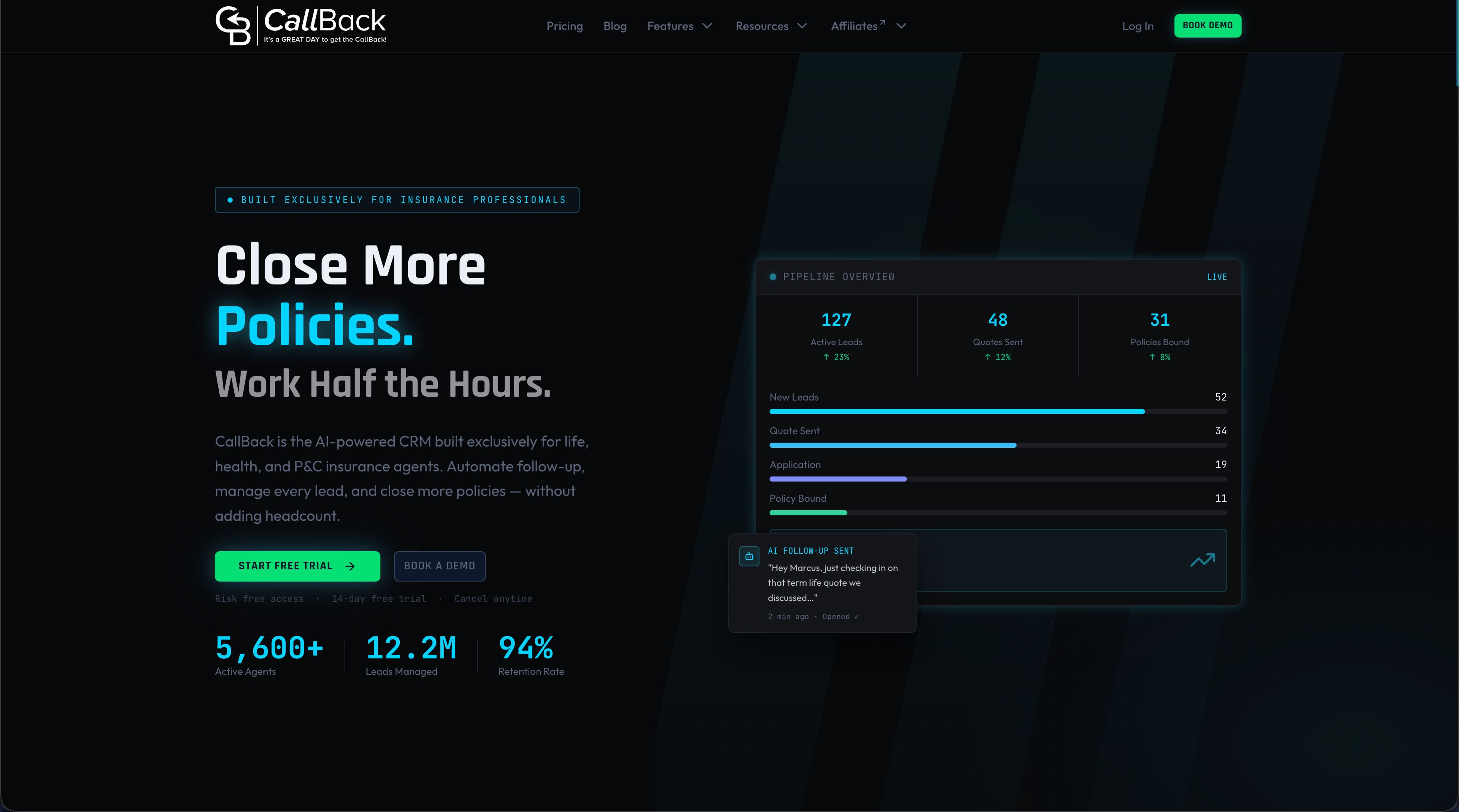
CallBack CRM is built for insurance sales workflows, with industry-tailored pipelines and automated follow-up by SMS, email and voicemail. The platform also includes workflow automation, proposal and contract tools, funnel and website builders and reputation management. Each step above maps to one of these tools. For related how-tos, see the guides on insurance funnel automation and lead generation workflows.
Texting that reaches the phone
SMS is the fastest channel for a new homeowner, but only if the message arrives. CallBack uses practices aimed at deliverability: unique message hashing, iMessage deliverability and carrier-approved verbiage. For an agent sending a few hundred follow-ups a week, that matters more than another template.
Pipeline stages for mortgage protection
A simple pipeline keeps nothing hidden:
- New lead
- Contacted
- Quote sent
- Application started
- Underwriting or approval
- Issued
- Review due at refinance or anniversary
Each stage can trigger its own message. A “quote sent” stage can start a reminder after two days. An “issued” stage can start a request for a review. For more on structuring this, read the funnel optimization guide and the guide to automating lead generation.
Explaining the product without confusing the client
Plain language closes more applications than product detail. A short script covers it:
- “Mortgage protection pays off your home loan if you pass away during the term.”
- “The money goes to your lender, so your family keeps the house without making payments.”
- “Property taxes and association dues are not included.”
- “The benefit usually goes down as your loan balance goes down, and the premium usually stays the same.”
These four sentences match what the research sources report. They also set accurate expectations. Clients who understand a policy keep it, and clients who keep it refer others.
Perspective
Most mortgage protection sales are lost after the first conversation, not during it. The homeowner liked the idea, meant to reply and never did. A message that arrives within minutes, a clear quote and a reminder two days later fix more of this than any change to the pitch.
We built CallBack for insurance agents who sell this way. Pipelines are set up for insurance sales, and follow-up runs by SMS, email and voicemail without manual data entry. The agent spends time on conversations with people who answer, not on tracking who to call next.
The same applies to agencies and IMOs. When a team shares one system, every lead has an owner, a stage and a next message. That keeps a pipeline of new homeowners from turning into a list of names.
Kyle
What CallBack costs
The Professional plan is $97 per month. Enterprise plans for teams are $297 per month for 10 full CRM accounts, $397 per month for 25 and $497 per month for 60, listed on the Enterprise page. The Unlimited AI Employee Bundle is $127 per month, and phone numbers cost $2.30 per month per number. SMS, email and AI usage are billed at wholesale rates, and the fees page lists each category.
Agents who want to put a mortgage protection follow-up sequence in place can start with the Professional plan and build the pipeline above. Agencies and IMOs with several producers can look at the Enterprise tiers.
FAQ
Is mortgage protection insurance required?
No. Lenders do not require it, and it is not part of the monthly housing payment. PMI is required on conventional loans with less than 20% down, and MIP is required on FHA loans, but those protect the lender. MPI is a separate, optional policy that protects the borrower’s family.
How much does mortgage protection cost?
NerdWallet reports premiums often range from about $20 to $100 or more per month. Loan amount is the main driver, followed by age and repayment term. Get written quotes from carriers for each client, since rates vary by company and by the buyer.
Does mortgage protection pay the family or the lender?
Usually the lender. The insurer pays the remaining loan balance, so the family has no mortgage payments to make. Some modern policies pay a designated beneficiary instead, so confirm this in writing for each policy.
When can a homeowner buy mortgage protection?
Experian says homeowners can typically apply during the first two years of the repayment term, and some insurers allow applications up to five years after closing. Contacting new homeowners soon after closing keeps them inside that window.
What is the difference between mortgage protection and term life?
Term life allows any coverage amount, pays a beneficiary the client chooses and uses full underwriting. MPI covers the mortgage, usually pays the lender, and has simplified underwriting. The benefit of MPI usually declines as the loan is paid down.
Sources
- NerdWallet: What Is Mortgage Protection Insurance?
- Progressive: What Is Mortgage Protection Life Insurance?
- Marcus by Goldman Sachs: Mortgage Protection Insurance
- Clark.com: What Is Mortgage Protection Insurance?
- Chase: What Is Mortgage Protection Insurance (MPI)?
- Opendoor: Mortgage Protection Insurance
- Kiplinger: Mortgage Protection Insurance Explained
- ValuePenguin: Mortgage Protection
- Homebuyer.com: MIP vs. PMI
- Experian: What Is Mortgage Protection Insurance?
- AmeriSave: Mortgage Protection Insurance
- DG Life Group: Mortgage Protection Guide