

Indexed universal life (IUL) is permanent life insurance with a death benefit, flexible premiums and a cash value account that earns interest linked to a market index. The product is explained in a few formulas: cap, participation rate, spread, floor, and policy charges. Agents who explain these clearly, and who follow up with prospects over the weeks and months an IUL decision takes, close more of the cases they open. CallBack CRM runs that follow-up through SMS, email and voicemail automation built for insurance pipelines.
TL;DR
- IUL is permanent insurance. Cash value is credited based on an index such as the S&P 500, but the money is not invested in the index itself.
- Crediting depends on four terms: cap, participation rate, spread and floor. A common floor is 0%, so a negative index year does not reduce the credited interest below the floor.
- Policy charges, premium loads and surrender periods reduce cash value. Clients need these explained in plain words before they buy.
- IUL costs more than term and usually less than whole life. A $500,000 policy averaged $335 a month for a 40-year-old woman in one 2026 rate analysis.
- IUL sales cycles are long. Automated, compliant follow-up keeps prospects engaged between the first call and the signed application.
Table of Contents
- What indexed universal life is
- IUL compared with term and whole life
- How the cash value is credited
- Premiums, charges and surrender periods
- Taxes: what agents can explain and what to refer
- Access to cash value and lapse risk
- What IUL costs
- Why IUL cases need a long follow-up process
- Where CallBack fits
- Our perspective
- FAQ
- Sources
What indexed universal life is
IUL is a type of permanent life insurance. It can last a lifetime and build cash value, with some or all of that value tied to the performance of a stock or bond index such as the S&P 500, according to NerdWallet. Like other universal life policies, it allows flexible premiums and an adjustable death benefit.
The key point for clients is that the policy owner does not buy shares. The North American Company’s IUL white paper states that an IUL is not an investment in the stock market. Interest is based on a selected index, funds are not invested in the index’s stocks, and the index does not include dividends.
The search volume for this topic is high because prospects hear about IUL from ads, social media and relatives, then arrive with partial information. An agent who opens with a clear definition earns the first minute of trust.
IUL compared with term and whole life
Prospects usually compare IUL with the two products they already know. The comparison below follows NerdWallet’s side-by-side tables.
| Feature | Term life | Whole life | Indexed universal life |
|---|---|---|---|
| Length | Set period, such as 10, 20 or 30 years | Lifetime | Lifetime |
| Cash value | None | Grows at a fixed, guaranteed rate | Tied to index and fixed-rate options; can decline |
| Premiums | Fixed | Fixed, no flexibility | Flexible |
| Death benefit | Fixed | Fixed | Adjustable |
| Relative cost | Lowest | Generally higher than IUL | Less than whole life, well above term |
This table is a good client handout. It shows where each product fits and why the cost difference exists. Term answers a temporary need at the lowest price. Whole life offers guarantees. IUL offers flexibility and index-linked growth potential.
How the cash value is credited
This is the section clients ask about most. Four terms control how much interest the account earns in a period. The Wall Street Journal’s IUL explainer gives examples of each.
- Cap. The maximum interest credited. With an 8% cap and a 15% index return, 8% is credited.
- Participation rate. The share of the index gain credited. At 80% participation, a 10% gain credits 8%.
- Spread. A percentage subtracted from the index gain. A 2% spread on a 10% gain credits 8%. Some policies use a spread instead of a cap.
- Floor. The minimum credit, typically 0%. If the index falls, the credit is not below the floor.
Guardian Life adds that participation rates usually range from 50% to over 100%, and that the floor is commonly 0%.
A worked example for clients
Take a policy with a 9% cap, 100% participation and a 0% floor.
- The index rises 12% in the crediting period. The policy credits 9%.
- The index rises 4%. The policy credits 4%.
- The index falls 10%. The policy credits 0% for that index credit.
In all three years, policy charges are still deducted from the cash value. That is the part clients often miss, and it belongs in the same conversation as the floor.
Carrier designs differ. Kansas City Life describes 12-month segments, where an indexed credit is calculated at segment maturity from the change in the S&P 500, with limits declared at the start of the segment and guaranteed for the segment term. Its accounts use different mechanisms, such as a growth cap, a participation proportion, or a higher minimum cap with an account charge. Agents should read the specific carrier’s guide before quoting any rate.
Premiums, charges and surrender periods
Premiums, less a premium load, go into the cash value. Monthly charges are then taken out. Pacific Life’s IUL guide lists administrative, coverage, cost-of-insurance and rider charges. The policy can be surrendered for its cash value less surrender charges and any outstanding policy debt.
A specific product shows the scale. The AIG product sheet (revised 05/25) lists:
- A current premium load of 10% up to target premium and 18% above target.
- A monthly administration fee of $10.
- A surrender charge period of up to 19 years.
- A guaranteed interim account interest rate of at least 2.00%.
These are one carrier’s figures for one product. Another carrier’s schedule will differ. The useful habit is to pull the current product sheet before each client meeting and walk through the load, the monthly fee and the surrender period.
Death benefit options
The same AIG sheet describes two common structures. Option 1 is level: the specified amount, or a corridor multiple of the accumulation value if higher. Option 2 is increasing: the specified amount plus the accumulation value. Increases are available subject to evidence of insurability. Clients who want the highest cash accumulation and clients who want a growing death benefit often need different options, so the choice is worth a short conversation.

Taxes: what agents can explain and what to refer
The tax treatment is a main reason clients ask about IUL. The WSJ explainer notes that cash value grows tax-deferred, withdrawals up to premiums paid are tax-free, and loans are income-tax-free as long as the policy stays in force.
Pacific Life’s Horizon IUL 2 brochure states the conditions behind tax-free income:
- Withdrawals do not exceed tax basis, generally the premiums paid less prior withdrawals.
- The policy stays in force until death. Policy debt above tax basis at lapse or surrender is taxable.
- Withdrawals in the first 15 policy years do not cause, or occur close to, a reduction in benefits.
- The policy does not become a modified endowment contract (MEC).
A MEC is a policy funded above the limits in the federal tax code. Per the AIG sheet, withdrawals or loans from a MEC are taxed as regular income, and a 10% penalty may apply before age 59½. Death benefits are generally income-tax-free under IRC Section 101(a)(1), with exceptions such as transfers for valuable consideration.
Agents explain the rules and the carrier illustration. For a client’s individual tax situation, the client’s CPA or tax attorney is the right professional to consult.
Access to cash value and lapse risk
Clients can take loans or withdrawals. Allstate notes that these may permanently reduce the death benefit, and that IUL is not designed for cash access until the policy has been in force for many years, typically at least 15. If cash value is drained too far, the policy can lapse.
Securian lists further points to disclose: lapse from insufficient premium, loans and withdrawals that reduce death benefit and surrender value, caps and participation rates that can change over time, and no index credit when the index is flat or down. Most IULs include no-lapse guarantees for the early years if required premiums are paid, per the WSJ.
Guardian describes IULs as policies that need diligent funding and monitoring. That is a useful frame for the agent’s role. A policy reviewed every year with the client stays on track, and that review is also a reason for the client to keep talking to the agent.
What IUL costs
Price is the second most common question after the definition. In MoneyGeek’s 2026 rate analysis, a $500,000 IUL policy averaged:
| Age | Woman, monthly | Man, monthly |
|---|---|---|
| 40 | $335 | $408 |
| 60 | $866 | $1,059 |
| 70 | $1,590 | $1,947 |
The same analysis shows smoking adds about 60% at age 40 ($537 for women, $649 for men), and doubling coverage to $1 million roughly doubles the rate. Premiums depend on age, coverage amount, health class and tobacco use. Funding level matters too: target, maximum and minimum funding produce different premiums.
These are averages for one year and one data set. Real quotes come from carrier illustrations, and the agent should run one for each client.
Why IUL cases need a long follow-up process
An IUL conversation rarely closes on one call. The prospect compares it with term and whole life, asks a spouse, talks to an accountant, and returns with questions about the cap. Most of the lost cases are not rejections. They are prospects who went quiet because nobody followed up with the next useful piece of information.
A workable IUL follow-up sequence has a few stages:
- Same day. A short text confirming the conversation and sending the comparison table above.
- Day two or three. An email that explains cap, participation and floor with the worked example.
- One week. A message about cost, with the quote the agent prepared and a link to book a call.
- Two to four weeks. A check-in that addresses the usual objection, such as charges or access to cash.
- After the sale. An annual review reminder, because funding and performance need monitoring.
Doing this by hand across dozens of open cases is where agents fall behind. The principles behind it are covered in CallBack’s guide to insurance lead nurturing and in its lead generation workflow tutorial. For the wider marketing side, lead nurturing strategies cover how staged messages raise conversion.
Compliance in the messages
IUL messaging has to stay accurate. Describe IUL as permanent life insurance with index-linked crediting, never as a stock market investment. State that caps, participation rates and charges apply. Use the carrier’s approved materials. Reusable message templates make this easier, because each sequence is reviewed once and then sent consistently.
Where CallBack fits
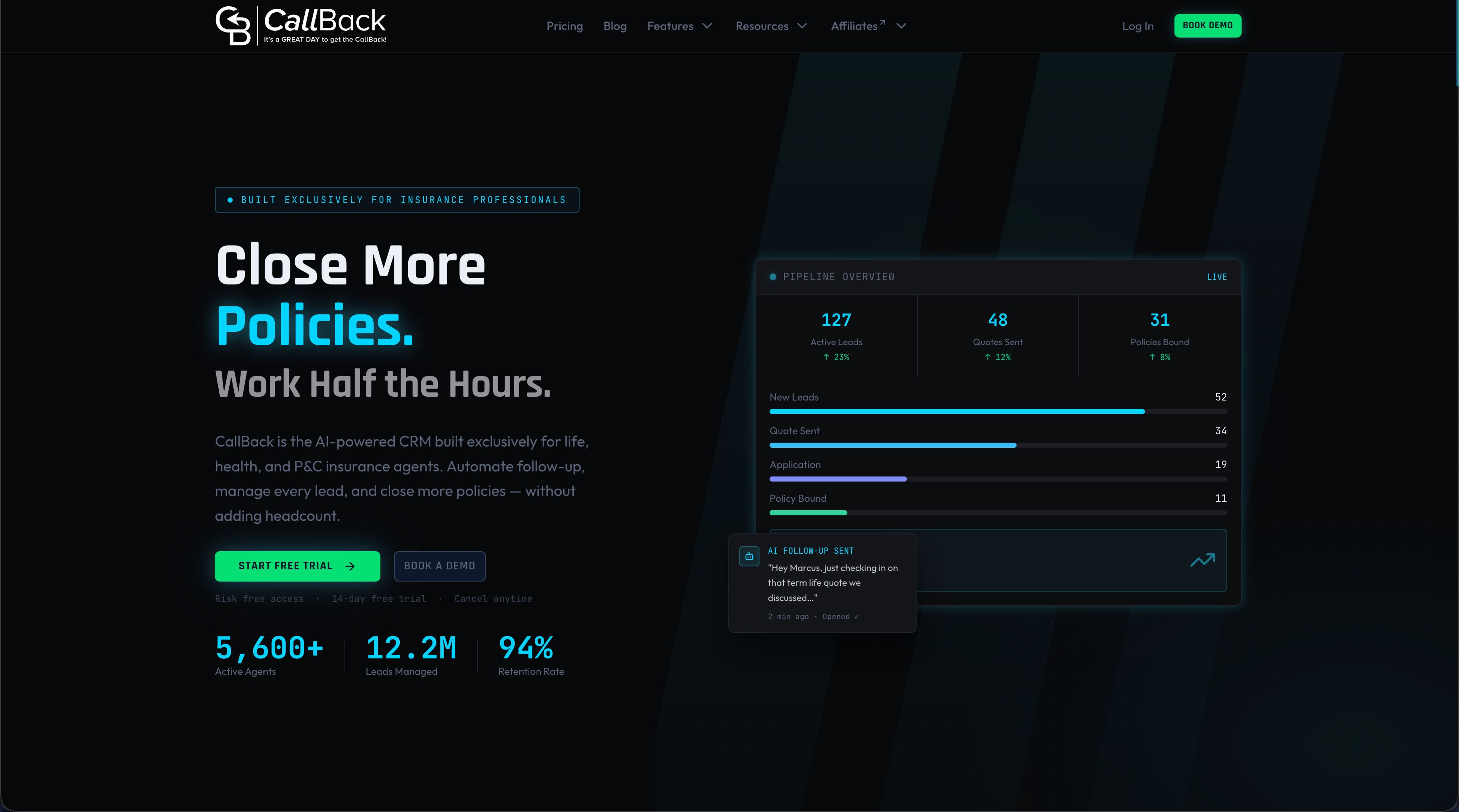
CallBack is a CRM and sales automation platform built for insurance agents, agencies and IMOs. It includes pipeline management, automated follow-up by SMS, email and voicemail, workflow automation, AI assistants, funnel and website builders, and reporting. An IUL pipeline can be set up with stages from first contact to application, with each stage tied to the follow-up steps above.

On delivery, CallBack uses unique message hashing, iMessage deliverability and phone-carrier-approved verbiage, so follow-up texts are built to reach the prospect.
Published pricing:
- Professional: $97 per month.
- Enterprise: $297 per month for 10 full CRM accounts, $397 per month for 25, and $497 per month for 60.
- Unlimited AI Employee Bundle: $127 per month.
- Phone numbers: $2.30 per month per number.
SMS, email and AI usage are billed at wholesale rates, listed on the fees page. Agents can start with the Professional plan, and agencies with several producers can look at the Enterprise plans.
For agents who sell IUL alongside final expense, mortgage protection or annuities, one platform can hold all of those pipelines. The final expense lead nurturing guide shows the same approach for a different product.
Our perspective
IUL is one of the most explained products in insurance, and one of the least consistently explained. Two agents can describe the same policy and leave the client with different ideas about what the floor means.
We built CallBack around insurance sales workflows, so the follow-up that explains a product like IUL does not depend on an agent’s memory. The cap example goes out on day two. The cost message goes out in week one. The annual review reminder goes out every year.
Our view is that the agents who grow with IUL are the ones who combine clear explanation with steady follow-up. Automation handles the second part, so the agent’s time goes to the conversations that need a licensed person.
Kyle
FAQ
Is indexed universal life invested in the stock market?
No. The cash value earns interest based on the performance of an index such as the S&P 500, but the funds are not invested in the index’s stocks, and the index does not include dividends. A floor, commonly 0%, sets the minimum credit. Policy charges are still deducted.
What is the downside clients ask about most?
Charges and caps. Premium loads, monthly policy charges and surrender periods reduce cash value, and caps limit the credited gain. Surrender periods run up to 19 years on one carrier’s product sheet. Reviewing the carrier illustration with the client covers this before the application.
How much does a $500,000 IUL policy cost per month?
MoneyGeek’s 2026 analysis puts the average at $335 a month for a 40-year-old woman and $408 for a man. At 60 it rises to $866 and $1,059. Age, health class, tobacco use and funding level all change the price, so a carrier illustration gives the actual figure.
How should agents follow up with IUL prospects?
With a staged sequence: a same-day text, an explanatory email within three days, a cost message in the first week, and check-ins over the following weeks. CRM workflows can send each step automatically and stop the sequence when the prospect replies or books.
Sources
- NerdWallet: Indexed Universal Life Insurance (IUL)
- Wall Street Journal: How Indexed Universal Life Insurance Works
- North American Company: The indexed universal life approach
- Guardian Life: Indexed Universal Life Insurance
- Kansas City Life: Indexed Universal Life Insurance
- Pacific Life: How Indexed Universal Life Works
- AIG product sheet, rev. 05/25
- Pacific Life: Pacific Horizon IUL 2 brochure
- Allstate: What Is Indexed Universal Life Insurance
- Securian Financial: Indexed Universal Life Insurance
- MoneyGeek: Indexed Universal Life Insurance Cost (2026 Rates)