

Health insurance is a contract: the client pays a premium, and the insurer pays part of the client’s medical costs. Agents win health clients by explaining that contract in plain words and by answering every inquiry before it goes cold. During the November to January enrollment season, the agent who replies first usually has the advantage. CallBack is a CRM and automation platform built for insurance agents, and it handles the follow-up side: SMS, email and voicemail outreach, pipelines and workflows in one place.
This guide covers two things. First, the health insurance basics clients ask about most, with official sources. Second, a follow-up routine that turns those questions into booked calls.
TL;DR
- Health insurance comes from employers, direct purchase, the Marketplace, or public programs such as Medicare and Medicaid. Each path has its own rules and deadlines.
- Clients confuse four cost terms: premium, deductible, copayment and coinsurance. Explaining them with one worked example removes most objections.
- Marketplace Open Enrollment on HealthCare.gov runs November 1 through January 15 each year. Special Enrollment Periods apply after events such as job loss, marriage, birth or a move.
- Premium tax credits and cost-sharing reductions depend on income and household, and require enrollment through a Marketplace.
- Fast, consistent follow-up across SMS, email and voicemail is where an automation platform earns its place in an agency.
Table of Contents
- What health insurance is, in the words clients use
- Where clients get coverage
- The four cost terms clients mix up
- Plan types and networks
- Subsidies, Medicaid and CHIP
- Enrollment windows set the calendar
- What changed for 2026
- How clients find and compare health options
- A follow-up routine for health leads
- CallBack for health insurance agents
- Perspective
- FAQ
- Sources
What health insurance is, in the words clients use
MedlinePlus, a service of the National Institutes of Health, defines health insurance as a contract. The client buys a plan or policy, and the company agrees to pay part of the client’s expenses when the client needs medical care. Most people in the U.S. get it through an employer, by buying directly, or through Medicare or Medicaid.
For Marketplace plans, HealthCare.gov says qualified plans cover 10 essential health benefits, free in-network preventive services, and pre-existing conditions. That is a short, accurate answer to the first question many new clients ask: “Will I be covered if I already have a condition?”
Keep the first call simple. A client who understands the contract in one sentence is far more likely to stay on the line for the comparison that follows.
Where clients get coverage
The Centers for Medicare & Medicaid Services (CMS) groups coverage into private insurance (employer, direct, or Marketplace) and public programs, including Medicare, Medicaid and Veterans Health Administration coverage. The table below shows who each route usually fits.
| Route | Typically fits | What the agent should confirm |
|---|---|---|
| Employer coverage | Employees offered a group plan | Whether the plan is fully insured or self-funded, and what the employee share costs |
| Marketplace plan | Self-employed, early retirees, people between jobs, anyone without an employer offer | Income, household size, ZIP code, enrollment window |
| Medicare | People 65 and older and some people with disabilities | Eligibility date and which parts the client needs |
| Medicaid and CHIP | Lower-income households, children, pregnant people, some people with disabilities | State rules, income, immigration status |
| COBRA | People who just lost job-based coverage | Election deadline and the full premium |
COBRA after a job loss
CMS explains that COBRA generally lets a person continue employer coverage for a limited period. It is often more expensive, because the employer no longer has to pay its share and may charge up to 2% for administration. The election window is typically 60 days.
This is a frequent moment to reach a new client. Someone who just lost a job is comparing COBRA with a Marketplace plan, and the same CMS material notes that a Special Enrollment Period or Medicaid and CHIP may also be options. A same-day reply with a clear comparison puts the agent ahead of a client’s own web searches.
The four cost terms clients mix up
CMS defines the terms this way:
- Premium: the amount paid to keep the plan active.
- Deductible: the amount the client pays for certain covered services before the plan starts to pay.
- Copayment: a fixed charge for a service, such as a doctor visit.
- Coinsurance: a percentage of the plan’s allowed amount that the client pays.
HealthCare.gov adds a useful distinction: the premium is paid even when no care is used, while deductibles and other out-of-pocket costs are paid when covered services are received.
The out-of-pocket maximum is the last piece. Kaiser Permanente’s guide says it is the most a person pays in a year for covered care, and after that the plan pays 100% of most covered services.
A worked example for the call
The numbers below are a hypothetical plan, used only to show the arithmetic.
- Monthly premium: $400, so $4,800 a year
- Deductible: $1,500
- Coinsurance: 20%
- Out-of-pocket maximum: $6,000
The client has a covered hospital bill of $10,000. The client pays the first $1,500 (deductible). On the remaining $8,500, the client pays 20%, which is $1,700. The client’s share of the bill is $3,200, below the $6,000 maximum. Add the $4,800 in premiums and the year costs this client $8,000 in total. A client who sees the premium and the bill side by side understands why a cheaper premium can cost more in a bad year.
Plan types and networks
HealthCare.gov lists four major plan designs:
- HMO: generally limits nonemergency care to the plan’s network.
- PPO: allows out-of-network care at a higher cost.
- POS: generally requires referrals to see specialists.
- EPO: generally covers only network care, except in emergencies.
The same page tells shoppers to weigh premiums and out-of-pocket costs, the plan type, and whether the plan covers their doctors, facilities and drugs. Those three checks make a good discovery script. Ask for the client’s doctors and prescriptions first, then discuss price.
Subsidies, Medicaid and CHIP
Financial help is where clients most often assume they do not qualify. Keep the pieces separate.
KFF’s subsidy guide describes two kinds of help: premium tax credits, which lower monthly premiums, and cost-sharing reductions, which lower deductibles and other out-of-pocket costs. Both require enrollment through a Marketplace. Premium tax credits may apply to Bronze, Silver, Gold and Platinum plans, while cost-sharing reductions are associated with Silver plans for eligible enrollees.

HealthCare.gov says Marketplace eligibility generally requires U.S. residence, citizenship, nationality or lawful presence, and not being incarcerated. Being able to enroll is a separate question from being able to receive federal savings. Say so on the call so the client is not surprised later.
For Medicaid and CHIP, CMS says eligibility can depend on income, household size, age, pregnancy, disability, state residence, and citizenship or immigration status. Applications can go to the state agency at any time, because there is no open enrollment period, or through a Marketplace application that screens for Medicaid and CHIP and passes the information to the state when appropriate.
Lawfully present immigrants may qualify for premium tax credits and cost-sharing reductions, and qualified noncitizens may qualify for Medicaid or CHIP under state rules, often with a five-year waiting period. Immigration questions are specific to each household. Take the facts, then confirm with the official Marketplace or state agency.
Enrollment windows set the calendar
HealthCare.gov lists annual Open Enrollment as November 1 through January 15. December 15 is generally the deadline for coverage that starts January 1, and January 15 is the deadline for coverage that starts February 1. Check the official site each year for the current schedule, since details can shift.
Outside that window, CMS materials say a Special Enrollment Period can follow a qualifying event such as loss of job-based coverage, marriage, birth, adoption or a move. The period and the proof required depend on the event.
For applications, HealthyChildren.org advises people to have income information, identification, proof of citizenship or lawful presence, Social Security numbers and a ZIP code ready. Send that list by text or email right after the first call. It saves the second call.

What changed for 2026
A few federal changes affect what agents tell clients.
- Network standards. For plan years starting on or after January 1, 2026, state Marketplaces and state-based Marketplaces on the federal platform must apply provider time-and-distance standards and review network adequacy before certifying plans.
- HSA eligibility. KFF reports that beginning January 1, 2026, Bronze and catastrophic plans in the individual market are treated as HSA-eligible high-deductible plans, on and off the Marketplace.
- Catastrophic coverage. The same KFF report says September 2025 guidance widened the catastrophic-plan hardship exemption starting in 2026 for some people who cannot receive premium tax credits or cost-sharing reductions because of income. California, Connecticut, Maryland and the District of Columbia are exceptions.
- Broker conduct. The 2025 federal payment notice, effective June 4, 2024, strengthened Marketplace requirements on network adequacy, standardized plans, Special Enrollment Periods, auto-reenrollment and broker or web-broker conduct.
The last item matters for agency owners. Documented, consistent client communication is part of running a clean health book, and a CRM that logs every message and call supports that habit.
How clients find and compare health options
A client usually starts with a search, a government site, a carrier page or a social ad. Then the client submits a form with several agents at once. Volume comes from lead sources such as paid ads for lead generation across search and social channels. Speed and quality of follow-up decide who gets the policy.
For agents building their own pipeline, these CallBack guides cover the groundwork:
- Types of lead generation for insurance agents
- Why lead generation is vital for insurance agents
- How to generate insurance leads that actually convert
A follow-up routine for health leads
Health leads are time-boxed. A client who inquires on December 3 needs a plan chosen before the December 15 cutoff for January 1 coverage. The routine below is built around that pressure. CallBack handles the repetitive parts, so the agent spends time on conversations.
Step 1: Capture every inquiry in one pipeline
Form fills, calls, texts and referrals should land in one place with a source tag. Where it goes wrong: leads scattered across inboxes and spreadsheets, with nobody sure who replied. CallBack’s CRM keeps the pipeline and contact record together, with industry-tailored pipelines for insurance.
Step 2: Reply in minutes, not hours
Send a short text and email the moment a lead arrives: who you are, what you can help with, and a link to book a call. Where it goes wrong: manual replies that wait until the agent is free. CallBack’s automated follow-up goes out by SMS, email and voicemail, and its workflows can start on a trigger such as a new form submission.
Step 3: Collect the application basics before the call
Use the checklist from the enrollment section: income information, identification, proof of citizenship or lawful presence, Social Security numbers and ZIP code. Where it goes wrong: a client who learns about missing documents on the day of the deadline. An automated message with the list, sent right after booking, avoids that.
Step 4: Run the comparison call
Start with doctors and prescriptions, then premium, deductible, coinsurance and out-of-pocket maximum, using the worked example above. Record the outcome in the CRM so the next message matches what was discussed.
Step 5: Keep following up
Some clients need a few days and a nudge before the deadline. Others need a reminder at renewal or after a life event. Automation workflows keep that outreach consistent. CallBack’s deliverability practices include unique message hashing, iMessage deliverability and carrier-approved verbiage for texts.
Step 6: Ask for a review
Clients who finish enrollment are the best source of local reputation. CallBack includes reputation management, so review requests can be part of the same workflow.
More detail on building these flows is in the lead generation workflow tutorial and the step-by-step lead generation guide.
CallBack for health insurance agents
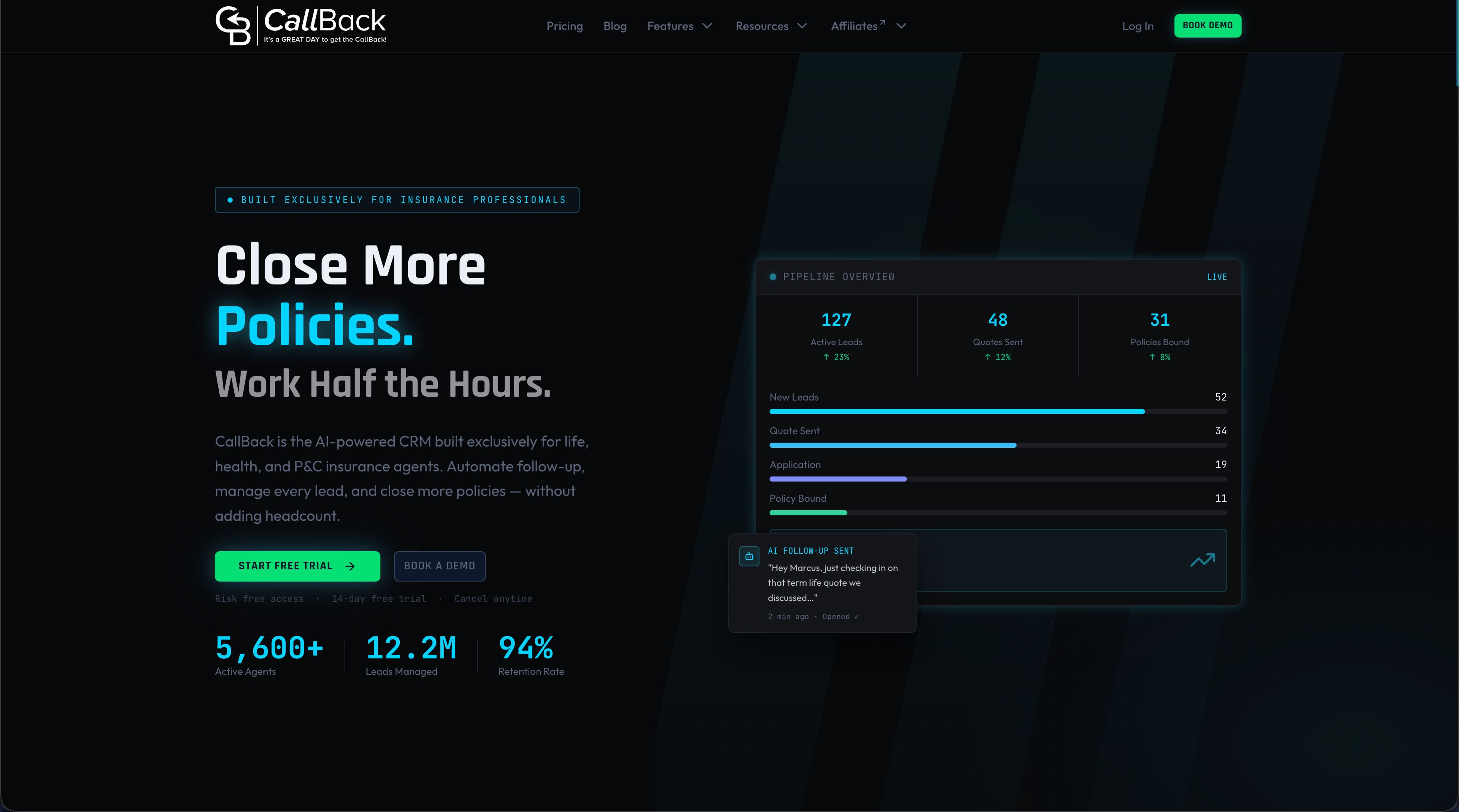
CallBack brings the CRM, pipeline management, email and SMS marketing, funnel and website builders, AI assistants, workflow automation, reputation management and mobile app access into one subscription for insurance agents, agencies and IMOs. Health insurance is among the lines it serves, alongside Medicare, final expense, mortgage protection and others.
Published pricing, as read from the site:
- Professional: $97 per month
- Enterprise: $297 per month for 10 full CRM accounts, $397 per month for 25, and $497 per month for 60
- Unlimited AI Employee Bundle: $127 per month
- Phone numbers: $2.30 per month per number
SMS, email and AI usage are billed at wholesale rates. The full list is on the fees page. The platform’s landing page shows the full feature set.
Perspective
Health insurance is a seasonal business with a hard clock. The deadlines come from HealthCare.gov and the carriers, and they do not move for an agent who replied late.
We built CallBack for insurance sales workflows, so the pipeline, the follow-up and the outreach channels sit in one system. Our aim is to take manual work off the agent: data entry, lead scoring, first replies and reminders. The agent keeps the part that needs a licensed professional, which is explaining the plan and guiding the choice.
We also think old habits like cold calling are a poor use of an agent’s time. When AI helps identify the leads that matter and personalize the message, agents spend their hours on warm conversations. That is the approach behind our platform.
Kyle
FAQ
When is health insurance Open Enrollment?
On HealthCare.gov, Open Enrollment runs from November 1 through January 15. December 15 is generally the deadline for January 1 coverage, and January 15 is the deadline for February 1 coverage. Check the official site each year for the current schedule.
What is the difference between a premium and a deductible?
The premium is the amount paid to keep the plan active, whether or not the client uses care. The deductible is what the client pays for certain covered services before the plan starts paying its share.
Can someone enroll in health insurance outside Open Enrollment?
Yes, in some cases. CMS materials describe Special Enrollment Periods after events such as loss of job-based coverage, marriage, birth, adoption or a move. The period and the proof needed depend on the event. Medicaid and CHIP have no open enrollment period, so applications can be made at any time.
What documents does a client need to apply?
HealthyChildren.org lists income information, identification, proof of citizenship or lawful presence, Social Security numbers and a ZIP code. Sending this list before the comparison call keeps the application moving.
Sources
- Health Insurance: MedlinePlus
- Tips about the Health Insurance Marketplace, HealthCare.gov
- Health Insurance Basics, CMS
- Health Coverage Basics, CMS
- 3 things to know before you pick a health insurance plan, HealthCare.gov
- How Does Health Insurance Work? Kaiser Permanente
- Explaining Health Care Reform: Questions About Health Insurance Subsidies, KFF
- Medicaid and CHIP fast facts, CMS
- Health Coverage Options for Immigrants, CMS
- Health Insurance Marketplace Open Enrollment, HealthyChildren.org
- CMS Final Rule for 2025 Qualified Health Plans
- Policy Changes Bring Renewed Focus on High-Deductible Health Plans, KFF
- HHS Notice of Benefit and Payment Parameters for 2025, Federal Register