

Term life insurance is the simplest product an agent sells and one of the easiest to lose. The product is easy to explain: a premium buys a death benefit for a set number of years. The sale is lost in the gaps, such as a lead that is not called back for hours, a quote that is never followed up, or a client who is never contacted as the term nears its end. This guide covers how term life works, what clients ask about cost, and how to set up follow-up so term leads become policies. CallBack CRM is built for this kind of insurance follow-up, with automated SMS, email and voicemail on insurance pipelines.
TL;DR
- Term life pays a death benefit only if the insured dies during the term. Premiums are level during the term and rise at renewal.
- Term sales are growing. LIMRA reported term new annualized premium of $824 million in the second quarter of 2026, up 6% from a year earlier.
- Clients usually overestimate price. Showing a real monthly figure early moves the conversation forward.
- Most lost term sales come from slow or inconsistent follow-up, not from the product.
- A CRM with insurance pipelines and automated outreach keeps every lead, quote and renewal date in one place.
Table of Contents
- What term life insurance is
- Why term life is a steady source of business
- Term lengths, renewal and the end of the term
- How much coverage to recommend
- What term life costs: figures to use in the conversation
- Underwriting: what to tell the client before the application
- Where term life sales are lost
- Building the term pipeline
- Pricing the tools
- Set up term life follow-up with CallBack
- FAQ
- Sources
What term life insurance is
Term life covers a defined period. The insurer pays a lump-sum death benefit to the beneficiaries if the insured dies within that period and premiums are current. The Texas Department of Insurance describes term as protection for one year or for five to 30 years or longer. If the insured outlives the term, there is no payout. The NAIC Life Insurance Buyer’s Guide adds that most term policies do not build cash value.
The NAIC is the National Association of Insurance Commissioners, the body of state insurance regulators. Its consumer guidance is a good reference to give clients who want an independent explanation.
The main terms to explain in plain words:
- Level term. The premium and death benefit stay fixed for 10, 15, 20, 25 or 30 years. Fidelity lists these standard lengths.
- Yearly renewable term. New York Life describes this as temporary coverage with premiums that start low and increase every year.
- Convertible term. The policy can be exchanged for permanent coverage. New York Life notes that conversion to whole life is generally available within the first ten years of the policy.
- Return-of-premium term. Farmers Insurance describes an option that refunds up to 90% of premiums paid if the insured survives the term.
Why term life is a steady source of business
The demand is there. LIMRA’s second quarter 2026 sales survey reported that term new annualized premium with excess premium rose 6% to $824 million, and term policy count rose 5% year over year. Total individual life new annualized premium was $4.75 billion for the quarter. LIMRA publishes these figures quarterly, so check its newsroom for the latest release.
Term is also an entry point. A client who buys 20-year term at 32 is a future prospect for conversion, additional coverage, annuities or retirement planning. Agents who track those clients keep the relationship. Agents who do not lose it when the policy is issued.
Term lengths, renewal and the end of the term
Clients rarely ask what happens at the end of the term. They should be told up front, and agents should have a plan for that date.
The Texas Department of Insurance states that premiums stay the same for the entire term but rise at renewal, because they are based on the client’s age at that point. It also notes that most companies offer term only up to age 70 or 80. Fidelity states that extending a term policy usually means a significantly higher premium.
The NAIC’s consumer article on choosing a policy type explains that a term policy may allow renewal even if health has changed, but at a higher price. If a policy is non-renewable, the client must apply for new coverage. The NAIC also advises not canceling a current policy until a new one is in force. Agents should repeat this to every client who is replacing coverage.
Matching term length to the need
The usual rule is to match the term to the obligation:
- A 30-year mortgage points to a 30-year term.
- Young children point to a 20-year term, to cover the years until they are independent.
- A short-term business loan or a bridge to retirement points to 10 or 15 years.
MoneyGeek makes the same point for families with a mortgage and children: 20- or 30-year terms matched to those obligations. Issue ages also limit the choice. One carrier’s term marketing guide (2021) lists issue ages of 18 to 75 for a 10-year term, 18 to 65 for 20 years and 18 to 55 for 30 years. Each carrier sets its own limits, so check the current guide for the carrier in question.
How much coverage to recommend
There is no single formula. Mass.gov’s consumer guide says some consumer groups suggest five times gross annual income, while insurance industry organizations suggest ten times. For a $40,000 income, that is $200,000 versus $400,000. The same guide tells buyers to weigh immediate death costs, a readjustment period and ongoing needs such as debts, child care, tuition and retirement against assets like savings, Social Security and pension benefits.
The California Department of Insurance lists the inputs: marital status, number of dependents, future education needs, income, assets and debts. It warns that both over-insuring and under-insuring can harm long-range financial goals.
A practical needs conversation covers five items:
- Annual income and the number of years the family would need it replaced.
- Mortgage and other debts.
- Final expenses.
- Children’s education costs.
- Existing coverage, savings and survivor benefits.
Capture these answers in the contact record. When a client says “I need to think about it,” the next message can reference the actual numbers discussed rather than a generic check-in.
What term life costs: figures to use in the conversation
Price is the first question. Guardian cites a survey finding that 72% of people overestimate the cost of a basic term policy. Giving a real monthly range early often removes that barrier.
Published averages for $100,000 of term coverage for healthy non-smokers, from QuickQuote (updated January 9, 2025):
| Age | Average monthly premium |
|---|---|
| 25 to 35 | $11 |
| 40 | $12 |
| 45 | $14 |
| 50 | $18 |
| 55 | $23 |
| 60 | $32 |
| 65 | $44 |
For larger amounts, Fidelity states that its quote tool estimates a $1 million, 20-year term policy for a 30-year-old non-smoking male in above-average health at about $46 per month, and about $36 per month for a female of the same age.
These are published averages for a period and a profile. They are not quotes. Actual premiums depend on age, sex, health, tobacco use, term length, face amount and the carrier. Fidelity notes that women generally cost less to insure because they tend to live longer. It also notes that clients can lower premiums by shortening the term, reducing the death benefit or paying annually instead of monthly. Always quote from the carrier’s current rates.
Underwriting: what to tell the client before the application
The NAIC Buyer’s Guide explains that eligibility is decided through underwriting. Depending on the policy, the applicant may answer health questions, visit a doctor or take a medical exam. Policies that skip detailed health information usually cost more and provide less coverage. The guide also warns that false statements can lead to reduced or cancelled coverage.

Carrier field guides show how specific the criteria are. One carrier’s field underwriting guide (2023) treats tobacco use in the previous 12 months, including vaping and nicotine substitutes, as tobacco use, and sets build and cholesterol limits by risk class. Guides change, so confirm with the carrier.
Two habits prevent a lot of problems:
- Ask about tobacco, medications and health history early, before quoting a rate class the client may not qualify for.
- Tell the client what to expect after applying, such as the exam, the phone interview and the usual wait, so a missed call from the examiner does not stall the case.
Where term life sales are lost
The product rarely loses the sale. The process does. The usual failure points:
- Slow first contact. A lead that filled out a form wants an answer now. Every hour of delay gives another agent the opening.
- No second touch. One call and one voicemail is not a follow-up plan.
- Quotes that go quiet. The client received a number and heard nothing for two weeks.
- Exam and paperwork stalls. The case sits in underwriting while the client forgets the next step.
- No renewal or conversion tracking. Clients who bought term years ago are never contacted again.
Each of these is a timing problem. Timing is what automation handles best.
A follow-up sequence for term leads
A basic sequence for a new term lead:
- Within minutes: a text and email confirming the request and offering a call time.
- Same day: a voicemail drop and a short message with a typical price range for the client’s age.
- Day 2 to 3: a message asking one question about the need, such as mortgage balance or number of children.
- After a quote: a reminder with the quote attached and a link to book a time.
- After the application: status messages that tell the client what happens next.
- After issue: a thank-you, a review request and a calendar reminder for the conversion or renewal window.
CallBack CRM supports automated follow-up by SMS, email and voicemail on pipelines built for insurance sales, and its workflow automation can run a sequence like this. The related guides on life insurance automation in phases and email automation workflows for agents go step by step. For lead sources, see automating lead generation for insurance agents.
Texting deliverability
A text that never arrives is a lost lead. CallBack uses unique message hashing, iMessage deliverability and carrier-approved verbiage, which are practices aimed at getting messages through. Agents should still write messages that are clear and relevant and send them only to people who have agreed to be contacted.
Building the term pipeline
A term pipeline usually has these stages: new lead, contacted, needs discussed, quoted, application submitted, underwriting, issued, and conversion or renewal watch. Each stage should have an owner and a next action.
For agencies and IMOs, add reporting: leads by source, contact speed, quote-to-application rate and applications by agent. These numbers show which lead sources and which agents need attention. The guide on why agents use a CRM covers the basics, and the sales automation workflow guide shows how the stages connect.
Pricing the tools
CallBack lists its plans on its site. Professional is $97 per month. Enterprise plans are $297 per month for 10 full CRM accounts, $397 per month for 25 and $497 per month for 60. An Unlimited AI Employee Bundle is $127 per month, and phone numbers are $2.30 per month per number. Usage fees for SMS, email and AI are billed at wholesale rates, and the fees page lists each category.
We build CallBack for insurance agents, so we see term life as a follow-up problem as much as a product problem.
A term policy is a simple promise. The client pays a level premium and the family is protected for a set number of years. The hard part for an agent is staying present across those years: the first call, the quote, the exam, the issue date, the review request and the conversion window. Every one of those is a date and a message.
Our platform is designed to carry those dates and messages. Insurance-specific pipelines, automated follow-up by SMS, email and voicemail, and workflows that run in the background mean an agent can spend time on the conversations that need a person. We think that is the better use of an agent’s day than manual data entry and cold calling.
For agencies and IMOs, the same setup means every agent follows the same process, and the owner can see it in one place.
Kyle
Set up term life follow-up with CallBack
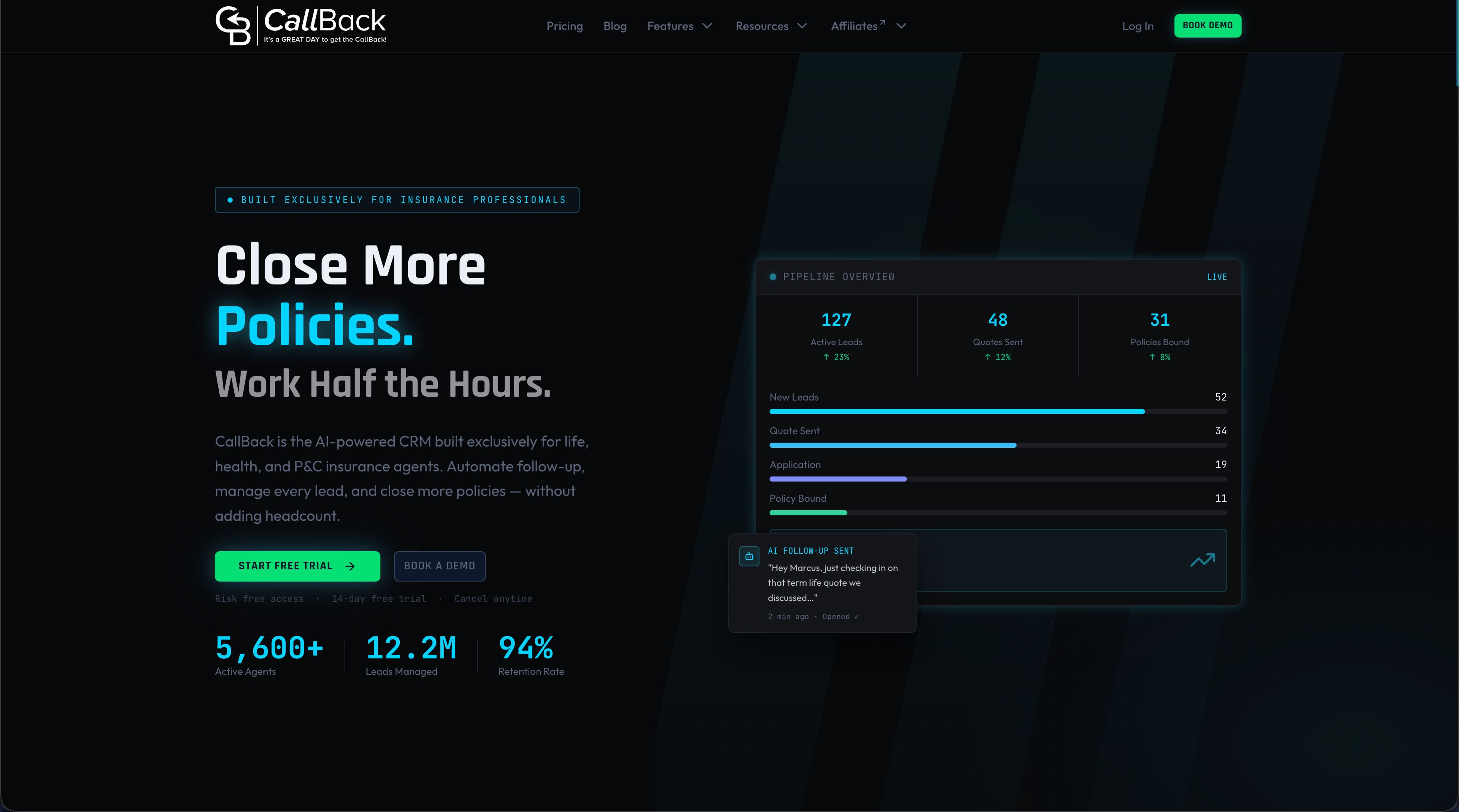
Agents who sell term life can start on the Professional plan at $97 per month. Agencies and IMOs with several agents can choose an Enterprise plan with 10, 25 or 60 full CRM accounts. The platform combines a CRM, email and SMS marketing, funnel and website builders, AI assistants and automation workflows, and it integrates with dialers, calendars and websites. The features page lists all of them.
Support is available 24/7, and data is hosted on Google Cloud.
FAQ
How should an agent explain term life in one sentence?
Term life pays a death benefit if the insured dies during a chosen period, such as 10, 20 or 30 years, and costs less than permanent coverage because it has no cash value. Premiums stay level during the term. The NAIC and state insurance departments publish plain-language guides that clients can read as well.
What should a client know about the end of the term?
The coverage ends unless it is renewed or converted. Renewal premiums are based on the client’s age at that time and are higher. If the policy is convertible, it can be exchanged for permanent coverage, generally within a window set by the carrier. Agents should note this date in the client record at issue.
How much term coverage is typical?
There is no fixed rule. Published guidance ranges from five to ten times annual income, and some sources go higher for families with debts and children. The amount should come from a needs analysis that covers income, debts, education costs, final expenses and existing assets.
Why do term leads go cold?
Mostly from slow or inconsistent contact. The client requests a quote, hears nothing for hours or days and talks to another agent. Automated first-touch messages and scheduled follow-ups close that gap, and the agent steps in once the client replies.
Sources
- LIMRA: U.S. Individual Life Insurance Sales, Second Quarter 2026
- Texas Department of Insurance: Life insurance guide
- NAIC Life Insurance Buyer’s Guide
- NAIC: What type of life insurance is right for you
- Fidelity: Term life insurance FAQs
- Fidelity: What is term life insurance and how does it work
- New York Life: Term life insurance policies
- Farmers Insurance: Term life insurance
- MoneyGeek: Is life insurance worth it
- North American Company: Term marketing guide
- Mass.gov: Buying life insurance and annuities in Massachusetts
- California Department of Insurance: Life Insurance Guide
- QuickQuote: Cost of a $100,000 life insurance policy
- Guardian: How term life works
- Corebridge field underwriting guide (2023)