

Google Ads can produce reliable insurance leads, but only when run as a disciplined, line-specific campaign with staffed intake behind it. Before spending a single dollar, confirm your licensing and staffing can support the state and line you’re targeting. Agents who set this up first, then run structured click-to-call or tight-form funnels, consistently see lower cost per lead than agents running loose, unstructured search campaigns.
TL;DR:
- Structured campaigns targeting specific lines and licensed states help control spend and improve lead quality, especially when paired with staffed intake hours.
- Exclusive inbound call leads cost roughly $24 to $40 per auto or home policy, while unstructured campaigns often result in higher costs and lower efficiency.
- Start with narrow exact and phrase match keywords and build a negative keyword list to prevent overspending on irrelevant searches like job seekers or informational queries.
- Use a CRM and automated follow-up systems to ensure rapid contact with leads, reducing waiting times that cause lost opportunities.
- Run small, defined pilot campaigns for 28 to 45 days, focusing on outcome metrics like qualified inquiries and policies, before scaling up spending.
Table of Contents
- What Do Insurance Leads Cost on Google Ads?
- How Should You Structure Your Insurance Ad Account?
- Which Keywords and Negatives Actually Work?
- What Do Compliance and Landing Pages Require?
- How Do You Track Leads From Click to Bound Policy?
- How Long Should a Pilot Run Before You Scale?
- Priorities for Agents Getting Started
- Turn Ad Clicks Into Booked Consultations Faster
- Sources
- FAQ
What Do Insurance Leads Cost on Google Ads?
Cost depends almost entirely on acquisition type, not just keyword or line. Three models dominate insurance PPC:
- Exclusive inbound calls — the prospect calls your office directly from the ad; highest intent, requires live staffing.
- Exclusive data leads — a form submission routed only to you; lower intent than a call, but easier to scale.
- Shared leads — the same submission sold to multiple agents; cheapest per unit, weakest conversion.
In properly structured accounts, exclusive inbound auto calls run roughly $24 to $40 per call, and home calls land around $30 to $40. Unstructured campaigns, by contrast, often cost far more per usable lead because clicks scatter across irrelevant queries.
Cost per click alone tells you almost nothing. A $12 click that turns into a bound policy beats a $4 click that never answers the phone. Reconcile every dollar spent back to qualified inquiries, not raw click volume.
Pro Tip: Budget at least $1,000 to $2,000 a month before judging results. Below roughly $750, Google’s Smart Bidding rarely has enough data to optimize, and you’ll mistake a data problem for a strategy problem.
How Should You Structure Your Insurance Ad Account?
Organize the account around three layers: line, state, and acquisition job. This keeps budgets clean and makes it obvious which piece is working.
- Account level — one account per agency or IMO.
- Campaign level — one campaign per line (auto, home, life, final expense) crossed with a licensed-state cluster.
- Ad group level — one ad group per acquisition job (click-to-call vs. quote-request form).
Assign one budget owner and one stop condition to every campaign. Mixing lines under a shared budget lets a cheap auto lead quietly cannibalize spend meant for life insurance, and nobody notices until the month is over.
For geo-targeting, use presence-only targeting with custom radii around your licensed service areas, and explicitly exclude states or counties where you’re not licensed to write business. Align call-only ad assets with your actual staffed hours and apply bid adjustments so spend concentrates when someone will pick up the phone.

Pro Tip: If your office closes at 5 p.m., pause click-to-call assets by 4:30. A missed call after hours doesn’t just waste the click. It often becomes a lead your competitor answers first.
Which Keywords and Negatives Actually Work?
Start narrow. Build your first campaigns on exact and phrase match buying keywords only, and hold off on broad match until you’ve built a real negative keyword list. Broad match without negatives is the single most common cause of overspend in insurance accounts, because the algorithm will happily spend your budget on searches like “insurance agent salary” or “how to become an insurance broker.”
High-intent starter keywords by line look like this:
- Auto: “cheap car insurance quote [state],” “switch auto insurance today”
- Home: “homeowners insurance quote near me,” “bundle home and auto insurance”
- Life: “term life insurance quote,” “life insurance no medical exam”
- Final expense: “burial insurance for seniors,” “final expense insurance quote”
Build a standing negative list covering job seekers, training programs, free downloads, complaint threads, and generic informational searches (“what is insurance”). Review the search terms report weekly and move new junk queries into your negative list before they burn more budget. This one habit, done consistently, eliminates more waste than any bid adjustment.
What Do Compliance and Landing Pages Require?
Insurance ads sit in one of Google’s more heavily policed categories, and the policy team checks both the ad copy and the page it points to. Never promise a specific savings amount, a guaranteed rate, or unqualified coverage claims. Instead, state your licensed states and line clearly in both the ad and the landing page.
- Certify where required. Some health and medical insurance verticals need Google’s advertiser certification before ads run.
- Link a visible privacy policy on every landing page tied to a lead form; this is a hard eligibility requirement for lead-form ad assets.
- Collect only what you need to route the lead: name, phone, state, and requested line of coverage. Save sensitive underwriting details (health history, income, driving record) for a live call, not the form itself.
- Keep the approved copy version and privacy policy on file next to every submission log, so you can produce them quickly if Google or a state regulator asks.
Use call assets only when someone can answer live during ad hours. Use lead forms only when you have a verified consent process and a follow-up system that contacts the prospect within minutes, not hours.
How Do You Track Leads From Click to Bound Policy?
The gap between “cost per click” and “cost per bound policy” is where most agents lose the thread. Map each stage of the funnel to a distinct event: generate_lead, qualify_lead, working_lead, and close_convert_lead, each stamped with an owner and a timestamp. Reconciling Google’s billing data against your own agency intake records is the only way to know your real return, since platform-reported conversions and actual bound policies rarely match perfectly.
Capture the GCLID on every form submission and either import offline conversions back into Google or route the data through a webhook. This feeds real outcomes back into Smart Bidding, so the algorithm starts favoring the queries that actually produce policies, not just clicks.
- Speed matters more than most agents expect: automated SMS acknowledgment and immediate task assignment through a CRM workflow built for insurance lead follow-up measurably improves contact rates.
- Don’t judge a campaign on week-one numbers. Run cohort reconciliation over a 28 to 45 day window before deciding anything.
Pro Tip: A lead that sits in an inbox for three hours is nearly a lost lead. Route new form submissions to a phone or SMS alert the moment they land, not the next time someone checks email.
How Long Should a Pilot Run Before You Scale?
Keep the first test small and specific: one line, one licensed-state cluster, a 28 to 45 day window, a named budget owner, and a hard spending cap. This isn’t about limiting ambition. It’s about getting a clean read before you multiply the spend.
- Track outcomes, not clicks. Qualified inquiries, booked consultations, quotes issued, applications submitted, and bound policies are the metrics that matter, pulled from reconciled agency data.
- Run a weekly maintenance pass: review search terms, mine new negatives, test two ad copy variants, and shift bids toward whichever asset drives calls or form conversions.
- Apply a decision matrix at the end of the window: if cost-per-bound-policy sits below your acceptable threshold and staffing kept pace with lead volume, scale the budget. If staffing lagged or the cost threshold was blown, fix the bottleneck before adding another dollar of spend.
Priorities for Agents Getting Started
Start with one line, one staffed intake path, and one pilot. Resist the urge to launch five campaigns at once. Expand only after you’ve reconciled real outcomes against real spend.
The two mistakes I see most: broad match with no negative list, and treating a form lead like a business card instead of a live opportunity. Build your tracking and CRM workflow before you build your ad copy. Measurement, not creativity, decides whether this channel makes you money.
— Kyle
Turn Ad Clicks Into Booked Consultations Faster
A CRM platform closes the gap that kills many Google Ads campaigns: the lag between a lead landing and someone actually reaching them. Where most agents lose leads sitting unanswered in an inbox, automated SMS and email sequences plus instant task assignment mean every new inquiry gets contacted within minutes, not hours.
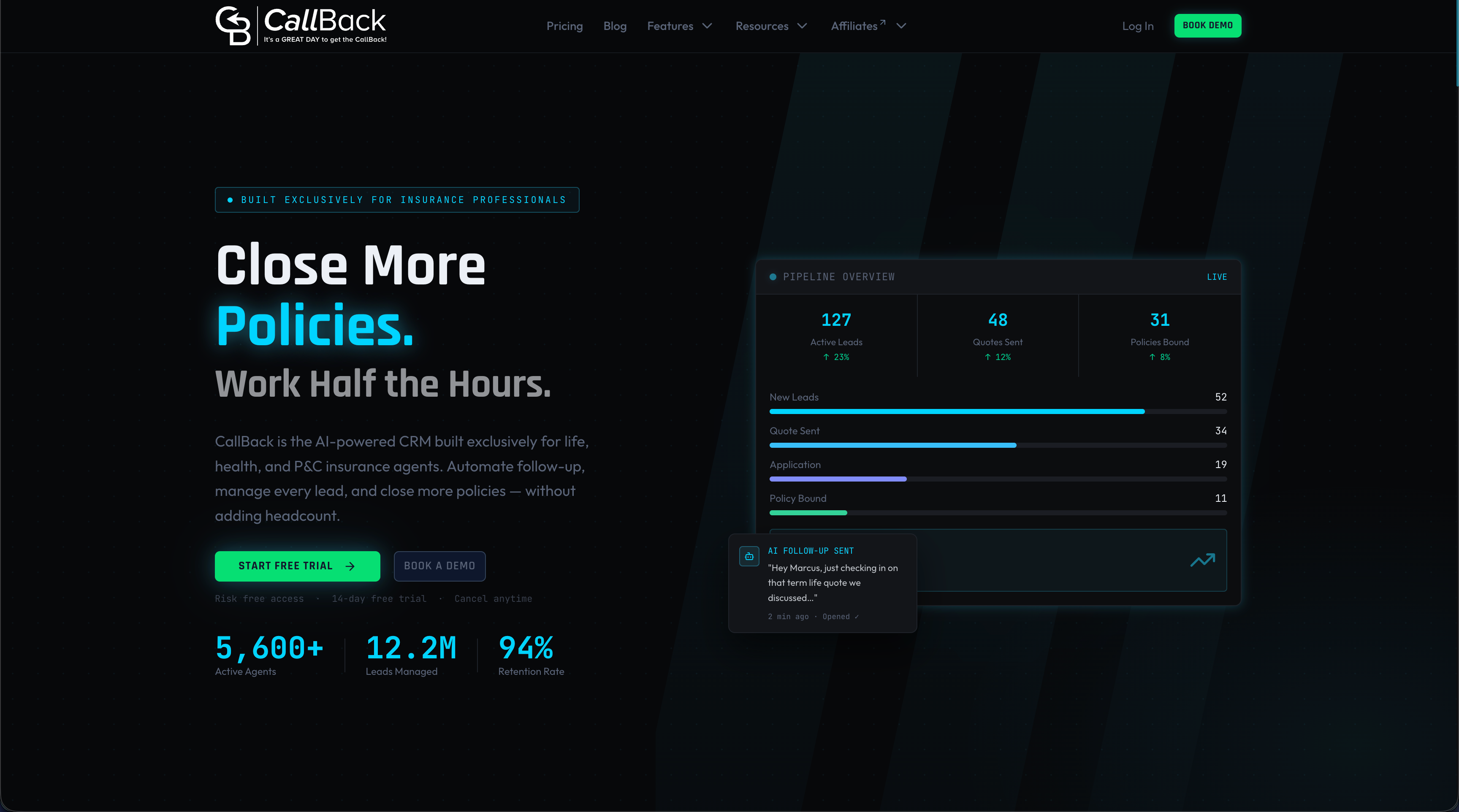
Such platforms can connect to paid campaigns through webhooks, direct form sinks, and call logging, and support offline-conversion import so the data feeding Google’s bidding better reflects bound policies, not just clicks. That closes the reconciliation loop the pilot phase depends on. You can build the compliant intake pages your ads point to using the funnel and website builder, and route every new lead into automated SMS follow-up the moment it arrives. Start a trial and connect your first campaign this week.
Sources
- Google Ads for Insurance Agents: A Campaign System
- How Much Do Insurance Leads Cost on Google Ads? 2026 Data
- Google Ads for Insurance Agents (2026): Structure, Keywords & Compliance | Ali Raza
- Google Ads for Insurance: 2026 Costs & Leads | VibeAds
This article is general information, not a substitute for advice from a qualified financial advisor. Consult a qualified financial professional about your own circumstances before acting on anything here.
FAQ
How Do I Get Leads for Insurance Sales Through Google Ads?
Build a line-specific campaign with exact and phrase match keywords, staff your intake before launching, and route every lead through fast follow-up. Structured click-to-call campaigns tend to outperform broad, unstructured search efforts.
Is $20 a Day Good for Google Ads in Insurance?
Budgets under roughly $750 per month usually fall short of what Smart Bidding needs to optimize reliably. Most practitioners recommend starting closer to $1,000 to $2,000 a month for a meaningful test.
How Much Do Google Ads Charge Per Lead in Insurance?
It varies by acquisition type: structured exclusive inbound calls for auto typically run $24 to $40 per call, and home calls $30 to $40, while shared leads cost less per unit but convert at a lower rate.
How Do I Get Leads From Google Ads Without Overspending?
Start with exact and phrase match buying keywords, avoid broad match until a strict negative keyword list is in place, and review search terms weekly to catch waste early.
Can a CRM Improve the Return on Insurance Google Ads Spend?
Yes. A CRM workflow with automated SMS and task assignment speeds up contact time, and offline-conversion import lets you reconcile actual bound policies against ad spend instead of relying on click data alone.