

A predictable insurance pipeline runs on seven stages: lead capture, initial contact, needs analysis, quote and proposal, presentation, close/application submitted, and submitted to issued, plus a Lost/Disqualified bin to keep the active list clean. Standardizing these insurance pipeline stages gives every producer the same map, which turns scattered follow-up into predictable conversions. The rule that makes it work: log every lead within minutes and hit your speed-to-contact target before anything else.
TL;DR:
- Automating speed-to-contact through instant routing and automated messaging is critical, as response times beyond ten minutes sharply reduce lead engagement.
- Consistently capturing and logging all required data at each stage prevents CRM clutter and improves forecast accuracy.
- Establishing standard templates and criteria for quotes and proposals reduces client confusion and accelerates decision-making.
- Regular follow-up post-application and disqualification rules prevent pipelines from stalling due to lack of communication or unresolved leads.
- Implementing an agency-wide, stage-based CRM with automation ensures accurate tracking, identifies bottlenecks quickly, and sustains process discipline.
Table of Contents
- What Are the 7 Insurance Pipeline Stages?
- How Do You Run Each Stage Day to Day?
- Which KPIs Actually Show Pipeline Problems?
- Why Do Insurance Pipelines Stall Most Often?
- How Do You Roll Out Standardized Stages Across a Team?
- How Does an Insurance CRM Enforce These Stages?
- A Practical Take on Standardizing Your Pipeline
- Run Your Pipeline Stages Without the Manual Follow-Up
- Sources
What Are the 7 Insurance Pipeline Stages?
Each stage needs a clear entry trigger, an exit rule, and a small set of required fields. Skip that discipline and your CRM turns into a junk drawer of half-finished records nobody trusts.
- Lead capture. A new lead enters from a website form, referral, call, or purchased list. Required fields: name, contact method, source, and product interest.
- Contacted / initial contact. The producer has reached the lead and confirmed interest. Log the contact date, method, and outcome.
- Needs analysis. A discovery conversation identifies coverage gaps, budget, and timeline. Required fields: current coverage, household or business details, and stated priorities.
- Quote and proposal. You’ve built pricing options tied to the discovery notes. Log carrier, premium range, and proposal date.
- Presentation. You walk the prospect through the recommendation, live or recorded. Track objections raised and the next scheduled touch.
- Close / application submitted. The prospect has signed and the application is filed with the carrier. Log the submission date and expected turnaround.
- Submitted to issued (active client). The policy is issued and the client is active. Track the issue date and first renewal window.
Anything that stops moving forward belongs in a Lost/Disqualified stage rather than sitting untouched in an earlier one. A standardized seven-stage sequence with consistent exit criteria is what separates agencies that can actually forecast revenue from ones guessing at month end.
How Do You Run Each Stage Day to Day?
The stages only work if producers know exactly what to do inside each one. Here’s the operating detail for every stage, including cadence, required data, and sample language.
- Lead capture. Assign a source tag immediately and route the lead to a producer within minutes, not hours. This is the single most time-sensitive step in the entire pipeline.
- Initial contact. Roughly half of leads go to whichever agent reaches them first, and contact odds drop sharply once response time slips past ten minutes. Call, then text, then email within the first hour, and log every attempt. Try: “I saw you were looking into [coverage type] — do you have two minutes to tell me what prompted that?”
- Needs analysis. This is where advisors separate from order takers. A repeatable discovery form that captures budget, timeline, and current coverage gaps prevents objections from ambushing you three calls later. Ask: “What would make this the wrong policy for you a year from now?” That single question surfaces price sensitivity, coverage doubts, and timing concerns in one shot.
- Quote and proposal. Present two or three options, ordered from best fit to budget alternative, not cheapest to most expensive. Document the reasoning behind each option so the client sees a recommendation, not a menu.
- Presentation. Confirm the meeting 24 hours ahead, walk through the proposal in the same order you built it, and end with a specific next step, either signature or a scheduled follow-up call.
- Close / application submitted. Confirm every required document is attached before submission. Missing signatures or health details are the top reason applications bounce back from underwriting.
- Submitted to issued. Set a touch at day 3, day 10, and day 20 post-submission so the client never wonders where their policy stands. Silence here is what generates cancellation calls.
Pro Tip: Track speed-to-contact as minutes elapsed between lead capture and first live conversation, not first attempt. A voicemail doesn’t count, and treating it like contact will hide a real bottleneck from your reports.
Which KPIs Actually Show Pipeline Problems?
Three formulas tell you almost everything about where deals stall. Conversion rate between any two stages equals the next-stage count divided by the prior-stage count, times 100. Average time-in-stage is the mean number of days a record sits in a given stage before moving. Quote-to-bind rate tracks how many proposals turn into signed applications, while submission-to-issue timeline tracks carrier turnaround separately from your own performance.
A 21-day sales cycle with 8 to 10 touches is a common benchmark for digital insurance leads. Use it as a diagnostic, not a rulebook. If a lead is still open at day 25 with only three touches logged, that’s a process failure, not a slow prospect.
Two patterns tell you what to fix:
- High volume, low conversion at one stage: the process is broken. Fix the script, the form, or the offer, not the person.
- Low volume, high time-in-stage: it’s a resourcing problem. The producer likely needs more capacity or better lead prioritization, not a new talk track.
Why Do Insurance Pipelines Stall Most Often?
Most stalled pipelines trace back to a handful of repeat offenders, and every one of them has a fix that doesn’t require new headcount.
- Slow initial response. Leads sit unassigned for hours. Fix: automation rules that route and notify within minutes of capture.
- Weak discovery. Producers quote before they understand the actual need. Fix: require a completed needs assessment form before a quote can be generated.
- Inconsistent proposals. Every producer builds quotes differently, confusing clients and slowing decisions. Fix: a standardized proposal template with a fixed option order.
- Silence after submission. No one follows up once the application is filed, so clients call the office worried or cancel out of frustration. Fix: a scheduled submission cadence with automated check-ins at set intervals, an approach lead nurturing strategies apply well beyond insurance.
Pro Tip: Set a hard disqualification rule, like no response after three attempts across seven days, and move that record into a long-term nurture stream instead of leaving it stuck in “contacted” forever, quietly dragging down your conversion math.
How Do You Roll Out Standardized Stages Across a Team?
Rolling out seven new stages agency-wide at once overwhelms producers and guarantees inconsistent adoption. Start narrow and expand once the process holds.
- Pick your three highest-variance stages (usually initial contact, needs analysis, and quote presentation) and document the exact talk track and required fields for each.
- Pilot for 30 days with a small group, checking in weekly on adherence, not just results.
- Score the pilot against speed-to-contact, time-in-stage, and quote-to-bind numbers before touching the remaining stages.
- Extend to all seven stages once the pilot group hits target metrics consistently.
Ongoing sustainability means manager dashboards visible to the whole team, incentives tied to stage-to-stage conversion rather than just closed premium, and a quarterly refresh of scripts and forms. Agencies that lock in this kind of consistency across producers tend to ramp new hires faster, because the new agent is learning a documented system instead of reverse-engineering a top performer’s habits.
How Does an Insurance CRM Enforce These Stages?
Manual tracking breaks down the moment a producer gets busy, which is exactly when speed-to-contact matters most. A dedicated lead management system closes that gap by tying automation directly to stage movement instead of leaving it to memory.
| Reader Need | How It Gets Solved |
|---|---|
| Speed-to-contact | Automated routing and SMS/email/voicemail sequences fire the moment a lead is captured |
| Consistent follow-up | Stage-based workflow automation replaces manual reminders with triggered cadences |
| Visibility into bottlenecks | Built-in reporting shows time-in-stage and conversion rate without a spreadsheet |
A 30-day pilot on any new system should track exactly three numbers first: speed-to-contact, quote-to-bind rate, and submission-to-issue turnaround. Everything else can wait until those three are stable.
A Practical Take on Standardizing Your Pipeline
The biggest mistake agencies make isn’t picking the wrong stages. It’s picking seven perfectly good stages and then letting every producer define “contacted” or “qualified” differently. That inconsistency is what makes pipeline reports lie to management. Once an agency locks in shared field definitions and exit criteria, the reporting stops being decorative and starts being diagnostic.
Speed-to-contact gets the most attention because it’s the easiest lever to pull, but needs analysis is where deals are actually won or lost long before a quote gets built. A rushed discovery conversation is the quiet killer of close rates. Document it as carefully as you document the close.
— Kyle
Run Your Pipeline Stages Without the Manual Follow-Up
Callbackcrm turns the seven-stage model in this guide into something your team actually runs, not just writes down in a training binder. Instead of relying on producers to remember every touch, automated SMS, email, and voicemail sequences fire the second a lead hits capture, which is exactly where speed-to-contact wins or loses deals.
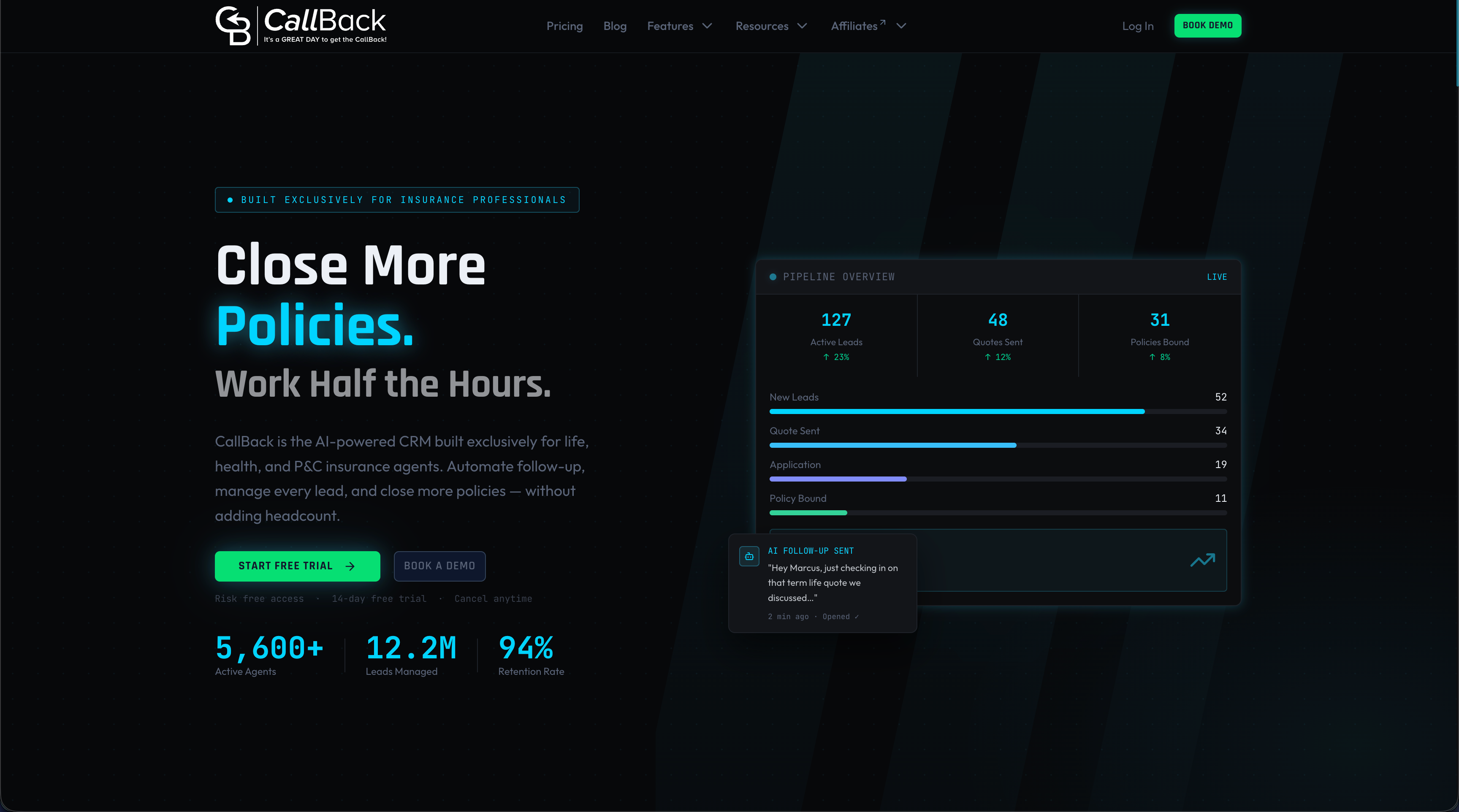
The platform is built for users who need stage-based workflows, AI-assisted lead scoring, and reporting that shows time-in-stage without a manual spreadsheet. If your team is still tracking needs analysis notes in a notebook and proposals in email threads, this is the fix. Check out the SMS automation features built to hit response-time targets automatically, and start a trial to see how your current pipeline stages perform once follow-up stops depending on memory.
Sources
- The Insurance Sales Process | EverQuote
- How to standardize your insurance sales process — PSM Brokerage