

Nurturing insurance leads matters because most of your quoted pipeline does not close on the first call, and without a system to stay in touch, that business goes to whoever follows up next. As of 2025, 85% of an agency’s quoted pipeline requires consistent follow-up, yet producers average barely two contact attempts before moving on. That gap is where premium walks out the door.
By the numbers: 85% of quoted pipeline needs ongoing follow-up to convert, but most producers stop after two attempts.
- Only 25 to 35% of consumers who request quotes buy within the first week.
- B2B insurance purchases often involve multiple decision-makers and stretch 6 to 18 months, per Gartner’s buying-group research.
- Structured follow-up sequences report 20 to 35% relative bind-rate improvement.
Key Takeaways
Nurturing insurance leads works because it recovers the majority of quoted pipeline that does not convert on first contact, raising bind rates, deal size, and long-term retention.
| Point | Details |
|---|---|
| Follow-up gap is large | 85% of quoted pipeline needs ongoing follow-up, but producers average about two attempts. |
| Structured sequences lift binds | Formal 30-day follow-up sequences report 20 to 35% relative bind-rate improvement. |
| Deferred demand is real | 65 to 75% of quote requesters buy later or from a competitor, not in week one. |
| CRM discipline is non-negotiable | An undocumented contact attempt is lost revenue when producers change roles. |
| CallBack CRM automates the gaps | The platform triggers timing, routing, and escalation for quote follow-up without added headcount. |
Table of Contents
- Why Nurture Insurance Leads: The Data Behind the Payoff
- Why Lead Nurturing Programs Fail in Insurance Agencies
- How Insurance Buyers Actually Decide
- Proven Lead Nurturing Strategies and Sequence Examples
- The Technology Stack for Scaling Nurture Without Adding Staff
- What to Measure and What ROI to Expect
- The 7-Minute Audit: Fixes to Run This Week
- How CallBack CRM Fits Into Your Nurture Sequence
- Frequently Asked Questions
- Sources
Why Nurture Insurance Leads: The Data Behind the Payoff
The financial case for lead nurturing strategies in insurance is not theoretical. Agencies that formalize follow-up sequences see measurable gains in three places: bind rate, deal size, and cost efficiency.
Conversion lift. Agencies with structured 30-day follow-up sequences report 20 to 35% relative improvements in bind rates compared to producers working leads ad hoc. That lift comes almost entirely from consistency, not from better scripts or cheaper leads.
Deal size and retention. Nurtured prospects tend to buy broader coverage, because education lowers the perceived risk of adding a rider or bundling a policy. Leads that receive consistent, relevant contact typically carry higher lifetime value than leads rushed to a quick quote-and-close.
Cost efficiency. Since 80% of new leads never convert into sales industrywide, every point of improvement on that baseline changes your cost per bind. An agency paying $40 to $60 per purchased lead recovers far more of that spend when a structured sequence, rather than a single call attempt, decides whether the lead converts.
- Map your current follow-up cadence against actual bind timing.
- Identify where leads go cold after the first or second touch.
- Calculate the revenue represented by leads that received fewer than three contact attempts.
Why Lead Nurturing Programs Fail in Insurance Agencies
Most failures trace back to four operational gaps, and they compound each other.
- Too few contact attempts. Producers average two touches when the data shows 65 to 75% of buyers need more time before they purchase.
- Generic sequences. One template sent to every lead ignores that insurance buyers span first-time shoppers, renewal-timeline switchers, and multi-policy households.
- Poor CRM discipline. If a touch is not logged, the agency has no record it happened, and the next producer starts from zero.
- Missing escalation rules. Warm signals like a clicked quote link or opened email go nowhere without a rule that routes them to a human.
Pro Tip: Set a 60-minute rule: if a producer hasn’t logged a contact attempt on a new quote within an hour, automatically escalate the lead to a manager or backup producer. This single rule closes more revenue leaks than any script rewrite.
How Insurance Buyers Actually Decide
Insurance purchases are rarely impulse buys. Many prospects sit in research or renewal-comparison mode for weeks, and commercial lines often involve several stakeholders over a 6 to 18 month window, according to Gartner’s buying-group research. Treating every lead like a single-recipient email list misreads how the purchase actually happens.
- Owner or decision-maker: wants bottom-line cost and coverage adequacy.
- CFO or finance lead: wants premium predictability and payment terms.
- End user or employee: wants claims experience and ease of use.
- HR or benefits admin: wants compliance and enrollment simplicity.
- Agent of record: wants continuity and service responsiveness.
When more than one stakeholder is involved, single-track sequences underperform. Account-level nurturing, with parallel content for each role, matches how the decision actually gets made.
Pro Tip: For any commercial account with more than one likely stakeholder, tag the lead as “multi-touch” in your CRM immediately and route a different content track to each contact rather than CC’ing everyone on the same email.
Proven Lead Nurturing Strategies and Sequence Examples
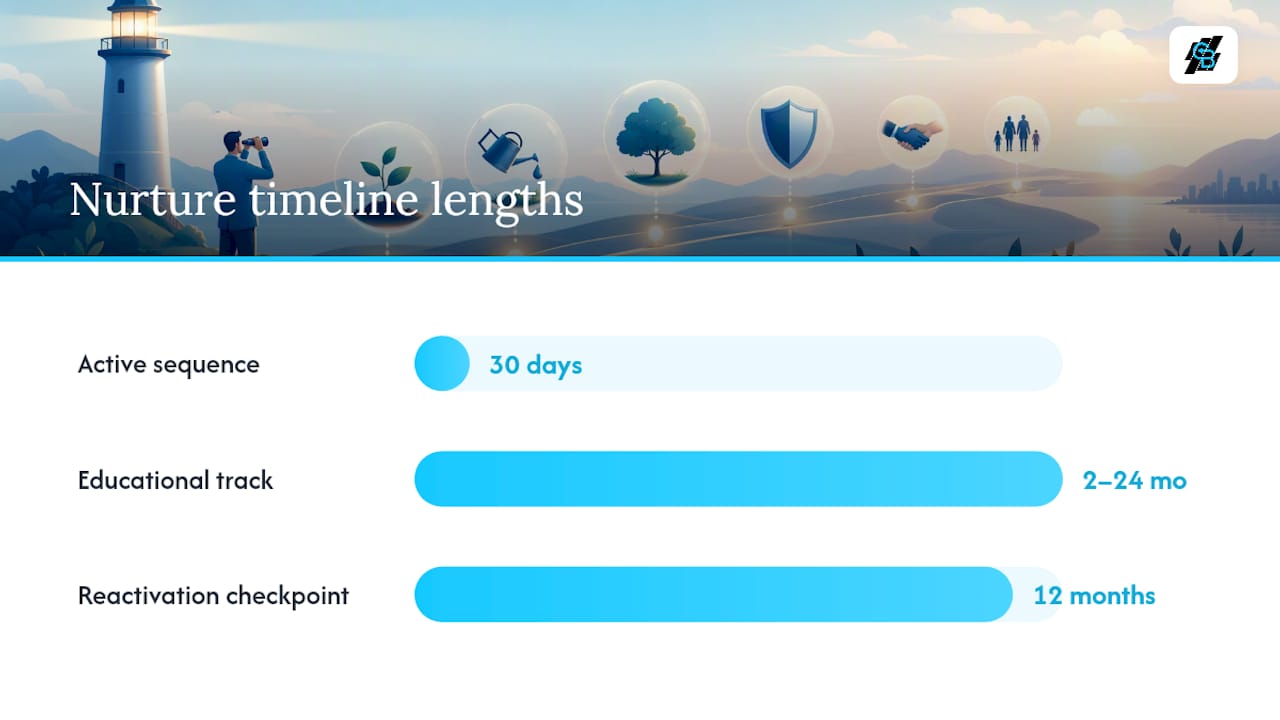
The most effective lead nurturing strategies for insurance run two tracks at once: a fast, active sequence for hot quotes, and a slower educational track for everyone else.
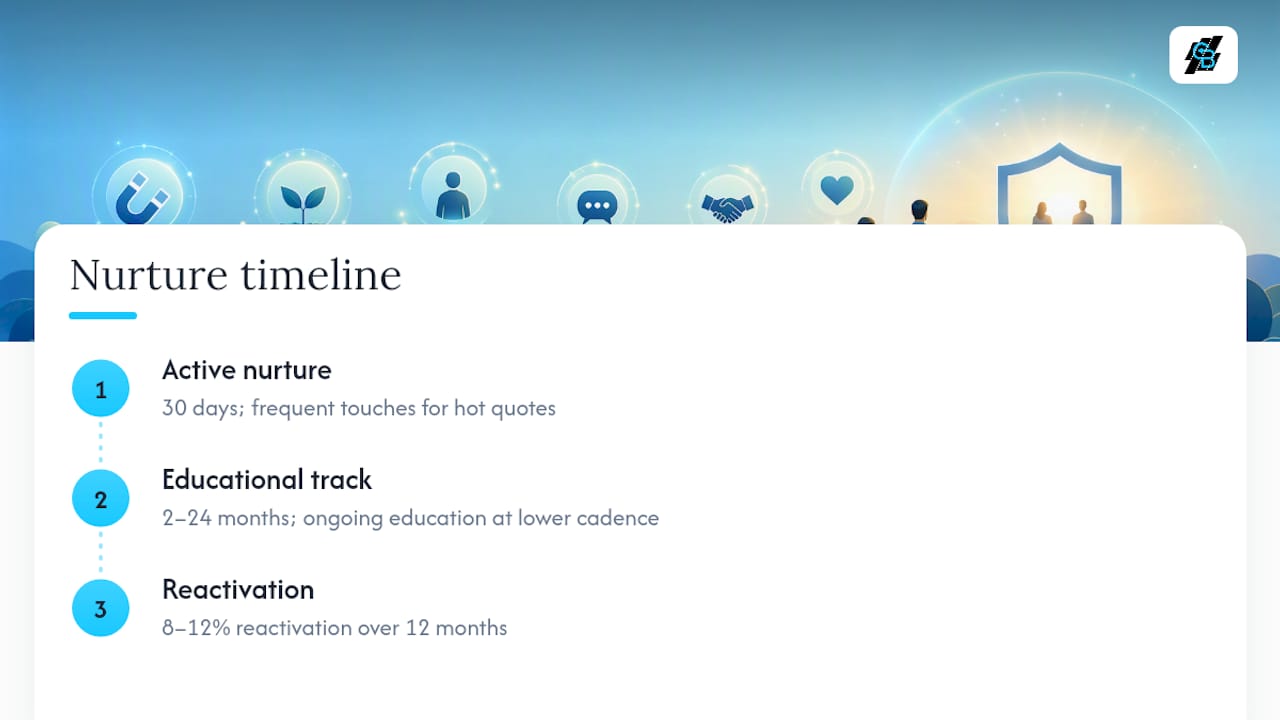
Track one: the 30-day active sequence, triggered the moment a quote goes out.
- Day 0: Automated acknowledgment confirming the quote was received.
- Day 1: SMS check-in asking if the prospect has questions.
- Day 3: Email comparing coverage options in plain language.
- Day 7: Producer phone call, live or a personalized voicemail.
- Day 14: Incentive touch, such as a bundling discount reminder.
- Day 30: Branch to either a closing push or the long-term nurture track.
Track two: the long-term educational track, running 2 to 24 months for leads not ready to buy. This is where reactivation rates of 8 to 12% over 12 months come from, and it captures the deferred demand that a 30-day window misses entirely.
Multi-channel logic matters here. Email carries detail, SMS carries urgency, and a producer call carries trust. Educational content and multi-channel outreach improve prospect readiness more reliably than any single channel alone.
Quick reference for producers building scripts:
- Voicemail line: “Following up on the quote we sent, wanted to see if you had questions about the deductible options.”
- Email subject: “Quick comparison: your two coverage options side by side.”
- Segmentation checklist: quote age, stated intent, renewal date, and prior contact count.
| Sequence element | Trigger point |
|---|---|
| Active track entry | Quote delivered |
| Educational track entry | 30 days with no bind |
| Reactivation checkpoint | 12 months on educational track |
The Technology Stack for Scaling Nurture Without Adding Staff
Scaling lead nurturing techniques without hiring more producers comes down to a simple formula: automation handles timing and routing, and your CRM handles ownership and accountability.
The minimum stack looks like this:
- API or webhook integration with your agency management system (AMS) so new quotes trigger sequences automatically.
- Near-real-time lead routing, so a warm signal reaches a producer within minutes, not hours.
- Conditional workflows that branch based on behavior, like an opened email or a clicked quote link.
- Engagement tracking that flags which leads are warming up before a producer even calls.
Automation does not replace the producer relationship. It removes the delay between a signal and a response, and it hands off a warmed prospect to the right person at the right moment.
This is also where the operational cost of manual work shows up. Producers lose 6 to 9 hours weekly to manual CRM updates and follow-up logging, time that automation reclaims for actual selling. A platform like CallBack CRM can integrate with your AMS and run the 30-day sequence described above without a producer manually queuing each touch.
Pro Tip: Before buying new software, audit whether your AMS actually supports webhook triggers. Many older systems require a manual export step that quietly breaks “real-time” routing.
What to Measure and What ROI to Expect
Measure five things: engagement rate, conversion velocity, bind rate lift, average premium per bind, and long-term reactivation rate. Benchmarks from industry follow-up data give you a realistic target range.
- Bind rate lift from structured sequences: 20 to 35% relative improvement.
- Long-term reactivation: 8 to 12% over 12 months for leads moved to the educational track.
- Baseline conversion risk: 80% of new leads never convert without intervention, so any improvement against that baseline is real revenue.
Quick ROI math: incremental binds multiplied by average premium, minus platform cost and SMS/email fees, gives you a payback timeline. Run A/B tests on subject lines, SMS send times, and the Day 7 call script, then track lift per experiment rather than changing everything at once.
The 7-Minute Audit: Fixes to Run This Week
Run these checks and fix the top two gaps you find.
- Confirm Day 0 automation fires within 5 minutes of a quote going out. Owner: Ops.
- Count average contact attempts per lead over the last 30 days. Owner: Sales manager.
- Check whether escalation rules exist for unanswered leads after 60 minutes. Owner: Ops.
- Verify every producer logs contact attempts in the CRM, not a personal notebook. Owner: Agency principal.
- Confirm long-term nurture leads are tagged and tracked separately from active quotes. Owner: Marketing.
- Test one SMS and one email subject line for open-rate difference. Owner: Marketing.
- Review reactivation rate on leads older than 12 months. Owner: Sales manager.
- Action item: Fix Day-0 automation timing this week, since delay here kills the highest volume of leads.
- Action item: Add a 60-minute escalation rule if none exists, owned by Ops, live by Friday.
- Action item: Require CRM logging on every touch, since an undocumented contact effectively did not happen when a producer changes roles or leaves.
Lessons From Watching Agencies Adopt Disciplined Nurturing
What worked most consistently was not a smarter script. It was agencies enforcing the boring rules: log every touch, escalate when a producer misses the window, and never let a warm signal sit untouched overnight.
Pro Tip: If a producer doesn’t log a contact attempt within 60 minutes, escalate automatically. This one rule prevented more lost business than any nurture template I’ve seen.
How CallBack CRM Fits Into Your Nurture Sequence
CallBack CRM automates the timing, routing, and escalation that most agency management systems leave to manual habit, which is exactly where the gaps in this article show up. The platform runs SMS and email sequences automatically the moment a quote is delivered, creates tasks for producers when a lead shows buying signals, and integrates with your AMS so nothing depends on someone remembering to log in and check a queue.
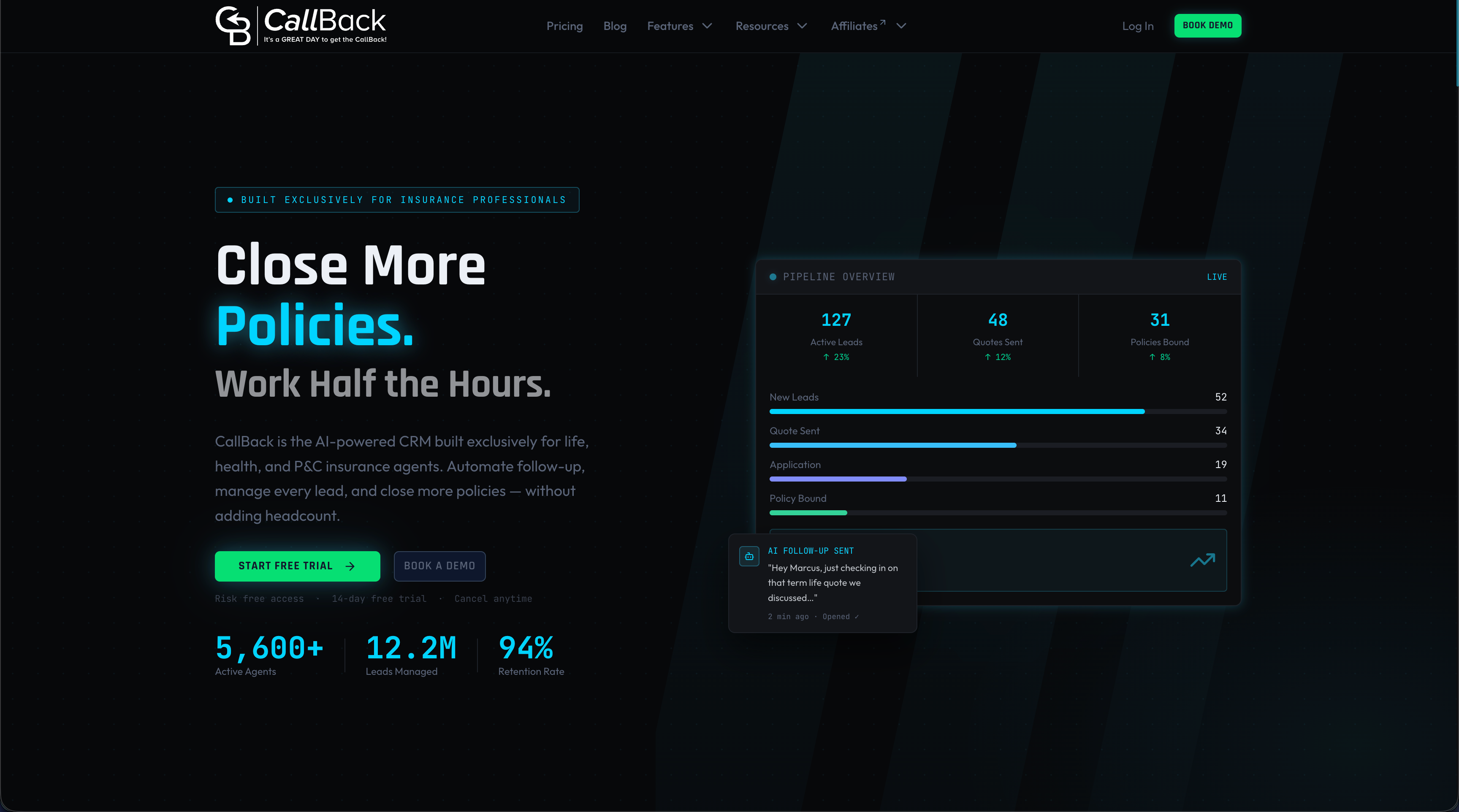
For agencies that want to test this without a full rebuild, start by building a dedicated quote-response page using CallBack CRM’s website and funnel builder, then layer in SMS automation for the Day 1 and Day 14 touches described in the 30-day sequence above. Try running that combination on your next 20 quoted leads and compare bind rates against your current process.
Frequently Asked Questions
Why nurture insurance leads instead of focusing only on new lead generation? Because most purchased or generated leads do not convert immediately. 80% of new leads never turn into sales without follow-up, so nurturing recovers value you already paid to acquire.
How long should an insurance lead nurture sequence run? Run an active 30-day sequence for hot quotes, then move unconverted leads to an educational track lasting 2 to 24 months, since reactivation can still reach 8 to 12% over 12 months.
What is the biggest reason nurturing programs fail? Insufficient contact volume combined with poor CRM logging. Producers often stop after two touches when most buyers need more time and more contact points before deciding.
Does lead nurturing actually increase policy size, or just conversion? Nurtured leads tend to buy broader coverage because ongoing education lowers perceived risk, which typically increases average deal size along with conversion.
Sources
- Managing your sales pipeline | Nationwide Agent Blog
- Automate Insurance Lead Nurture & Follow-Up Guide | US Tech Automations
- Insurance lead nurturing: converting cold leads | LeadGen Economy
- Monday
- Lead management 101 and the ultimate guide to lead nurturing | Zendesk Blog
Recommended
- Insurance Lead Nurturing: A Complete 2026 Guide for Agents | CallBack CRM Blog
- Insurance Email Sequences for Agents & Agencies: 2026 Playbook | CallBack CRM Blog
- Final Expense Lead Nurturing Guide for Agents | CallBack CRM Blog
- Lead Generation Workflow Tutorial for Insurance Success | CallBack CRM Blog