

The most effective approach to pipeline management for insurance combines a policy-centric pipeline model with automated speed-to-lead workflows and strict follow-up discipline. Insurance data revolves around renewal dates, carriers, and underwriting steps, so a generic sales pipeline will not track what matters. CallBack CRM is one option built specifically for this structure, though the process outlined below works regardless of the platform behind it.
TL;DR:
- Agents should prioritize early lead qualification with consistent scoring fields and automate the calculation process to efficiently identify high-potential prospects.
- Speed-to-lead response times should be within 15 minutes during business hours, with automatic follow-ups if the initial contact goes unanswered within four hours.
- Renewal activities require a structured cadence starting 90 days before policy expiration to maximize retention and facilitate cross-selling during review conversations.
- An insurance-native CRM should focus on policy-centric data, integrating real-time with systems like claims and billing for automatic updates on underwriting status and renewals.
- Implementation of pipeline management best practices benefits from phased rollout over 90 days, emphasizing discipline in logging touchpoints, adhering to SLAs, and regularly reviewing key KPIs.
Table of Contents
- Map the Insurance Sales Pipeline: Stages and Key Differences
- Qualify Leads Early: Scoring Fields and Quick Filters
- Track Every Touchpoint and Improve Speed-to-Lead
- Nurture Relationships and Bake Renewals Into the Pipeline
- Metrics and KPIs That Matter for Insurance Pipelines
- Tools, Automation, and Integrations That Work for Insurance
- Implementation Checklist and a 30/60/90 Plan
- Why Discipline Beats Chasing New Tools
- How CallBack CRM Supports This Approach
- Sources
- FAQ
Map the Insurance Sales Pipeline: Stages and Key Differences
A standard insurance sales pipeline moves through six stages: prospecting, lead, quote or proposal, application and underwriter review, bind or issued, and renewal. This structure differs from a generic sales pipeline in several ways. Deals do not simply close: they pause for underwriting review, restart for replacement business, or expand through multi-line bundling. Renewal is not the end of the pipeline. It functions as a recurring stage that repeats every policy term, according to Nationwide’s overview of insurance sales pipeline management, which lists prospecting, lead generation, qualification, quote or proposal, and closing as the core stages agencies track.
For producers and customer service representatives, this creates specific operational demands:
- Producers need visibility into which quotes are waiting on underwriting versus which are ready to close.
- CSRs need renewal dates visible well before the policy term ends, not just at expiration.
- Replacement business (switching a client from one carrier to another) needs its own tracking path since it skips prospecting but still requires full underwriting.
- Multi-line households need a single record that shows every policy and quote, not separate pipelines per product.
Qualify Leads Early: Scoring Fields and Quick Filters
Fast qualification separates agencies that convert leads quickly from those that lose them to slower competitors. Every lead record should capture a consistent set of fields before a producer spends time on it.
- Line of business (auto, home, life, commercial, and so on).
- Current renewal date or policy expiration.
- Current carrier, if known.
- Stated urgency (shopping now versus researching).
- Budget range or current premium.
- Required documents (driver’s license, prior declarations page, business records).
A simple point system helps producers prioritize without guesswork. Renewal within 30 days can add 20 points, a stated urgency of “shopping now” can add 15, and a missing required document can subtract 10 until it arrives. Leads should also carry compliance flags: licensing status, state of residence versus the agent’s licensed states, and any NIPR record details relevant to the sale. Skipping this step creates compliance exposure later.
Pro Tip: Build the scoring fields into your intake form so the score calculates automatically instead of relying on a producer to fill it in later.

Track Every Touchpoint and Improve Speed-to-Lead
Every call, text, email, quote sent, and document request needs a timestamped log entry tied to the lead record. Without this, agencies cannot tell whether a lead went cold from lack of interest or lack of follow-up.

Speed-to-lead matters more than most agencies assume. Response-time benchmarks from HubSpot’s sales statistics show that faster first-contact performance consistently correlates with stronger conversion outcomes across sales teams, which supports setting a firm internal SLA rather than treating response time as flexible.
A workable SLA looks like this:
- First contact attempt within 15 minutes of lead capture during business hours.
- A second attempt within four hours if the first goes unanswered.
- A structured follow-up cadence: day one, day three, day seven, then a switch to a slower monthly nurture.
- Automatic reassignment to another producer if the assigned one has not logged an attempt within the SLA window.
A master sales automation workflow for insurance agents can route new leads and generate the first follow-up task without manual assignment.
Nurture Relationships and Bake Renewals Into the Pipeline
Insurance sales cycles run longer than a single call, and renewals deserve their own structured cadence rather than a last-minute reminder.
- New quotes get a same-day call, a follow-up email within 24 hours, and a text reminder before any deadline the client mentioned.
- Life and commercial lines, which typically involve longer decisions, shift to a weekly touch by email or a scheduled call rather than daily contact.
- Renewal outreach starts at the 90-day mark with a light check-in, moves to a coverage review offer at 60 days, and becomes a direct renewal and cross-sell conversation at 30 days.
- Suppression rules stop outreach once a client has responded or renewed, preventing duplicate messages from separate workflows.
Cross-sell offers work best inside the renewal conversation itself, when the client is already reviewing coverage, rather than as a separate unrelated pitch.
Metrics and KPIs That Matter for Insurance Pipelines
A handful of numbers tell an agency whether its pipeline is healthy. Conversion rate by stage shows where leads stall, for example, quotes that reach underwriter review but rarely bind. Average sales cycle length flags whether a line of business is taking longer than it should to close.
- Pipeline coverage ratio: active pipeline value divided by the sales target, tracked weekly.
- Conversion rate by stage: percentage of leads advancing from one stage to the next, reviewed monthly.
- Speed-to-lead: time from lead capture to first contact attempt, checked daily.
- Renewal retention rate: percentage of policies renewed versus total up for renewal, reviewed monthly.
- Attach rate: percentage of clients holding more than one policy, tracked quarterly.
Response speed remains one of the more reliable levers agencies have for improving early-stage conversion, based on aggregated benchmarks in HubSpot’s sales statistics. Speed-to-lead and daily coverage checks belong on a daily dashboard; retention and attach rate fit better in a monthly review since they move more slowly.
Tools, Automation, and Integrations That Work for Insurance
An insurance-native CRM organizes data around the policy, not just the contact. This matters operationally: a policy-first structure lets renewal triggers, cross-sell prompts, and underwriting status update automatically as a policy moves through its term. According to Decerto’s guide to insurance CRM architecture, modern insurance CRMs integrate in real time with policy administration systems, claims, and billing, while generic CRMs require heavy manual configuration to approximate the same behavior and still miss insurance-specific needs.
Automation priorities should follow a fixed order rather than being built all at once:
- Lead capture that feeds directly into the pipeline without manual entry.
- Immediate routing to the right producer based on line of business or territory.
- Speed-to-lead tasks that fire automatically on capture.
- Renewal triggers set at 90, 60, and 30 days before expiration.
Integration priorities follow a similar order of importance: policy administration and agency management systems first, then claims visibility, commission tracking, and compliance overlays that flag licensing issues before they become problems. A guide to integrating CRM and marketing for insurance agents covers how these connections typically get built.
Pro Tip: Build renewal triggers before cross-sell campaigns. Cross-sell only works reliably once the renewal data feeding it is accurate.
Implementation Checklist and a 30/60/90 Plan
Rolling out pipeline management works best in phases rather than all at once.
- Days 1 to 30: configure pipeline stages and required fields, map every lead source into the CRM, and set basic scoring rules.
- Days 31 to 60: build two automations (speed-to-lead routing and renewal triggers), then train producers and CSRs on logging touchpoints.
- Days 61 to 90: enforce SLAs, review the first month of KPI data, and adjust scoring based on which leads actually converted.
| Role | Responsibility |
|---|---|
| Producer | Logs every touchpoint, follows SLA response times |
| CSR | Monitors renewal dates and required documents |
| Operations | Owns automation rules and monthly KPI reporting |
Common pitfalls include skipping training, which leaves data incomplete, and building too many automations before the basic stages are configured correctly. A sales pipeline guide for insurance agents offers additional templates for this phase.
Why Discipline Beats Chasing New Tools
Most agencies that struggle with pipeline management do not need another tool. They need producers who log every touchpoint and managers who review the pipeline weekly rather than at quarter’s end. A short coaching checklist works better than a new feature list: are SLAs being met, are renewal dates current, and is the pipeline coverage ratio actually reviewed. Swap tools only when the process is disciplined and the current system still cannot support it, such as when it cannot connect to a policy administration system at all.
— Kyle
How CallBack CRM Supports This Approach
Some CRM platforms offer built-in workflow tools that support lead capture, routing, speed-to-lead tasks, and renewal triggers at 90, 60, and 30 days, reducing the need for custom setup. Agencies piloting the system typically start with two automations, an immediate speed-to-lead workflow and a renewal-trigger sequence, before expanding further.
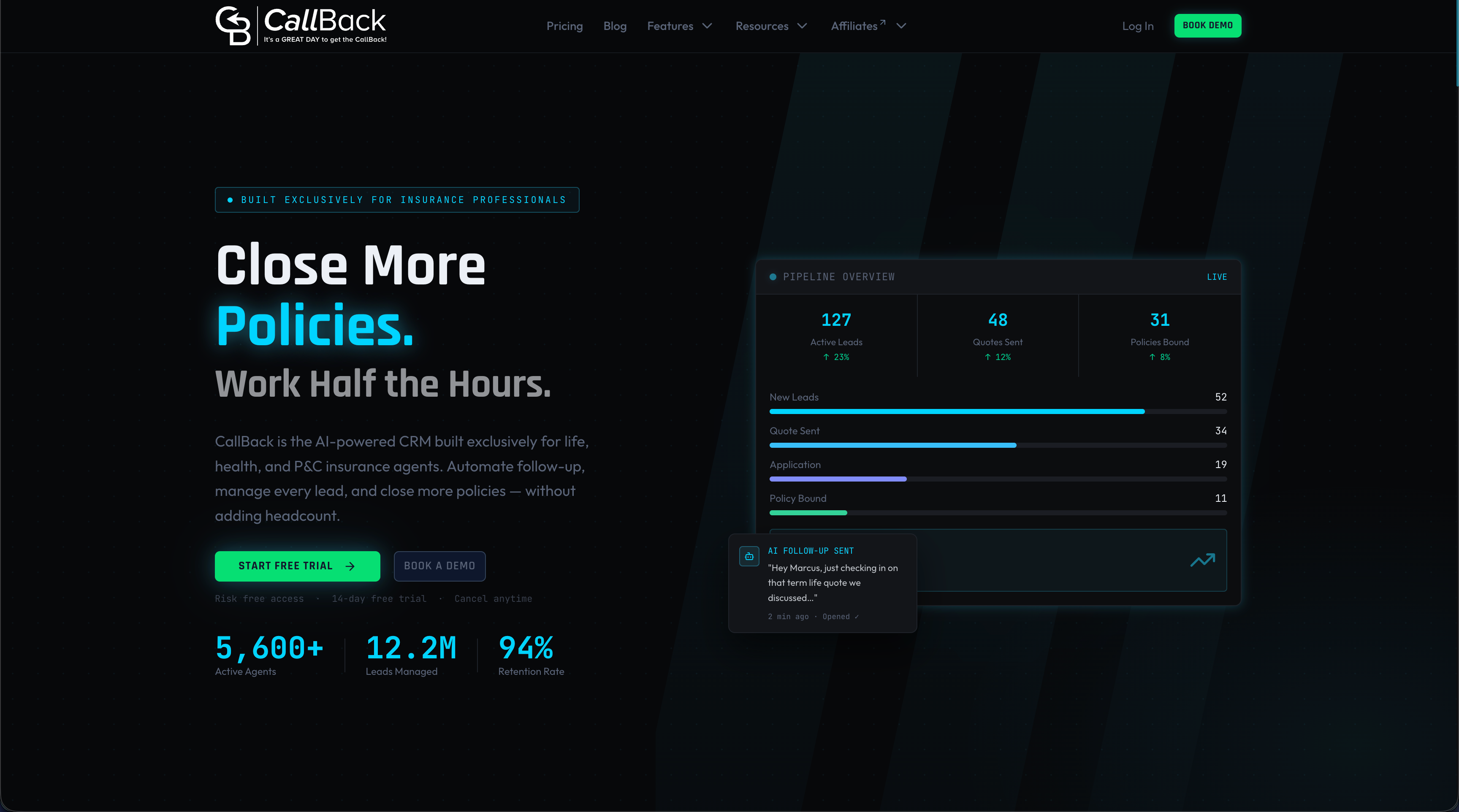
Agencies ready to test this can start with the Professional plan priced per the publisher’s own published rates, or review Enterprise options for larger teams needing multiple full CRM accounts.
Sources
- Insurance CRM: The Essential 2026 Guide for Mid-Tier P&C Carriers
- Insurance sales pipeline management: How to turn leads into customers
- Sales statistics — HubSpot Blog
FAQ
What Is Pipeline Management?
Pipeline management is the process of tracking prospects and clients through defined stages, from first contact to a closed sale and beyond. In insurance, it also includes renewal cycles, since a policy generates repeat pipeline activity every term.
What Is the Best CRM for Insurance?
The best CRM for insurance is one built around policy data rather than generic contact records, since it can automate renewal triggers and cross-sell prompts without heavy manual configuration.
What Is the Best Way to Manage My Sales Pipeline?
The most reliable approach combines defined pipeline stages, consistent lead qualification, fast speed-to-lead response, and a renewal cadence that starts 90 days before expiration. Reviewing KPIs like pipeline coverage ratio and conversion rate by stage on a regular schedule keeps the pipeline accurate rather than reactive.
What Is the Highest Paid Position in Insurance?
Compensation varies widely by role, specialty, and whether a position is commission-based, so no single job title applies universally across the industry. Senior underwriting, actuarial, and agency ownership roles tend to carry higher earning potential, though specific figures depend on location and book of business.