

Short answer: most U.S. jurisdictions let one participant record a call without telling the other side, but 12 states require all participants to consent before a call can be recorded. When any party might be in California, Florida, Illinois, Washington, or one of the other all-party states, announce the recording and get verbal consent on the record. The federal baseline, 18 U.S.C. § 2511, permits one-party consent, but state law controls when it is stricter.
TL;DR:
- Twelve states require all-party consent, including California, Illinois, and Washington, making disclosure and verbal agreement mandatory before recording calls.
- The majority of U.S. states follow federal law, allowing recording by one participant without informing others, but it’s safest to assume all-party rules apply if unsure.
- Hybrid states like Connecticut and Nevada have specific rules depending on the context, with some distinctions between phone and in-person conversations.
- Violating consent laws can lead to civil damages, criminal charges, and large-scale liability if thousands of calls are recorded unlawfully.
- Implementing a process that announces, records, timestamps, and logs consent on every call is the most reliable way to mitigate legal and financial risks.
Table of Contents
- Which states require all-party consent versus one-party consent
- How one-party, all-party, and hybrid consent actually work
- State-by-state call recording consent rules
- Interstate calls: whose law applies when participants are in different states
- What unlawful call recording can cost you
- A practical compliance checklist for recording calls
- How we built this guide
- Our take on managing call recording risk
- Using CallBack CRM to support your recording and consent workflow
- FAQ
- Sources
Which states require all-party consent versus one-party consent
Before reading statute text or planning a compliance workflow, we find it faster to know where a call falls at a glance. As of 2026, 12 states require consent from every participant on a call, while the remaining states and the District of Columbia follow the one-party rule set by federal law.
The all-party consent states are:
- California
- Connecticut
- Florida
- Illinois
- Maryland
- Massachusetts
- Michigan
- Montana
- Nevada
- New Hampshire
- Pennsylvania
- Washington
A few of these states, including Connecticut and Nevada, apply different rules depending on whether the communication happens by phone, in person, or electronically. We treat those as hybrid cases rather than clean all-party states, and we cover the practical distinctions in the next section.
Every other state, roughly 37 states plus the District of Columbia, follows the federal one-party standard: if you are a participant in the call, you can record it without telling anyone else. If your state is not on the list above and you are not sure which bucket it falls into, the safest move is to treat the call as if it needs all-party consent anyway. That single habit removes the guesswork and protects you if a participant happens to be calling in from a stricter state.
How one-party, all-party, and hybrid consent actually work
Federal law sets the floor. Under 18 U.S.C. § 2511, it is legal for a person to record a wire, oral, or electronic communication as long as that person is a party to it. This is the “one-party consent” rule, and it means that in the absence of a stricter state law, you can record your own calls without announcing it.
One-party consent means only one person on the call (often the person doing the recording) has to agree to it. All-party consent, sometimes loosely called “two-party consent,” means every single participant has to agree, whether there are two people on the line or twelve. The two-party label is a misnomer: a conference call with five participants in an all-party state still needs consent from all five, not just two.
Hybrid states complicate the picture further because the rule depends on the medium or context, not just the state:
- Connecticut requires all-party consent for telephone calls but applies a different standard to in-person conversations.
- Oregon generally follows one-party consent for phone calls but requires notice for in-person conversations.
- Nevada’s courts have drawn distinctions between phone recordings and in-person recordings that do not map cleanly onto a single rule.
12 of 50 states (plus D.C.) require all-party consent for call recording, according to Smarsh’s state-by-state analysis, while the remaining 38 jurisdictions follow the federal one-party standard. That ratio is why most national businesses find it simpler to build around the strictest common denominator rather than switch rules call by call.
Consent itself can be obtained two ways. Implied consent through announcement happens when you tell participants the call is being recorded and they continue the conversation anyway; several all-party states, including Washington, treat continued participation after a recorded announcement as valid consent. Express on-record consent goes a step further: you ask the participant to say “yes, I consent” and capture that response in the recording itself. The second method creates clearer evidence if your consent practices are ever challenged.

State-by-state call recording consent rules
The table below summarizes the consent regime, governing statute, and a practical note for each state and the District of Columbia. States not marked “all-party” or “hybrid” follow the one-party federal baseline.
Call centers and sales teams operating nationally tend to run into the most friction in California, Illinois, Pennsylvania, and Washington, where enforcement and private litigation around recorded calls are more common than in other all-party states. Treating those four as your highest-risk jurisdictions, even within the all-party group, is a reasonable way to prioritize training and script review.
Interstate calls: whose law applies when participants are in different states
Call recording law gets genuinely uncertain once participants are spread across state lines, because no single federal rule tells you which state’s law controls. Courts deciding these disputes have looked at factors like where the recording device was located, where each party was physically situated, and which state has the strongest interest in protecting its residents’ privacy. That uncertainty is exactly why a conservative default matters more than trying to predict how a court would rule in your specific case.
The practical rule of thumb that most compliance-minded businesses adopt: if any participant on the call might be located in an all-party state, treat the entire call as if all-party consent is required. This “strictest-state-first” approach sidesteps the choice-of-law question entirely, because you are complying with the toughest applicable standard regardless of which law a court eventually applies.
A few scenarios illustrate why this matters:
- A sales rep in Texas calls a prospect whose area code is in Arizona, but the prospect has since moved to California. Treating the call as all-party protects the rep even though neither party is in Texas, a one-party state.
- A conference call includes participants dialing in from Illinois, New York, and Texas. Because Illinois requires all-party consent, the safest approach is to announce recording and obtain consent from everyone on the line before proceeding.
- A remote sales call is routed through a VoIP system registered in a one-party state, but the customer’s billing address is in Washington. The customer’s location, not the system’s registration, is the one that matters for risk purposes.
Pro Tip: Build your call-recording workflow around the toughest state law you might encounter, not the state where your office happens to sit.
What unlawful call recording can cost you
The penalties for recording a call without proper consent range from statutory fines to criminal charges, and the exposure compounds quickly when a business records thousands of calls a year instead of one.
At the federal level, violating the Wiretap Act can trigger both criminal penalties and a civil claim. Under 18 U.S.C. § 2520, a person whose call was recorded unlawfully can recover actual damages or a statutory minimum, whichever is greater, plus possible attorney’s fees. Federal civil remedies under 18 U.S.C. § 2520 allow recovery of actual damages or a statutory minimum amount, which means even a single unlawful recording can carry meaningful financial exposure.
State-level penalties vary widely and often stack with federal exposure:
- California treats illegal recording as grounds for both criminal prosecution and civil suits, with statutory damages available per violation.
- Washington’s statute allows criminal charges for violations while also permitting the enumerated exceptions, such as emergency calls, to apply without penalty.
- Several all-party states allow class action claims when a business records calls with a customer base spanning thousands of callers, turning a single policy mistake into a large aggregated liability.
Enforcement in this area increasingly comes from private civil suits rather than government prosecutions, particularly against businesses that record customer service or sales calls at scale. A policy that works fine for a single agent recording personal calls can become a serious liability once a company records thousands of calls a month without a documented consent process.
A practical compliance checklist for recording calls
Getting consent right is less about legal theory and more about building a repeatable process that your team follows every time, regardless of which state a caller happens to be in.
- Default to announcing on every call. Use a short, consistent script: “This call may be recorded for quality and training purposes. Do you consent to being recorded?”
- Capture consent on the recording itself. A verbal “yes” captured at the start of the call is the clearest evidence you can produce later.
- Timestamp and log every recording. Store the date, time, and consent confirmation alongside the audio file, not in a separate system that could get disconnected from the recording.
- Use geo-detection where possible. If your phone system can flag area codes or billing addresses tied to all-party states, route those calls through a mandatory consent prompt.
- Build consent into your IVR flow. An opt-in prompt before a call connects to a live agent removes the risk of a rep forgetting to ask.
- Train staff on the script and the reasoning behind it. Agents who understand why the script exists are less likely to skip it under pressure.
- Restrict access to stored recordings. Limit who can retrieve recorded calls, and set a retention policy that matches your legal and business needs.
- Get written consent for high-risk or ongoing relationships. For recurring business communications, a signed consent form supplements the verbal announcement and strengthens your position if a dispute arises later.
- Loop in legal counsel for multi-state campaigns. Scripts, retention policies, and consent flows should get a legal review before a national rollout, especially for insurance, finance, or other regulated sales.
Pro Tip: Treat the consent announcement as part of your script, not an optional add-on. A rep who skips it even once creates a gap in your documentation that is hard to fix after the fact.
How we built this guide
This guide was compiled by Kyle, drawing on federal statute, state statutory text, and guidance from regulatory and legal-education sources. We consulted the federal Wiretap Act, individual state statutes, FCC consumer guidance on recording telephone conversations, and legal explainers from the Digital Media Law Project to cross-check consent classifications state by state.
Our review process included:
- Verifying each state’s consent regime against its primary statute or, where no statute exists, documented case law.
- Cross-referencing hybrid-state distinctions (phone versus in-person) against legal guides rather than relying on a single source.
- Aligning federal civil remedy figures with the statutory text in 18 U.S.C. § 2520 rather than secondary summaries.
As a platform supporting insurance agents and agencies with phone-based outreach, we pay close attention to how call logging, timestamping, and secure storage intersect with state consent rules, since those operational details are exactly where compliance gaps tend to appear.
Our take on managing call recording risk
Most businesses treat call recording consent as a legal checkbox instead of an operational habit, and that is where things go wrong. The law is not actually the hard part: a dozen states require all-party consent, and the rest follow a one-party baseline. The hard part is building a process that applies the stricter rule by default, every time, regardless of which rep is on the call or which state the customer happens to be dialing from that day.
We think the conservative posture, announcing and documenting consent on every call, is worth the small friction it adds to a sales conversation. A few seconds of “this call may be recorded, do you consent” rarely costs you the sale, but a missing consent record can cost far more if a dispute ever reaches a courtroom. For anything beyond a simple two-person sales call, particularly multi-state conference calls or ongoing customer relationships, we would rather see a business loop in legal counsel early than find out after the fact that its script did not hold up.
— Kyle
Using CallBack CRM to support your recording and consent workflow
Building a reliable consent process is one thing. Keeping a clean, timestamped record of every call across a growing sales team is another, and that is where the right phone system makes the checklist above easier to run consistently. A quality phone system handles both making and receiving calls, and recorded calls should be stored with secure cloud hosting rather than scattered across individual devices or disconnected tools.
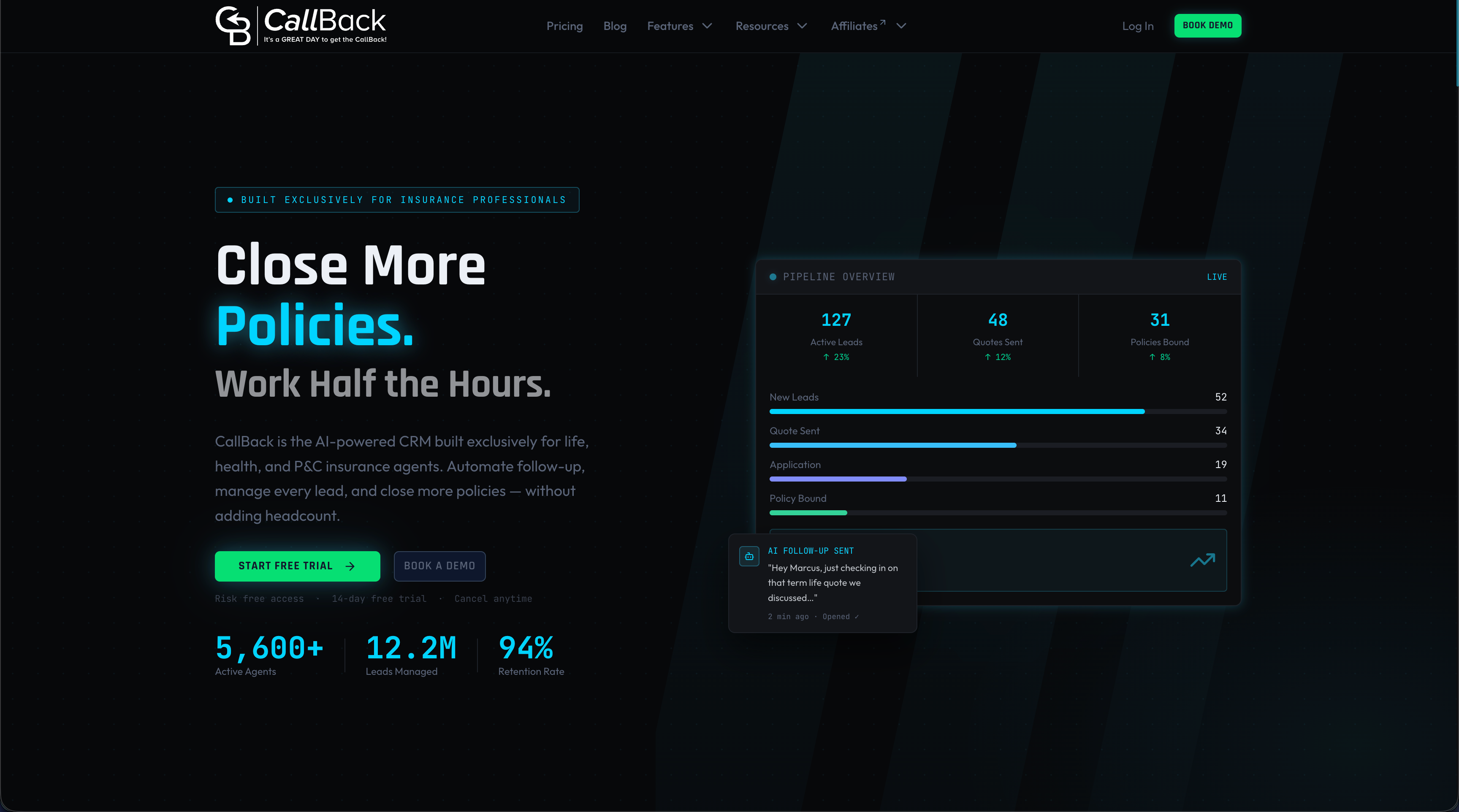
A few features line up directly with the compliance steps covered in this guide:
- Call recordings are logged with timestamps, which supports the documentation step in your consent checklist.
- Workflow automation can route calls through a consistent script or prompt before an agent connects, using advanced marketing automation and dialer capabilities to streamline compliance.
- Centralized storage keeps consent records attached to the call itself instead of a separate spreadsheet.
- Access controls limit who on your team can retrieve stored recordings, supporting the retention and access step above.
For agents and agencies that want these capabilities built into the same system they already use for pipeline management, our Professional plan starts at $97 per month, and our Enterprise plans support larger teams that need multiple full CRM accounts with consistent logging across every seat. Visit our fees page for a full breakdown of phone system and messaging costs before you roll out a new consent workflow across your team.
This article is general information, not a substitute for advice from a qualified lawyer. Consult a qualified legal professional about your own circumstances before acting on anything here.
FAQ
What states require consent to record phone calls?
Twelve states require consent from every participant before a call can legally be recorded: California, Connecticut, Florida, Illinois, Maryland, Massachusetts, Michigan, Montana, Nevada, New Hampshire, Pennsylvania, and Washington. Every other state follows the federal one-party standard, which allows a participant to record without telling the other side.
Do you legally have to tell someone the call is being recorded?
It depends on the state. In the 12 all-party states, you must disclose the recording and get consent from every participant, while in one-party states you are not legally required to announce it, though the FCC recommends disclosure as a prudent practice when you are unsure which law applies.
Is it illegal to record a phone call in the USA?
Recording a phone call is legal under federal law when at least one participant consents, per 18 U.S.C. § 2511. It becomes illegal when a stricter state law applies, such as the all-party consent requirement in states like California or Washington, and that consent was not obtained.
Can I sue someone for recording me without my permission in the USA?
Yes, in states that require all-party consent or under federal law when neither participant consented, a recorded party can bring a civil claim and potentially recover actual damages or a statutory amount under 18 U.S.C. § 2520. Whether a suit succeeds depends on the specific state’s statute and the circumstances of the recording.
Sources
- Call recording laws by state (Smarsh)
- 18 U.S.C. § 2511 — Interception and disclosure of wire, oral, or electronic communications
- Recording telephone conversations — Federal Communications Commission