

A sales playbook standardizes the insurance sales process so every producer runs the same seven stages instead of improvising. The fastest fix for most agencies is standardizing the three stages causing the biggest conversion leaks, usually initial contact, needs analysis, and the close. Agencies that make this change typically see faster agent ramp time and measurably higher stage-to-stage conversion within one quarter.
TL;DR:
- Agencies that focus on standardizing their initial contact, needs analysis, and closing stages typically improve conversion rates and agent ramp times within a quarter.
- A one-page seven-stage framework with clear objectives, scripts, and KPIs helps agents consistently follow the process, reducing reliance on informal methods.
- Automating lead routing, follow-up sequences, and proposal delivery through a CRM significantly increases speed to contact and ensures adherence to the playbook.
- Weekly micro-coaching and roleplay sessions, along with tracking key performance indicators, reinforce habit formation and prevent drift back to old habits.
- Response times under five minutes are critical for maintaining lead conversion, with automation tools like CallBack CRM ensuring rapid follow-up.
Table of Contents
- What Belongs in an Insurance Sales Playbook
- A Copy-Ready 7-Stage Playbook Template
- Rolling Out the Playbook: A 30/60/90-Day Plan
- Objection Handling Scripts and Roleplay That Actually Builds Skill
- How a CRM Turns the Playbook Into a Habit, Not a Handout
- What Actually Breaks Playbook Adoption
- Put the Playbook on Autopilot With CallBack CRM
- Sources
- FAQ
What Belongs in an Insurance Sales Playbook
An insurance sales playbook needs four working parts, not a binder of theory. Skip any one of them and agents fall back to whatever they learned informally from the last manager who trained them.
The process flow comes first: a one-page summary of each stage, its objective, and what “done” looks like before an agent moves forward. Role definitions come next. Who owns a lead the moment it hits the CRM, and who hands it to service after the policy is issued? Vague ownership is where leads stall for days.
Talk tracks and objection scripts need a fixed home, whether that is a shared drive folder or a CRM record, not a memory an agent hopes to recall under pressure. Round out the playbook with:
- A short library of qualifying questions tied to each stage
- Email and proposal templates that don’t require rewriting from scratch
- A KPI list covering conversion rate, response time, and average days per stage
- A recurring coaching schedule, not a one-time training day
Miss the KPI list and the playbook becomes a document nobody checks against reality. Structured sales processes improve consistency and cut compliance risk precisely because they replace guesswork with a repeatable standard.
A Copy-Ready 7-Stage Playbook Template
Insurance agencies that formalize their pipeline tend to use some version of this seven-stage framework, and it works as a one-page template you can adapt today.
-
Lead capture. Objective: log every lead within seconds of arrival, no exceptions. Target response time: under 5 minutes. Must-use asset: an automated intake form. Agent prompt: “Confirm receipt and set the first callback time before doing anything else.”
-
Initial contact and qualify. Objective: confirm interest and basic eligibility. Ask about current coverage, renewal date, and budget range. Must-use asset: a qualification script. Prompt: “Ask what’s not working with their current coverage before pitching anything.”
-
Needs analysis. Objective: identify coverage gaps, not just price sensitivity. Ask about dependents, assets, and risk tolerance. Must-use asset: a discovery question bank. Prompt: “Let the client describe the gap in their own words first.”
-
Quote and proposal. Objective: deliver a written proposal within 24 hours of needs analysis. Must-use asset: a proposal template. Prompt: “Frame every option against the specific gap you identified.”
-
Presentation. Objective: walk through the proposal live, not by email alone. Ask which concerns are strongest. Must-use asset: a presentation script with built-in pause points. Prompt: “Stop and ask one question for every two minutes you talk.”
-
Close. Objective: confirm the decision and paperwork, not negotiate from scratch. Must-use asset: a close checklist. Prompt: “If this feels like a fight, an earlier stage was skipped.”
-
Submitted to issued. Objective: track the policy through underwriting and confirm delivery. Must-use asset: a status update sequence. Prompt: “Update the client before they have to ask.”
Keep each stage to one page, with scripts and checklists stored as annexes rather than crammed into the main document.
Rolling Out the Playbook: A 30/60/90-Day Plan
Full adoption doesn’t happen from a single training meeting. A 30-day pilot focused on the three stages with the widest performance gap between top and bottom producers gives an agency real data before it commits to a company-wide rollout.
Days 1 to 30: Pilot the highest-variation stages with a small group. Track conversion rate and average days per stage as your baseline.
Days 31 to 60: Expand to the full team. Run weekly 20 to 30 minute rehearsals where agents practice talk tracks out loud, with manager coaching and peer roleplay built in.
Days 61 to 90: Formalize measurement. Report stage conversion rates, average days per stage, and speed-to-contact against a target under 5 minutes, reviewed weekly with the team.
- Pilot before you scale: three stages, 30 days, real numbers
- Weekly rehearsals beat one-time onboarding sessions
- Record roleplay calls; agents improve faster watching themselves than hearing a lecture
- Report the same three KPIs every week so drift gets caught early
Pro Tip: Assign one manager to own the KPI report every week. If nobody owns the number, nobody watches it, and the playbook quietly reverts to habit within a month.
Objection Handling Scripts and Roleplay That Actually Builds Skill
A simple four-step formula handles most insurance objections without sounding scripted: acknowledge the concern, reframe it around the client’s actual goal, back it up with evidence or comparison, then propose the next step. An agent facing “your premium is too high” acknowledges the cost concern, reframes toward the coverage gap the client already described, points to what a claim without that coverage would cost, then asks to walk through one adjustment together.
Discovery questions that focus on outcomes and gaps, rather than price alone, head off objections before they surface, as explained in how to create buyer personas for targeted marketing success. Roleplay drills work best with a defined scenario, a stated goal, a list of common traps agents fall into, and a short feedback checklist a manager fills out after each run.
- Use AI roleplay tools to stress-test scripts and discovery questions before live calls
- Keep live roleplay for tone, pacing, and emotional read, since AI rehearsal works best as a safe testing ground, not a substitute for it
- Record every live roleplay session for review
How a CRM Turns the Playbook Into a Habit, Not a Handout
A written playbook only changes behavior when the system enforces it automatically. About half of all leads convert with whoever contacts them first, and conversion odds drop sharply once response time slips past 5 to 10 minutes. That statistic alone justifies routing leads and triggering the first outreach without a human deciding to do it manually.
A CRM built for the insurance sales process should automate:
- Lead routing and priority scoring the moment a lead arrives
- Follow-up sequences timed to the 5 to 12 touchpoints personal and commercial lines typically need
- Proposal and document delivery tied to the quote stage
- Talk-track prompts surfaced directly inside the record an agent is working
Unified communications and speed-to-lead are operational levers a CRM controls directly, and CallBack CRM’s sales automation workflows apply this logic to routing, follow-ups, and reporting inside a single system built for agencies.
What Actually Breaks Playbook Adoption

Most agencies fail not from a weak playbook but from three predictable mistakes: writing 20 pages instead of one page per stage, rolling out without tracking a single KPI, and skipping roleplay because it feels awkward. One agency I’ve seen described standardizing just the initial contact and needs analysis stages, nothing else, and watched their contact-to-quote conversion improve within a month, simply because agents stopped guessing what to ask.
The habit that sustains this long after the rollout meeting is over is weekly micro-coaching. Ten minutes, one call reviewed, one adjustment made.
— Kyle
Put the Playbook on Autopilot With CallBack CRM
Every stage in this playbook depends on something happening fast and consistently, lead capture, routing, follow-up timing, and proposal delivery, and that’s exactly where most agencies lose the thread once volume picks up. CallBack CRM handles the repetitive half of the playbook automatically: it captures and routes leads the moment they arrive, triggers follow-up sequences by SMS and email, stores your talk tracks and templates inside each record, and reports stage conversion without a spreadsheet.
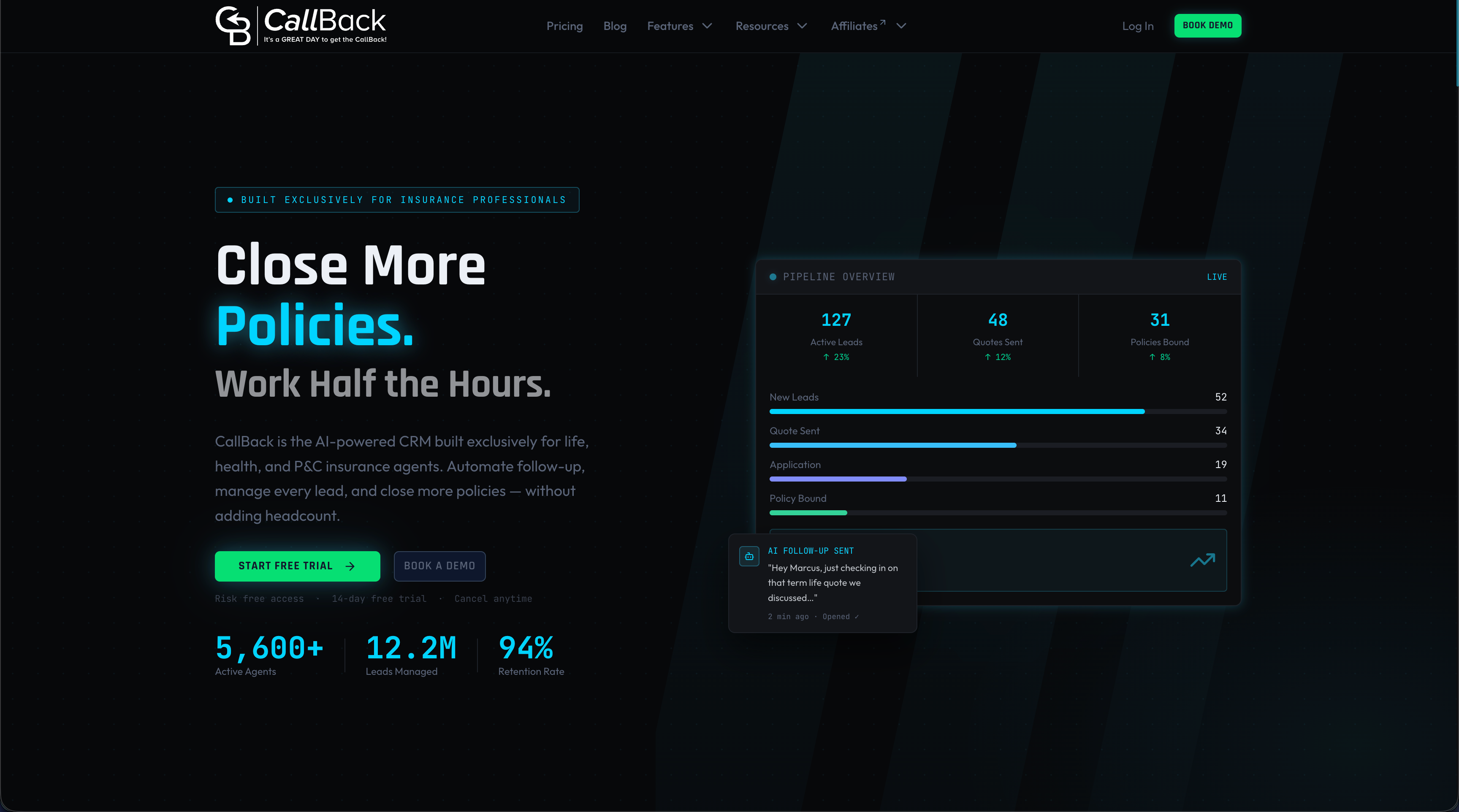
When you evaluate any CRM for this job, check three things: whether it integrates with your existing dialer and calendar, what its trial period looks like, and how it handles data security. CallBack CRM runs on Google Cloud with 24/7 support, and agencies can start a trial to see how the lead generation workflow fits their own pipeline before committing to anything.
Sources
For deeper reading on the process itself, the Word & Brown broker basics guide covers stage definitions in detail, while Vanillasoft’s process breakdown and the Alexander Group’s playbook research explain why standardization outperforms improvisation at scale.
- Broker Basics: Insurance sales steps — Word & Brown broker blog
- How to standardize your insurance sales process — PSM Brokerage
- How to master the insurance sales process — Vanillasoft
- SmartSell profile — Software Advice
FAQ
What is an example of a sales playbook?
A common example is a one-page-per-stage document covering the seven stages from lead capture to submitted-to-issued, each with an objective, target response time, qualifying questions, and a talk track.
What four elements should a sales playbook include?
A workable playbook needs a defined process flow, clear role and hand-off rules, talk tracks with objection scripts, and a KPI list tied to a regular coaching schedule.
What is the 30-60-90 rule in sales?
It’s a rollout timeline: pilot the highest-variation stages in the first 30 days, expand training and roleplay across the full team by day 60, then formalize KPI reporting by day 90.
How fast should an insurance agent respond to a new lead?
Aim for under 5 minutes. Conversion odds drop sharply once response time slips past that window, since roughly half of leads go to whoever contacts them first.
Can a CRM replace the playbook itself?
No. A CRM like CallBack CRM enforces the playbook through automated routing, follow-ups, and reporting, but the talk tracks, stages, and coaching decisions still come from the document your team writes.