

Contact lapsed policyholders within 24 to 48 hours using a phased sequence that starts with email or SMS, escalates to a live call, and confirms whether the lapse was accidental before offering anything else. Delay past that window and recovery odds drop fast. The two variables that separate agencies that consistently winback lapsed policyholders from those that don’t are automation and compliance, and both scale a single manual process into something a small team can run across thousands of policies.
TL;DR:
- Automated, three-phase sequences within 48 hours significantly increase the chances of policy reinstatement by addressing common lapse causes and offering timely incentives.
- Prioritization based on lapse reason, premium size, tenure, and recency improves recovery effectiveness, with high-value policies warranting manual agent outreach.
- Speed of detection and automation triggers, such as webhooks from AMS platforms, are critical to acting on lapses before chances decline.
- Compliance with TCPA and consent rules is essential, requiring thorough documentation, restricted contact times, and suppression of opt-outs to avoid violations.
- Typical recovery rates for automated sequences range from mid-teens to approximately one-third of lapses, with costs in the low double digits per recovered policy.
Table of Contents
- How Do You Winback Lapsed Policyholders Effectively?
- How Should You Score and Prioritize Lapsed Policies?
- How Does Automation Trigger a Win-Back Sequence?
- What Compliance Rules Apply to Win-Back Outreach?
- What Recovery Rates and Costs Should You Expect?
- What Mistakes Kill Win-Back Programs?
- What Does a Real Win-Back Rollout Look Like?
- How Does CallBack CRM Fit This Framework?
- Why Most Win-Back Programs Fail Before They Start
- Put This Workflow on Autopilot With CallBack CRM
- Where to Read More on This Topic
- Sources
- FAQ
How Do You Winback Lapsed Policyholders Effectively?
Recovering a lapsed account isn’t one message. It’s a sequence, and the order matters as much as the content.
Case studies on automated recovery workflows show that agencies running a structured, three-phase sequence recover significantly more policies than those relying on a single follow-up call, largely because phased automated sequences catch policyholders before they’ve fully committed to a new carrier.
- Phase 1, hours 0 to 48: Acknowledge the lapse and verify intent. Many lapses are accidental, a missed autopay, an expired card, a mailing address error. Lead with something like: “We noticed your policy lapsed on [date]. If this wasn’t intentional, you can reinstate with one click here.” Keep the tone service oriented, not sales oriented.
- Phase 2, days 7 to 15: Send a reason matched message paired with a re-quote. If the lapse traces to a price objection, lead with a revised quote. If it traces to a service complaint, lead with what changed. A sample agent-voice line: “I looked at your account and found a way to lower your premium by adjusting your deductible. Want me to send the new numbers?”
- Phase 3, day 30: Escalate to a competitive offer and route high-value prospects into a live agent call queue. Time-limited incentives work here better than earlier in the sequence, since the policyholder has already had two chances to reinstate for free.
The ideal cadence runs three to five touches over 30 to 45 days, moving from SMS or email first, then voice, then agent outreach for anyone who has engaged but not converted.
How Should You Score and Prioritize Lapsed Policies?
Not every lapsed account deserves the same effort. A $180 six-month auto policy that lapsed because of nonpayment competes for attention against a $4,000 commercial umbrella policy that lapsed because a competitor undercut you on price, and those two cases need very different responses.
Build a weighted score using four dimensions:
- Lapse reason: Accidental nonpayment scores highest, competitor switch scores medium, service complaint scores lowest without remediation.
- Premium size: Higher annual premium justifies agent-handled outreach over pure automation.
- Tenure: Policyholders with three or more years on the books typically respond better to a personal touch than a new client would.
- Recency: A lapse from the last 15 days scores far higher than one from 90 days ago, since reason-based segmentation consistently outperforms generic blast messaging.
Score bands typically split into high priority (agent call within 24 hours), medium priority (automated sequence with an agent check-in at day 15), and low priority (fully automated, no manual touch). Before launching, verify mobile numbers, documented consent, and lapse reason accuracy. Bad data at this stage wastes every message that follows.
How Does Automation Trigger a Win-Back Sequence?
Speed depends entirely on how fast your system detects the lapse and acts on it. Manual daily reports create a lag that automation eliminates.
- Detect the lapse event. Most AMS platforms flag a
policy.status_changedevent or support a daily IVANS download query. Configure that event to fire a webhook into your CRM the moment status changes, not the next business day. - Pass the right data. The webhook should carry policy number, premium, coverage type, lapse date, and prior carrier terms so your automation platform can pre-populate re-quote fields automatically. This is the step that removes minutes of manual entry per case and speeds same-day quote delivery.
- Branch on engagement. A policyholder who clicks the reinstatement link but doesn’t complete it routes to an agent call. One who opens nothing after three touches routes to long-term nurture instead of continued daily contact.
- Apply suppression rules. Anyone who reinstates, opts out, or fails to open the first three messages exits the active sequence to avoid duplicate outreach and complaint risk.
Pro Tip: Build your suppression list before you build your outreach sequence. Agencies that automate messaging first and bolt on suppression later are the ones who get flagged for repeat contact complaints.
Tools like the CRM workflow patterns built for insurance can map these triggers without custom development work.
What Compliance Rules Apply to Win-Back Outreach?
The FCC has confirmed that TCPA rules apply to AI-generated voice calls, which means an automated voicemail drop carries the same consent obligations as a live agent dialing manually.
Before every send, run these checks:
- Confirm documented consent for the specific channel, SMS consent doesn’t cover voice, and voice consent doesn’t cover SMS.
- Restrict calls and texts to the time-of-day windows your state and the TCPA allow.
- Screen against internal and national Do Not Call lists every time, not just at list upload.
- Log every send, response, and opt-out in your CRM for audit purposes.
Cap frequency at three to five touches per sequence and suppress anyone who doesn’t engage or who opts out, since documented consent and auditable logging reduce complaint volume while letting you contact more people safely.
What Recovery Rates and Costs Should You Expect?
Set targets before you launch, or you’ll have no way to know if the program worked.
- Contact rate: percentage of lapsed policyholders reached across all channels.
- Response rate: percentage who engage with any message in the sequence.
- Re-quote-to-bind time: days between re-quote delivery and reinstatement.
- Recovery rate: automated sequences typically recover a notable portion of lapsed policies, typically ranging from mid-teens to around one-third, well above single-touch manual outreach.
- Cost per recovered policy: automated programs report costs in the low tens of dollars, versus far higher manual labor costs per account.
- Recovered premium: total annual premium reinstated through the program.
Retention economics back this up. Harvard Business Review’s analysis frames keeping existing customers as consistently more valuable than acquiring new customers.
What Mistakes Kill Win-Back Programs?
Most failed programs share the same handful of errors, and all of them are fixable in a week.
- Leading with price. A generic discount offer sent to everyone ignores why the policy lapsed in the first place and converts worse than a reason-matched message.
- Batching outreach weekly. Waiting for a Friday mail merge instead of triggering on the lapse event itself costs you the highest-conversion window.
- Relying on one channel. Email-only sequences underperform multi-channel sequences that combine email, SMS, and voice.
- Skipping data hygiene. Bad phone numbers, missing consent flags, and mislabeled lapse reasons quietly sabotage even a well-designed sequence.
Pro Tip: Audit your lapse reason field before you build anything else. If half your records say “other,” your segmentation model is guessing, not scoring.
What Does a Real Win-Back Rollout Look Like?
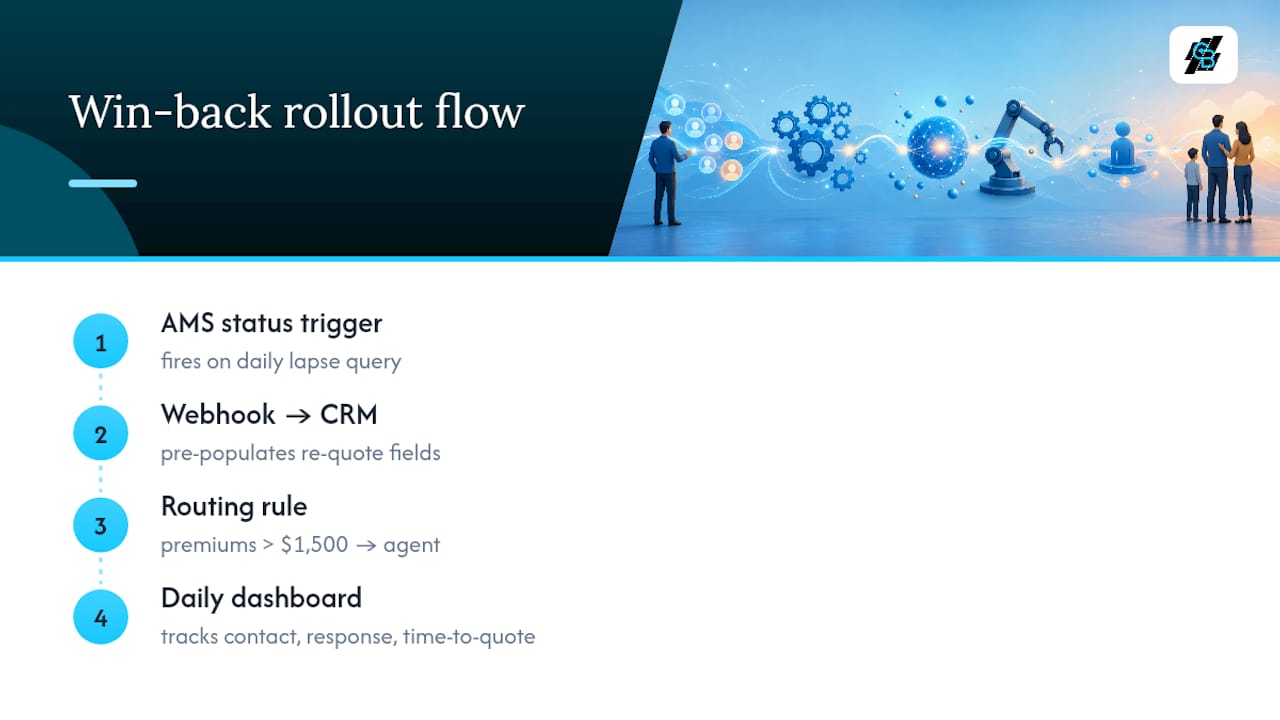
A mid-size agency with 1,200 active policies and an average premium of $1,100 configured a three-phase sequence inside its AMS, triggering on the daily lapse query and routing through webhook to its CRM.
After configuring automated triggers, pre-populated re-quotes, and an agent call queue for accounts over $1,500 in premium, results shifted within the first 90 days.
The operational build took three steps: an AMS status trigger, a webhook into the CRM to pre-populate re-quote fields, and a routing rule sending premiums over $1,500 straight to an agent. The dashboard the team watched daily during rollout tracked contact rate, response rate, and time-to-quote, since those three numbers predicted recovery rate two weeks before it showed up in the final tally.
How Does CallBack CRM Fit This Framework?
CallBack CRM is an all-in-one marketing and sales automation platform built primarily for insurance agents, agencies, and IMOs, with AI tools for customer engagement, lead generation, and sales process management. The platform combines CRM management, email and SMS marketing, funnel and website builders, automation workflows, and reputation management in one system. For agencies building lead-qualification content around win-back campaigns, evergreen webinars built for insurance offer another channel to qualify re-engaged prospects before they hit an agent’s calendar.
Why Most Win-Back Programs Fail Before They Start
The conventional advice on lapsed policyholders treats the problem as a messaging problem. Write a better email, offer a bigger discount, try harder. That’s backwards. The research consistently points to speed and structure as the real levers, not creativity. A policyholder contacted within 48 hours with a plain acknowledgment of an accidental lapse converts better than one contacted three weeks later with a clever discount offer.
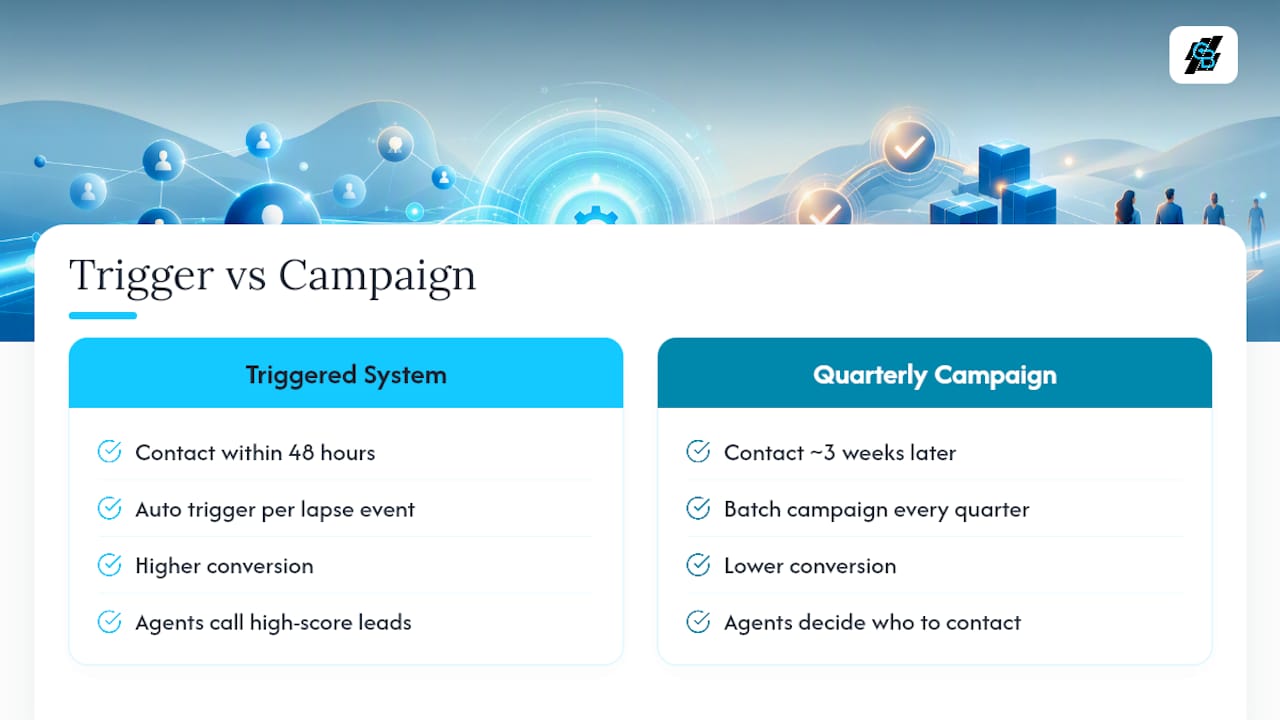
What gets underestimated is how much of this is an operations problem disguised as a marketing problem. Agencies that treat win-back as a campaign they launch quarterly will always lose to agencies that treat it as a standing trigger fired by every lapse event, every day, without a human deciding when to start. The agent’s time should go toward the calls the scoring model flags as high value, not toward deciding who gets contacted first.
If you’re starting from scratch, prioritize the trigger and the segmentation before you touch messaging copy. A mediocre message sent within 48 hours to the right segment will outperform a great message sent three weeks late to everyone.
— Kyle
Put This Workflow on Autopilot With CallBack CRM
CallBack CRM is the alternative to hiring another staffer just to run daily lapse reports. Instead of a spreadsheet and a to-do list, the platform triggers your phased sequence, from SMS and email through routed agent calls, the moment an AMS status change comes through, and logs every consent flag and send for your compliance file automatically.
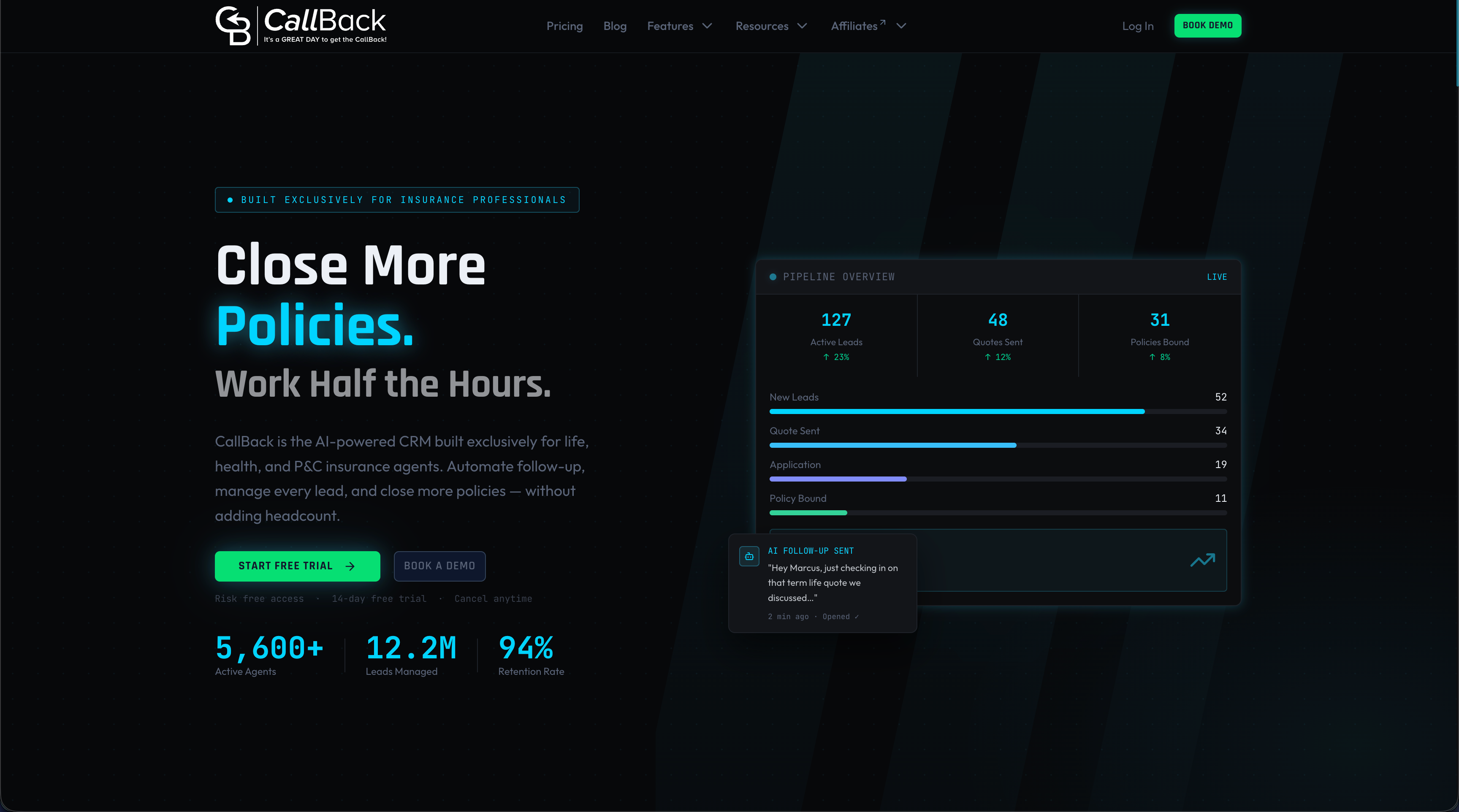
To get started, sign up for the Professional plan, or check the Enterprise plans available for agencies running multiple full CRM accounts. Before your demo, pull a sample lapse report, note your AMS name, and confirm which contact fields (mobile, email, consent status) you already track. Add-on costs for phone numbers, SMS, and AI features are listed on the pricing and fees page, and SMS-specific automation details are covered on the SMS marketing features page. For broader retention thinking beyond win-back, proven retention strategies offer useful complementary tactics.
Where to Read More on This Topic
FCC guidance on TCPA and AI voice calls covers voice compliance requirements. Harvard Business Review examines customer retention economics. Industry benchmarks on automated recovery appear in this case study on lapsed policy recovery.
Sources
- Slash Lapsed Policy Losses: 3-Step Winback 2026
- FCC: TCPA applies when AI technologies generate human-like voices
- The value of keeping the right customers — HBR
FAQ
Can a Lapsed Policy Be Reinstated?
Yes, most carriers allow reinstatement within a defined grace period, often 10 to 30 days depending on the policy and state, without requiring a new application. After that window closes, the policyholder typically has to reapply and may face new underwriting or a higher rate.
What Happens When an Insurance Policy Lapses?
Coverage stops on the lapse date, meaning any claim filed after that point isn’t covered. The policyholder usually receives a lapse notice and a limited window to reinstate before the policy is treated as canceled and a new application becomes necessary.
What Does Win-Back Mean in Insurance?
Win-back refers to the structured process of re-engaging a policyholder after their coverage has lapsed, using targeted outreach to bring them back before they commit to a competitor. Agencies that automate this process with reason-matched sequences consistently recover more accounts than those relying on generic follow-up.
What Is Unintentional Lapse Protection?
Unintentional lapse protection is a policy provision, common in life insurance, that gives a secondary contact notice before a lapse takes effect and, in some cases, extends the grace period for policyholders who missed a payment by accident. Not every policy includes it, so agents should check the specific contract language before assuming it applies.
How Much Does CallBack CRM Cost for Win-Back Automation?
CallBack CRM’s Professional plan starts at $97 per month, with Enterprise plans running from $297 to $497 per month depending on the number of full CRM accounts needed. Add-on fees for phone numbers, SMS, and AI features are listed separately on the fees page.