

TL;DR:
- Effective personalized marketing relies on quality data, audience segmentation, and modular content. Businesses see significant growth when combining behavioral signals with tiered campaigns and continuous updates. Proper execution requires focusing on real-time data, automation, and respecting customer privacy for sustainable results.
Personalized marketing strategies are defined as data-driven approaches that tailor messages, offers, and experiences to individual customers based on their behavior, preferences, and intent. Businesses that execute these strategies correctly see measurable lifts in engagement, conversion rates, and customer loyalty. The difference between winning and losing in modern marketing often comes down to one question: are you speaking to a person or broadcasting to a crowd? This guide walks you through the data requirements, segmentation methods, execution steps, and performance benchmarks you need to build campaigns that actually work.
What data and tools do personalized marketing strategies require?
Effective marketing personalization starts with the right data, not the most data. Four types matter most: zero-party data (what customers tell you directly), first-party data (what your own systems capture), behavioral data (clicks, page visits, time on site), and intent data (signals that indicate purchase readiness).
Owning customer data through zero-party and first-party strategies is now a competitive necessity, not a nice-to-have. Third-party cookie tracking is shrinking fast, and brands that rely on it are losing their personalization foundation.
| Data type | What it captures | Primary tool |
|---|---|---|
| Zero-party | Stated preferences, survey answers | Typeform, checkout questions |
| First-party | CRM records, purchase history | Callbackcrm, Salesforce |
| Behavioral | Site clicks, email opens, scroll depth | Google Analytics, HubSpot |
| Intent | Search queries, ad engagement signals | Bombora, LinkedIn Insights |
The collection method matters as much as the data type. One well-placed preference question at checkout can generate more actionable segmentation data than dozens of passive tracking pixels. That single question respects privacy and delivers a direct signal you can act on immediately.
Progressive profiling is the practice of collecting one or two data points per customer interaction rather than demanding a full profile upfront. Tools like Callbackcrm support this approach through automated workflows that ask the right question at the right moment in the customer journey.
Pro Tip: Ask one zero-party question per touchpoint. “What’s your biggest challenge right now?” placed in a post-purchase email generates segmentation data that no pixel can match.
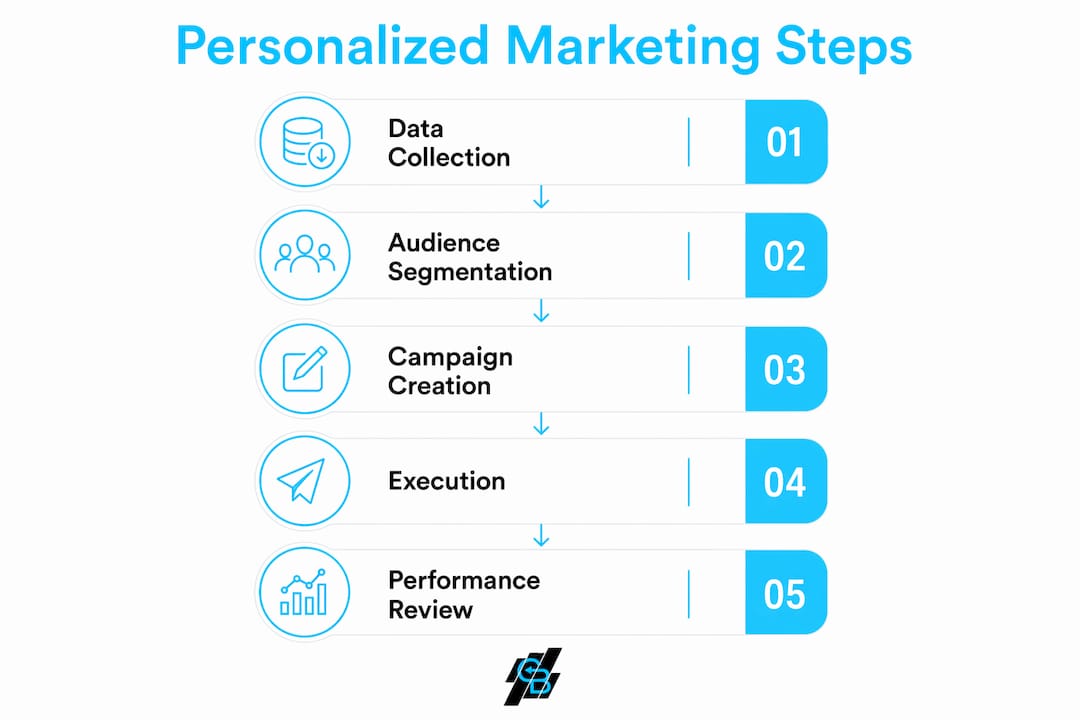
83% of consumers are willing to share personal data when it leads to genuinely personalized experiences. That willingness disappears the moment customers feel surveilled rather than served. Transparent data collection with clear value exchange is the only approach that scales.
How to segment your audience for better personalized customer engagement
Audience segmentation is the process of dividing your customer base into groups that share meaningful characteristics, then crafting distinct messages for each group. Generic segmentation by age or location is a starting point, not a strategy.
The most effective segmentation criteria combine four dimensions:
- Demographics: industry, company size, job title, geography
- Behavioral signals: pages visited, content downloaded, email engagement frequency
- Role-based intent: decision-maker vs. researcher vs. end user
- Purchase stage: awareness, consideration, or ready to buy
Segmenting your audience into tiers aligns your personalization effort with account value and maximizes return on investment. A tiered approach works like this: Tier 1 accounts receive fully customized outreach with personalized landing pages and direct sales contact. Tier 2 accounts receive lightly personalized email sequences. Tier 3 accounts receive automated nurture campaigns with dynamic content blocks.
In B2B contexts, this tiered model produces dramatic results. Deep personalization for Tier 1 accounts can lift reply rates 3–5 times and reduce the sales cycle by approximately 18 days. That is not a marginal improvement. It is a structural change in how fast deals close.
In B2C contexts, behavioral segmentation drives the most impact. A customer who browsed life insurance policies three times in one week is in a fundamentally different segment than someone who opened one email six months ago. Treating them the same way wastes budget and erodes trust.
Pro Tip: Refresh your segments every 30 days. Customer behavior shifts constantly, and a segment built on data from last quarter may no longer reflect current intent.
Dynamic audience updates are non-negotiable. Static lists decay fast. The best CRM platforms, including Callbackcrm, support AI-driven customer engagement by automatically moving contacts between segments based on real-time behavior triggers.
What steps create and deliver effective tailored marketing campaigns?
Execution is where most personalization efforts fail. Marketers plan well but build campaigns as monolithic pieces of content that cannot adapt. The fix is modular content architecture.

Modular content assembly enables scalable, economically viable personalized campaigns. Instead of writing a unique email for every segment, you build interchangeable blocks: a headline module, a pain-point module, a social proof module, and a call-to-action module. The system assembles the right combination for each recipient automatically.
Here is the step-by-step process for building and delivering personalized campaigns:
- Audit your data. Identify what you know about each segment and where the gaps are. No personalization system works without clean, current data.
- Build your content library. Create modular assets for each stage of the funnel. Write three headline variants, four pain-point descriptions, and two call-to-action options per segment.
- Set up your orchestration layer. Use your CRM or marketing automation platform to define rules: if a contact visits the pricing page twice, trigger the “ready to buy” email sequence.
- Activate omnichannel delivery. High-performing personalization integrates dynamic website content, email, ads, and SMS marketing into a single coordinated experience. A prospect should see consistent messaging whether they open an email or land on your homepage.
- Define next-best-action triggers. Map out what happens after each customer response. A reply to an email should trigger a different follow-up than a click without a reply.
- Test one variable at a time. Run A/B tests on subject lines, content modules, and send times separately. Testing everything at once produces data you cannot interpret.
The most common pitfall at this stage is over-automation without human review. Automated sequences can send the wrong message to the wrong person if your segmentation logic has errors. Build in a weekly audit of your top-performing and worst-performing sequences.
Pro Tip: Use your personalized email workflow as the backbone of your campaign. Email has the highest direct response rate of any channel and gives you the clearest behavioral data for refining other touchpoints.
Customization requires manual user input, while true personalization uses AI to anticipate needs without explicit requests. That distinction matters when you are choosing tools. A platform that only lets customers choose their own preferences is not a personalization engine. You need AI that predicts the next best action based on behavioral patterns.
How to measure effectiveness and fix common personalization problems
The minimum performance benchmark for any personalized campaign is a 15% revenue lift per visitor compared to a generic experience. If your campaigns are not hitting that threshold, something in your data, segmentation, or content assembly is broken.
Four metrics define campaign health:
- Revenue lift per visitor: the clearest signal of whether personalization is generating real business value
- Engagement rate: open rates, click rates, and time on page reveal whether your content is resonating
- Reply rate: especially in outbound sequences, reply rate tells you if your message is relevant enough to prompt a response
- Sales cycle length: a shortening cycle indicates that personalization is reducing friction and accelerating decisions
The three most common reasons personalization fails are data starvation, over-segmentation, and intrusive tactics. Data starvation happens when budgets are spread too thin across too many ad sets, leaving AI models without enough conversion events to learn from. The result is a system that cannot optimize because it never sees enough signal.
| Challenge | Root cause | Solution |
|---|---|---|
| Low reply rates | Wrong segment or generic messaging | Tighten segmentation criteria; add one personalized detail |
| AI not optimizing | Too few conversion events per ad set | Consolidate ad sets; increase budget per set |
| Customer complaints about “creepy” targeting | Overt surveillance signals | Shift to intent-based personalization; reduce retargeting frequency |
| Declining engagement over time | Static segments and stale content | Refresh segments monthly; rotate content modules quarterly |
Personalization must continuously adapt based on customer interactions to remain effective and compliant with evolving privacy regulations. Build quarterly audits into your calendar. Review your data sources, update your segments, and retire content modules that are no longer performing.
Personalization based on predicted intent rather than overt surveillance increases trust and loyalty over time. The goal is to make customers feel understood, not watched.
Key takeaways
Personalized marketing strategies deliver measurable growth only when data quality, tiered segmentation, and modular content execution work together as a system.
| Point | Details |
|---|---|
| Start with zero-party data | Ask one direct preference question per touchpoint to build clean, consent-based segmentation data. |
| Tier your audience | Assign Tier 1 accounts full custom outreach; use automated sequences for lower-value segments to protect budget. |
| Build modular content | Create interchangeable content blocks so AI can assemble the right message for each recipient at scale. |
| Measure revenue lift first | The 15% revenue lift benchmark per visitor is your primary signal that personalization is working. |
| Refresh segments monthly | Static audience lists decay fast; update segments based on real-time behavioral data every 30 days. |
Why most personalization efforts stay shallow (and how to go deeper)
I have reviewed a lot of personalization programs over the years, and the pattern is almost always the same. A team invests in a CRM, sets up a few email sequences with first-name tokens, and calls it personalization. Then they wonder why engagement rates are flat.
Real personalization is not about inserting a name. It is about delivering the right message at the exact moment a customer is ready to receive it. That requires behavioral data, not just demographic data. It requires AI that learns from interactions, not just rules someone typed into a workflow builder.
The insight that changed how I think about this came from watching how AI-powered campaigns behave when they have enough data versus when they are starved of it. A well-fed AI model finds patterns humans would never spot. A starved model just guesses. Most teams are running starved models because they split their budget across too many campaigns.
My honest advice: consolidate before you expand. Run fewer, better-funded campaigns. Let your AI model accumulate enough signal to actually learn. Then scale what works. The teams that do this consistently outperform the teams chasing every new channel simultaneously.
Privacy is the other piece most marketers underweight. Customers are not opposed to personalization. They are opposed to feeling surveilled. The fix is simple: personalize based on what customers tell you and what they do on your platform, not on third-party data they never consented to share. That approach also happens to be more durable as privacy regulations tighten globally.
Modular content is the operational unlock that makes all of this sustainable. You cannot write unique copy for every segment at scale. But you can build 20 content blocks and let your system assemble them intelligently. That is how you get personalization that feels human without burning out your team.
— Kyle
How Callbackcrm puts these strategies into practice
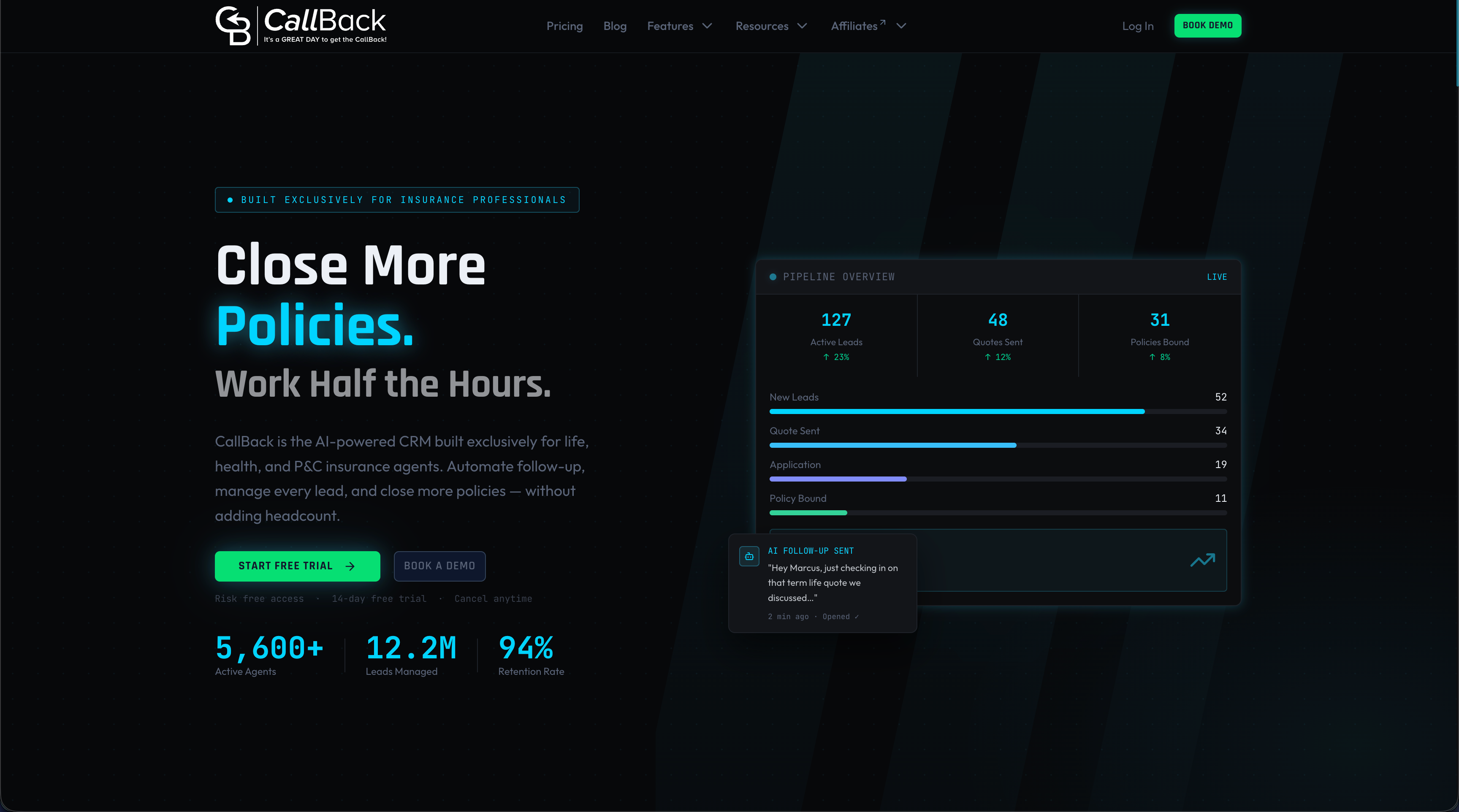
Callbackcrm gives insurance agents, agencies, and IMOs a single platform to execute every layer of a personalized marketing program. From AI-powered lead scoring and behavioral segmentation to automated email and SMS sequences, the platform handles the operational complexity so you can focus on strategy. The 50+ AI-powered features inside Callbackcrm cover CRM management, dynamic content delivery, funnel building, and reputation management in one place. For agents who want direct, personal outreach at scale, the SMS marketing tools let you reach prospects with targeted messages that feel one-to-one, not broadcast. If you are ready to move from generic campaigns to data-driven personalization, Callbackcrm is built for exactly that transition.
FAQ
What is personalized marketing, exactly?
Personalized marketing is the practice of using customer data and AI to deliver messages and offers tailored to individual behavior, preferences, and intent. Unlike customization, which requires manual user input, personalization anticipates needs automatically.
How much data do you need to start personalizing?
You can start with a single zero-party data point, such as one preference question at checkout. Clean, consented data from a small audience outperforms large volumes of low-quality third-party data.
What is a realistic revenue lift from personalization?
The minimum benchmark for effective personalization is a 15% revenue lift per visitor compared to a generic experience. Tier 1 account personalization in B2B contexts can produce reply rate increases of 3–5 times.
Why does AI-driven personalization sometimes fail to optimize?
AI models require sufficient conversion events per ad set to exit the learning phase and begin optimizing. Spreading budget too thin across many campaigns starves the model of signal and prevents meaningful personalization.
How often should you update your audience segments?
Segments should be refreshed at least every 30 days. Customer behavior shifts continuously, and segments built on older data will misfire, sending the wrong message to people who have already moved to a different stage of the buying journey.