

TL;DR:
- Lead lifecycle management defines, tracks, and governs how prospects move through revenue stages from initial contact to customer. It creates a structured process with clear ownership and criteria that reduces gaps, prevents revenue loss, and improves conversion rates. Automation and strong alignment between marketing and sales are essential for predictable, scalable growth.
Lead lifecycle management is the operational discipline of defining, tracking, and governing the movement of a prospect through every revenue stage, from initial interaction to closed-won or disqualification. CRM platforms like Salesforce and HubSpot provide the data infrastructure, but the discipline itself goes far beyond software setup. Marketing professionals and business leaders who understand what is lead lifecycle management gain a repeatable system for preventing revenue leakage, aligning teams, and converting more prospects into customers. Without it, leads fall into gaps between marketing and sales, and revenue disappears silently.
What is lead lifecycle management and why does it matter?
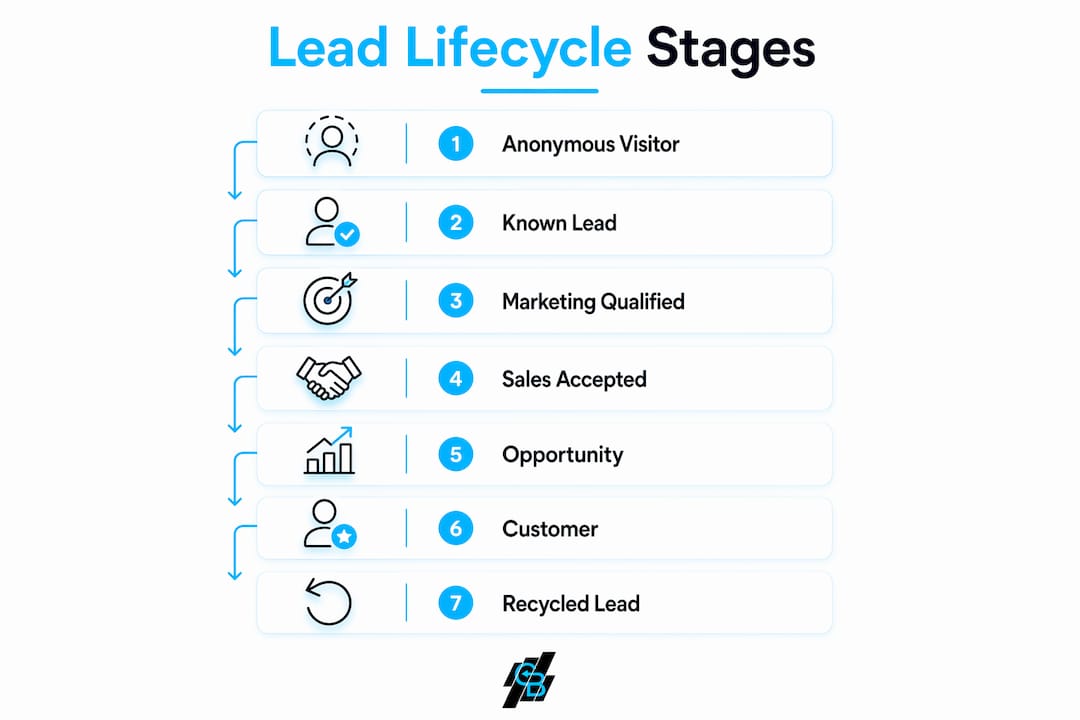
Lead lifecycle management is the process of tracking leads through defined stages such as Anonymous Visitor, Known Lead, MQL, SAL, SQL, Opportunity, and Customer. Each stage has clear, observable exit criteria and a designated owner. That structure is what separates a predictable revenue engine from a chaotic pipeline where nobody knows why deals stall.
The importance of lead management shows up most clearly when it is absent. Leads get passed to sales too early, sales ignores them, and marketing blames sales for poor follow-up. The real problem is structural: no agreed-upon definition of when a lead is ready to move. The lead management process fixes that by making progression verifiable, not subjective.
CRM platforms like Salesforce and HubSpot provide foundational data storage, but lead lifecycle management adds dynamic, AI-informed motion to prioritize sales efforts and automate workflows. Think of the CRM as the road and lifecycle management as the traffic system. Without the traffic system, cars pile up at every intersection.
What are the key stages in the lead lifecycle?
The lifecycle consists of 7 core stages with clear, observable exit criteria and stage ownership to prevent revenue loss. Each stage answers a specific question about where the prospect stands and who is responsible for moving them forward.
The seven stages are:
- Anonymous Visitor: A person interacting with your content before any identity is known. Exit criterion: form fill, chat initiation, or ad click that captures identity.
- Known Lead: Identity is captured but no qualification has occurred. Marketing owns this stage.
- Marketing Qualified Lead (MQL): The lead meets behavioral or demographic criteria that signal readiness for sales attention. Exit criterion: defined scoring threshold reached.
- Sales Accepted Lead (SAL): Sales explicitly reviews and accepts the MQL. This stage is the most commonly skipped and the most important checkpoint in the entire process.
- Sales Qualified Lead (SQL): Sales confirms budget, authority, need, and timeline. Exit criterion: opportunity created.
- Opportunity: Active deal in the pipeline with a defined close date and value.
- Customer: Deal closed. The lifecycle does not end here. Customer data feeds back into segmentation and referral programs.
Most organizations underestimate the number of stages needed, often using only 4–5, which causes leads to fall into “black holes” where they stagnate. Seven to eight distinct stages are industry best practice.
Pro Tip: Map each stage to a specific team owner and a verifiable exit criterion before you configure anything in your CRM. A stage without an owner is a stage where leads go to die.

| Stage | Owner | Exit Criterion |
|---|---|---|
| Anonymous Visitor | Marketing | Identity captured via form or chat |
| Known Lead | Marketing | Lead entered into CRM |
| MQL | Marketing | Scoring threshold reached |
| SAL | Sales | Explicit acceptance or rejection logged |
| SQL | Sales | Opportunity created in CRM |
| Opportunity | Sales | Deal closed or disqualified |
| Customer | Account Management | Onboarding complete |
How does lead lifecycle management prevent revenue loss?
Revenue loss in the lead management process comes from what practitioners call “black holes.” These are the gaps between stages where no one owns the lead and no system flags the stall. A lead sits at MQL status for 30 days, nobody follows up, and the prospect buys from a competitor.
Effective lead lifecycle management requires marketing and sales to agree 100% on stage definitions and shared KPIs to avoid lead loss and ensure predictable progression. That agreement is not a one-time meeting. It is a documented, enforced operating standard with accountability built in.
Automation reduces the human error that causes most of these losses. Automated workflows and centralized CRM data reduce manual scoring errors and misrouting. When a lead hits an MQL threshold, the system routes it to the right sales rep within minutes, not days. Speed matters because lead response time directly affects conversion rates.
“Lead lifecycle management systems convert chaotic data and processes into a repeatable, scalable growth infrastructure that powers sustained revenue.” — What Is Lead Lifecycle Management?
The benefits of a well-run lead management process include:
- Shorter sales cycles because reps receive pre-qualified leads with context
- Higher conversion rates because marketing only passes leads that meet agreed criteria
- Cleaner pipeline data because every stage transition is logged and auditable
- Faster identification of where leads stall, so teams can fix the bottleneck
Understanding the lead funnel optimization techniques that reduce drop-off at each stage is the practical next step after defining your stages.
What role do lead nurturing and recycling play?
Recycling, disqualification, and re-engagement represent the majority of lead volume and are critical parts of lead lifecycle management, not edge cases. Most marketing teams focus almost entirely on generating new leads. The bigger revenue opportunity sits in the existing database of leads that were not ready the first time.
Lead nurturing strategies keep those leads warm until timing or circumstances change. Nurturing is a continuous, multi-channel effort that triggers content and outreach tailored to lead behavior and stage, extending beyond initial lead capture. Channels include email, retargeting, SMS, and conversational chat with segmented drip sequences.
A recycled lead is not a failed lead. It is a lead whose timing was wrong. The trigger for recycling a lead back into a nurturing sequence should be explicit: the SAL stage rejection with a reason code, a SQL that went dark after initial contact, or an opportunity lost to “no decision.” Each reason code maps to a different nurture track.
Here is a practical framework for recycling leads effectively:
- Log the rejection reason at the SAL or SQL stage. “Not ready” and “wrong fit” require different nurture tracks.
- Assign a re-engagement date based on the reason. “Not ready” leads often convert within 6–12 months with consistent nurturing.
- Segment by behavior during the nurture phase. A lead that opens every email but never clicks is different from one that clicks product pages repeatedly.
- Score continuously. Behavior during nurturing updates the lead score in real time. When the score crosses the MQL threshold again, the lead re-enters the active lifecycle automatically.
- Use multiple channels. Email alone is not enough. SMS and retargeting ads reinforce the message and keep the brand visible without being intrusive.
Pro Tip: Build a “nurture exit” trigger into your CRM. When a recycled lead’s score crosses your MQL threshold, the system should automatically create a new SAL task for sales. No manual review required.
Pairing this with proven lead nurturing strategies that use behavioral segmentation gives your team a clear playbook for re-engaging stalled prospects.
How do marketing and sales teams align around the lead lifecycle?
Marketing and sales alignment on actual customer experience rather than internal assumptions prevents lost leads and improves conversion predictability. The biggest alignment failure is not attitude. It is undefined terms. When marketing and sales use the word “qualified” differently, every handoff becomes a dispute.
The SAL stage solves this problem structurally. The SAL stage functions as a checkpoint where sales audits MQLs for quality, reducing silent drop-offs and misalignment. SAL forces explicit acceptance or feedback from sales, improving lifecycle handoff transparency. Without SAL, sales silently ignores MQLs it considers unqualified, and marketing never knows why.
Alignment requires these operational commitments:
- Documented stage definitions that both teams sign off on, reviewed quarterly
- Shared KPIs that include both marketing metrics (MQL volume, MQL-to-SAL rate) and sales metrics (SAL-to-SQL rate, SQL-to-close rate)
- Feedback loops where sales logs rejection reasons at SAL and SQL, giving marketing data to improve lead quality
- Joint pipeline reviews at least monthly, where both teams review stage-by-stage conversion rates together
AI and automation in lead scoring allow marketing and sales teams to focus on highest-value interactions and reduce manual errors. When the system handles routing and scoring, the human conversation shifts from “why did you send me this lead?” to “how do we close this deal?”
A practical lead generation workflow that maps automation triggers to each lifecycle stage gives both teams a shared operating document, not just a shared spreadsheet.
Key Takeaways
Lead lifecycle management is the cross-functional operating discipline that converts unstructured prospect data into predictable revenue by enforcing stage definitions, ownership, and verifiable exit criteria across marketing and sales.
| Point | Details |
|---|---|
| Define all 7 stages | Use Anonymous Visitor through Customer, each with a clear owner and exit criterion. |
| Never skip SAL | The Sales Accepted Lead stage prevents silent drop-offs and forces explicit sales feedback. |
| Recycle aggressively | Most lead volume is recycled leads. Build nurture tracks for every rejection reason code. |
| Align on shared KPIs | Marketing and sales must track MQL-to-SAL and SAL-to-SQL rates together, not separately. |
| Automate stage transitions | CRM automation reduces manual errors and speeds up lead routing to improve conversion rates. |
Why most lifecycle programs fail before they start
The most common mistake I see is treating lead lifecycle management as a CRM configuration project. Teams spend weeks building Salesforce fields and HubSpot workflows, then wonder why nothing changes. The system is not the problem. The operating model is.
Lead lifecycle management is not a CRM configuration project but a business process discipline. That means the real work happens in the room where marketing and sales leaders agree on what “qualified” actually means. That conversation is uncomfortable because it exposes how differently the two teams have been operating. Do it anyway.
The second failure I see consistently is ignoring the recycled lead population. Marketing leaders focus on new lead volume because it is easy to measure and easy to report. Re-engagement is harder to attribute and harder to celebrate. But the leads already in your database cost money to acquire. Ignoring them is the most expensive habit in revenue operations.
Implementing verifiable exit criteria for each lifecycle stage enforces accountability and reduces subjective disagreement between marketing and sales over lead quality. Start there. Define what a lead must do or demonstrate before it moves to the next stage. Make it observable. Make it auditable. Then build the automation around those criteria, not the other way around.
— Kyle
How Callbackcrm supports your lead lifecycle
Callbackcrm is built for insurance agents, agencies, and IMOs who need a complete lead lifecycle system without stitching together five separate tools.
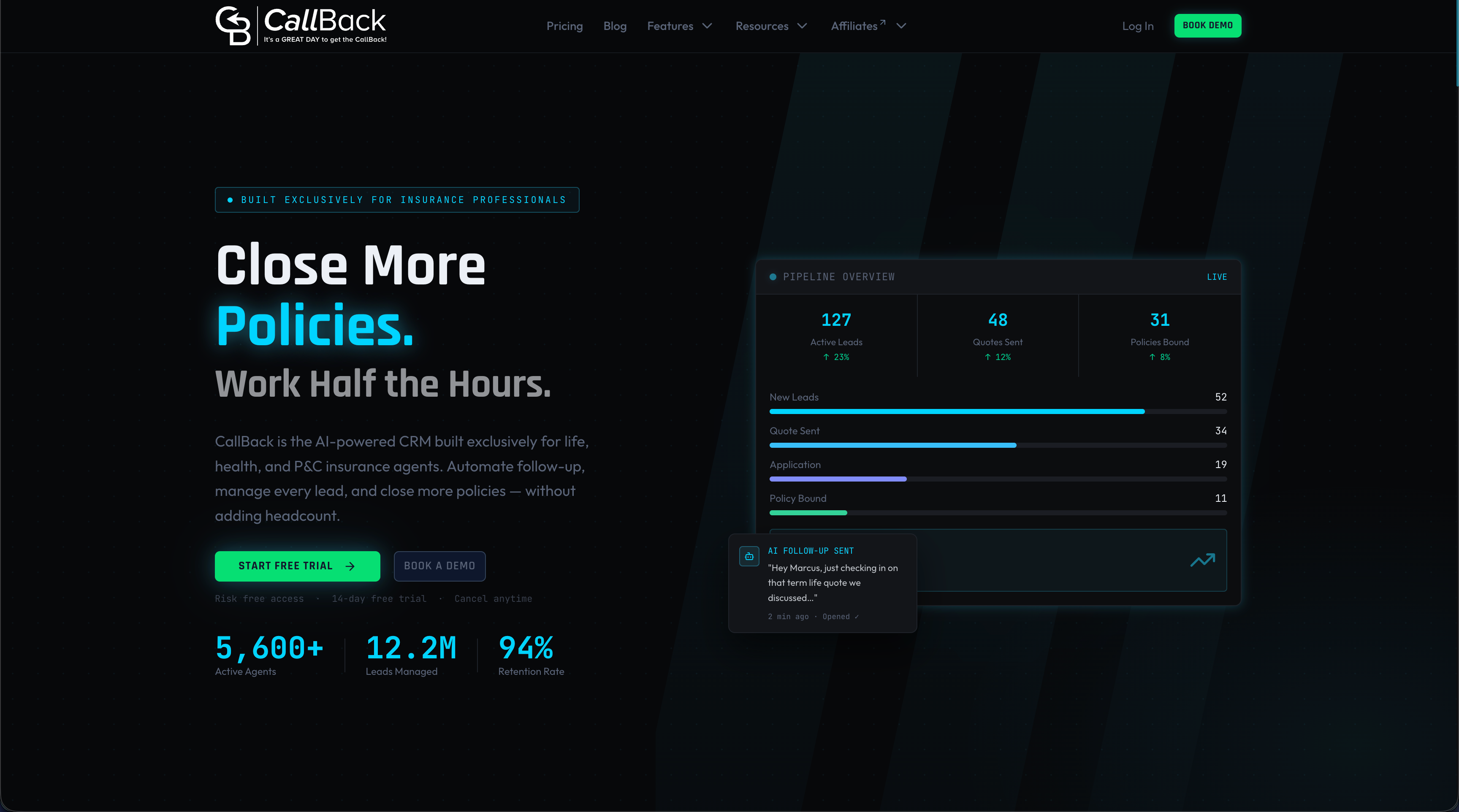
The platform’s AI-powered features cover lead scoring, automated routing, multi-channel nurturing via email and SMS, and CRM stage management in one place. When a lead crosses your MQL threshold, Callbackcrm routes it to the right rep automatically and logs the transition. When a lead stalls, automated nurture sequences re-engage them across email, SMS, and chat without manual intervention. The email marketing automation tools let you build segmented drip sequences tied directly to lifecycle stage, so every message matches where the prospect actually is in the process.
FAQ
What is lead lifecycle management in simple terms?
Lead lifecycle management is the process of tracking every prospect through defined stages, from first contact to customer, with clear rules for who owns each stage and when a lead moves forward.
How many stages should a lead lifecycle have?
Industry best practice calls for 7–8 distinct stages. Using fewer than that causes leads to stall in undefined gaps between marketing and sales.
What is the Sales Accepted Lead (SAL) stage?
SAL is the checkpoint where sales explicitly reviews and accepts or rejects an MQL. It prevents silent drop-offs and gives marketing direct feedback on lead quality.
Why is lead recycling part of the lead management process?
Recycled and re-engaged leads represent the majority of lead volume. Ignoring them wastes the acquisition cost already spent and leaves significant revenue on the table.
How does automation improve lead lifecycle management?
Automation handles stage transitions, lead scoring updates, and routing in real time, reducing manual errors and ensuring leads reach the right rep at the right moment.