

TL;DR:
- In 2026, hybrid lead scoring models combining rule-based and AI techniques deliver the highest accuracy and sales adoption. To build effective systems, insurance teams should define clear criteria, integrate multiple data sources, and ensure team alignment through quarterly recalibration. Trust and collaboration with sales agents are essential, as models are most successful when developed with their input and explained transparently.
Lead scoring is the practice of ranking prospects by their likelihood to convert, using data-driven criteria across fit, behavior, intent, and engagement signals. For insurance marketing and sales teams, the right lead scoring methods 2026 demands are no longer optional. Predictive AI models now push accuracy from a 15–25% baseline to 40–60%, a shift that changes how agents prioritize every single call. Tools like HubSpot, Salesforce Einstein, and MadKudu have made these models accessible. The debate in 2026 is no longer whether to use AI. It is how to deploy it without losing the sales team’s trust.
What are the best lead scoring methods 2026 insurance teams use?
The four main scoring approaches in use today are rule-based, predictive AI, hybrid, and the four-signal quadrant model. Each has a distinct tradeoff between accuracy, deployment speed, and how well your sales reps will actually adopt it.

Rule-based scoring
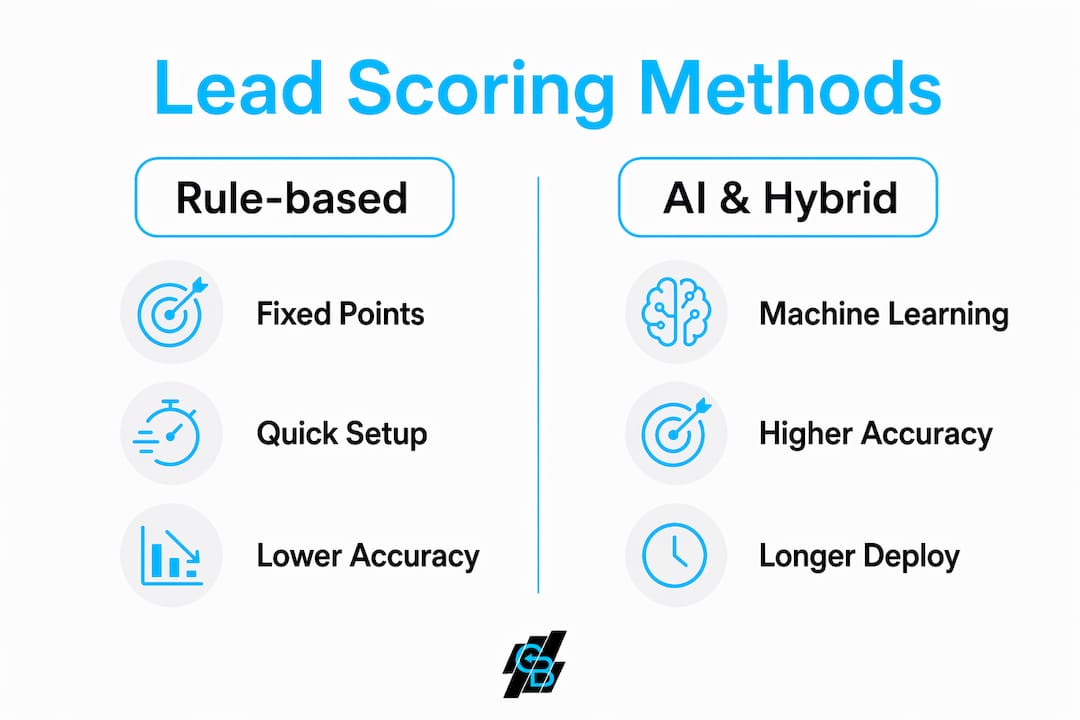
Rule-based scoring assigns fixed point values to specific attributes. A prospect who matches your ideal customer profile (ICP) on age, geography, and policy type might score 40 points. One who downloads a quote form adds 20 more. The model is transparent and easy to explain to any agent. The downside is accuracy. Rule-based models cap out at 15–25% accuracy because they cannot detect complex patterns across dozens of variables simultaneously. That ceiling costs insurance teams real revenue.
Predictive AI scoring
Predictive AI models use machine learning to analyze historical win/loss data and surface patterns no human would spot manually. AI-powered scoring reaches 40–60% accuracy in 2026 deployments. The tradeoff is deployment time. Pure AI models require 8–12 months to build and validate, plus large volumes of clean historical data. For smaller agencies or IMOs without deep CRM history, that is a significant barrier.
Hybrid models
Hybrid models combine a transparent rule-based fit layer with an AI re-ranker on top. Hybrid architectures deploy in 6–10 weeks and achieve 80–85% real-world accuracy. That is the sweet spot for most insurance organizations. Sales reps can see why a lead scored high (the rule-based layer explains it), while the AI layer captures subtler signals the rules would miss.
The four-signal quadrant
The four-signal quadrant model segments every lead across fit, behavioral engagement, intent data, and decay signals. Top insurance organizations classify Tier A leads (scoring 90–120 points) as roughly 15% of their pipeline, requiring follow-up within 24 hours. This tiered structure prevents agents from wasting time on cold prospects while ensuring the hottest leads get immediate attention.
| Model | Accuracy | Deploy time | Data needs | Sales adoption |
|---|---|---|---|---|
| Rule-based | 15–25% | 1–2 weeks | Low | High |
| Predictive AI | 40–60% | 8–12 months | High | Medium |
| Hybrid | 80–85% | 6–10 weeks | Medium | High |
| Four-signal quadrant | Varies | 3–6 weeks | Medium | High |
Pro Tip: If your agency has fewer than 500 closed deals in your CRM, start with a hybrid model. Pure AI needs volume to train on. Hybrid gives you accuracy without waiting a year for results.
How do you build an effective lead scoring system for insurance?
Building a scoring system that your sales team will actually use requires five deliberate steps. Skipping any one of them is the most common reason models fail within the first two quarters.
-
Define your ICP criteria. Select 5–10 active scoring variables tied directly to your insurance buyer profile. These might include policy type interest, geographic location, age bracket, prior coverage history, and digital engagement level. Models with more than 15 variables are too complex and reduce sales adoption. Keep it lean.
-
Integrate multiple data sources. Pull firmographic data for fit scoring, behavioral data from your CRM and website, and third-party intent data from platforms like Bombora or G2. Intent data integration doubles or triples accuracy compared to fit-only models. Combining first-party behavior with third-party intent signals is now table stakes for competitive insurance teams.
-
Set tiered lead grades. Define clear thresholds: Tier A (90–120 points) for immediate outreach, Tier B (60–89 points) for nurture sequences, and Tier C (below 60) for long-term drip campaigns. Tiered grades tell agents exactly what to do next without requiring them to interpret a raw number.
-
Align marketing and sales on SLAs. Failing to align both teams on scoring inputs and service-level agreement ownership causes model failure within two quarters. Decide together who owns score updates, what triggers a handoff, and how quickly sales must act on Tier A leads.
-
Choose the right platform. HubSpot and Salesforce Einstein both offer built-in scoring with insurance-specific customization options. For teams that want AI scoring without heavy IT involvement, Callbackcrm provides automated scoring workflows built specifically for insurance agents and IMOs.
Here are the core data inputs your scoring model should draw from:
- Fit signals: Policy type match, geography, age, household income bracket
- Behavioral signals: Email opens, quote form completions, webinar attendance, page visits
- Intent signals: Third-party research activity on Bombora or G2, competitor comparisons
- Decay signals: Days since last engagement, unsubscribes, career page visits
Pro Tip: Map your last 50 closed deals before building any model. Look for the 3–4 behaviors that appeared in 80% of wins. Those become your highest-weighted variables.
What are the common pitfalls in lead scoring for insurance teams?
Most scoring models do not fail because of bad data. They fail because of poor maintenance and misaligned teams. These are the mistakes that cost insurance marketers the most.
Overbuilding the model. Adding 20 or 30 variables feels thorough. In practice, it creates a black box that agents distrust and managers cannot explain. Experts recommend 5–10 active criteria for mid-market teams. Every variable you add beyond that threshold reduces adoption without meaningfully improving accuracy.
Ignoring negative signals. Most teams score what leads do. Few score what leads stop doing. Negative scoring signals like inactivity, competitor site visits, and career page views raise model accuracy by 12–15% and prevent stale leads from clogging your pipeline. An insurance prospect who visited your pricing page three months ago and has not returned since is not a hot lead. Your model should reflect that.
Skipping quarterly recalibration. Models trained on outdated data drift quietly. A variable that predicted conversion well in Q1 may be irrelevant by Q3 as market conditions shift. Run a win/loss analysis every quarter and adjust variable weights based on what actually closed. This is not optional maintenance. It is the difference between a model that works and one that misleads.
Using a 100-point scale without clear tiers. A score of 67 means nothing to a sales agent without context. Convert raw scores into named tiers (Hot, Warm, Cold) or letter grades (A, B, C) so agents know immediately what action to take. Clarity drives adoption.
What advanced lead scoring strategies are emerging for insurance in 2026?
The most effective teams in 2026 are moving beyond basic scoring into architectures that combine multiple signals in smarter ways. Three strategies stand out.
Compound scoring formulas
Compound scoring multiplies fit, intent, and engagement scores rather than adding them. Compound models outperform additive models because a lead must score well across all three dimensions to rank highly. A prospect with high fit but zero intent activity scores low. That is the right outcome. Additive models would still rank that prospect as moderate, sending agents after someone who is not actually in-market.
Cohort-aware re-training
Cohort-aware re-training updates the model using only the most recent 90 days of outcome data, weighted more heavily than older data. This keeps the model sensitive to current buyer behavior without discarding historical patterns entirely. Insurance markets shift with rate changes, regulatory updates, and seasonal demand. A model trained on last year’s data will miss this year’s buyers.
AI-powered tools built for scale
Three platforms lead the field for advanced insurance scoring in 2026. Darwin AI specializes in predictive lead models with explainability features that satisfy compliance-conscious insurance teams. MadKudu focuses on behavioral and intent signal weighting. 6sense adds account-level intent data that works well for agencies targeting commercial lines. Each tool solves a different part of the scoring problem.
| Tool | Strength | Best for |
|---|---|---|
| Darwin AI | Explainable AI models | Compliance-focused teams |
| MadKudu | Behavioral signal weighting | High-volume personal lines |
| 6sense | Account-level intent data | Commercial lines agencies |
| Salesforce Einstein | CRM-native scoring | Large agencies on Salesforce |
| HubSpot | Ease of setup | Small to mid-size agencies |
Pro Tip: Before buying any scoring tool, ask the vendor for a sample explainability report. If they cannot show you why a lead scored high in plain language, your sales reps will not trust it either.
Key takeaways
Hybrid lead scoring models combining rule-based transparency with AI re-ranking deliver the best accuracy and sales adoption for insurance teams in 2026.
| Point | Details |
|---|---|
| Hybrid models win on accuracy | Hybrid architectures reach 80–85% accuracy and deploy in 6–10 weeks, outpacing pure AI timelines. |
| Keep models lean | Use 5–10 active variables; models with more than 15 criteria reduce sales adoption without improving results. |
| Negative signals matter | Inactivity and competitor visits as negative signals raise model accuracy by 12–15%. |
| Recalibrate every quarter | Win/loss data from the past 90 days should drive variable weight updates to prevent model drift. |
| Team alignment is non-negotiable | Marketing and sales must share ownership of scoring inputs and SLAs or the model fails within two quarters. |
Why I think most insurance teams are solving the wrong lead scoring problem
I have watched insurance marketing teams spend months debating which AI platform to buy while their existing CRM data sits unstructured and their sales reps ignore scores entirely. The technology is rarely the bottleneck. The bottleneck is trust.
Sales agents in insurance are skeptical by nature. They have been burned by bad leads before. When you hand them a score without explaining what drove it, they default to their gut. That is not stubbornness. That is rational behavior. The teams I have seen succeed with advanced lead scoring strategies all share one trait: they built the scoring logic with their sales reps, not for them.
The pandemic accelerated AI adoption across insurance marketing, but it also created a false confidence in model outputs. Behavioral data from 2020 and 2021 was genuinely unusual. Teams that trained models on that period and never recalibrated are now chasing ghosts. Quarterly recalibration is not a technical task. It is a business discipline.
My honest recommendation: start with a hybrid model, involve your top two or three agents in defining the scoring criteria, and run a 90-day pilot before rolling out to the full team. The model does not need to be perfect. It needs to be trusted.
— Kyle
How Callbackcrm helps insurance teams score leads in 2026
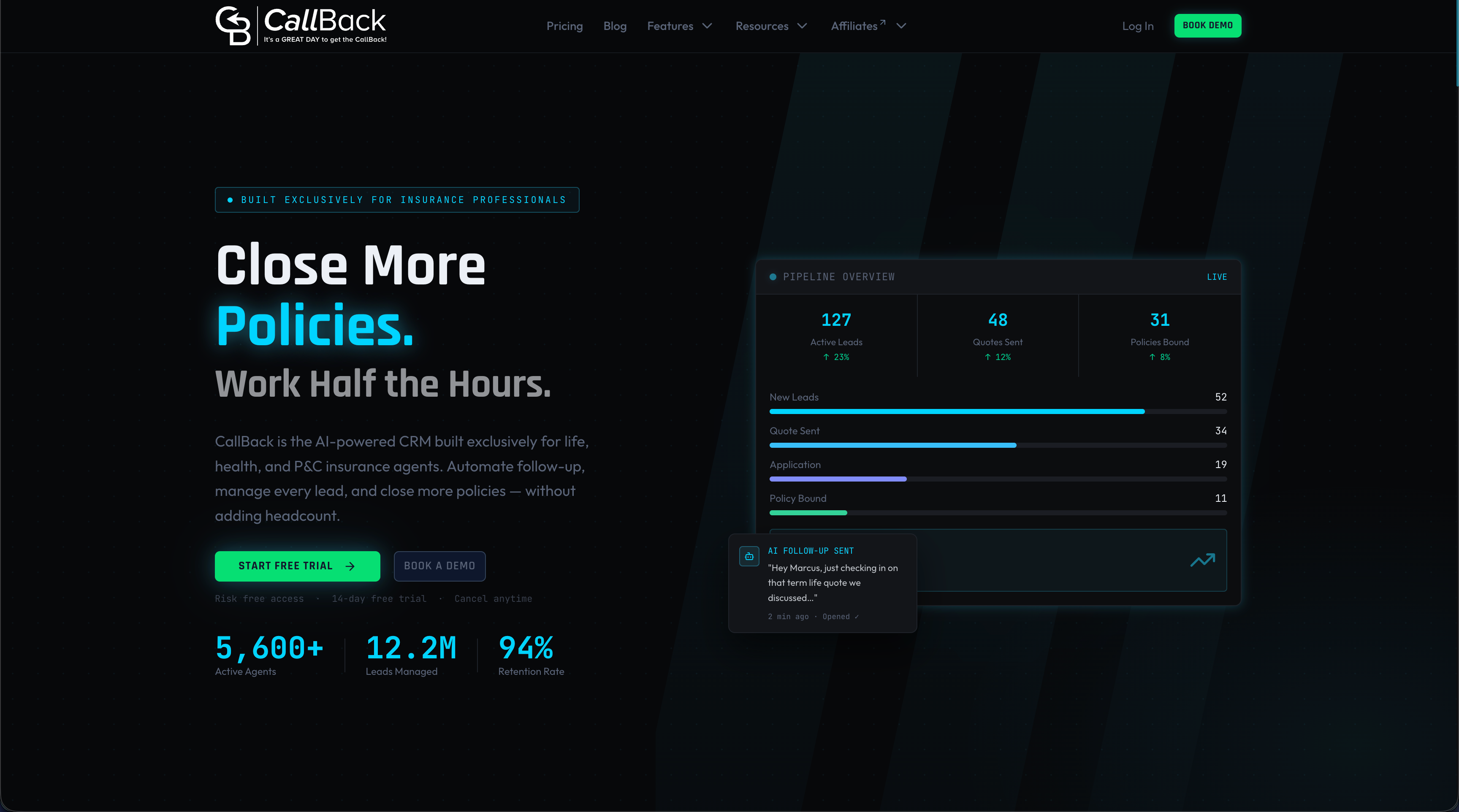
Callbackcrm is built specifically for insurance agents, agencies, and IMOs who need AI-powered lead scoring without a six-month implementation project. The platform scores leads automatically using behavioral and engagement data, then sorts them into tiered grades so your agents know exactly who to call first. SMS marketing features feed real-time behavioral signals back into the scoring model, keeping scores current as prospects engage. Automation workflows trigger follow-up sequences the moment a lead crosses your Tier A threshold. Explore the full suite of AI-powered tools Callbackcrm offers to see how lead scoring fits into a complete insurance sales workflow.
FAQ
What is the most accurate lead scoring method in 2026?
Hybrid models combining a rule-based fit layer with an AI re-ranker achieve 80–85% real-world accuracy and deploy in 6–10 weeks. Pure AI models reach 40–60% accuracy but require 8–12 months and large data volumes.
How many scoring variables should an insurance team use?
Experts recommend 5–10 active criteria for mid-market insurance teams. Models with more than 15 variables become too complex for sales adoption without meaningfully improving accuracy.
What are negative scoring signals and why do they matter?
Negative signals are behaviors that indicate a lead is unlikely to buy, such as inactivity, competitor site visits, or career page views. Adding negative signals raises model accuracy by 12–15% and removes stale leads from your active pipeline.
How often should you recalibrate a lead scoring model?
Recalibrate every quarter using recent win/loss data. Models trained on outdated data drift quietly and begin misdirecting sales effort as market conditions change.
What is the difference between additive and compound scoring?
Additive scoring sums all signal scores, which can inflate rankings for leads strong in only one dimension. Compound scoring multiplies fit, intent, and engagement scores, so a lead must perform well across all three signals to rank as a high-priority prospect.