

TL;DR:
- AI-powered outreach automates and personalizes multi-channel sales messages, improving reply rates for insurance teams. Building workflows with clear ICPs, branching logic, and a unified inbox leads to faster lead qualification and higher engagement. Regular auditing and human interaction ensure AI outreach remains effective and trustworthy.
An AI-powered outreach workflow is defined as a system that uses artificial intelligence to automate, personalize, and sequence multi-channel sales and marketing communication at scale. For insurance agents and marketers, this means replacing manual follow-up chains and cold calling with intelligent automation that identifies warm leads, sends the right message at the right time, and manages replies across email, SMS, and LinkedIn from a single platform. The results are measurable: reply rates as high as 30% and campaign setup times under 15 minutes. That kind of efficiency is not a feature upgrade. It is a fundamental shift in how insurance sales teams generate and convert leads.
What components make an AI-powered outreach workflow effective?
Every high-performing automated outreach solution is built on four core components. Miss one, and the entire system underperforms.
The first component is lead finding. Effective platforms connect to large B2B databases to identify prospects that match your Ideal Customer Profile, or ICP. The ICP is the precise description of your best-fit customer, defined by attributes like job title, company size, geography, and buying signals. Consolidated AI platforms replace up to 7 separate tools by combining lead discovery, enrichment, and outreach in one place.
The second component is multi-channel engagement. Insurance prospects do not live in one channel. A workflow that reaches out only by email misses the majority of your audience. Effective AI-driven engagement strategies combine email, LinkedIn, SMS, and phone calls in coordinated sequences. Each channel reinforces the others, and the AI decides which channel to use next based on how the prospect responds.
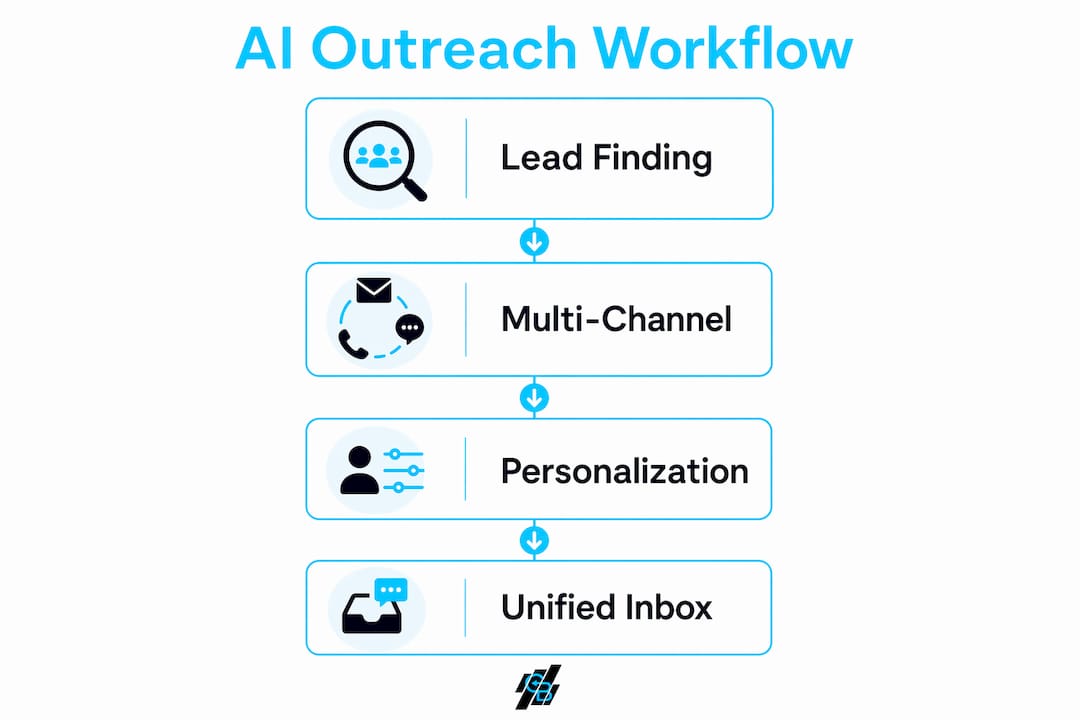
The third component is AI personalization. Generic messages get ignored. AI personalization engines pull from customer profile data and real-time intent signals to write messages that feel individual, not templated. This is the difference between a drip campaign and a genuine conversation starter.

The fourth component is a unified inbox. All replies from every channel flow into one place. This prevents lost context and speeds up lead qualification significantly.
Core feature categories for AI outreach systems
| Feature Category | What It Does | Why It Matters for Insurance |
|---|---|---|
| Lead discovery and enrichment | Finds and qualifies prospects from large databases | Targets the right policyholders and decision-makers |
| Multi-channel sequencing | Coordinates email, SMS, LinkedIn, and calls | Reaches prospects where they are most active |
| AI personalization engine | Writes tailored messages using profile and intent data | Increases reply rates and reduces unsubscribes |
| Unified inbox | Aggregates all replies in one interface | Prevents lost leads and speeds up follow-up |
| Email deliverability infrastructure | Manages warmup, SPF, DKIM, and DMARC settings | Keeps messages out of spam folders |
Pro Tip: Before choosing an outreach platform, count how many separate tools your team currently uses for lead finding, messaging, and reply management. If the answer is more than three, consolidation alone will improve your results.
How to build step-by-step AI outreach workflows for insurance pros
Building an AI outreach workflow that converts requires a clear sequence. Skipping steps early in the process creates problems that are hard to fix once campaigns are live.
-
Define your Ideal Customer Profile. Start with specifics: what type of insurance are you selling, who buys it, and what triggers their decision? For a Medicare supplement agent, the ICP might be adults aged 64 turning 65 within 90 days in specific zip codes. The tighter your ICP, the better your AI can find matching leads.
-
Use AI to identify and enrich leads. Feed your ICP into your platform’s lead discovery engine. The AI scans databases and behavioral signals to surface prospects who are actively researching insurance options. Signal-based lead identification produces initial replies within 48 hours because it targets people already in a buying mindset.
-
Build your multi-step sequence with branching logic. A linear sequence sends the same message to everyone regardless of behavior. Branching logic changes the path based on what the prospect does. If a prospect opens your email but does not reply, the AI triggers a LinkedIn connection request. If they click a link, the next message references what they viewed. This behavioral responsiveness is what separates intelligent outreach systems from basic schedulers.
-
Automate message personalization using AI agents. AI agents write message variations using the prospect’s name, company, role, and the specific signal that triggered the outreach. The result reads like a message written by a human who did their homework. Agentic AI systems handle this 1:1 personalization at scale without manual intervention, replacing the old model of writing one template for thousands of contacts.
-
Set reply routing and follow-up triggers. When a prospect replies, the AI categorizes the response and routes it to the right team member or triggers the next workflow step. A positive reply goes to a sales rep immediately. A “not now” reply enters a long-term nurture sequence automatically.
-
Monitor engagement data and adjust. Review open rates, reply rates, and conversion data weekly. If a specific message in your sequence underperforms, rewrite it and test the new version. AI outreach optimization is not a set-and-forget process. It requires regular review to stay effective.
Pro Tip: Branching logic based on behavioral triggers, such as an email open with no reply triggering a LinkedIn visit, can reduce your sequence setup time to under 15 minutes once you have a template library built.
What mistakes break AI outreach workflows?
The most common failure in automated outreach solutions is not a technology problem. It is a setup problem. Knowing where workflows break down saves you weeks of troubleshooting.
-
Fragmented tech stacks create data silos. When your lead database, email tool, and CRM do not share data, you lose context between touchpoints. A prospect who already spoke to a rep gets a cold introduction email. That kills trust immediately. Consolidated platforms with unified inboxes solve this by keeping all conversation history in one place.
-
Poor email deliverability ruins campaigns before they start. Email deliverability infrastructure, including automated warmup and DNS management covering SPF, DKIM, and DMARC, is the foundation of any outreach campaign. Without it, your messages land in spam and your reply rate is zero regardless of message quality.
-
Over-automation makes outreach feel robotic. Sending too many messages too quickly, or using the same template for every channel, signals automation to the recipient. Insurance prospects are skeptical by nature. Messages that feel mass-produced get deleted.
-
Ignoring workflow transparency creates blind spots. High-performing sales teams prefer platforms with clear visibility into signal triggers and branching logic over simple message schedulers. If you cannot see why the AI made a decision, you cannot fix it when results drop.
“The biggest risk in AI outreach is not that the AI will say the wrong thing. It is that you will not know it is saying the wrong thing to the wrong person at the wrong time. Auditability in your workflow logic is not optional. It is the only way to maintain consistent results and fix problems before they compound.”
Pro Tip: Run a deliverability check on your sending domain before launching any new campaign. A domain with poor reputation will undermine even the best-written sequence.
How do AI outreach workflows boost insurance lead engagement?
The performance gap between manual outreach and AI-driven engagement strategies is significant in insurance marketing. The numbers reflect a structural advantage, not just a convenience.
Reply rates up to 30% are achievable with multi-channel AI workflows. Manual email-only campaigns in insurance typically see reply rates well below that. The difference comes from timing, personalization, and channel diversity working together rather than separately.
Campaign setup time drops to under 15 minutes when branching logic templates are in place. That speed matters because insurance sales cycles are seasonal. Open enrollment periods, policy renewal windows, and life events create short windows where outreach must launch fast to capture demand.
Intent signal-triggered workflows convert cold outreach into warm conversations by reaching prospects when they are actively researching. An insurance prospect who just searched for Medicare supplement plans is fundamentally different from one who has not. AI identifies that signal and triggers outreach immediately.
Insurance outreach performance with AI workflows
| Metric | Manual Outreach | AI-Powered Workflow |
|---|---|---|
| Average reply rate | Low single digits | Up to 30% |
| Campaign setup time | Hours to days | Under 15 minutes |
| Channel coverage | Typically email only | Email, SMS, LinkedIn, calls |
| Lead qualification speed | Manual and slow | AI-assisted and immediate |
| Personalization at scale | Not feasible manually | Automated per prospect |
Multi-channel synchronization produces the highest engagement lift. When a prospect receives a coordinated sequence across email and SMS with consistent messaging, the recognition effect builds trust faster than any single channel can alone. For insurance agents building AI-driven customer engagement, that trust is the conversion trigger.
Key Takeaways
An AI-powered outreach workflow built on ICP definition, behavioral branching logic, and a unified inbox is the most direct path to higher reply rates and faster lead conversion in insurance sales.
| Point | Details |
|---|---|
| Define your ICP first | Precise customer profiles give AI the targeting data it needs to find warm leads. |
| Use branching logic, not linear sequences | Behavioral triggers cut setup time and increase reply rates significantly. |
| Consolidate your tech stack | A unified inbox prevents lost context and speeds up lead qualification. |
| Protect email deliverability | SPF, DKIM, and DMARC settings keep campaigns out of spam before they start. |
| Audit your workflow regularly | Transparent AI logic lets you spot and fix underperforming steps before they compound. |
What I have learned from watching insurance teams adopt AI outreach
The transition from manual outreach to AI-driven workflows is not as smooth as the demos suggest. I have watched insurance agencies invest in solid platforms and still get mediocre results because they skipped the ICP definition step. They fed the AI a vague description of their ideal client and got a vague list of leads in return. Garbage in, garbage out applies to AI just as much as it does to spreadsheets.
The agencies that see the biggest gains are the ones that treat the first two weeks as a calibration period. They run small batches, review every reply, and adjust their branching logic based on what they learn. They do not launch to 10,000 contacts on day one.
The personalization question is where I see the most debate. Some agents worry that AI-written messages will feel fake. The reality is the opposite. A well-configured AI agent, pulling from a detailed ICP and real intent signals, writes a better first message than most humans do under time pressure. The key is feeding it enough context. Thin data produces thin messages.
My strongest recommendation is to keep at least one human touchpoint in every sequence. After a prospect replies, a real person should take the next step. AI handles the volume problem. Humans handle the trust problem. The AI outreach process for insurance works best when it gets prospects to the conversation, not when it tries to close them.
The agents who resist AI outreach entirely are losing ground fast. The ones who adopt it without discipline are burning their sender reputation and their prospect lists. The middle path, disciplined setup, regular auditing, and human follow-through, is where the real results live.
— Kyle
Callbackcrm brings AI outreach tools built for insurance teams
Insurance agents and marketers who want a single platform for AI-powered outreach, lead management, and multi-channel communication can find it in Callbackcrm. The platform combines CRM management, AI assistants, automation workflows, and full SMS marketing capabilities in one place, removing the fragmented tech stack problem entirely.
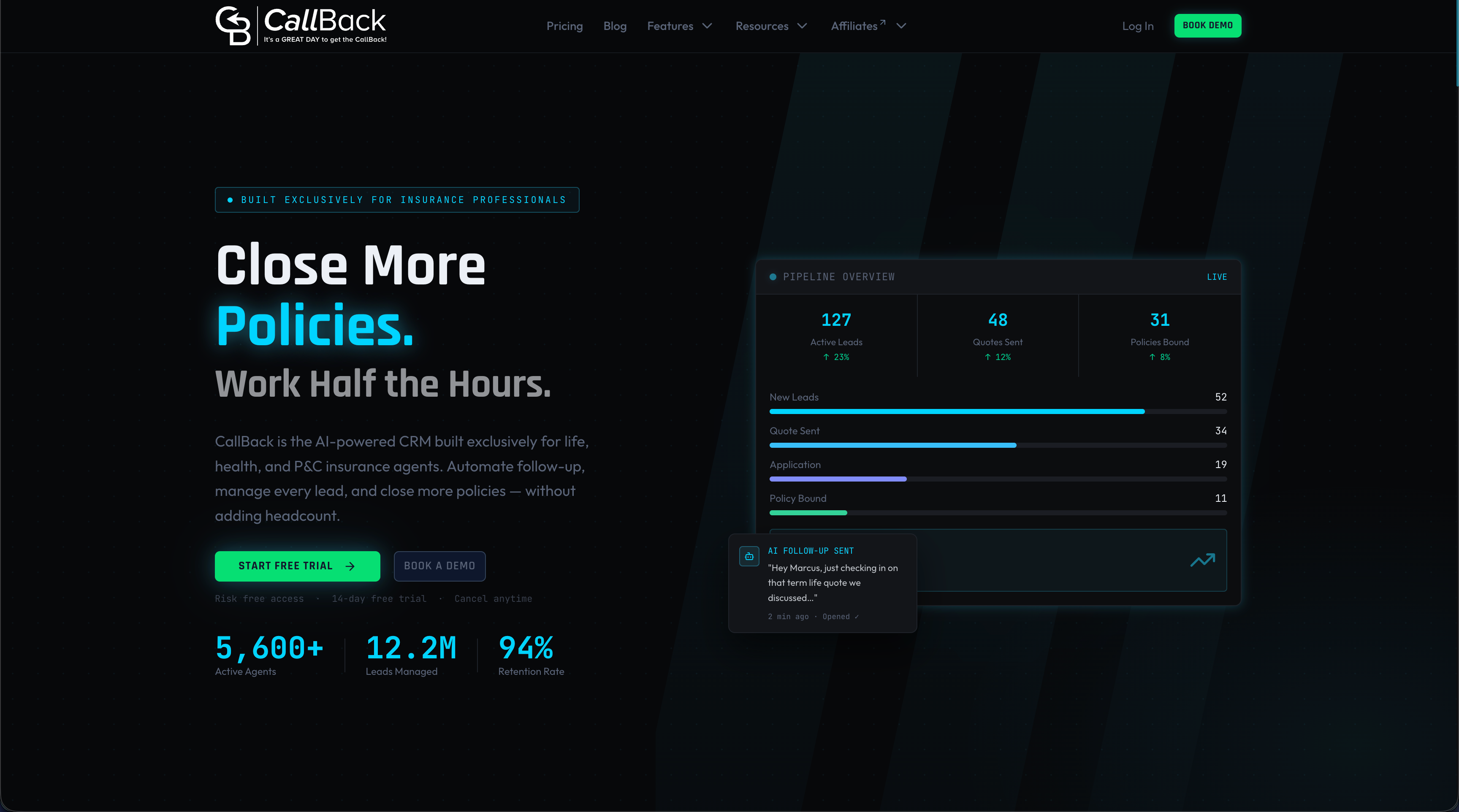
Callbackcrm is built specifically for insurance agents, agencies, and IMOs. Its AI-driven tools handle lead scoring, automated follow-up sequences, and personalized outreach without requiring a technical team to manage them. The platform runs on Google Cloud for secure data handling and offers 24/7 support. Agents who want to see how AI content marketing fits into a broader outreach strategy can also explore resources at babylovegrowth.ai. A free trial is available directly through Callbackcrm for teams ready to replace manual outreach with an intelligent system.
FAQ
What is an AI-powered outreach workflow?
An AI-powered outreach workflow is a system that uses artificial intelligence to automate, personalize, and sequence sales and marketing messages across multiple channels. It replaces manual follow-up with behavioral triggers and branching logic that respond to prospect actions in real time.
How does branching logic improve outreach results?
Branching logic changes the next message or channel based on what a prospect does, such as opening an email but not replying. This behavioral responsiveness produces reply rates as high as 30% and reduces campaign setup time to under 15 minutes.
Why does email deliverability matter for AI outreach?
Without proper DNS settings including SPF, DKIM, and DMARC, automated emails land in spam folders before prospects ever see them. Deliverability infrastructure is the foundation of any outreach campaign, regardless of message quality.
How do insurance agents define an Ideal Customer Profile for AI outreach?
An ICP for insurance outreach specifies attributes like age, geography, policy type interest, and life event triggers. The more specific the ICP, the more accurately AI can identify and prioritize warm leads from large databases.
What is a unified inbox and why does it matter?
A unified inbox aggregates replies from email, LinkedIn, and SMS into one interface. It prevents lost context between channels and enables AI-assisted reply routing, which speeds up lead qualification and keeps sales conversations moving forward.