

For insurance agents and agencies evaluating AI-powered CRM and sales automation platforms, the recommended first demo is Callbackcrm: an all-in-one platform built specifically for agents, with SMS/email/voicemail automation, AI assistants, funnel builders, and Google Cloud hosting. Beyond Callbackcrm, agents commonly evaluate insurance-first all-in-ones, standalone AMS platforms with carrier integrations, and general CRM tools with AI add-ons.
Shortlist at a glance:
- Callbackcrm — Insurance-focused CRM with AI assistants, automated SMS/email/voicemail, funnels, and 24/7 support. Free trial available; hosted on Google Cloud.
- Insurance-first all-in-one platforms (e.g., EZLynx, AgencyZoom, InsuredMine) — Built around policy lifecycle, carrier downloads, and renewal workflows for agencies already managing high book volume.
- AMS platforms with carrier integrations (e.g., AgencyBloc) — Strong on commission tracking, ACORD forms, and carrier connectivity; lighter on outbound AI automation.
- General CRM with AI add-ons — Flexible but require custom configuration for insurance workflows; longer onboarding timelines.
Table of Contents
- How do these AI CRM alternatives compare for insurance agencies?
- How do you choose the right AI CRM for your agency?
- CRM vs. AMS: which path fits your agency right now?
- What AI and automation features should you evaluate?
- What should you expect from onboarding and migration?
- Key Takeaways
- Why an insurance-first AI CRM is the right approach
- Callbackcrm: the recommended demo for insurance agencies
- Useful sources and further reading
How do these AI CRM alternatives compare for insurance agencies?
AI sales enablement produced an average premium revenue per producer increase of 28% and reduced cost-per-acquired-policy by $187 across a panel of independent and mid-market insurance agencies. That data point sets the benchmark for what the right platform should deliver.
| Dimension | Callbackcrm | Insurance-first all-in-one | AMS with carrier integrations | General CRM + AI add-on |
|---|---|---|---|---|
| Best for | Solo agents to IMOs needing full automation | Mid-market agencies with high renewal volume | Agencies prioritizing commission accounting | Teams with existing tech stacks |
| Product type | All-in-one CRM + automation | All-in-one AMS/CRM | AMS | CRM |
| AI & automation | SMS, email, voicemail, AI assistant, lead scoring, funnels | Renewal automation, email templates | Limited; rule-based workflows | Varies by add-on |
| Carrier integrations | Third-party integrations + API hooks | Native carrier downloads | Strong native carrier downloads | Minimal |
| Pricing signal | Monthly subscription + wholesale SMS/AI usage | Per-user or per-policy tiers | Per-user tiers | Per-seat + add-on fees |
| Onboarding time | Days to weeks; 24/7 support | Weeks to months | Weeks | Weeks to months |
| Data & security | Google Cloud hosting | Varies | Varies | Varies |
| Mobile access | Yes | Yes | Limited | Yes |
Pricing note: Callbackcrm bills SMS and AI usage at wholesale rates on top of the base subscription. Insurance-first all-in-ones and AMS platforms typically charge per user or per policy; confirm exact tiers during a demo.
How do you choose the right AI CRM for your agency?
Prioritize data fit, prebuilt insurance workflows, and speed-to-lead automation above all else. A platform with generic AI that has never been trained on insurance data will underperform one built for the vertical, regardless of how polished the interface looks.
Decision criteria:
- Does the platform include prebuilt insurance templates (renewal sequences, cross-sell campaigns, ACORD form support)?
- Can it connect to your carriers via download or API?
- How does it handle SMS, email, and voicemail outreach natively — not through a third-party bolt-on?
- Does it offer lead nurturing across multiple channels with configurable cadences?
- What compliance controls exist for TCPA and state-level messaging rules?
- Is mobile access full-featured or read-only?
- What does onboarding include — live training, documentation, or just a knowledge base?
Questions to ask vendors during a demo:
- Show a lead captured through a funnel and converted via an automated SMS/AI appointment booking sequence.
- Run a predictive renewal list ranked by premium and lapse risk.
- Export a commission report by carrier and producer.
- Demonstrate what happens when a lead does not respond to the first three touchpoints.
- What data does your AI require to produce accurate lead scores, and how long does it take to calibrate?
Red flags to watch for:
- AI claims with no explanation of what data trains the model.
- No native carrier connectivity or vague “integration roadmap” answers.
- Opaque per-message or per-AI-call pricing disclosed only after contract signing.
- Custom configuration timelines longer than 60 days for a standard agency setup.
CRM vs. AMS: which path fits your agency right now?
Choose a CRM if sales growth and speed-to-lead matter most. Choose an AMS if policy lifecycle management, renewals, and commission accounting are the primary need. Choose an all-in-one when you want a single system of record that handles both, with AI automation layered on top.
| Capability | CRM | AMS | All-in-one |
|---|---|---|---|
| Lead capture & routing | Strong | Weak | Strong |
| Quoting support | Limited | Strong | Moderate |
| Renewal automation | Via workflows | Native | Native + AI |
| Commission tracking | Limited | Strong | Moderate to strong |
| Carrier downloads | Rare | Standard | Varies |
| AI outreach (SMS/email/voice) | Strong | Rare | Strong |
Use-case examples:
- A solo agent focused on appointments needs speed-to-lead SMS automation and an AI assistant to qualify inbound leads. A CRM or all-in-one fits better than a full AMS.
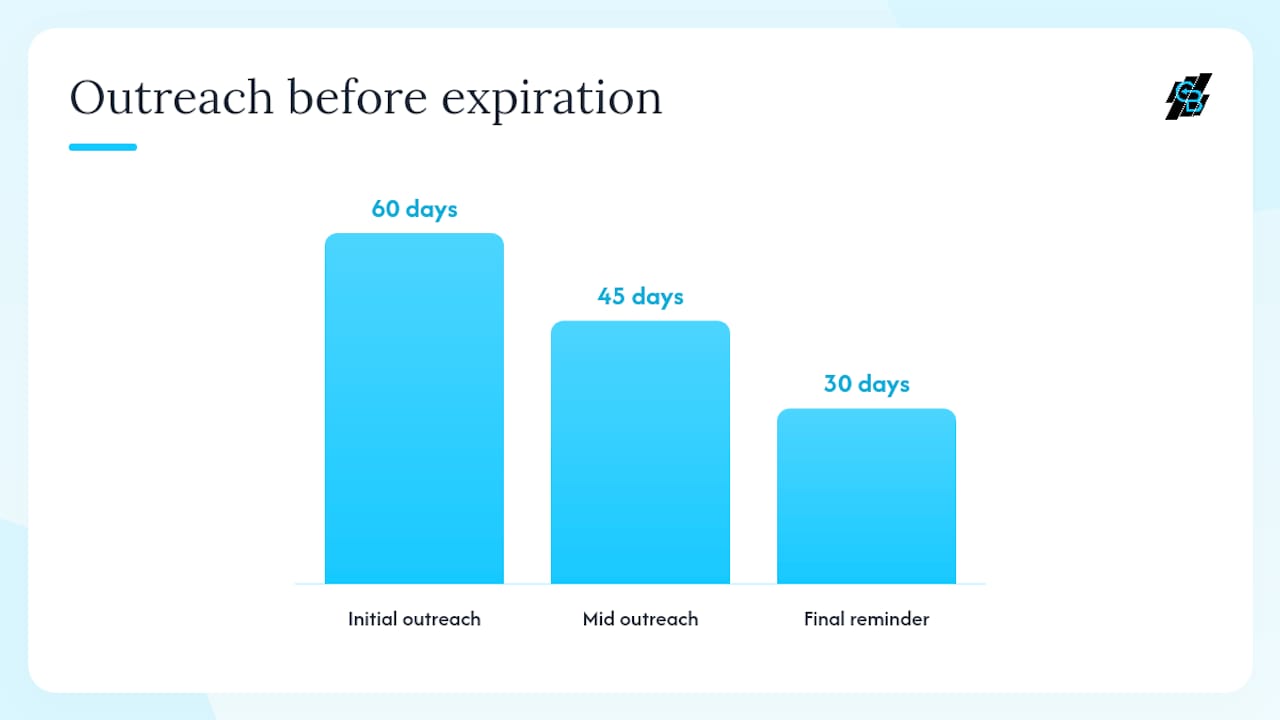
- A mid-market agency with 500+ renewals per quarter needs automated renewal outreach at 60, 45, and 30 days before expiration, plus daily action lists ranked by premium. An AMS or all-in-one handles this well.
- An IMO tracking commissions across multiple carriers and producers needs robust commission accounting. An AMS or all-in-one with commission modules is the right path.
A hybrid path works for agencies not ready to migrate fully: start with a CRM plus an AI automation layer, then migrate policy data to an AMS once the team is trained. The caution is data readiness. AI features produce unreliable scores when contact records are incomplete or field mapping is inconsistent.
What AI and automation features should you evaluate?
Prioritize features that reduce producer time on low-value outreach and act on your agency’s own data. Lead scoring and next-best-action recommendations that focus producers on a ranked shortlist deliver the largest lift, with research showing a 28% average premium revenue increase per producer, per AI sales enablement studies.
Feature checklist:
- Speed-to-lead SMS automation (sub-5-minute response to new leads)
- Multi-channel outreach: SMS, email, and voicemail drops
- AI assistant for lead qualification and appointment booking
- Conversation intelligence (call recording, transcription, sentiment flags)
- Predictive renewal flags from book-of-business data
- ACORD form support and pre-fill
- Commission tracking and carrier-level reporting
- Carrier downloads or API hooks
- Pipeline forecasting and producer activity dashboards
Demo tasks to run live with any vendor:
- Capture a test lead through a landing page and watch the automated SMS/AI sequence fire within five minutes.
- Generate a renewal list for the next 30 days, sorted by premium at risk.
- Export a commission report by carrier and producer for the prior quarter.
- Trigger a multi-step nurture sequence and confirm SMS, email, and voicemail all fire in the correct order.
The AI marketing tools guide from Callbackcrm outlines additional insurance-specific demo tasks worth adding to your scoring sheet.
Pro Tip: Before any demo, export a sample of 50 real contact records and ask the vendor to run a live lead score against them. A platform that cannot score your actual data in a demo will not score it reliably in production.
What should you expect from onboarding and migration?
Expect a staged migration: data cleanup, then a pilot with one team or product line, then full rollout. Agencies that follow this path typically see payback within months when the platform automates renewals and lead conversion.
Timeline by agency size:
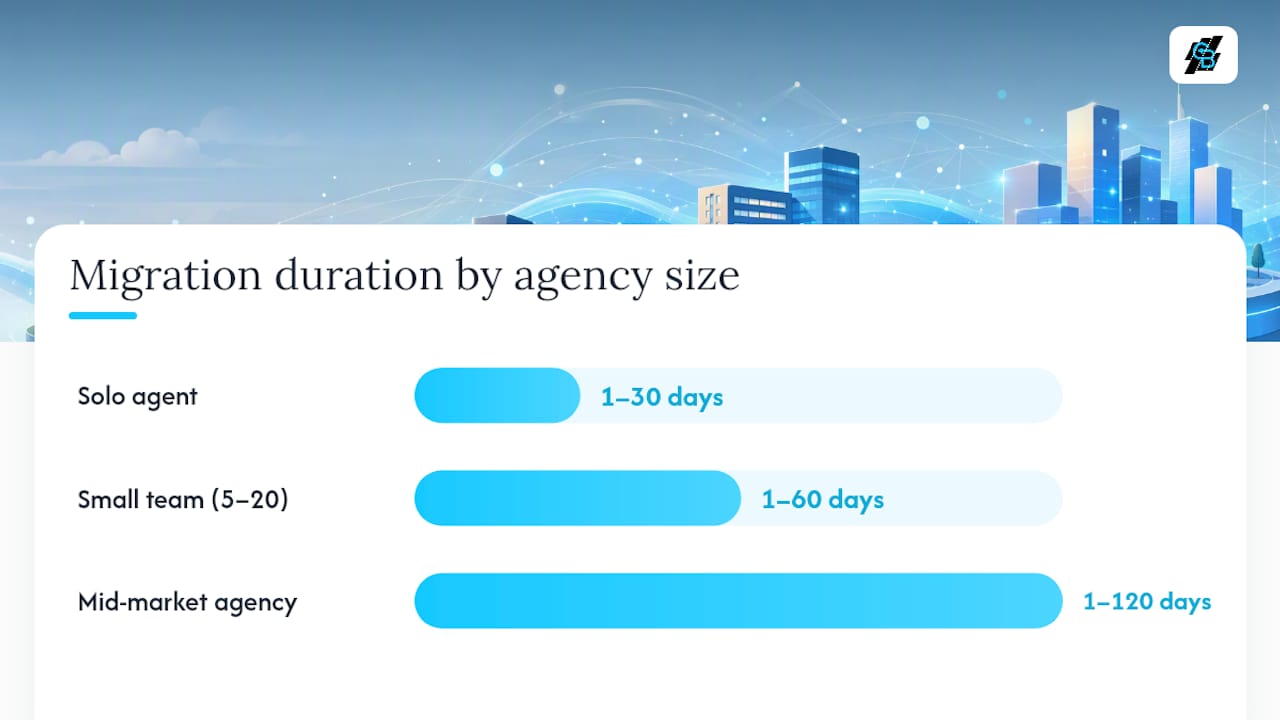
- Solo agent (days 1–30): Export contacts, map fields, configure SMS/email templates, run first automated sequence. Pilot criterion: first AI-booked appointment within two weeks.
- Small team, 5–20 producers (days 1–60): Add user accounts, train producers on mobile app, connect carrier integrations, run renewal automation for the nearest 30-day expiration window.
- Mid-market agency (days 1–120): Full data migration including commission history, ACORD mapping, carrier downloads, and custom reporting. Pilot criterion: measurable reduction in manual renewal calls by day 90.
Migration checklist:
- Export all contact records with complete field mapping (name, policy number, carrier, renewal date, producer assignment).
- Map ACORD form fields to the new platform’s data model.
- Transfer commission history by carrier and producer.
- Confirm carrier integration access credentials before go-live.
- Build a user training plan that covers mobile app, automation workflows, and reporting.
Budget items to plan for: base subscription, one-time implementation or setup fee, SMS/email/AI usage (billed at wholesale on Callbackcrm), integration costs, and producer training time. The sales automation workflow guide covers how to measure producer hours reclaimed post-migration.
Key Takeaways
For insurance agencies, the right AI CRM is the one that automates renewals, qualifies leads before producer handoff, and connects to your carriers — Callbackcrm covers all three out of the box.
| Point | Details |
|---|---|
| Demo Callbackcrm first | It combines CRM, SMS/email/voicemail automation, funnels, and AI assistants built for insurance agents. |
| AI ROI is measurable | A 12-month panel showed an average 28% premium revenue increase per producer with AI sales enablement. |
| Top three decision criteria | Prebuilt insurance workflows, native multi-channel outreach, and carrier integration depth matter most. |
| Plan a staged migration | Data cleanup, then a pilot, then full rollout — solo agents can be live in 30 days; mid-market agencies need up to 120. |
| Start with a free trial | Callbackcrm offers a free trial and demo path at callbackcrm.com/features/websites. |
Why an insurance-first AI CRM is the right approach
The conventional wisdom in insurance technology is that any good CRM, with the right integrations, can serve an agency. That framing underestimates how much configuration time a generic platform requires before it produces anything useful for a producer.
Insurance-specific AI models, trained on vertical data, deliver materially better scoring accuracy than generic sales AI. A platform that ships with renewal sequences, ACORD form support, and carrier connectivity pre-built removes weeks of setup that a generic CRM cannot avoid. The agencies that see the fastest ROI are the ones that start with clean data, a narrow pilot goal (renewals for the next 30 days, or speed-to-lead for one product line), and a platform that does not require a developer to configure.
The AI retention tools that move the needle are not chatbots. They are lead scoring, next-best-action lists, and automated multi-touch sequences that keep producers focused on the highest-value conversations. This approach drove a 28% revenue lift per producer in industry panel studies — not by replacing producers, but by removing the low-value work that keeps them from selling.
Callbackcrm: the recommended demo for insurance agencies
Callbackcrm gives insurance agents and agencies automated renewals, SMS and email outreach, voicemail drops, AI assistants, funnel builders, and carrier integrations in one platform, hosted on Google Cloud with 24/7 support. There is no long configuration runway before you see results. Agents can run their first automated sequence within days of signup, and the free trial lets you test the core workflows against your own data before committing.
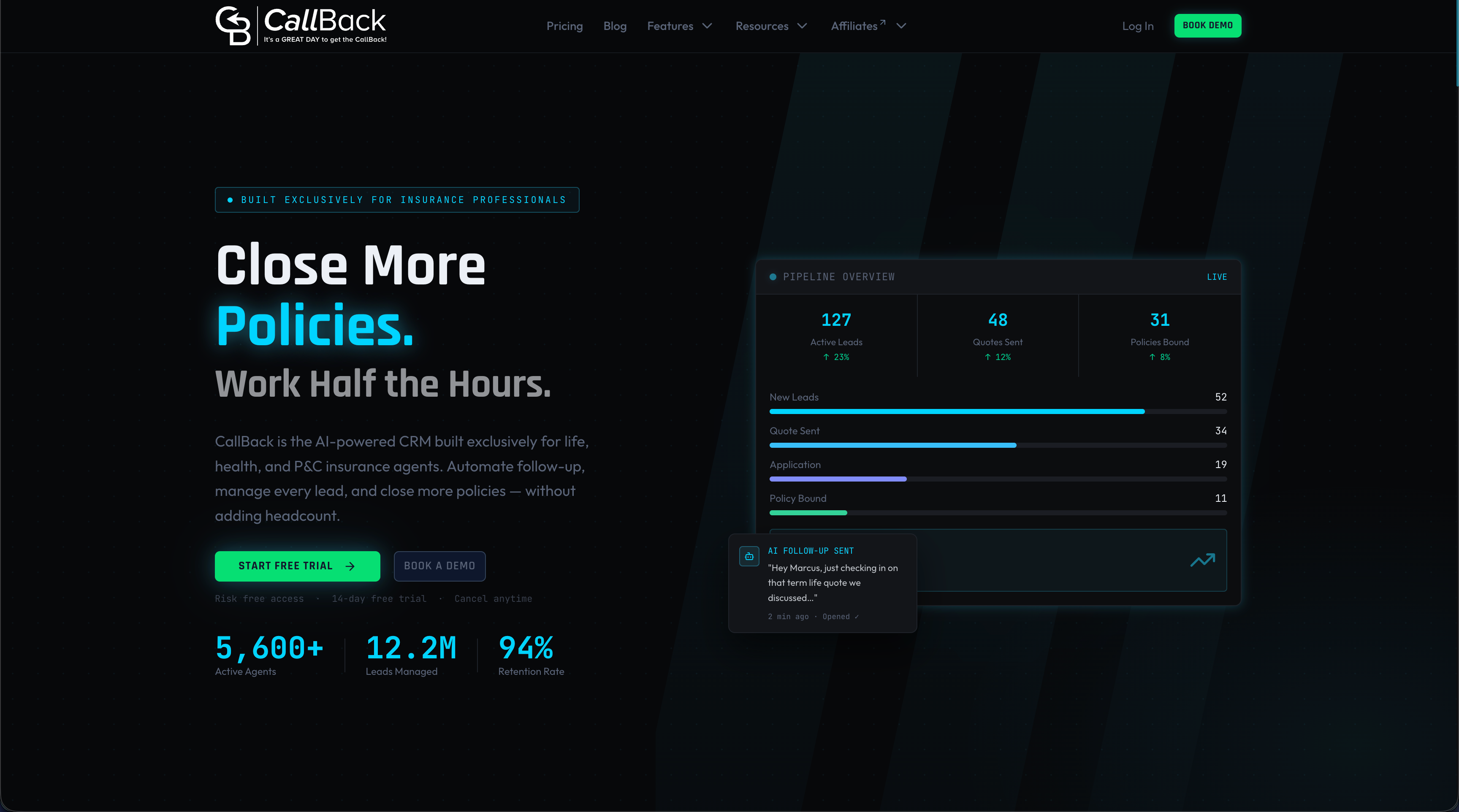
Start a free trial or book a demo at callbackcrm.com/features/websites to see the renewal automation and AI appointment booking in action with your own leads.
Useful sources and further reading
- AI Sales Enablement for Insurance Agencies: 2026 Guide | Arete
- CallBack CRM: Home
- Callback CRM: SMS Marketing Features for Business in 2025
- Build Websites & Funnels with CallBack: Free Trial & Pricing in 2026
- Top 8 AI Marketing Tools for Insurance Agencies 2026 | CallBack CRM Blog