

The most effective agent productivity tools for insurance agents in 2026 combine AI lead scoring, marketing automation, and CRM management into a single connected workflow. The tools below are selected for their direct relevance to insurance sales and agency operations in the US.
Top tools at a glance:
- Callbackcrm — All-in-one AI platform built specifically for insurance agents: CRM, email and SMS marketing, funnel builders, AI assistants, and reputation management
- Predictive lead scoring platforms — Stack-rank leads by urgency and customer sentiment before issues escalate
- Workflow automation tools — Connect CRM, lead sources, and marketing channels to eliminate manual data entry
- AI outreach and follow-up systems — Automate personalized email and SMS sequences based on lead behavior
- Funnel and website builders — Capture and convert prospects without relying on third-party developers
- Social media management tools — Schedule and publish content across platforms from one dashboard
- Proposal and contract automation — Generate, send, and track documents without switching apps
- Reputation management platforms — Monitor and respond to reviews automatically
- Integration middleware (e.g., Zapier) — Connect disparate tools so data stays synchronized across the stack
Table of Contents
- What features actually matter in an agent productivity tools list?
- How insurance agencies can implement AI tools without overcomplicating the stack
- What industry benchmarks say about agent productivity in 2026
- Callbackcrm gives insurance agents an all-in-one AI platform
- Key Takeaways
- The case for consolidation over complexity
What features actually matter in an agent productivity tools list?
The right tool does more than speed up manual work. According to productivity expert Si Fisher, effective automation offloads repetitive data entry and lead routing entirely, freeing agents for higher-value conversations.
Core features to evaluate
- Predictive AI lead scoring: Ranks leads by urgency and sentiment so agents contact the right prospects first, not just the newest ones
- Automated workflows: Handle follow-up sequences, appointment reminders, and lead routing without manual triggers
- CRM integration: Centralizes contact history, pipeline stages, and communication logs in one place
- Email and SMS marketing: Sends segmented, personalized outreach at scale based on lead behavior
- Sentiment analysis: Flags contacts likely to escalate or disengage, enabling proactive outreach
- Funnel and website builders: Converts traffic into leads without external developers
- Security and compliance: Leading platforms use bank-level encryption and secure cloud infrastructure; Callbackcrm, for example, runs on Google Cloud security standards, which meets the data handling requirements most insurance carriers expect
Pro Tip: Before evaluating any new tool, check whether it offers a free tier or usage-based pricing. The Agent Native Registry scores tools on a 33-point checklist across discovery, authentication, pricing, tooling, and reliability — a useful filter before committing to a subscription.
Pricing models

Most platforms use tiered subscriptions based on contact volume or seat count. Some offer usage-based pricing for outreach channels like SMS. All-in-one platforms tend to cost more upfront but eliminate the need for three or four separate subscriptions.
Why AI-powered tools outperform manual processes
AI-driven outreach workflows enable automated lead scoring and segmented personalized outreach, reducing the manual backlog that slows most agencies. Agents who use these tools spend less time on data entry and more time on conversations that close. For a deeper look at how these tools fit together, the AI marketing tools for agents breakdown covers the most relevant options by workflow stage.
How insurance agencies can implement AI tools without overcomplicating the stack
The most common mistake agencies make is adding tools before the foundation is stable. Practitioners consistently recommend starting with three core components: a CRM, a primary lead source, and a speed-to-lead channel. Everything else layers on top.
Implementation steps:
- Start with the foundational trio. Get a CRM running, connect your primary lead source, and set up a speed-to-lead channel (call, text, or AI assistant) before adding any other tools.
- Map existing workflows first. Identify where leads enter, where they stall, and where data gets entered manually more than once. Those are the highest-priority automation targets.
- Layer AI on familiar platforms. AI tools perform best when they sit on top of workflows agents already use. Connecting to Gmail or Outlook reduces resistance and speeds adoption.
- Use integration middleware. Tools like Zapier act as connective tissue between CRM, lead sources, and marketing platforms, keeping data synchronized without manual effort.
- Train the team incrementally. Introduce one automation at a time. Full stack rollouts without phased training create confusion and low adoption.
- Evaluate security and compliance early. Confirm that any tool handling client data meets your carrier’s requirements and applicable state regulations before going live.
- Measure output, not activity. Track lead response time, conversion rate by source, and pipeline velocity. These numbers show whether the tools are working, not just whether agents are using them.
AI can handle a large majority of routine agency tasks, but complex client situations still benefit from human judgment. A hybrid model, where AI handles volume and humans handle escalations, produces the best results for most agencies.
What industry benchmarks say about agent productivity in 2026
The Agent Native Registry evaluated 59 productivity tools on a 33-point agent-readiness checklist covering discovery, authentication, pricing, tooling, and reliability. The top 10 tools averaged 49 out of 100, meaning most still have gaps for fully autonomous use. Only 4 of the top 10 offer a Model Context Protocol server for direct AI agent integration.
SupportLogic’s research shows that predictive AI can stack-rank leads and cases by urgency and sentiment, directing agent attention to the highest-value interactions before problems escalate. This shifts the productivity goal from “respond faster” to “respond to the right contact first.” For insurance agents managing large books of business, that distinction changes daily output.
Si Fisher’s framework goes further: successful agents automate complex workflows, not just simple tasks, freeing mental bandwidth for client strategy rather than administrative follow-through. The agencies seeing the strongest results in 2026 treat their AI tools as the operational layer of the business, not a supplement to manual processes.
The hybrid human-AI model remains the most practical approach. Routine outreach, lead scoring, appointment scheduling, and data entry run on automation. Underwriting conversations, claims guidance, and complex policy reviews stay with agents. That division of labor is where AI-driven productivity gains are most consistent across agency sizes.
Callbackcrm gives insurance agents an all-in-one AI platform
Insurance agents who want marketing automation, CRM, and AI-driven lead management without stitching together multiple subscriptions have a direct option in Callbackcrm.
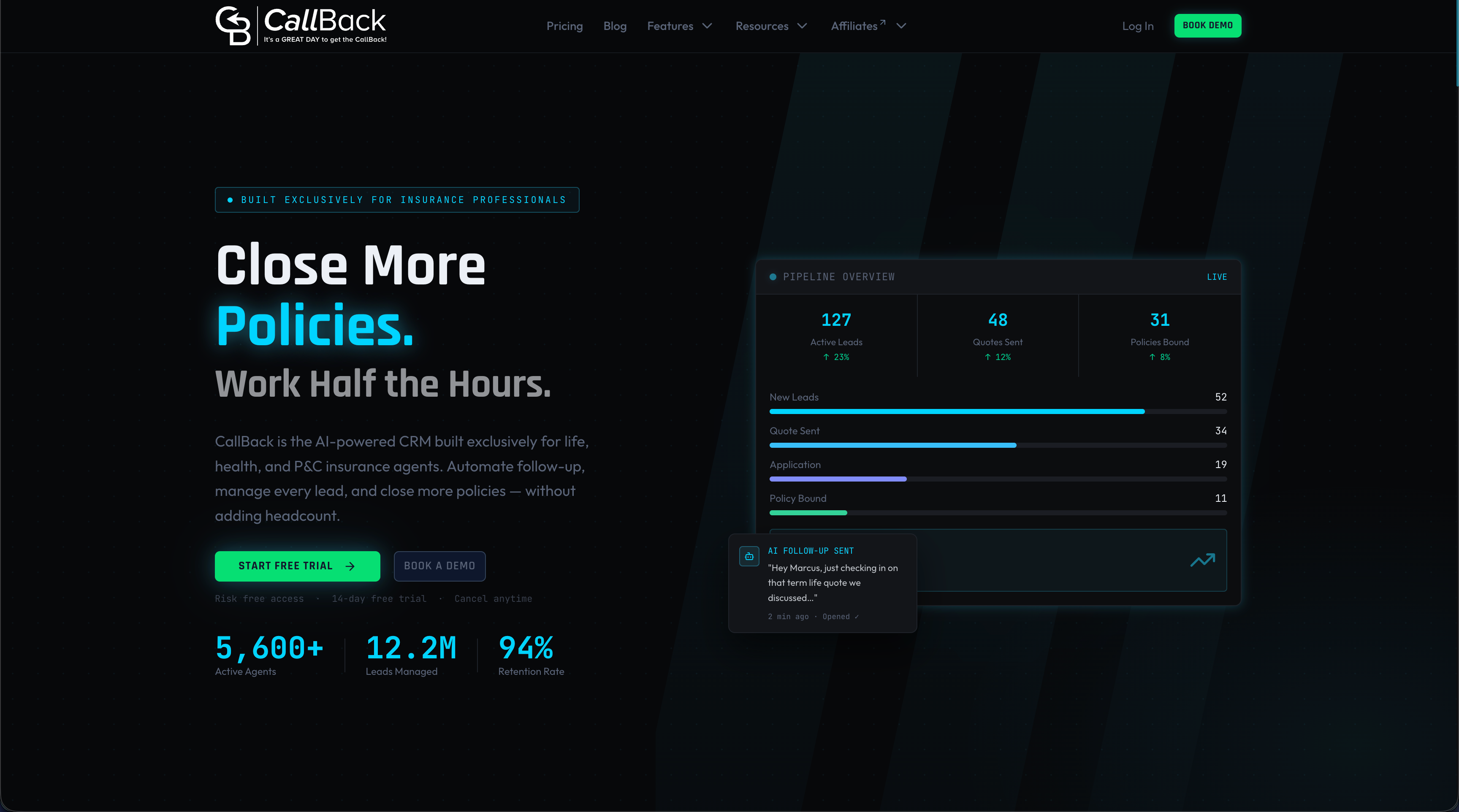
Callbackcrm is built specifically for insurance agents, agencies, and IMOs. It replaces cold calling with AI-powered outreach that identifies high-value leads, scores them automatically, and personalizes follow-up based on behavior. The platform covers SMS marketing, email campaigns, social media scheduling, reputation management, and proposal tools in one interface. Agents also get website and funnel builders that capture and convert leads without external developers. All data runs on Google Cloud infrastructure, and 24/7 support is included. To see the full feature set, visit the Callbackcrm features page.
Key Takeaways
AI-powered tools for insurance agents deliver the most value when they automate lead scoring, outreach, and data entry while keeping human agents focused on complex client conversations.
| Point | Details |
|---|---|
| Start with the foundational trio | Deploy a CRM, lead source, and speed-to-lead channel before adding any other tools. |
| AI handles a large majority of routine tasks | A hybrid human-AI model covers volume automation while humans manage complex cases. |
| Benchmark tools before buying | The Agent Native Registry’s 33-point checklist covers discovery, authentication, pricing, tooling, and reliability. |
| Predictive scoring changes daily priorities | AI that ranks leads by urgency and sentiment directs agent effort to the highest-value contacts first. |
| Callbackcrm consolidates the stack | It covers CRM, email, SMS, funnels, AI assistants, and reputation management in one insurance-specific platform. |
The case for consolidation over complexity
Most insurance agencies do not have a tool shortage. They have a coordination problem. Leads enter through one system, get scored in another, trigger follow-up in a third, and fall through the gaps between all of them. The productivity loss is not from slow agents. It comes from data that does not move cleanly between platforms.
The agencies gaining ground in 2026 are not the ones with the longest tool list. They are the ones that picked fewer, better-integrated tools and trained their teams to use them consistently. An AI assistant that agents actually open every morning outperforms a sophisticated platform that sits unused after the first week.
The shift worth making is not from manual to automated. It is from fragmented to unified. When the CRM, outreach, and reporting all share the same data, agents stop managing tools and start managing relationships.