

Insurance sales is changing fast, and the tools promising to automate your pipeline have multiplied just as quickly. Sorting through dozens of platforms, each claiming to be the best AI-powered solution, is genuinely overwhelming, especially when the wrong choice can create compliance headaches under HIPAA or TCPA regulations. The good news is that the right framework cuts through the noise. This guide walks you through proven evaluation criteria, real-world examples, and a side-by-side comparison so you can choose the sales automation tool that actually fits how your agency works.
Table of Contents
- How to evaluate sales automation tools for insurance
- Salesforce Financial Services Cloud: Enterprise automation with Einstein AI
- Pipedrive: User-friendly pipeline and AI assistant for small teams
- Custom AI tools: Tailored lead automation and compliance advantages
- Summary table: Comparing top sales automation tools
- Choosing the right tool for your agency: Real-world recommendations
- Next steps: Power your agency with modern automation
- Frequently asked questions
Key Takeaways
| Point | Details |
|---|---|
| Compliance comes first | Choose automation tools with proven features for insurance regulations to avoid costly risks. |
| AI saves time and boosts ROI | Custom and advanced AI reduces manual hours and can provide ROI within 1-2 months. |
| Tailor tools to agency size | Large agencies need enterprise tools like Salesforce, while smaller ones benefit from user-friendly options. |
| Automation improves retention | Consistent automated outreach increases client retention rates significantly for insurance agencies. |
How to evaluate sales automation tools for insurance
Generic AI tools built for retail or SaaS sales can be a liability in insurance. Regulated workflows require platforms that understand compliance requirements out of the box, not as an afterthought. The sales automation benefits for insurance agencies are real, but only when the tool fits the industry.
Off-the-shelf platforms often lack the guardrails needed for TCPA-compliant outreach or HIPAA-safe data handling. Specialized tools deliver 20-50% efficiency gains precisely because they are built for regulated, relationship-driven sales cycles. That gap between generic and vertical-specific is where most agencies lose time and money.
Use this evaluation checklist when comparing any platform:
- Lead management: Can the tool score, route, and follow up on leads automatically without manual data entry?
- Compliance features: Does it support TCPA, HIPAA, and state-level insurance regulations natively?
- Integration depth: Will it connect cleanly with your existing quoting tools, AMS, or carrier portals?
- Automation depth: Can it handle multi-step workflows, not just single email triggers?
- Speed to ROI: How quickly can you reduce workload and see measurable efficiency gains?
- Scalability: Will it grow with your agency without requiring a full rebuild?
Custom solutions offer better compliance fit but cost more upfront. Off-the-shelf tools are faster to deploy but may need workarounds for insurance-specific needs. Knowing where your agency sits on that spectrum is the first decision to make.
Salesforce Financial Services Cloud: Enterprise automation with Einstein AI
Salesforce is the 800-pound gorilla of CRM, and its Financial Services Cloud is built specifically for regulated industries. The Einstein AI layer adds automated lead nurturing, pipeline forecasting, and compliance tracking that generic Salesforce deployments simply do not offer.
A mid-sized brokerage case study showed what this platform can do at scale: 28% revenue growth, 50% faster sales cycles, and 95% client retention after full implementation. Those are not marketing numbers. They reflect what happens when a well-resourced agency pairs the right CRM for insurance agents with a disciplined rollout.
“Established tools like Salesforce excel in enterprise environments with robust data handling and compliance capabilities, though high complexity and cost remain real barriers for smaller teams.”
Here is what Salesforce Financial Services Cloud does well for insurance:
- Einstein AI lead scoring: Automatically ranks prospects by conversion likelihood so your producers focus on the best opportunities.
- Automated compliance workflows: Flags policy renewal deadlines, tracks consent records, and manages documentation requirements.
- Pipeline visibility: Gives managers a real-time view of every deal stage across the entire agency.
- Deep integration: Connects with carrier systems, quoting platforms, and third-party data sources.
The tradeoff is real. Salesforce requires significant setup time, ongoing admin resources, and a budget that smaller agencies may not have. The automation workflows that make it powerful also make it complex. If you have in-house IT or a dedicated ops team, the investment pays off. If you are a five-person shop, it may be more than you need.
Pipedrive: User-friendly pipeline and AI assistant for small teams
Not every agency needs enterprise-grade complexity. Pipedrive was built for sales teams that want a clean, visual pipeline without a six-month implementation project. For small insurance agencies just starting with automation, it is often the right first step.
The drag-and-drop pipeline makes deal tracking intuitive, and automated reminders keep follow-ups from falling through the cracks. Pipedrive’s AI sales assistant handles deal probability prediction and lead prioritization, which is genuinely useful for outbound insurance sales. It is not as deep as Salesforce’s Einstein AI, but it covers the core use cases without the learning curve.
Key strengths for insurance agencies:
- Visual pipeline management: See every prospect at every stage in one clean view.
- Automated follow-up reminders: Never miss a renewal call or policy review appointment.
- AI deal forecasting: Get probability scores on open deals to focus energy where it counts.
- Quick onboarding: Most small teams are up and running within a week.
The honest limitation is that Pipedrive’s native AI features are lighter than competitors. Deeper automation, like multi-step drip sequences or advanced lead scoring, often requires connecting Zapier or third-party tools. That adds cost and complexity over time. If you need a robust automated lead funnel from day one, you may outgrow Pipedrive faster than expected.
Pro Tip: Start with Pipedrive’s free trial and map your top three manual tasks (follow-ups, lead routing, renewal reminders) to specific automation features before committing. If those three use cases are covered natively, it is likely a good fit for your team size.
Custom AI tools: Tailored lead automation and compliance advantages
What happens when your workflow does not fit a standard template? Or when your compliance requirements are strict enough that a generic platform creates more risk than it solves? That is where custom and vertical-specific AI tools earn their place.
Platforms like SalesTank, AgentFront, and AIQLabs are built specifically for insurance sales workflows. They handle HIPAA and TCPA compliance natively, integrate with carrier-specific systems, and automate lead qualification in ways that generic tools cannot replicate. Custom AI systems save 20-40 hours weekly on lead qualification alone and deliver ROI in as little as 30-60 days.

That time savings is significant. If your producers are spending 15 hours a week manually qualifying inbound leads, a custom AI tool can hand them a pre-scored, pre-qualified list every morning. That is time redirected into actual selling. The automating insurance leads process becomes a background function rather than a daily burden.
Why agencies choose custom or vertical AI tools:
- Compliance by design: HIPAA and TCPA rules are baked into the workflow, not bolted on.
- Deep carrier integration: Connect directly with the systems your agency already uses.
- Hands-off lead qualification: AI screens, scores, and routes leads before a human ever touches them.
- Faster ROI: Narrower scope means faster setup and measurable results within the first two months.
The AI sales benefits are clearest here because the tool is solving a specific, well-defined problem rather than trying to be everything to everyone. The tradeoff is higher upfront investment and a longer vendor evaluation process. But for agencies with unique compliance needs or complex sales models, the fit is worth it.
Pro Tip: Before evaluating custom AI vendors, document your current lead qualification process step by step. The more precisely you can describe your workflow, the easier it is to assess whether a vendor’s solution actually matches your needs or just sounds like it does.
Summary table: Comparing top sales automation tools
To make decision-making easier, compare these solutions side-by-side. Specialized tools deliver 20-50% efficiency gains, but only when matched to the right agency profile. Use this table to quickly short-list based on your size and requirements.
| Tool | Best for | Lead automation depth | Compliance | Speed to ROI | Customization | Cost |
|---|---|---|---|---|---|---|
| Salesforce Financial Services Cloud | Large agencies, enterprise | Very high | Excellent | 6-12 months | High (with IT resources) | High |
| Pipedrive | Small teams, new to automation | Moderate | Basic | 1-4 weeks | Low to moderate | Low to mid |
| Custom AI (SalesTank, AgentFront, AIQLabs) | Agencies with unique workflows | Very high | Excellent | 30-60 days | Very high | Mid to high |
The automation sales boost you get from any of these tools depends heavily on how well the platform matches your actual workflow. A high-complexity tool used at 20% capacity will always underperform a simpler tool used fully.
Choosing the right tool for your agency: Real-world recommendations
With all these options clarified, how do you make the final call for your team? The answer starts with an honest assessment of your agency’s size, compliance exposure, and current sales process maturity.
Follow this short-list process:
- Map your needs first. Write down your top five manual tasks that eat the most time. Lead follow-up, renewal reminders, and data entry are the usual suspects.
- Filter by compliance. If your agency handles Medicare, ACA, or life products, compliance-first tools are non-negotiable. Eliminate any platform that cannot demonstrate TCPA and HIPAA alignment.
- Request demos with your actual data. Do not evaluate tools in a vacuum. Bring a sample lead list and a real workflow scenario to every demo.
- Evaluate integration depth. The best automation tool is useless if it cannot talk to your quoting system or AMS.
- Check support quality. Insurance sales does not stop at 5 PM. Make sure your vendor offers responsive, knowledgeable support.
“Even basic automation can boost lead conversion by 35-40% for small agencies when the tool is matched to the right workflow and used consistently.”
The temptation is to chase the most feature-rich platform. Resist it. Integration quality and regulatory alignment matter far more than a long feature list. Explore automation alternatives if your current tools are not delivering the compliance or integration depth your agency needs.
Next steps: Power your agency with modern automation
The tools covered in this article each solve a real problem, but most insurance agencies need a platform that handles the full picture: lead management, client communication, compliance, and reporting in one place.
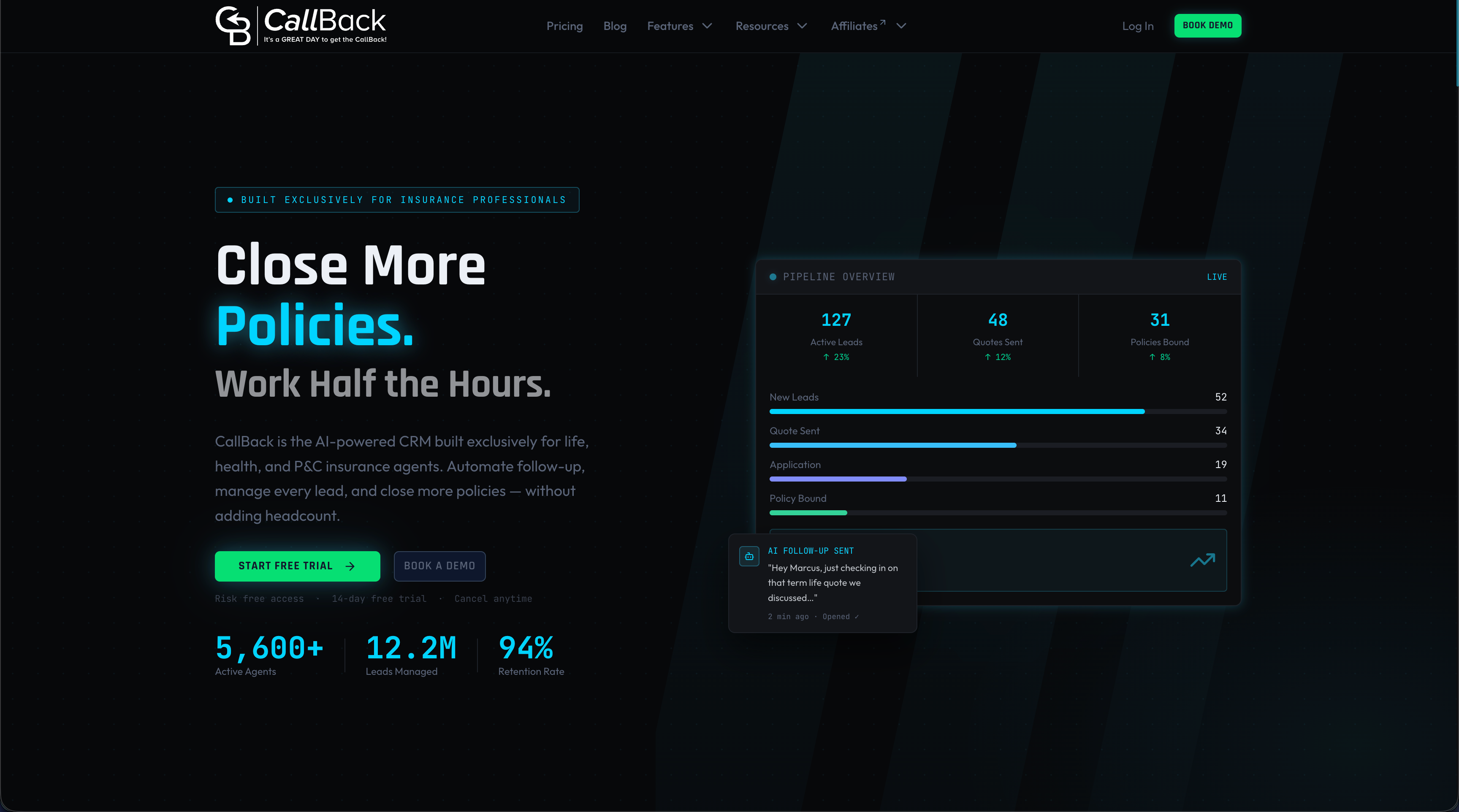
CallBack CRM was built specifically for insurance agents, agencies, and IMOs who want to replace manual processes with intelligent automation. From AI SMS automation that reaches prospects at the right moment to email automation tools that nurture leads through every stage of the funnel, the platform covers the workflows that matter most. Explore the complete AI feature set to see how CallBack CRM maps to the evaluation criteria covered in this guide. Book a demo and see the direct impact on your agency’s lead conversion and retention numbers.
Frequently asked questions
Which sales automation tool is best for strict insurance compliance?
Custom or vertical-specific tools like Salesforce Financial Services Cloud offer the strongest compliance coverage for regulated insurance workflows, with HIPAA and TCPA protections built into the platform architecture.
How quickly can insurance agencies see ROI from sales automation?
Custom AI tools can deliver measurable ROI in as little as 30-60 days, while enterprise platforms like Salesforce typically require 6-12 months to reach full productivity.
Are off-the-shelf AI sales tools risky for insurance agencies?
Yes. Generic platforms often lack the compliance guardrails insurance requires, making industry-focused or custom tools the safer and more effective choice for most agencies.
What are the most important features for insurance sales automation?
Automated lead qualification, TCPA and HIPAA compliance, seamless integration with your AMS or quoting tools, and multi-step communication workflows are the features that deliver the most measurable impact.
How do sales automation tools help boost client retention?
Automation keeps follow-up consistent and personalized at scale. Salesforce Financial Services Cloud, for example, helped one brokerage achieve 95% client retention by automating renewal outreach and policy review reminders.