

TL;DR:
- AI dramatically reduces proposal production time by automating repetitive tasks and streamlining workflows. It shifts proposal managers from document assembler to strategic reviewer, keeping humans responsible for pricing and compliance. Effective AI adoption requires strong governance, integrated workflows, and a governed content library to ensure accurate and consistent proposals.
AI in proposal management is defined as the use of machine learning and generative AI systems to automate, accelerate, and improve every stage of the proposal lifecycle, from initial discovery through final submission. AI tools reduce proposal production time by 60–75%, compressing what once took six hours into roughly 90 minutes. That shift is not incremental. It fundamentally changes what proposal managers do, how teams are structured, and where human judgment adds the most value. Platforms like Callbackcrm are already embedding AI automation workflows into sales and marketing operations, giving proposal teams a clear model for what disciplined AI adoption looks like in practice.
What key proposal tasks does AI handle best?
AI excels at the parts of proposal work that are repetitive, structural, and time-consuming. 62% of proposal teams use generative AI to handle RFP questionnaire responses, 57% use it for editing and proofreading, and 52% use it to generate first drafts. Those numbers reflect where AI delivers the fastest, most measurable return.
The specific tasks AI handles well include:
- First-draft generation: AI produces structured narrative from a brief, a past proposal, or a knowledge base, giving writers a strong starting point rather than a blank page.
- Resume and credential matching: AI scans team bios and matches relevant experience to specific RFP requirements automatically.
- Data extraction and formatting: AI pulls key requirements from lengthy RFP documents and maps them to response templates.
- Editing and proofreading: AI catches inconsistencies, passive voice, and compliance gaps faster than manual review.
- Translation and localization: AI adapts proposals for international bids without requiring a separate translation workflow.
Human roles remain critical in areas where errors carry legal or commercial consequences. Pricing, contractual terms, service level agreements, and go/no-bid decisions all require human judgment. AI drafts the structure. Humans own the decisions.
Pro Tip: Build a persistent knowledge base before you start prompting. Store your methodology, past winning proposals, brand voice guidelines, and client case studies in one place. Persistent knowledge bases produce consistent, brand-aligned outputs. Blank-page prompting produces generic content every time.

How does AI reshape the proposal manager’s role?
The proposal manager role is shifting from coordinator and document assembler to strategist and quality director. AI handles the structural, analytical, and repetitive content components. That frees proposal managers to focus on win themes, narrative differentiation, and the relationship context that no AI system can replicate.
This shift is more significant than it first appears. A proposal manager who once spent 70% of their time on formatting, chasing subject matter experts, and assembling sections now spends that time on competitive positioning, client-specific messaging, and review quality. The output improves because the manager’s attention is directed where it actually matters.
“Proposal managers are becoming strategic directors overseeing AI-driven production, focusing on narrative, differentiation, and relationship context. The professionals who thrive will be those who treat AI as a production engine and reserve their own capacity for the decisions that win business.”
Source: Future of Proposal Management: How AI Is Reshaping the Industry
Human review remains non-negotiable even as AI takes on more production work. Compliance requirements, contractual accuracy, and strategic positioning all depend on a qualified professional reading the final document before it leaves the building. AI accelerates production. It does not replace accountability.
Agencies that encode specific methodologies into their AI workflows show an 18% higher close rate compared to teams using generic AI drafting. The lesson is clear: AI amplifies whatever methodology you feed it. A weak methodology produces weak proposals faster. A strong, documented methodology produces winning proposals at scale.
What risks come with AI adoption in proposal management?
Over-reliance on AI is the most common and costly mistake proposal teams make. Speed without accuracy is a primary risk, and AI systems produce confident, well-formatted outputs even when the underlying content is wrong. That combination is dangerous in a proposal context where a pricing error or a misquoted SLA can create legal exposure.
The risks fall into four categories:
- Hallucinated facts and figures: AI generates plausible-sounding numbers that do not exist in your source data. Pricing, timelines, and technical specifications are the highest-risk areas.
- Compliance gaps: AI does not inherently understand regulatory requirements or client-specific compliance obligations. It will omit critical clauses unless explicitly instructed.
- Content library decay: Teams that rely on AI without governing their knowledge base accumulate outdated, inaccurate, or off-brand content that AI then recycles at scale.
- Blurred accountability: When AI drafts and humans approve without careful review, errors slip through because everyone assumes someone else caught them.
Building and maintaining a governed content library is the single most effective mitigation strategy. A content library with version control, ownership, and regular audits prevents AI from hallucinating and ensures compliance across every proposal.
Pro Tip: Divide your workflow explicitly. Assign AI to drafting, extraction, and formatting. Assign named humans to pricing, contractual terms, and final sign-off. Write this division into your process documentation so accountability never becomes ambiguous.
How do you integrate AI into proposal workflows effectively?
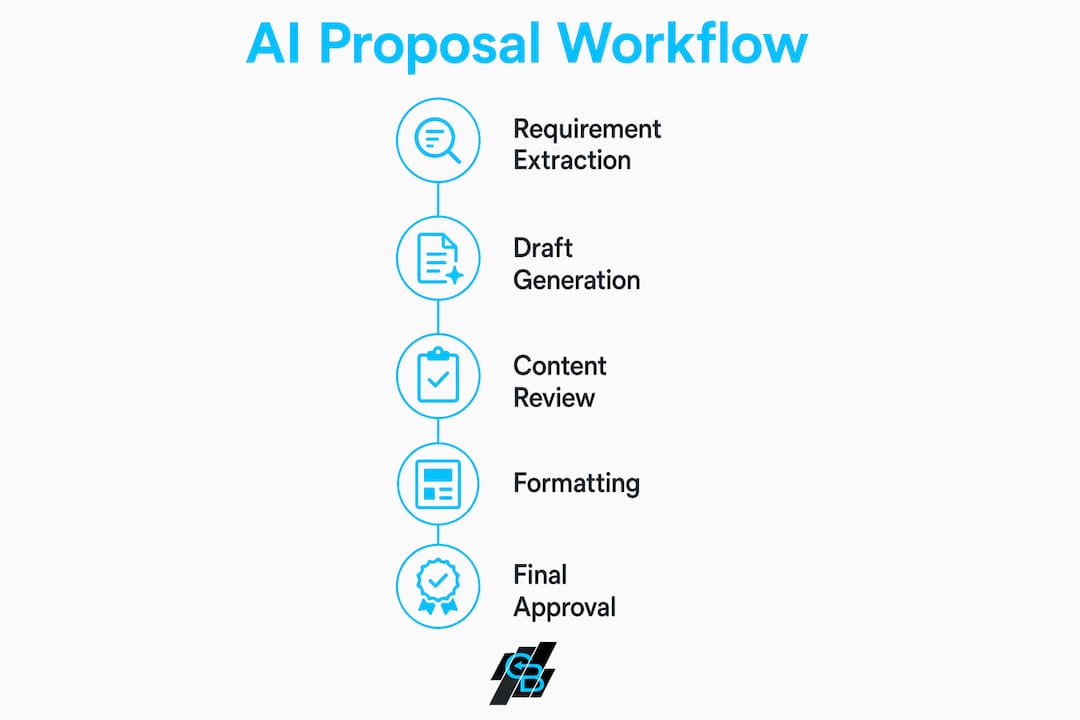
Viewing AI as an operational system, not just a writing tool, is what separates teams that see real gains from those that see marginal ones. The most effective implementations use a multi-stage pipeline where AI and humans each own specific stages.
A proven five-stage workflow looks like this:
| Stage | AI role | Human role |
|---|---|---|
| Discovery and ingestion | Extracts requirements from RFP documents | Validates scope and flags ambiguities |
| Retrieval and matching | Pulls relevant content from knowledge base | Confirms relevance and strategic fit |
| Drafting | Generates structured narrative sections | Reviews tone, accuracy, and win themes |
| Pricing and terms | Surfaces historical data for reference | Owns all pricing decisions and SLA commitments |
| Final review and routing | Checks formatting and compliance flags | Approves, signs off, and submits |
AI assists 60–70% of repetitive tasks in this model. Humans own pricing and final decisions without exception. That division is what makes the workflow both fast and safe.
Generative AI workflows improve proposal costs, cycle time, and decision quality most significantly when connected to CRM, ERP, and knowledge management systems. AI working in isolation from your client data and historical wins produces generic output. AI connected to your full data ecosystem produces proposals that reflect real client relationships and proven delivery track records.
Enterprise teams report reducing 25-hour RFP responses to under 5 hours, saving 20 hours per proposal. At scale, that reduction translates directly to lower cost per bid and the capacity to pursue more opportunities without adding headcount. For agencies and insurance teams, that capacity gain is a genuine competitive advantage. Callbackcrm’s AI automation workflows follow this same operational logic, connecting AI-driven tasks to CRM data and client history for more relevant, faster outputs.
The ask-questions-first prompting technique is one practical method worth adopting immediately. Before generating a draft, configure your AI to ask clarifying questions about the client, the scope, and the win strategy. This forces specificity and eliminates the generic outputs that make AI-assisted proposals indistinguishable from each other. For teams building out their 2026 automation strategy, this technique pairs well with a structured knowledge base and a governed content library.
AI in proposal management also delivers measurable productivity gains for agencies beyond the proposal function itself. When proposal teams spend less time on production, they contribute more to client strategy, relationship management, and business development. The productivity benefit compounds across the organization.
Key Takeaways
AI in proposal management delivers the greatest value when it operates as a governed workflow system, not as a standalone writing tool, with humans retaining ownership of pricing, compliance, and final decisions.
| Point | Details |
|---|---|
| Production time drops sharply | AI reduces proposal production time by 60–75%, freeing teams to pursue more bids. |
| Role shifts toward strategy | Proposal managers move from assemblers to quality directors overseeing AI-driven production. |
| Human oversight is non-negotiable | Pricing, SLAs, and contractual terms must stay under human control to avoid legal exposure. |
| Knowledge base quality determines output | A governed content library prevents hallucination and keeps AI outputs accurate and on-brand. |
| Workflow integration multiplies gains | AI connected to CRM and ERP systems produces better proposals than AI used in isolation. |
Why I think most teams are still using AI wrong
Most proposal teams treat AI like a faster typist. They paste in an RFP, ask for a draft, and then spend hours fixing what comes back. That approach captures maybe 20% of the available benefit and creates a false sense that AI is not ready for serious proposal work.
The teams getting real results have done something different. They built a system first. They documented their methodology, curated a content library, defined who owns what decision, and then introduced AI into a structured workflow. The AI did not change their process. It accelerated a process that already worked.
What I find most interesting about the current moment is the role reversal happening at the senior level. Junior proposal writers used to handle formatting and assembly while senior managers focused on strategy. AI now handles formatting and assembly. That means senior managers need to be more strategic, not less. The professionals who will struggle are those who defined their value by production speed. The ones who will thrive are those who always knew that the real work was understanding the client.
The governance question is the one most teams avoid because it requires discipline and internal politics. Who maintains the content library? Who audits it? Who decides when a past proposal is no longer a valid reference? These questions feel administrative, but they determine whether your AI outputs are accurate or dangerous. Get the governance right before you scale the AI.
— Kyle
How Callbackcrm supports AI-powered proposal and sales workflows
Proposal teams that want AI to work across the full sales cycle need more than a writing tool. They need a platform that connects proposal activity to client data, follow-up sequences, and marketing automation.
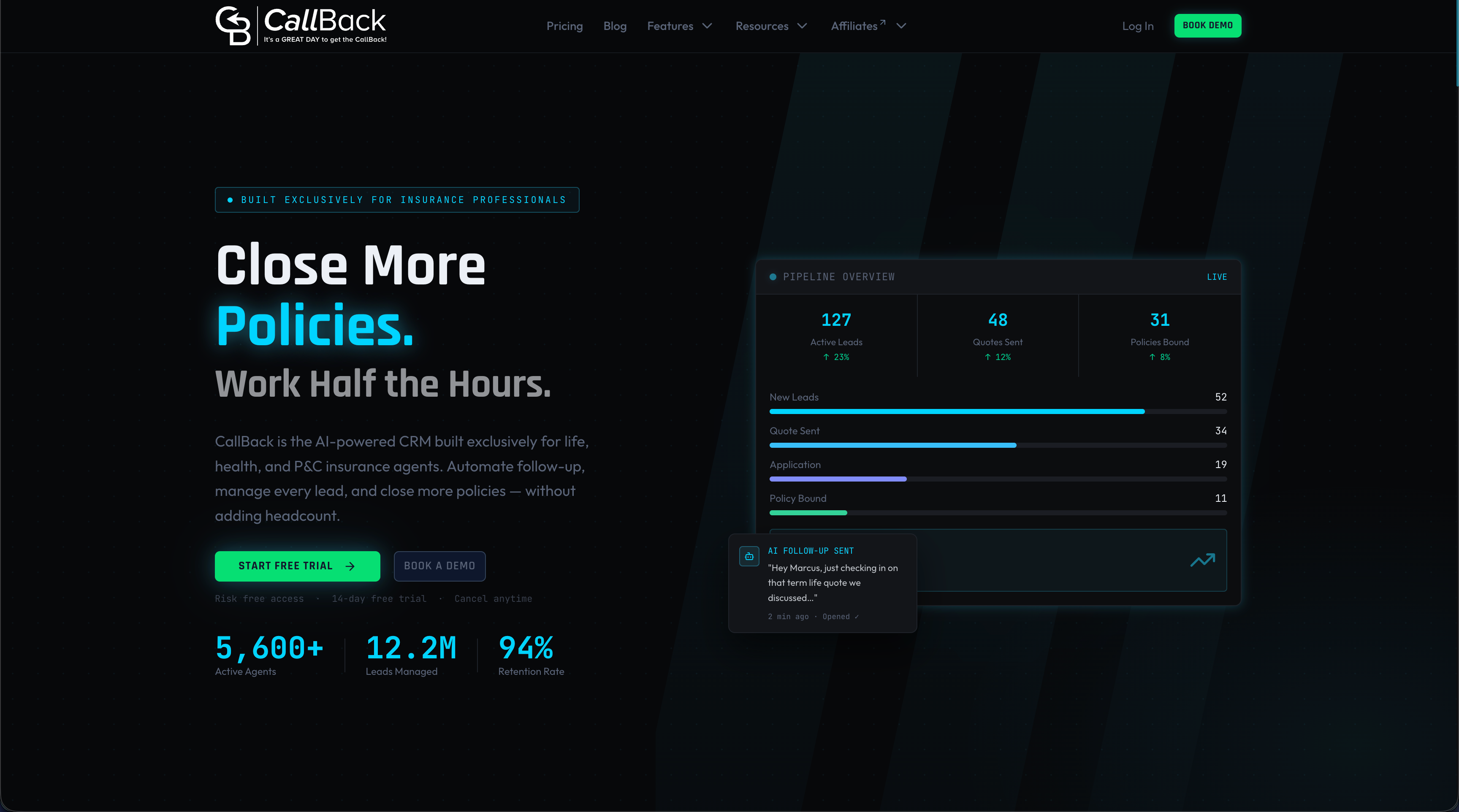
Callbackcrm brings AI automation, CRM management, and marketing tools into one platform built for agencies and insurance teams. Its website and funnel builder gives proposal teams a way to present offers and capture responses without switching platforms. The SMS marketing features keep prospects engaged between proposal submission and decision. For teams ready to connect AI-driven proposals to a full sales and marketing workflow, Callbackcrm provides the infrastructure to do it at scale.
FAQ
What is the role of AI in proposal management?
AI in proposal management automates repetitive tasks like drafting, formatting, data extraction, and editing, reducing production time by 60–75% while freeing proposal managers to focus on strategy and client-specific positioning.
Which proposal tasks should humans always control?
Pricing, contractual terms, service level agreements, and go/no-bid decisions must remain under human control. AI can generate confident but incorrect outputs in these areas, creating legal and commercial liability.
How does AI affect proposal win rates?
AI does not directly improve win rates on its own. Agencies that encode specific methodologies into AI workflows show an 18% higher close rate compared to those using generic AI drafting, meaning the quality of your methodology determines the outcome.
What is the biggest risk of using AI for proposals?
The biggest risk is speed without accuracy. AI produces well-formatted, confident outputs even when the content is wrong, making human review of every final document a requirement rather than an option.
How should teams structure an AI proposal workflow?
The most effective structure uses a five-stage pipeline: ingestion, retrieval, drafting, pricing review, and final approval. AI handles the first three stages. Humans own pricing and final sign-off without exception.