

TL;DR:
- AI-powered proposal management uses verified knowledge bases to generate accurate, compliant drafts quickly. It embeds seamlessly into existing CRMs and workflows, reducing proposal times by around 60 percent and improving close rates. Proper governance, source tracing, and integration are essential for effective, trusted implementation.
AI-powered proposal management turns proposal creation into a data-backed workflow. Callbackcrm generates first drafts from a verified knowledge base with >95% accuracy, hosted securely on Google Cloud, making it a practical choice for insurance agents, agencies, and IMOs who need speed and precision.
TL;DR:
- Generate compliant first drafts in minutes, not hours
- Match each proposal to prospect context using CRM data
- Send a single branded interactive link with e-sign and payment built in
- All data hosted on Google Cloud with 24/7 support
Accuracy matters in insurance. Platforms that draw from verified knowledge bases report over 95% accuracy on AI-generated content, which directly reduces hallucination risk and the compliance exposure that comes with it.
Ready to pilot? Request a demo from Callbackcrm and see the workflow in action.
Table of Contents
- Why does AI proposal management matter for insurance agents?
- What features should you expect from an AI proposal system?
- How do you implement AI proposal tools step by step?
- Which KPIs should you track to measure ROI?
- What red flags should you watch for in AI proposal tools?
- How does Callbackcrm deliver AI proposal management for insurance teams?
- Key Takeaways
- The part most agents overlook
- Callbackcrm: start your AI proposal pilot
- Useful sources and further reading
Why does AI proposal management matter for insurance agents?
Insurance agents lose time on manual proposal drafting that could go toward selling. A buyer-specific proposal sent within hours of a discovery call closes faster than a generic PDF sent two days later. That gap is where intelligent proposal tools create real value.
Key benefits for insurance teams:
- Faster turnaround: Vendors report proposal time reductions of around 60% and first-draft readiness of 80–90% on the first pass.
- Fewer manual errors: AI draws from approved content, reducing copy-paste mistakes in coverage details or pricing.
- Better client experience: Proposals tailored to the prospect’s situation, not a generic template.
- Pipeline impact: Response time reductions up to 80% mean teams handle more opportunities with the same headcount.
Stat to know: Some vendors report ROI realized within the first month simply by winning one additional deal that would otherwise have been lost to a slower competitor.
Secure hosting matters too. Google Cloud infrastructure gives agencies and their clients confidence that proposal data is protected, which is a baseline expectation in regulated industries.
What features should you expect from an AI proposal system?
The top feature categories are knowledge-base accuracy, deal intelligence, native integrations, interactive proposal delivery, and governance. Each one affects insurance outcomes differently.
Feature checklist:
- Verified knowledge base: Content drawn from approved sources, not the public web. This is what keeps source tracing and trace scores in place and prevents hallucinations.
- Deal intelligence / pre-scoring: A live intelligence layer analyzes prospect data and historical wins to evaluate deal viability before drafting begins, so agents focus on high-probability opportunities.
- Native integrations: AI-native platforms embed directly into Word, Google Docs, and CRMs rather than forcing agents into a separate portal. Less friction means higher adoption.
- Interactive proposal links: Switching from static PDFs to interactive links puts e-signature and payment on a single branded page and provides engagement analytics.
- Governance and traceability: Every AI-generated section traces back to its source, so reviewers can approve output with confidence.
| Feature | Why It Matters for Insurance | Realistic Expectation |
|---|---|---|
| Knowledge-base accuracy | Prevents compliance errors in coverage language | >95% accuracy from verified KB |
| First-draft speed | Reduces time per proposal | First draft in 30–60 minutes |
| CRM/Word/Docs embedding | Keeps agents in their existing workflow | Native connectors required |
| Interactive e-sign + payment | Accelerates signature and collection | Single branded link, mobile-ready |
| Source tracing | Supports compliance review and audit trails | Section-level trace scores |
Pro Tip: Seed the knowledge base with your three most recent winning proposals and tag each section with the compliance-approved language your underwriting team has already signed off on. This gives the AI a governed starting point from day one.
How do you implement AI proposal tools step by step?
Start with a targeted pilot on a single product line, such as high-value annuities or commercial lines, before rolling out across the agency. That scope keeps the data clean and the results measurable.
Implementation checklist:
- Data audit: Inventory existing proposals, case studies, and approved content. AI-native tools can ingest past proposals and produce usable first drafts in minutes once the content is uploaded.
- Integration scoping: Map which CRM fields, document stores, and call transcripts the AI needs to access. Confirm Word, Google Docs, and CRM connectors are available.
- Pilot design: Select 10–20 sample deals. Define success metrics upfront: draft readiness, time to send, and proposal-to-close rate.
- Governance setup: Lock the approved knowledge base. Assign review routing so compliance or a senior agent approves AI output before it goes to the client.
- Training and adoption: Run a structured onboarding session with sales reps and one SME. Build a short playbook covering how to capture deal context in CRM custom fields.
- Scale: Expand the content library as the team wins deals. Capture SME rationales during handoff so the AI learns from real outcomes.
Involve sales reps, one underwriter, and a compliance contact from the start. Their sign-off on the knowledge base prevents rework later.
Pro Tip: Capture deal context through a structured “War Room” brief: a set of CRM custom fields where the rep records the prospect’s primary concern, budget signal, and competing carrier. That context feeds the AI and produces buyer-specific narrative rather than generic coverage language.

Which KPIs should you track to measure ROI?
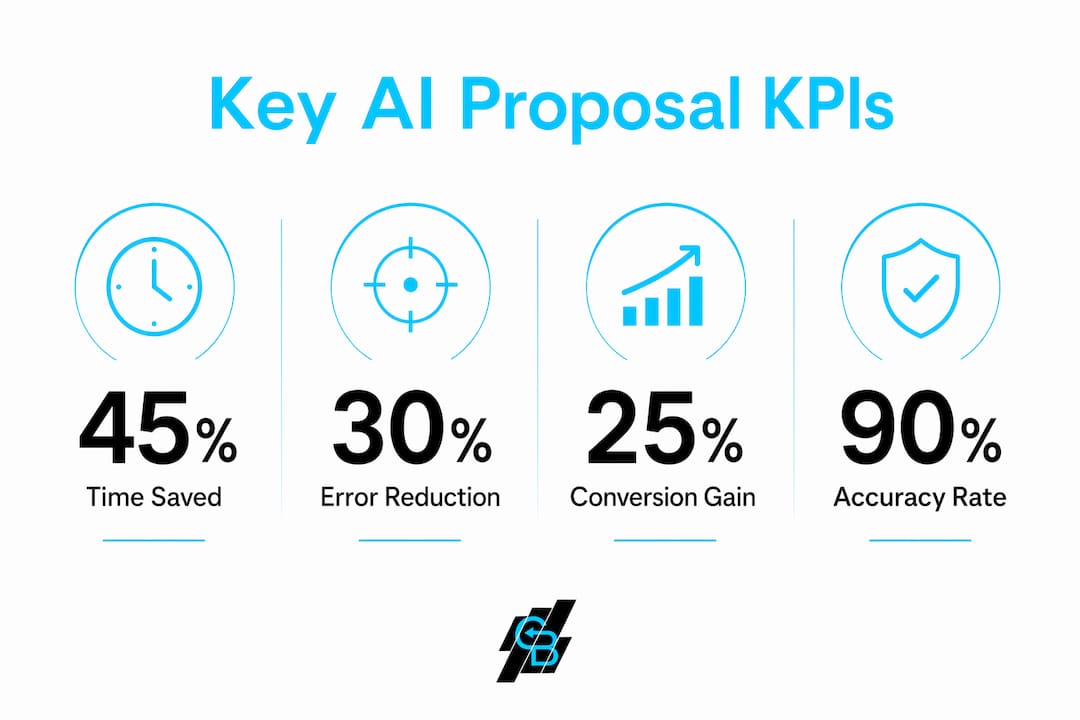
Track both efficiency and effectiveness. Efficiency metrics show time saved; effectiveness metrics show whether proposals are actually closing.
| KPI | Benchmark | How to Calculate |
|---|---|---|
| Time per proposal | ~60% reduction vs. manual | (Old avg. hours – New avg. hours) × loaded hourly rate |
| First-draft readiness | 80–90% on first pass | Sections accepted without edit ÷ total sections |
| Proposal-to-close rate | Baseline + improvement over pilot | Closed deals ÷ proposals sent |
| Signature speed | Days from send to signed | Average calendar days, tracked per deal |
| SME hours saved | Varies by team size | Hours redirected from drafting to selling |
Minimum reporting fields to capture on every proposal:
- Open rate on the interactive link
- Section-level time spent (which sections buyers read longest)
- Approval cycle time from draft to send
- Win score trend over the pilot period
Review these metrics weekly during the pilot and monthly after full rollout. Section-level engagement data is especially useful: if buyers consistently skip a section, that section needs rewriting, not just resending. Tying AI productivity gains to specific KPIs also makes the business case easier to present to agency owners and IMO leadership.
What red flags should you watch for in AI proposal tools?
The top risks are unverified content sources, no traceability, poor CRM integration, and weak analytics. Any one of these can derail an insurance team’s adoption.
Pitfalls to avoid:
- Hallucinations from unverified sources: If the AI draws from the public web rather than an approved knowledge base, it can generate incorrect coverage language. That is a regulatory risk.
- Separate portals: Tools that require agents to leave their CRM to draft proposals see low adoption. The workflow break is enough to kill the habit.
- No source tracing: Without section-level trace scores, compliance reviewers cannot confirm where content originated.
- Poor analytics: If you cannot see whether a buyer opened the proposal or which section they spent time on, follow-up is guesswork.
- Weak integration: A tool that does not sync with your CRM means manual data entry, which reintroduces the errors the AI was supposed to eliminate.
Minimum governance requirements before signing any vendor contract: source tracing at the section level, an approval routing workflow, confidence scores on AI-generated content, and a documented update cadence for the knowledge base. Require these in writing, along with data handling SLAs and a clear process for flagging outdated content.
How does Callbackcrm deliver AI proposal management for insurance teams?
Callbackcrm provides an insurance-focused AI proposal layer embedded directly into its CRM and marketing automation platform. Agents do not switch tools. The proposal workflow lives inside the same system handling their pipeline, follow-up sequences, and client communications.
Callbackcrm capabilities mapped to buyer requirements:
- CRM integration: Proposal data pulls from and writes back to the CRM automatically, keeping deal records current.
- AI assistants: Generate first drafts, rewrite sections, and personalize content based on prospect data stored in the CRM.
- Proposal and contract tools: Build, send, and track proposals from a single interface. Supports AI-driven document management across the full sales cycle.
- E-sign and payments: Clients sign and pay on one branded link, no separate DocuSign account required.
- Google Cloud hosting: Secure infrastructure that meets the data handling expectations of regulated industries.
- 24/7 support: Available for agents and agencies across all subscription tiers.
A typical Callbackcrm pilot runs 30–60 days. The team ingests existing proposals into the knowledge base, configures CRM field mapping, and runs sample deals through the AI drafting workflow. Pricing follows a subscription model with AI, SMS, and email usage billed at wholesale rates.
Trust signals: Callbackcrm’s knowledge-base-driven AI targets over 95% accuracy on generated content. The platform is hosted on Google Cloud, integrates with major CRMs, supports e-sign and payment collection, and provides 24/7 customer support. Implementation guides are maintained by the Callbackcrm team and updated as the platform evolves.
Key Takeaways
AI-powered proposal management gives insurance agents faster drafts, fewer errors, and measurable conversion gains when built on a verified knowledge base and embedded in the existing CRM workflow.
| Point | Details |
|---|---|
| Accuracy is the baseline | Platforms drawing from verified knowledge bases report over 95% accuracy, reducing compliance risk. |
| Speed compounds over time | Vendors report proposal time reductions of around 60% and first-draft readiness of 80–90% on the first pass. |
| Integration drives adoption | Tools embedded in Word, Google Docs, and CRMs see higher adoption than standalone portals. |
| Governance is non-optional | Source tracing, approval routing, and confidence scores must be in place before any insurance team goes live. |
| Callbackcrm fits the workflow | Callbackcrm embeds AI proposal tools inside its insurance-focused CRM, with Google Cloud hosting and 24/7 support. |
The part most agents overlook
Most conversations about AI proposal tools focus on speed. That is the wrong starting point for insurance teams.
Speed matters, but the real risk in insurance proposals is accuracy. A proposal that goes out fast with incorrect coverage language, a wrong exclusion, or a misquoted premium creates liability. The agents who get the most out of these tools are the ones who spend the first two weeks of a pilot doing nothing but building and auditing the knowledge base, not drafting proposals.
The second thing most teams underestimate is change management. Agents who have drafted proposals manually for years will not adopt a new tool because it is technically better. They adopt it when a manager shows them a specific deal where the AI saved three hours and the proposal closed faster. That one concrete example does more than any training session.
If you are evaluating a vendor, ask them to show you the source trace on a sample output before you see the demo. If they cannot show you exactly where every sentence came from, the governance is not ready for insurance.
Callbackcrm: start your AI proposal pilot
Callbackcrm is built for insurance agents who need proposal automation inside their existing sales workflow, not bolted onto it. The platform combines AI drafting, CRM data sync, e-sign, and payment collection in one place, so agents spend less time on documents and more time closing.
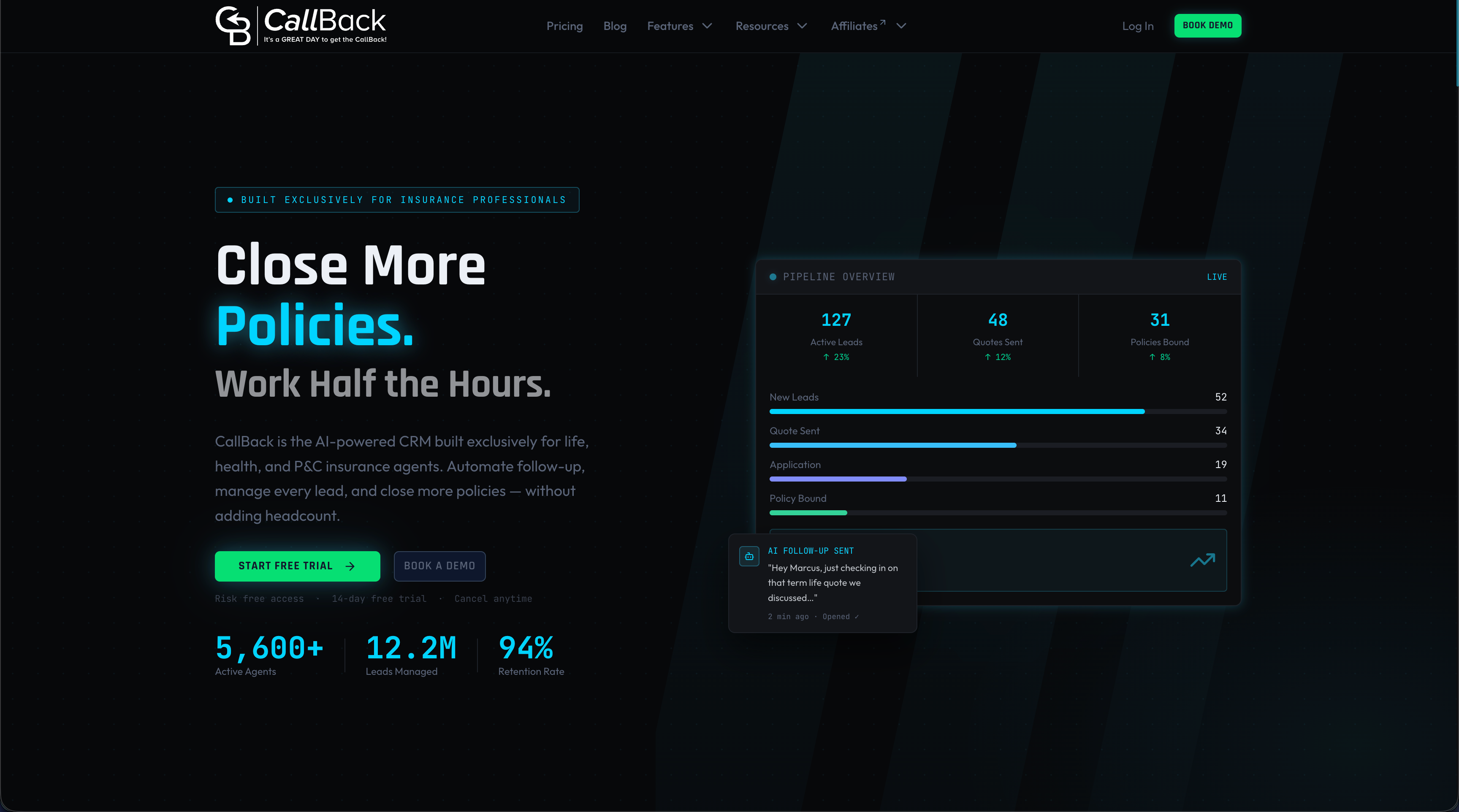
A demo takes 30 minutes. Bring two or three of your current proposal templates and one active deal. The Callbackcrm team will configure a sample workflow, show you how the AI drafts from your knowledge base, and walk through the interactive proposal link your clients will receive.
- Bring: two to three existing proposal templates and one active deal
- Expect: a live draft generated from your content in the session
- Timeline: 30–60 day pilot with measurable KPIs from week one
Request your pilot configuration or explore SMS and outreach features that connect proposal follow-up to your full automation workflow.
Useful sources and further reading
These resources support the claims in this guide and provide additional depth on implementation, benchmarks, and platform capabilities.
- The Role of AI in Proposal Management: 2026 Guide — Callbackcrm’s deep-dive on AI integration with proposal workflows and CRM platforms.
- AI-Powered Outreach Workflow for Insurance Sales — How proposal management fits into broader insurance sales automation.
- AI Automation Workflows That Drive Agency Growth — Playbooks for agency-level automation and scaling.
- AI for Agencies: Productivity and ROI Analysis — Third-party analysis of AI productivity gains relevant to proposal ROI calculations.
- Inventive.ai: AI Proposal Generator — Vendor data on knowledge-base accuracy and hallucination reduction.
- Responsive: Proposal Management and Traceability — Source tracing and governance features explained.
- AutoRFP.ai: AI Proposal Response Automation — Response time reduction data and ROI scenarios.