

Insurance agencies waste thousands of hours yearly on repetitive data entry and follow-up tasks. AI-powered CRM systems reduce manual data entry by 40%, freeing agents to focus on building relationships and closing deals. This guide reveals how AI-driven CRM transforms insurance operations through automation, predictive analytics, and personalized client engagement while addressing security, implementation, and common misconceptions.
Table of Contents
- Understanding The Role Of CRM In Insurance Agencies
- Key AI And Automation Features In Modern Insurance CRMs
- Quantifiable Benefits Of AI-Driven CRM Adoption In Insurance
- Common Misconceptions And Pitfalls Regarding CRM Implementation In Insurance Agencies
- Comparative Framework: Selecting The Right CRM For Your Insurance Agency
- Data Security And Compliance Considerations In Insurance CRM Systems
- Implementing AI-Powered CRM In Your Insurance Agency: Practical Steps And Best Practices
- Summary And Future Outlook For AI-Powered CRM In Insurance Agencies
- Discover CallBack CRM: AI-Driven Solutions For Insurance Agencies
Key Takeaways
| Point | Details |
|---|---|
| Efficiency Gains | AI CRMs cut manual work by 40% and accelerate sales cycles through intelligent automation |
| Lead Quality | Predictive analytics and automated scoring identify high-value prospects and improve conversion rates |
| Personalization | AI assistants enable tailored client communications at scale without sacrificing the human touch |
| Compliance Ready | Modern platforms integrate cloud security standards and regulatory safeguards for insurance data |
| Implementation Success | Proper training, clear KPIs, and phased rollout maximize ROI for agencies of all sizes |
Understanding the Role of CRM in Insurance Agencies
Customer Relationship Management systems have evolved from simple contact databases into sophisticated platforms that drive every aspect of insurance agency operations. Early CRM tools focused on organizing client information, but modern solutions integrate artificial intelligence to automate workflows, predict customer behavior, and personalize outreach.
Insurance agencies face unique operational challenges that generic CRM systems often fail to address. Manual policy tracking, scattered client communications, and inconsistent follow-up processes create inefficiencies that cost time and revenue. Agents spend hours on administrative tasks instead of revenue-generating activities, leading to missed opportunities and declining client satisfaction.
AI-powered CRM platforms specifically designed for insurance agencies transform these pain points into competitive advantages. Intelligent automation handles routine data entry, policy renewals, and initial client inquiries. Predictive analytics identify which leads are most likely to convert, allowing agents to prioritize their time effectively. Personalized communication tools maintain consistent engagement across email, SMS, and social channels without manual intervention.
Successful AI CRM adoption requires agencies to meet several prerequisites:
- Clean, centralized client data that can be migrated and integrated
- Leadership commitment to workflow changes and staff training
- Clear business objectives tied to measurable CRM outcomes
- Technical infrastructure supporting cloud-based platforms and integrations
- Budget allocation for platform costs, implementation, and ongoing optimization
Agencies that embrace these foundational elements position themselves to leverage AI advantages that separate market leaders from competitors struggling with outdated manual processes.
Key AI and Automation Features in Modern Insurance CRMs
AI-driven CRM platforms deliver specific capabilities that revolutionize how insurance agencies generate, nurture, and convert leads. Lead scoring algorithms analyze behavioral data including website visits, email engagement, and social media interactions to assign numerical values indicating purchase intent. This predictive approach ensures agents contact prospects at optimal moments in their decision journey.
Automated client outreach transforms inconsistent manual follow-up into systematic nurture campaigns. When a prospect downloads a policy comparison guide, the CRM triggers a personalized email sequence addressing common questions about coverage options. If the prospect opens emails but doesn’t respond, the system escalates to SMS outreach or schedules a callback reminder for the assigned agent.
AI assistants handle routine client interactions that previously consumed agent time:
- Answering frequently asked questions about policy terms and coverage limits
- Scheduling appointments and sending automated reminders
- Processing simple policy updates and document requests
- Identifying cross-sell opportunities based on life events and policy gaps
Integration with marketing and sales funnels creates seamless workflows from initial ad click through policy binding. When a Facebook lead ad captures contact information, the CRM automatically creates a prospect record, assigns it based on territory rules, and initiates the appropriate nurture sequence. This eliminates the manual data transfer that causes leads to fall through the cracks.
Pro Tip: Balance automation with personal touchpoints by reserving complex consultations and relationship-building conversations for human agents while letting AI handle qualification and routine inquiries.
These features collectively reduce time spent on administrative tasks while improving response consistency and speed. Agencies report that automation handles 60-70% of initial prospect interactions, allowing experienced agents to focus their expertise where it delivers maximum value.

Quantifiable Benefits of AI-Driven CRM Adoption in Insurance
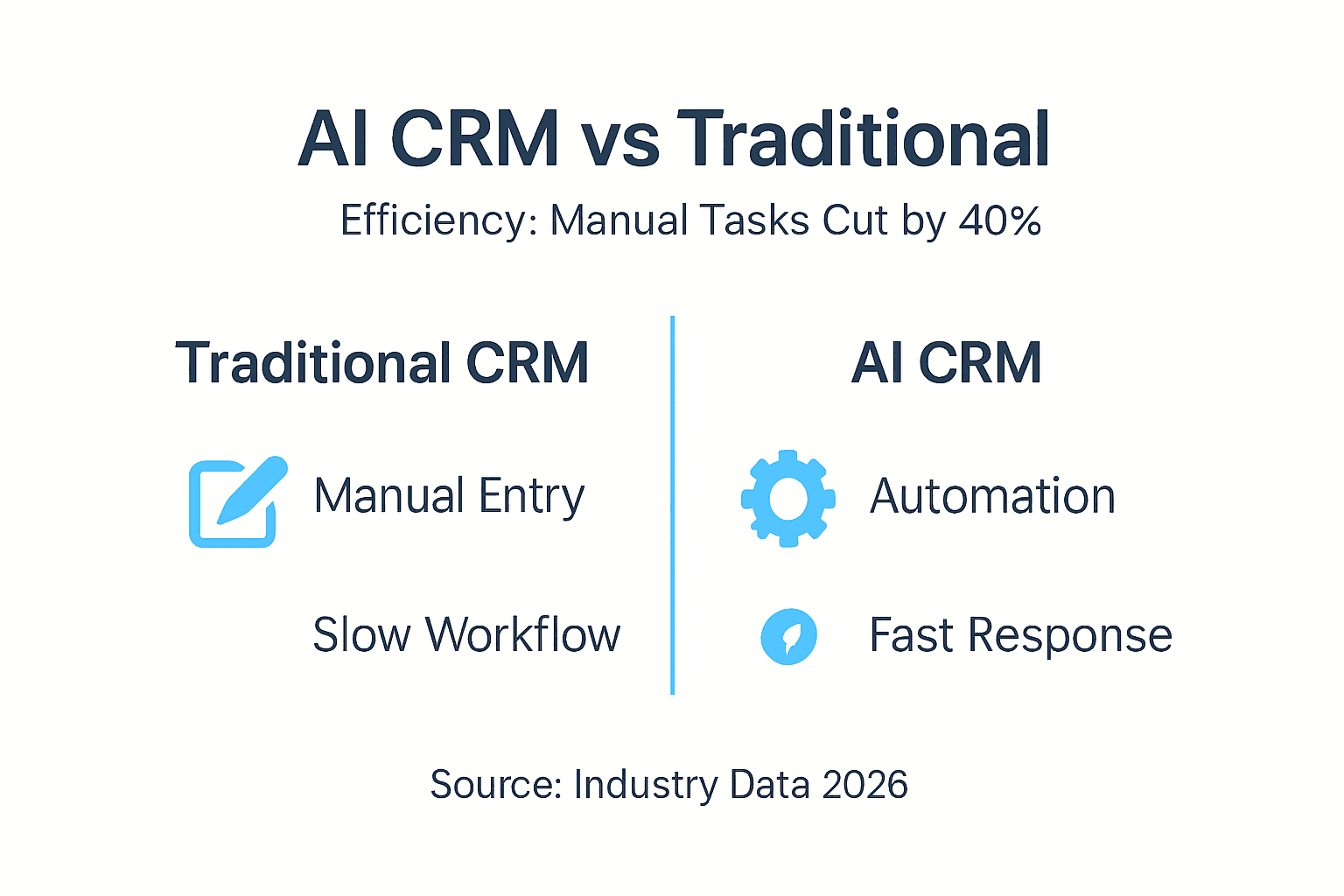
Empirical data demonstrates that AI CRM adoption delivers measurable improvements across key insurance agency performance metrics. Efficiency gains manifest immediately as automated data entry and workflow orchestration eliminate repetitive manual tasks that previously consumed agent hours.
| Metric | Traditional CRM | AI-Powered CRM | Improvement |
|---|---|---|---|
| Manual data entry time | 8-10 hours/week | 4-6 hours/week | 40% reduction |
| Lead response time | 24-48 hours | Under 5 minutes | 95% faster |
| Lead conversion rate | 2-3% | 5-7% | 150% increase |
| Client retention rate | 75-80% | 85-90% | 10 percentage points |
| Average sales cycle | 45-60 days | 30-40 days | 33% shorter |
Lead quality improvements stem from predictive analytics that identify prospects matching ideal customer profiles. Rather than working every inquiry equally, agents prioritize contacts with behavioral signals indicating readiness to purchase. This focused approach increases conversion rates while reducing wasted effort on low-probability prospects.
Client retention benefits from automated touchpoint sequences that maintain consistent engagement throughout the policy lifecycle. Birthday messages, policy anniversary reminders, and proactive renewal outreach keep agencies top of mind. AI identifies optimal communication frequency for each client, preventing both neglect and oversaturation.
Insurance agencies should track these success metrics to validate CRM ROI:
- Cost per acquired customer and customer acquisition trends over time
- Agent productivity measured by policies sold per hour worked
- Client lifetime value and repeat purchase rates
- Net Promoter Score reflecting client satisfaction and referral likelihood
- Technology adoption rates among staff and feature utilization metrics
Pro Tip: Establish baseline measurements before CRM implementation and review KPIs monthly to identify optimization opportunities and demonstrate ROI to stakeholders.
Common Misconceptions and Pitfalls Regarding CRM Implementation in Insurance Agencies
Many insurance agency owners resist AI CRM adoption based on outdated assumptions about complexity, cost, and applicability to their business size. Modern platforms offer tiered pricing models and simplified onboarding that make sophisticated automation accessible to agencies with modest budgets and technical resources.
The belief that only large enterprises benefit from AI CRM contradicts market data. Research shows 70% of small and mid-sized agencies experience significant growth after implementing AI-powered platforms. Smaller agencies often see proportionally greater benefits because automation eliminates bottlenecks that previously limited their capacity to serve more clients.
Concerns that AI will replace human agents misunderstand how automation enhances rather than eliminates roles. AI handles repetitive qualification and nurturing tasks, freeing agents to focus on consultative selling and relationship management where human judgment and empathy create irreplaceable value. The technology identifies which prospects need immediate agent attention and prepares context so conversations start productively.
Common implementation pitfalls that undermine CRM success include:
- Inadequate staff training leading to poor adoption and feature underutilization
- Migrating incomplete or inaccurate data that compromises automation reliability
- Overlooking compliance requirements for insurance-specific regulations
- Over-automating client communications and losing personal connection
- Failing to customize workflows for agency-specific processes and terminology
- Neglecting regular system audits and optimization as business needs evolve
Realistic expectations about automation capabilities prevent disappointment. AI excels at pattern recognition, routine task execution, and data processing but cannot replicate the nuanced judgment required for complex underwriting decisions or sensitive client situations. Successful agencies view AI as a powerful tool that amplifies agent capabilities rather than a complete replacement for human expertise.
Comparative Framework: Selecting the Right CRM for Your Insurance Agency
Choosing an AI-powered CRM requires evaluating platforms against criteria specific to insurance agency operations and compliance obligations. Generic business CRM systems lack the industry-specific features and regulatory safeguards that insurance-focused platforms provide.
| Criteria | CallBack CRM | Generic CRM Platforms |
|---|---|---|
| Insurance-specific workflows | Pre-built templates for policy sales, renewals, claims | Requires extensive customization |
| AI lead scoring | Trained on insurance buyer behavior patterns | General scoring models need tuning |
| Compliance features | Built-in HIPAA and state insurance law safeguards | Manual compliance configuration |
| Integration ecosystem | Native connections to insurance tools and carriers | Limited insurance-specific integrations |
| Automation depth | End-to-end workflows from lead to policy binding | Basic email sequences and reminders |
| Support quality | 24/7 assistance from insurance CRM specialists | General support with limited industry knowledge |
Vendor specialization significantly impacts implementation success and ongoing value. Platforms designed for insurance understand policy lifecycle management, regulatory documentation requirements, and commission tracking needs that generic CRM vendors overlook. This domain expertise translates to faster setup, more relevant features, and support teams who speak your language.
Scalability considerations vary by agency size and growth trajectory. Small agencies benefit from platforms offering robust core features at accessible price points with upgrade paths as client volume increases. Mid-sized agencies require advanced automation, multi-user collaboration tools, and reporting capabilities. Large agencies and IMOs need enterprise-grade security, white-label options, and API access for custom integrations.
Pros and cons of typical CRM choices:
- Industry-specific platforms: Deep insurance expertise but potentially higher costs and smaller vendor ecosystems
- Major business platforms: Broad integrations and name recognition but require significant customization for insurance workflows
- Startup solutions: Innovative features and competitive pricing but uncertain long-term viability and support
Agencies prioritizing compliance and out-of-the-box insurance functionality should favor specialized vendors. Those with robust technical teams capable of extensive customization may find value in adaptable general business platforms.
Data Security and Compliance Considerations in Insurance CRM Systems
Insurance agencies handle sensitive personal and health information subject to strict regulatory oversight. HIPAA requirements govern health insurance data, while state insurance departments enforce additional privacy and security standards. Selecting a CRM platform with built-in compliance safeguards prevents costly violations and protects client trust.
Cloud security standards implemented by reputable CRM vendors include encryption for data at rest and in transit, regular security audits, penetration testing, and continuous monitoring for unauthorized access attempts. Leading platforms leverage enterprise-grade infrastructure from providers like Google Cloud and AWS that maintain certifications for multiple compliance frameworks.
Secure CRM design incorporates role-based access controls limiting which staff members can view or modify sensitive client information. Audit logs track every data access and modification, creating accountability and supporting compliance investigations. Automated backup systems and disaster recovery protocols ensure business continuity even after system failures or security incidents.
Best practices for ensuring data privacy during CRM implementation:
- Conduct thorough vendor security assessments reviewing certifications, audit reports, and breach history
- Implement multi-factor authentication for all user accounts accessing client data
- Establish data retention policies defining how long information is stored and when it should be purged
- Train staff regularly on security protocols, phishing awareness, and proper data handling
- Create incident response plans specifying steps to take if a breach occurs
- Review and update security configurations quarterly as threats evolve
Pro Tip: Schedule annual security audits with independent compliance experts to validate that your CRM implementation meets current regulatory requirements and industry best practices.
Agencies should consult legal and compliance advisors before deploying new CRM systems to verify that platform capabilities, data handling procedures, and vendor agreements satisfy applicable regulations. This proactive approach prevents expensive remediation and potential regulatory sanctions.
Implementing AI-Powered CRM in Your Insurance Agency: Practical Steps and Best Practices
Successful AI CRM adoption follows a structured implementation roadmap that addresses technical integration, staff training, and continuous optimization. Strategic planning prevents common pitfalls that undermine CRM projects and ensures agencies realize expected benefits.
- Evaluate current workflows and identify specific pain points that AI automation should address, such as slow lead response or inconsistent follow-up.
- Research and compare CRM platforms using the selection criteria outlined earlier, requesting demos focused on your priority use cases.
- Plan data migration by cleaning existing client records, standardizing formats, and mapping fields to the new system structure.
- Configure the platform with insurance-specific templates, automation rules, and integrations before importing production data.
- Train staff thoroughly on core features, emphasizing how the CRM improves their daily workflows rather than adding busywork.
- Launch with a pilot group testing workflows and providing feedback before rolling out agency-wide.
- Monitor adoption metrics and performance KPIs weekly during the first month, then monthly as operations stabilize.
- Iterate continuously by gathering user feedback, optimizing automation rules, and expanding feature utilization over time.
Common failure points include rushing implementation without adequate testing, neglecting staff training that drives adoption, and treating the CRM as a one-time project rather than an ongoing operational system. Agencies that invest in comprehensive training and change management see significantly higher utilization rates and faster ROI.
Pro Tip: Leverage CallBack CRM’s specialized training resources and AI automation templates designed specifically for insurance agencies to accelerate your implementation and avoid reinventing proven workflows.
Setting measurable goals before launch creates accountability and helps identify optimization opportunities. Define targets for lead response time, conversion rates, client retention, and agent productivity. Review these metrics in monthly team meetings, celebrating wins and troubleshooting underperforming areas collaboratively.
Maintaining competitive advantage requires treating CRM as a strategic asset that evolves with your agency. Quarterly reviews should assess whether automation rules still reflect current business priorities, identify new features worth adopting, and evaluate whether the platform continues meeting your needs as the agency grows.
Summary and Future Outlook for AI-Powered CRM in Insurance Agencies
AI-powered CRM systems deliver transformative benefits for insurance agencies through dramatic efficiency gains, improved lead quality, enhanced client engagement, and built-in compliance safeguards. Automation eliminates manual tasks that previously consumed 40% of agent time, while predictive analytics identify high-value prospects worth prioritizing. Personalized communication maintains consistent client touchpoints that strengthen retention and generate referrals.
Ongoing challenges require continued attention as agencies mature their CRM capabilities. Staff training must evolve as platforms add features and new team members join. Balancing automation efficiency with personal relationship-building remains an art requiring regular calibration. Regulatory landscapes shift as privacy laws tighten and new compliance requirements emerge.
Emerging trends reshaping insurance CRM technology in 2026 and beyond:
- Deeper AI insights analyzing voice conversations and video consultations to identify client concerns and opportunities
- Enhanced personalization using behavioral psychology and communication preferences to optimize outreach timing and messaging
- Increased automation expanding into previously manual areas like complex underwriting analysis and claims processing
- Tighter integration between CRM, marketing platforms, carrier systems, and external data sources creating unified workflows
- Advanced predictive models forecasting client lifetime value, lapse probability, and cross-sell readiness with greater accuracy
Agencies that modernize operations with AI CRM position themselves to thrive as competition intensifies and client expectations rise. The technology investment pays dividends through higher productivity, better client experiences, and scalable growth that would be impossible with manual processes.
Discover CallBack CRM: AI-Driven Solutions for Insurance Agencies
If you’re ready to transform your insurance agency operations with AI automation, CallBack CRM delivers the specialized features and support you need. Our platform combines intelligent lead management, predictive scoring, automated nurturing, and compliance-ready security designed specifically for insurance professionals.
Explore our comprehensive feature set including AI assistants that handle routine inquiries, advanced lead management that prioritizes your highest-value prospects, and intelligent automation workflows that nurture clients throughout the policy lifecycle. Experience firsthand how CallBack CRM addresses the efficiency, engagement, and compliance challenges discussed throughout this guide. Start your free trial today and join thousands of insurance professionals who have modernized their agencies with AI-powered CRM technology.
FAQ
What are the biggest benefits of AI-powered CRM for insurance agencies?
AI CRM reduces manual data entry by 40%, allowing agents to focus on relationship-building and sales activities. The technology improves lead conversion through predictive scoring, personalizes client communications at scale, and ensures compliance with insurance regulations. Agencies report measurable efficiency gains, shortened sales cycles, and increased client retention rates that directly impact revenue growth.
How does AI improve lead generation and scoring in insurance CRMs?
Predictive analytics examine behavioral signals including website visits, email engagement, and social media interactions to identify prospects most likely to purchase. Automated nurturing sequences maintain consistent contact with leads through personalized emails and SMS messages timed for maximum impact. This systematic approach ensures no qualified prospect falls through the cracks while agents prioritize their time on high-probability opportunities.
What are common misconceptions about CRM for insurance agencies?
Many believe AI CRM is too complex or expensive for small agencies, but modern platforms offer tiered pricing and simplified onboarding accessible to businesses of all sizes. Another misconception is that AI replaces human agents, when in reality it augments their work by handling routine tasks and qualification. Implementation challenges like staff training and data migration are manageable with proper planning and vendor support.
How can insurance agencies ensure data security with AI CRM systems?
Choose platforms compliant with HIPAA and state insurance regulations that implement encryption, access controls, and regular security audits. Establish internal protocols including multi-factor authentication, role-based permissions, and quarterly security reviews. Consult compliance experts annually to validate that your CRM configuration meets evolving regulatory requirements and industry best practices for protecting sensitive client information.