

TL;DR:
- Callbackcrm is the best alternative to Drop.co for insurance agencies needing an all-in-one platform with AI inbound handling and two-way SMS. Unlike Drop.co, it offers native callback management, verifiable delivery reports, and seamless CRM integration, reducing lead leakage and manual follow-up. Transitioning to Callbackcrm ensures compliance, lowers costs per delivered message, and consolidates workflows in a single platform.
Callbackcrm is the best Drop.co alternative for insurance agencies that need AI-powered inbound handling, two-way SMS, and an integrated CRM in one place. Drop.co focuses on high-volume per-drop sending rather than callback automation or AI-driven conversation, which leaves agencies managing inbound leads manually. Other market alternatives include Slybroadcast and Drop Cowboy, both of which handle ringless voicemail (RVM) delivery but similarly lack native AI CRM workflows.
Table of Contents
- 1. Best Drop.co alternatives at a glance
- 2. How these platforms actually differ from Drop.co in your workflow
- 3. How these platforms were evaluated
- 4. What to require from any Drop.co alternative
- 5. Pricing and cost trade-offs when switching
- 6. Compliance and deliverability checks before you switch
- 7. Migration checklist if you choose Callbackcrm
- 8. Final recommendation
- Key Takeaways
- The case for moving beyond broadcast
- Callbackcrm: built for agencies that need more than a drop
- Useful sources
1. Best Drop.co alternatives at a glance
The table below compares the platforms most relevant to insurance agents and IMOs evaluating Drop.co replacement options.
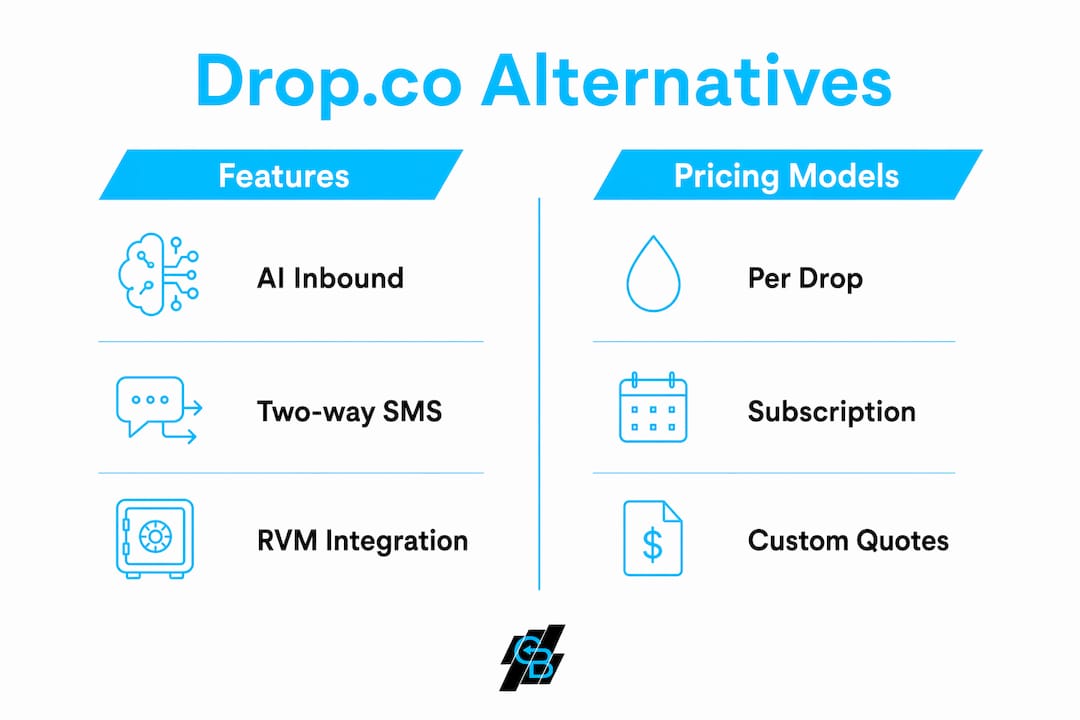
| Platform | Best for | Core features | AI capabilities | Compliance | Pricing model |
|---|---|---|---|---|---|
| Callbackcrm | Agencies and IMOs wanting all-in-one AI CRM | CRM, RVM, two-way SMS, AI assistants, funnels, workflows | AI inbound agent, lead scoring, automated follow-up | TCPA support, audit logs, Google Cloud hosting | Subscription + wholesale usage fees |
| Slybroadcast | Solo agents needing basic RVM delivery | Ringless voicemail delivery, basic reporting | None native | Basic opt-out handling | Per-drop or monthly plans |
| Drop Cowboy | Small agencies wanting RVM + simple SMS | RVM, SMS, basic campaign tools | None native | Basic DNC tools | Per-drop credits |
| Drop.co | High-volume broadcast senders on a budget | Ringless voicemail delivery | None | Basic | Per-drop |
Callbackcrm suits agencies and IMOs that want a single platform covering CRM, outreach, and inbound handling. Slybroadcast and Drop Cowboy work for agents who only need RVM delivery and are comfortable managing callbacks and CRM separately. Common Drop.co competitors also include Skipio and iJungo, but neither offers the insurance-specific CRM depth that agencies typically need.
2. How these platforms actually differ from Drop.co in your workflow
Drop.co sends voicemail drops. That is its job. The gap shows up the moment a prospect calls back.
- Drop.co has no native callback handling. Inbound calls go wherever your phone system sends them, with no AI qualification or CRM logging.
- Conversation-first platforms like Callbackcrm deploy an AI inbound agent that answers callbacks, qualifies the prospect, and logs the interaction directly in the CRM.
- Two-way SMS is absent from Drop.co. Platforms with native two-way SMS let prospects reply to a text and continue the conversation without agent involvement.
- Delivery reporting on Drop.co is basic. Verifiable delivery reports let agencies reconcile billed drops against actual deliveries and keep accurate CRM history.
- Pay-per-delivery pricing, offered by some alternatives, means you pay only when a drop lands. Drop.co charges per attempted drop, regardless of delivery outcome.
Pro Tip: During any vendor demo, ask the rep to show you a live delivery report with per-drop status codes. If they cannot produce one in under two minutes, assume the reporting is not reliable enough for budget reconciliation.
3. How these platforms were evaluated
Platforms were assessed across seven criteria weighted toward what insurance agencies actually need in 2026.
- AI and automation (30%): Does the platform handle inbound callbacks automatically? Does it qualify leads without agent involvement?
- Deliverability and compliance (20%): Are delivery reports verifiable? Does the platform support TCPA-safe sending, DNC suppression, and opt-in record keeping?
- Integrations (15%): Does it connect to agency management systems, dialers, calendars, and ad platforms?
- Pricing transparency (15%): Is the cost model clear? Does pay-per-delivery apply, or are you charged for failed drops?
- Onboarding and support (10%): Is there structured onboarding? Is support available outside business hours?
- Security (10%): Is there SOC 2 Type II evidence or equivalent? Are audit logs available?
Sources used: vendor documentation, publicly available trial accounts, vendor-reported compliance artifacts, and published platform reviews.
4. What to require from any Drop.co alternative
Use this checklist before signing with any platform.
Must-have features:
- Native AI inbound agent or callback-handling automation
- Two-way SMS with conversation threading
- CRM sync that logs every interaction automatically
- Verifiable delivery reporting with per-drop status
- Secure audit logs for opt-in records and DNC suppression
- TCPA-compliant sending controls
Nice-to-have features:
- AI voice cloning for personalized RVM
- Multilingual support
- REST API for custom integrations
- Multi-attempt delivery for undelivered drops
Demo questions to ask every vendor:
- Can you show me a delivery report with per-drop status codes right now?
- Do you charge for failed drops, or only for verified deliveries?
- Can you provide a sample audit log showing opt-in records and DNC suppression?
- Is SOC 2 Type II certification available, or an equivalent security attestation?
- How does your AI inbound agent handle a callback at 9 PM on a Saturday?
Consolidating RVM, two-way SMS, and AI inbound capability into one platform reduces lead leakage and eliminates cross-tool data mapping that slows follow-up. Agencies evaluating insurance marketing organization tools should treat platform consolidation as a primary criterion, not a secondary one.
5. Pricing and cost trade-offs when switching
Drop.co charges per attempted drop. That model looks cheap until delivery rates drop and you realize you paid for messages that never landed.
Common pricing models across alternatives:
- Per-drop billing: Charged per attempt regardless of delivery outcome (Drop.co’s model).
- Pay-per-delivery: Charged only for verified successful deliveries. Lower effective cost for high-volume senders.
- Subscription plus credits: Monthly base fee covers platform access; SMS, RVM, and AI usage billed at wholesale rates (Callbackcrm’s model).
- Add-on AI minutes: Some platforms charge separately for AI inbound agent time.
What to track when comparing costs:
- Delivery rate and what percentage of billed drops actually land
- AI usage fees per minute or per interaction
- Phone number rotation and verification costs
- SMS fees per segment (outbound and inbound)
- Onboarding and setup fees
Cost comparison example: An agency sending thousands of drops per month at a per-attempted-drop rate pays the total cost regardless of delivery outcome, which can result in paying for numerous undelivered drops. A pay-per-delivery model at $0.07 per delivered drop costs $245 for 3,500 delivered messages. The effective cost per delivered message is lower, and the CRM history is accurate.
Pro Tip: Free or very low-cost platforms often produce higher total acquisition costs due to poor delivery rates and missing compliance documentation. Evaluate cost per delivered message and cost per qualified callback, not just the headline per-drop price.

6. Compliance and deliverability checks before you switch
Scaling outreach without verified compliance controls is a liability. Sophisticated agencies prioritize SOC 2 Type II and audit logging to reduce legal exposure as they grow.
Compliance items to request from any vendor:
- Written TCPA-safe sending policy
- DNC suppression list integration and update frequency
- Opt-in record storage with timestamps
- Audit logs exportable for legal review
- SOC 2 Type II report or equivalent security attestation
- Phone number validation before sending
Deliverability checks:
- Verifiable per-drop delivery reports with status codes
- Multi-attempt delivery for undelivered messages
- Percentage of successful drops versus billed drops (ask for a recent campaign sample)
- Phone validation to filter disconnected or invalid numbers before a campaign runs
Compliance questions for your legal and ops team:
- Does this platform’s DNC suppression update in real time or on a delay?
- How are opt-out requests captured and propagated across campaigns?
- What happens if a prospect’s number appears on the National DNC Registry after a campaign starts?
7. Migration checklist if you choose Callbackcrm
A typical small agency completes migration in 1–3 weeks. An IMO or larger agency should plan 3–6 weeks.
- Export your lists from Drop.co. Download contact lists with all available metadata, including opt-in timestamps and opt-out records.
- Map your fields. Match Drop.co contact fields to Callbackcrm CRM fields before importing. Flag any custom fields that need manual mapping.
- Import contacts into Callbackcrm. Use the platform’s import tool and validate a sample batch before running the full import.
- Recreate message templates. Transfer RVM scripts and SMS templates. Update any that reference Drop.co-specific tracking links.
- Run a seed-list test. Send a small test batch to internal numbers to verify delivery, two-way SMS threading, and CRM logging before going live.
- Enable two-way SMS and AI inbound agent. Configure the AI inbound agent to handle callbacks and route qualified leads to the correct pipeline stage.
- Run parallel for the first week. Keep Drop.co active on a reduced list while Callbackcrm handles new outreach. This protects against lead loss during cutover.
- Validate opt-outs. Confirm that all opt-out records from Drop.co are suppressed in Callbackcrm before any campaign goes live.
Pro Tip: Import contacts in batches of 500–1,000 and validate delivery on each batch before scaling. This surfaces field-mapping errors and deliverability issues before they affect your full list.
Agencies using sales and marketing integration as part of their migration see faster follow-up and fewer leads falling through the gap between outreach and CRM.
8. Final recommendation
Callbackcrm is the recommended choice for insurance agencies and IMOs moving away from Drop.co. It covers RVM, two-way SMS, AI inbound handling, and CRM in one platform, which eliminates the manual callback bottleneck that broadcast-only tools leave open. Agencies that want to test the platform can start with a demo to see the AI inbound agent and two-way SMS in a live environment before committing.
Key Takeaways
Callbackcrm is the strongest Drop.co alternative for insurance agencies because it combines AI inbound handling, two-way SMS, and CRM tracking in a single platform, eliminating the manual callback gap that broadcast-only tools leave open.
| Point | Details |
|---|---|
| AI inbound handling matters most | Broadcast-only tools leave callbacks unqualified; an AI inbound agent converts them automatically. |
| Pay-per-delivery lowers effective cost | Paying only for verified deliveries produces a lower cost per delivered message than per-attempted-drop billing. |
| Compliance documentation is non-negotiable | Request SOC 2 Type II evidence, audit logs, and DNC suppression records before signing any contract. |
| Consolidation reduces lead leakage | One platform for RVM, SMS, and CRM eliminates cross-tool data mapping and missed inbound interactions. |
| Callbackcrm covers the full workflow | CRM, RVM, two-way SMS, and AI inbound handling are available in one subscription with Google Cloud hosting. |
The case for moving beyond broadcast
The agencies still evaluating Drop.co alternatives purely on per-drop price are asking the wrong question. The drop is the easy part. Every platform on this list can put a voicemail in a prospect’s inbox. What separates a functional outreach program from one that actually produces appointments is what happens in the 90 seconds after a prospect hears that message and calls back.
Broadcast-first tools were built for a world where agents had time to return every call personally. That world is gone for any agency operating at scale. The platforms worth evaluating in 2026 are the ones that treat the callback as the beginning of an automated conversation, not a task in an agent’s queue. AI-driven lead generation has shifted the standard: prospects expect an immediate, relevant response. An AI inbound agent that qualifies a callback at 9 PM on a Sunday is not a luxury feature. For a growing agency, it is the difference between a booked appointment and a lost lead.
The consolidation argument is equally practical. Agencies running separate tools for RVM, SMS, and CRM spend real time on data mapping and reconciliation that adds no value to the sales process. A single platform with multi-channel automation removes that overhead entirely.
Callbackcrm: built for agencies that need more than a drop
If your agency sends voicemail drops and then waits for agents to return calls manually, you are leaving qualified leads on the table every day. Callbackcrm replaces that gap with an AI inbound agent that qualifies callbacks automatically, logs every interaction in the CRM, and keeps the conversation moving through two-way SMS without agent involvement.
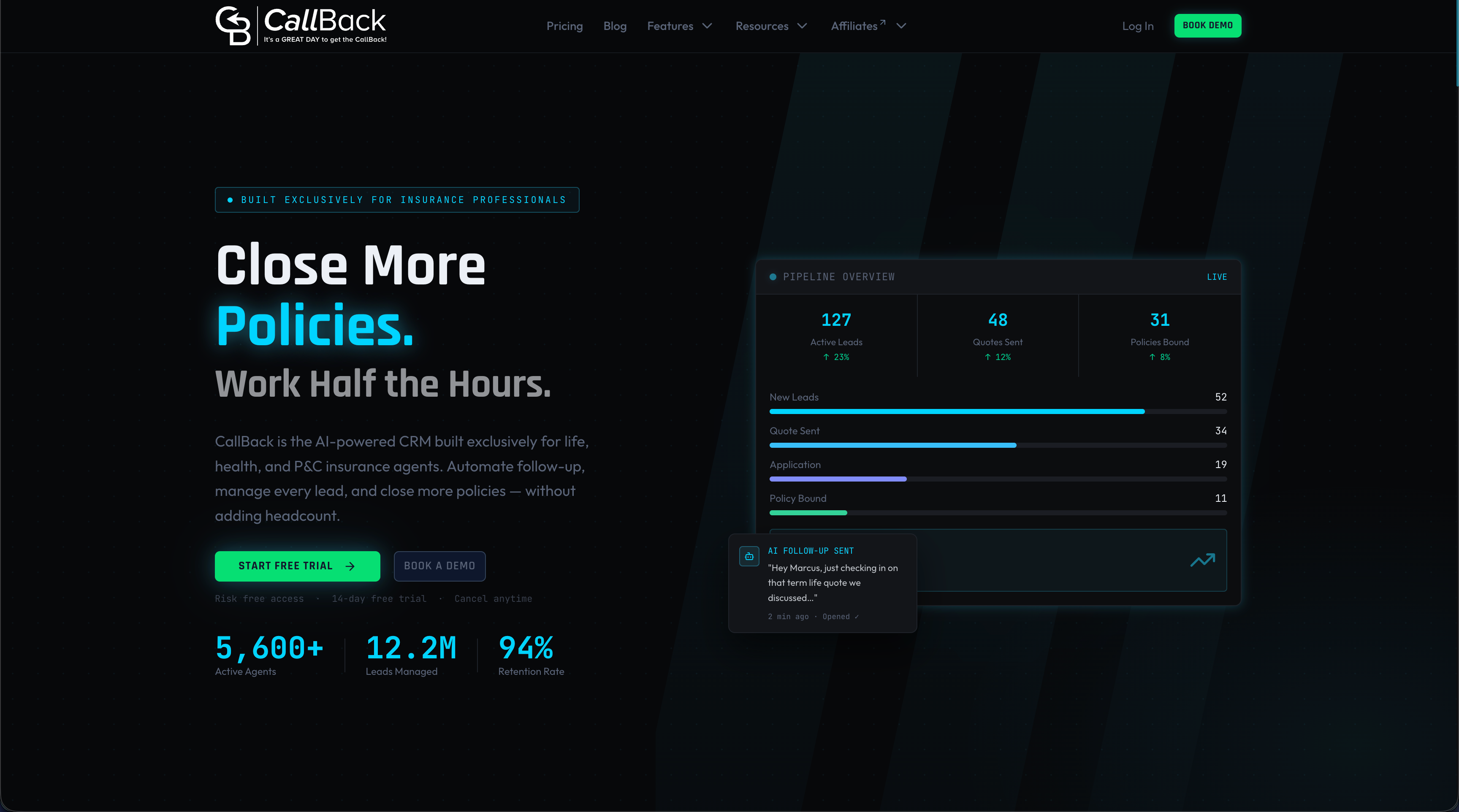
The platform runs on Google Cloud, includes TCPA-compliant sending controls, and covers RVM, SMS, CRM, and AI workflows in one subscription. There is no need to stitch together separate tools or reconcile data across platforms. To see the AI inbound agent and SMS marketing features in a live environment, book a demo directly from the Callbackcrm website.
Useful sources
- Drop.co pricing and feature review (VoiceDrop) — Documents Drop.co’s per-drop model, lack of free trial, and absence of advanced AI features.
- Best Drop.co alternatives for 2026 (VoiceDrop) — Covers the industry shift from broadcast to conversation-first platforms, AI inbound handling, and compliance priorities.
- VoiceDrop vs. Drop.co comparison — Explains pay-per-delivery versus per-attempted-drop pricing and its effect on effective cost.
- Drop.co competitor landscape (SitePrice) — Lists commonly compared alternatives including Slybroadcast, Drop Cowboy, Skipio, and iJungo.
- Callbackcrm platform overview — Source for Callbackcrm feature set, Google Cloud hosting, and insurance-agency positioning.