
Coordinating insurance sales, follow-up, and policy management using separate tools often leads to missed leads and inconsistent client experiences. Many insurance CRM and automation platforms either gate industry-specific workflows behind expensive enterprise plans or lack real-time AI-driven support for quoting and lead qualification. This comparison covers pricing, setup complexity, and insurance-focused automation across five platforms so you can choose a CRM that simplifies your workflow and improves policy conversion rates.
Table of Contents
- CallBack CRM
- SalesPulse
- Lead Callback
- GetCallbacks
- Wunderite
- Analysis of Insurance CRM and Automation Solutions
CallBack CRM
At a Glance
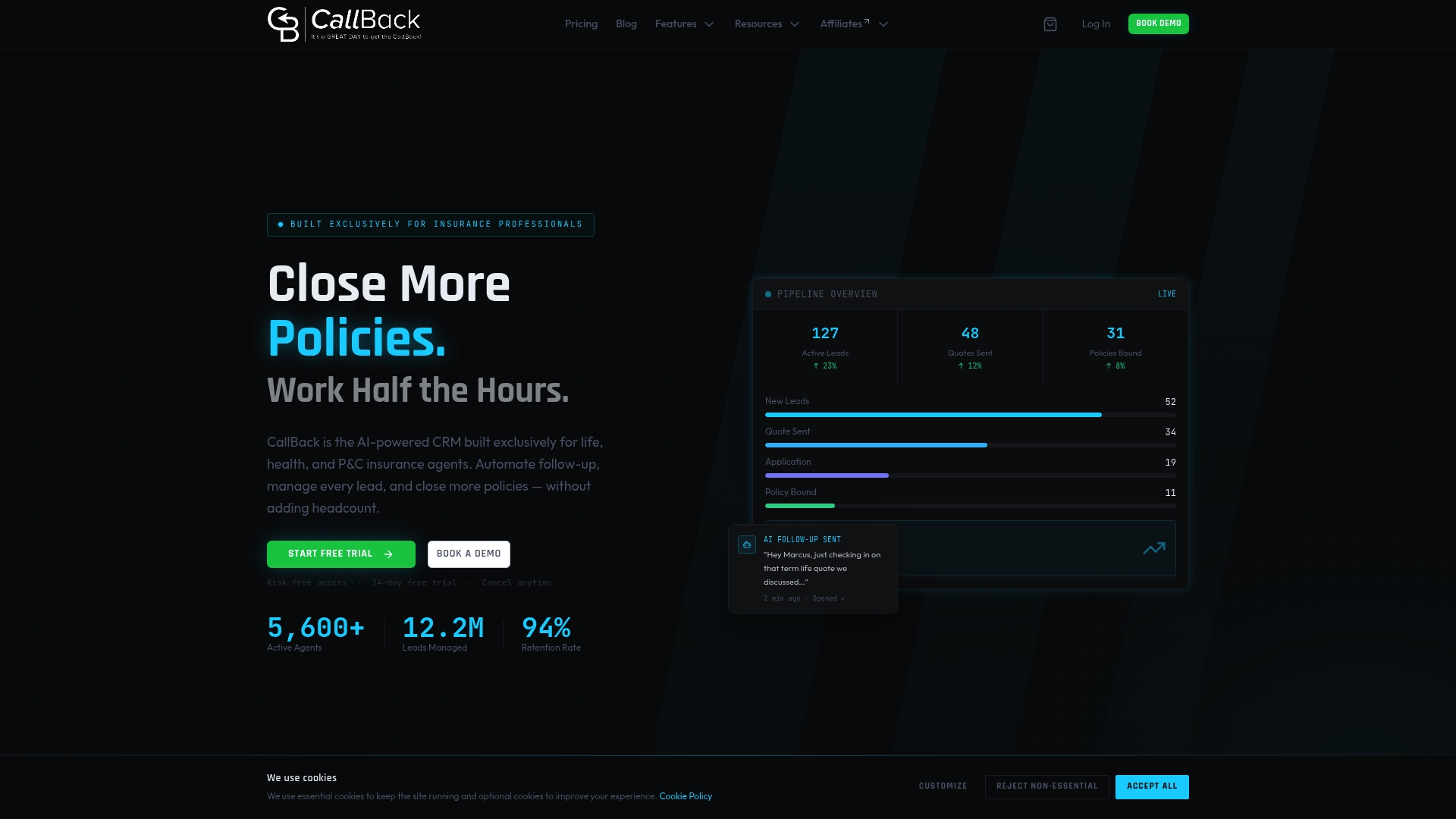
$97 per month is the vendor’s most popular plan and comes with a 14 day free trial, which makes trying the platform low risk for a solo agent. CallBack CRM focuses exclusively on insurance workflows and folds AI into follow up, lead scoring, and content generation.
Core Features
CallBack CRM combines AI-driven follow-up sequences across SMS, email, and voicemail with visual pipelines for prospect and policy management. Multichannel messaging covers SMS, email, WhatsApp, and social DMs so conversations stay in one place.
Reputation tools collect and manage reviews and automated workflows handle lead nurturing and repetitive tasks. A mobile app keeps agents responsive when they are out of the office.
Key Differentiator
Built exclusively for insurance professionals, the platform ties AI follow up and pipeline management to insurance sales processes such as multi-product pipelines for life, health, Medicare, and P&C. That vertical focus shapes templates, scoring, and automation behavior specifically for policy conversion and retention.
Pros
-
Automates follow up to reduce lead leakage. The platform sequences SMS, email, and voicemail so fewer warm leads fall out of the funnel.
-
Tailored to insurance workflows. Preconfigured pipeline stages and messaging templates reflect policy lifecycles rather than generic sales stages.
-
Integrates AI for content creation and lead scoring. Agents get suggested messages and priority flags without building models from scratch.
-
Replaces multiple point tools. Messaging, pipeline views, reputation management, and analytics live in one place which lowers app switching for small teams.
-
Mobile app lets agents manage follow up, tasks, and reviews on the go so field agents stay responsive between appointments.
Cons
- Enterprise pricing can vary and lacks transparency; third party reviews have flagged customer support and pricing clarity as areas that need improvement.
Notable Integrations
CallBack CRM connects to Zapier, Zoom, Meta Ads, Google Ads, and offers API and webhooks for custom integrations.
Who It’s For
Insurance agents, brokers, and small agency teams that sell multiple products and want a single CRM oriented around policy pipelines and automated outreach. Good fit for users who plan to adopt AI for routine messaging and lead scoring rather than build custom models.
Unique Value Proposition
The $97 per month popular plan lowers the barrier for solo agents to adopt AI follow up and pipeline automation. For a one person or small team replacing several subscriptions, that entry price can shift budget from hiring extra staff to buying a single tool that handles lead qualification and outreach.
Real World Use Case
An agent adds new leads from a lead vendor into CallBack CRM, assigns them to a visual pipeline for Medicare and life, and launches a timed SMS and email sequence. Follow up automations surface the highest scored prospects while the reputation module requests reviews after policy issuance.
Pricing
The vendor lists a most popular plan at $97 per month with a 14 day free trial. Custom enterprise pricing is available for larger organizations and may vary based on scale and required services.
Website: https://callbackcrm.com
SalesPulse
At a Glance
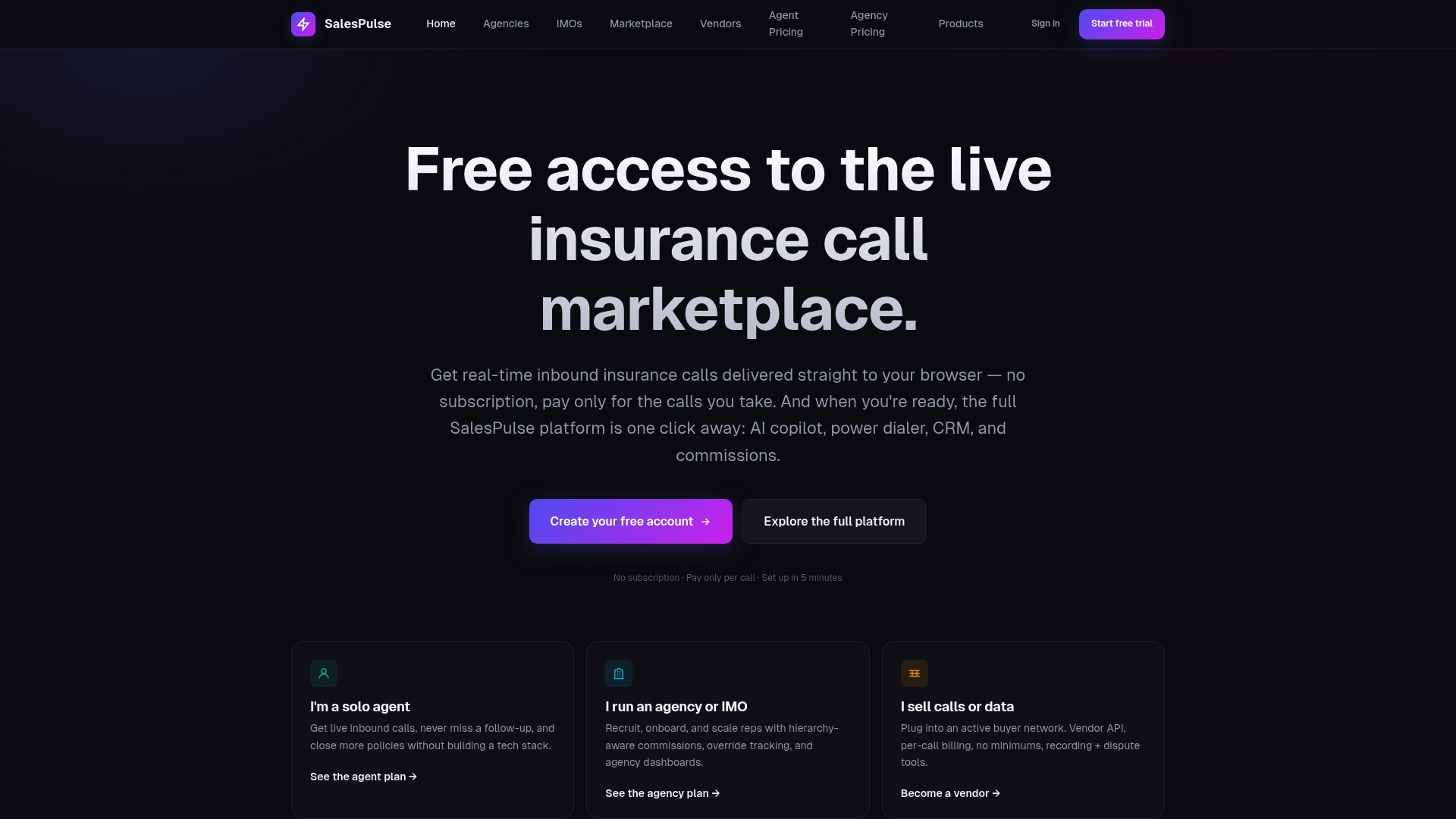
A live inbound call marketplace charges only when a bridge connects, letting agents pay per connected call rather than buying bulk minutes. SalesPulse combines that marketplace with AI-driven call coaching and live quoting so you can handle a lead from ring to policy in one session.
Core Features
- Live inbound call marketplace with real-time filtering and pay-per-connection billing so you only pay for answered bridges.
- AI Copilot for live transcription, tone detection, objection handling, and post-call scoring with follow-up drafts.
- Smart Quoter that surfaces live carrier rates and deep links into carrier applications for faster submissions.
- Power dialer with local presence and carrier-grade telephony plus a CRM tailored to insurance policy and deal flow tracking.
Key Differentiator
SalesPulse is built specifically for insurance workflows and puts calling, quoting, and coaching under a single login. That design reduces tab switching between dialer, quoter, and CRM and keeps an agent on the call with actionable prompts from the Copilot during each interaction.
Pros
- Live call pricing minimizes wasted spend. The pay-per-bridge model is practical for agents who buy lead volume selectively and want precise cost control.
- The AI Copilot provides real-time coaching, not just summaries, which helps less experienced agents handle objections and preserve compliance language while on a live call.
- Tight quoting integration shortens the path from lead to submission. Agents get rates and carrier deep links without manual carrier lookups.
- Everything under one account reduces switching costs for agencies and IMOs managing recruiting, commissions, and pipelines across teams.
- Transparent marketplace access with no contracts lowers the barrier for individual agents to trial inbound lead handling.
Cons
- The platform depends on reliable internet and telephony. Users in low-bandwidth areas will experience degraded performance or dropped features.
- Buyers report setup complexity for large hierarchies and multi-level IMOs, which can require a dedicated admin to configure permissions and overrides.
- Offline capabilities are limited since most features run in a browser, so field agents with intermittent connectivity will lose parts of the workflow.
When It May Not Fit
If your agency operates in regions with spotty internet or relies on heavy offline usage, SalesPulse will create gaps in call quality, quoting, and real-time coaching. Large IMOs with complex override calculations may find initial setup slow and will likely need onboarding support to model multi-tier commissions correctly.
Who It’s For
Independent agents, small agencies, and IMOs seeking a single platform for inbound sales, real-time quoting, and coaching. It fits teams that value live call control and per-connection billing and can manage a web-first workflow with stable connectivity.
Real World Use Case
An agent handling final expense leads answers via the marketplace, uses the Copilot to surface objection scripts and tone warnings mid-call, runs a Smart Quoter to show rates, and sends a carrier deep link for e-signature. The entire interaction, from ring to follow-up, lives in one CRM record.
Pricing
Marketplace access is free. Individual plans start at $79/month. Agency tiers begin at $195/month with additional features and seats. Calls use pay-as-you-go bridge billing so minute costs vary with usage.
Website: https://salespulse.app
Lead Callback
At a Glance
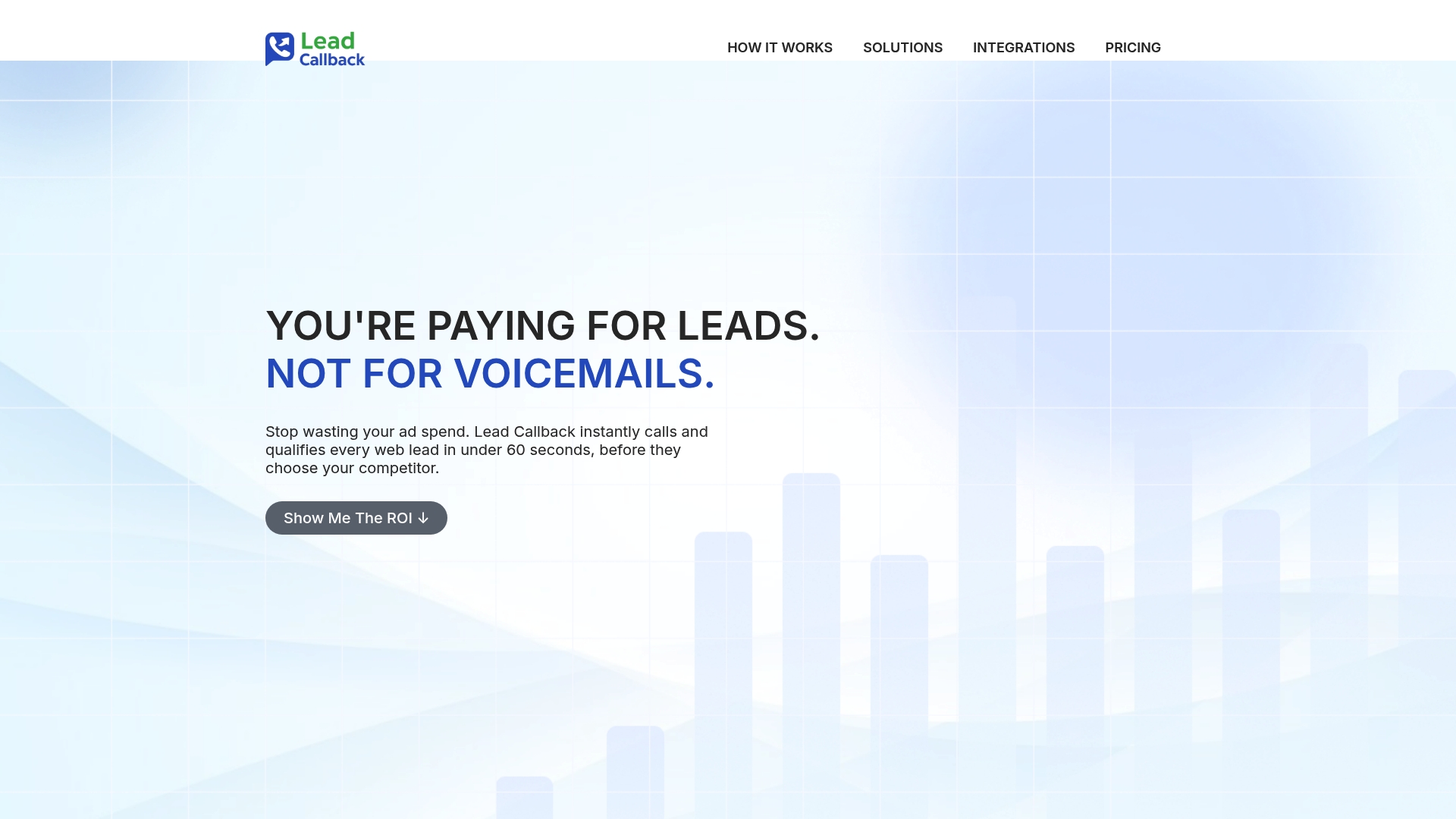
The vendor advertises an instant outbound calling engine that reaches and qualifies web leads within 60 seconds and backs that with a money-back guarantee if conversion rates do not improve within 30 days. The standard plan is a flat $299/month and includes engagement for up to 500 new leads per month.
Core Features
- Instant outbound AI calling and lead qualification that triggers from web forms and ad leads.
- Customizable call scripts and qualification workflows so agents or sales teams receive screened prospects only.
- Automatic lead transfer or calendar booking when a lead qualifies.
- Native CRM connectors, webhooks, and a strategy manager included during onboarding.
Key Differentiator
That 60-second claim plus a refund promise is the central differentiator. The platform is built for the single purpose of removing response delay and routing only qualified prospects to human reps, which shifts work from chasing cold leads to handling live conversations quickly.
Pros
- Fast initial contact. The vendor cites third-party data showing meaningful gains in speed-to-lead metrics, which supports faster qualification and higher contact rates.
- Predictable pricing. A flat monthly fee covering up to 500 engaged leads simplifies budget planning for mid-volume teams.
- Integration focus. Native CRM hooks and support for Zapier, Make, and webhooks let you feed leads into existing automation without rebuilding pipelines.
- Onboarding support. A dedicated onboarding and strategy manager is included, reducing configuration time and helping tune scripts for your vertical.
- Reduced manual follow up. Automated outbound calls and qualification free reps to focus on momentum-ready conversations.
Cons
- Automation can feel transactional. Industries that depend on early rapport or highly nuanced intake may find the automated first touch off-putting.
- Setup requires cooperation. Initial script customization and routing logic need input from your sales team and the onboarding manager.
- Scale limits on the standard plan. The 500-lead monthly cap may generate extra costs for high-volume lead generators.
- Compliance check required. You should verify local telemarketing and automated call regulations before deploying broadly.
When It May Not Fit
If your business relies on careful human intake during the first contact, Lead Callback’s automated approach may reduce conversion quality. Also, teams with more than 500 new leads per month on a steady basis will likely pay above the listed plan or need a custom arrangement.
Notable Integrations
- CRM systems like HubSpot and Salesforce
- Webhooks and API access for custom flows
- Zapier, Make, and n8n for no-code automation
Who It’s For
Businesses that generate steady online lead volume and need near-immediate engagement to prevent lead decay. Common fits are real estate brokerages, high-ticket insurance agencies, and direct response advertisers driving Facebook Lead Ads.
Real World Use Case
A real estate agency connected website inquiries and Facebook lead ads to Lead Callback. The agency reported three times more leads qualifying for live sales conversations after routing initial outreach through the instant call engine.
Pricing
The standard plan is $299 per month and includes engagement for up to 500 new leads, unlimited users, onboarding support, and all listed features. Overage or higher-volume arrangements are available but may cost extra.
Website: https://leadcallback.ai
GetCallbacks
At a Glance
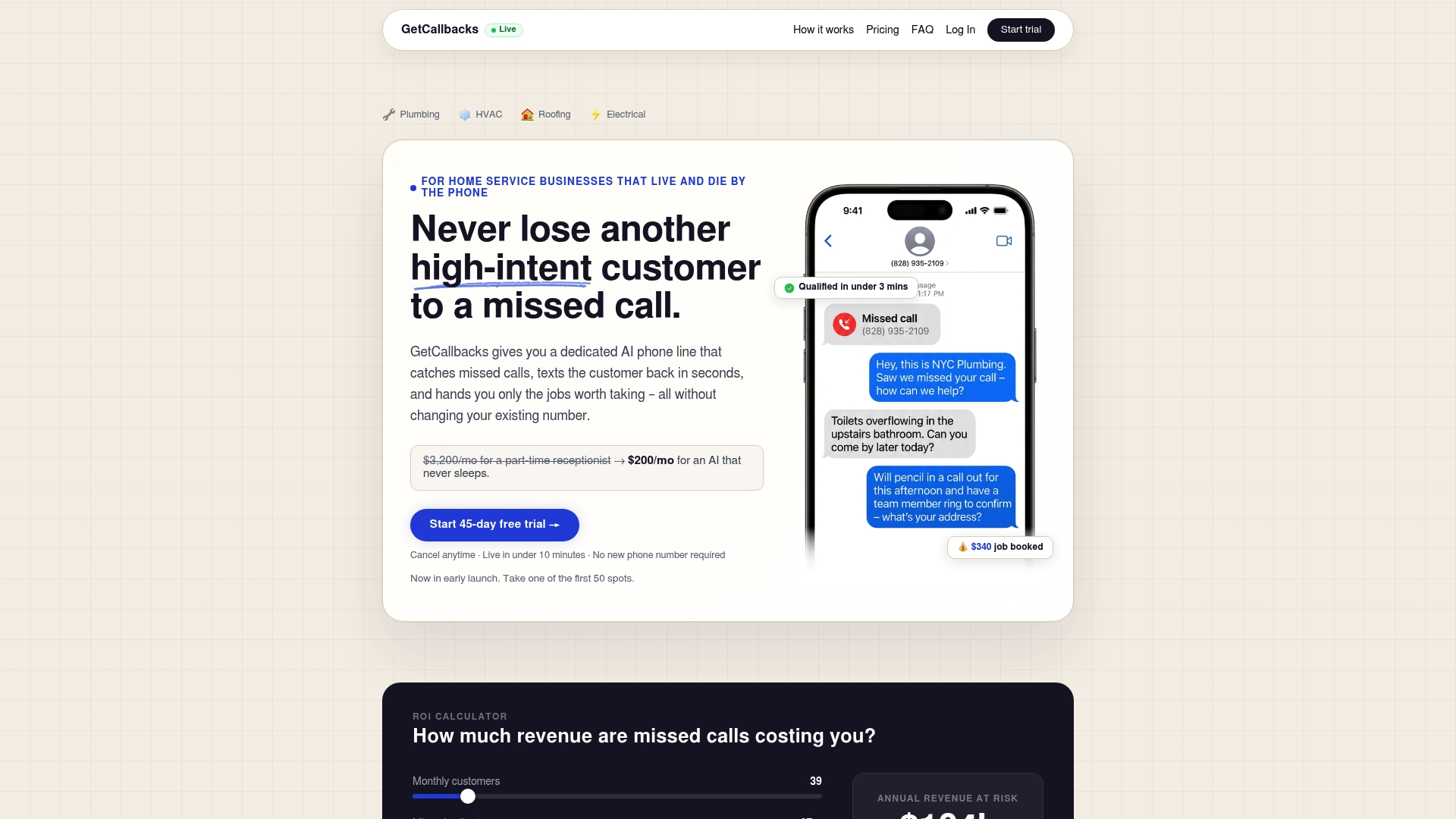
The vendor advertises setup in under 10 minutes with no number change, which is a concrete time-to-live claim for busy owner-operators. GetCallbacks pairs that rapid setup pitch with a dedicated AI phone line that works alongside your existing business number.
Core Features
- Dedicated AI phone line for missed call recovery, configured to answer and qualify when you miss a call.
- Automatic SMS qualification and booking that asks customers for job details and offers appointment times.
- Works with existing business phone numbers so you do not have to change your published number.
- Real-time owner escalation for hot leads so a human can jump in when a job is urgent.
- The vendor advertises a fast setup process, referenced above.
Key Differentiator
GetCallbacks stands out by offering a dedicated AI line that integrates without forcing you to switch numbers. That design lowers friction for small trades businesses that depend on one published phone number for repeat customers and referrals.
Pros
- Cost-effective alternative to hiring a part-time receptionist for evenings and weekends; it replaces labor hours with a fixed subscription.
- Quick setup and ease of use; the onboarding promise reduces the hours you spend on configuration and training.
- Automates lead qualification and follow-up so you spend less time on no-shows and vague voicemail pickups.
- Helps increase conversion of missed calls into booked jobs by pushing SMS confirmations and appointment links.
- Provides 24/7 call handling outside business hours so after-hours callers still get triaged.
Cons
- Primarily built for small operations; larger enterprises may find feature depth and volume limits restrictive.
- The product overview offers limited customization details, which makes workflow fit harder to verify before purchase.
- Setup depends on carrier call forwarding support, introducing a technical variable outside the vendor’s control.
- Buyers must trust AI to communicate professionally with customers, which can feel risky for reputation-sensitive trades.
When It May Not Fit
If your business handles very high call volumes or needs complex IVR routing and custom CRMs, GetCallbacks may not scale. Also avoid it if you require deep API integrations, advanced call analytics, or highly customized scripting for branded call flows.
Who It’s For
Solo operators and small teams in home services such as plumbing, HVAC, roofing, and electrical who want to turn missed calls into booked jobs without hiring extra staff. Ideal where a single published number must remain unchanged.
Real World Use Case
A plumbing contractor routes missed calls to the GetCallbacks AI line. Customers receive an SMS asking for problem details and preferred times. Hot leads trigger immediate owner escalation and several appointments get booked that otherwise would have been lost.
Pricing
Priced at $200/month, billed monthly with a cancel anytime policy. That straightforward model makes cost comparisons versus part-time receptionists or local answering services easy to calculate.
Website: https://getcallbacks.com
Wunderite
At a Glance
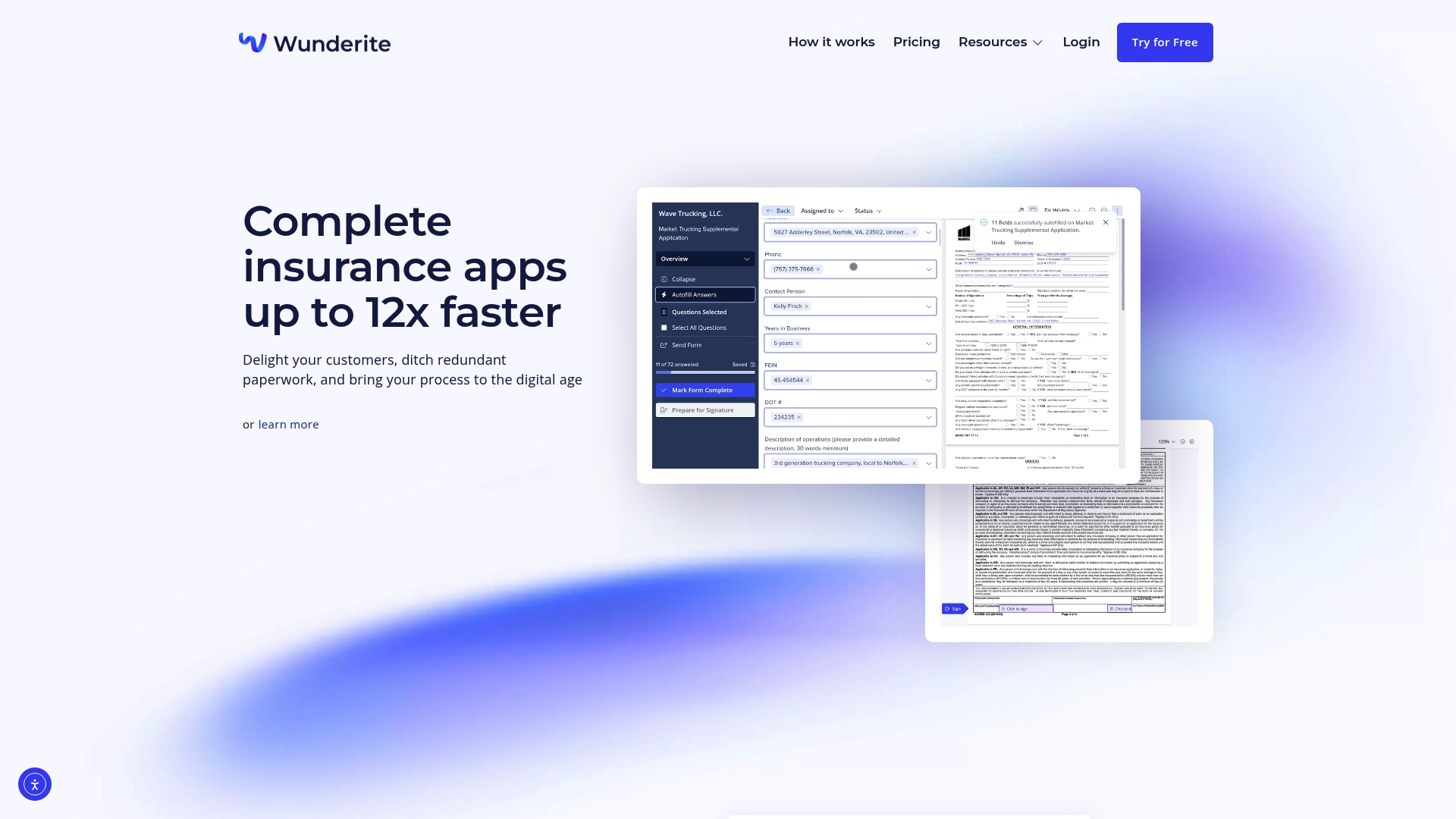
Wunderite’s marketing materials claim it can autofill 80% of renewal forms for an agency, a striking figure that cuts repetitive typing. The product was co-founded by insurance veterans and focuses on tying forms, signatures, and workflows directly into AMS platforms.
Core Features
- Automated form autofill from existing risk and policy data for faster submission.
- Digital signatures and document management with mobile access for remote transactions.
- Workflow automation with team controls, custom risk data columns, and bulk import/export support.
- Real-time notifications, webhook support, and integrations that move completed records back into agency management systems.
Key Differentiator
Deep integration with major insurance management systems is Wunderite’s defining angle. That connectivity plus built-in automation means data flows from forms into AMS systems without manual rekeying, which reduces duplicate entry and the common errors agencies see when juggling multiple vendor portals.
Pros
- Integrations with core AMS platforms reduce manual entry and improve data consistency for carriers and internal teams.
- Autofill and automation shorten the hands-on time agents spend on renewals and new business tasks.
- Frontend tools and backend controls let individual producers work on the mobile app while admins manage workflows and permissions centrally.
- The platform was built by industry practitioners, so field workflows and insurance terminology are baked in rather than added later.
- Mobile access to forms and signatures helps agencies close transactions while in the field or during virtual meetings.
Cons
- Initial setup and integration configuration can be complex and may require technical support or professional services.
- Some advanced capabilities such as custom columns and higher-level automations are gated behind higher-tier plans or add-on fees.
- Integration troubleshooting with an AMS can slow deployments for very small teams that lack IT resources.
When It May Not Fit
If your agency has a single-person office or no technical resource, the platform’s integration setup could be more overhead than benefit. If budget sensitivity is high and you need every feature without extra fees, the requirement for higher-tier plans may make Wunderite a costly choice early on.
Notable Integrations
Wunderite connects with common insurance systems used by agencies: AMS360, ImageRight, Applied Epic, and HawkSoft. It also supports Zapier for bridging to CRMs and AgencyZoom, EZLynx, and InsuredMine for policy and prospect handoffs.
Who It’s For
Mid to large independent insurance agencies and multi-producer shops that need to digitize application and renewal flows and that already use an AMS. Teams that plan to centralize processing and reduce rekeying will extract the most value.
Real World Use Case
The vendor advertises a scenario where an agency autofills most renewal fields, collects digital signatures on mobile, and syncs completed forms into AMS360, moving processing from days to hours. That kind of throughput helps retention teams handle high renewal volumes with fewer clerical hires.
Pricing
Pricing is not listed publicly and the company typically provides subscription quotes tailored to agency size and integration needs. Expect a quoted plan rather than a fixed published price and plan for potential add-on costs for advanced automations.
Website: https://wunderite.com
Intro pre-write:
- Does callbackcrm.com clearly outpace every usable competitor on a single dimension? NO
- If NO: best tradeoff dimension for the primary reader — While CallBack CRM offers automation and pipeline management tailored for insurance, others like Lead Callback excel in immediate engagement metrics.
- First sentence draft: Choosing the right CRM and automation tool in the insurance domain requires considering workflow complexity, volume demands, and engagement speed.
Competitor win pre-write:
- Which competitor wins which dimension: Lead Callback wins speed of engagement due to its instant call response capability boosting contact rates.
- Does this dimension matter to the primary reader? YES
Best Fit uniqueness check:
- List each bullet scenario in one clause: [For small insurance agencies needing end-to-end policy pipelines with responsive follow-ups] / [For agents wanting a pay-per-call system with live coaching] / [For high-volume lead generators focusing on speed and simplicity] / [For service businesses requiring integration with existing phone systems] / [For mid-sized agencies streamlining forms and submission workflows]
- Can any two be swapped without changing meaning? NO
Our Pick pre-write:
- The ONE capability unique to callbackcrm.com in this set: Integration of AI with insurance-tailored pipeline stages and messaging templates
- Evidence from the reviews: Built exclusively for insurance professionals, the platform ties AI follow-up and pipeline management to insurance sales processes such as multi-product pipelines (Callback CRM review)
- Closing sentence draft: CallBack CRM excels for agencies wanting a unified, insurance-specialized CRM with advanced automation capabilities.
- Substitution test: “GetCallbacks excels for agencies wanting a unified, insurance-specialized CRM with advanced automation capabilities.”
- Does the substituted version still work as a recommendation? NO
- If YES: rewritten closing sentence: Not applicable
Analysis of Insurance CRM and Automation Solutions
Choosing the right CRM and automation tool in the insurance domain requires considering various factors such as workflow complexity, lead volume, and engagement needs. This analysis compares five prominent platforms: CallBack CRM, SalesPulse, Lead Callback, GetCallbacks, and Wunderite, highlighting their unique features and targeted applications to guide your selection.
Focus-Oriented Features and Usability
CallBack CRM and Wunderite demonstrate clear advantages for insurance professionals through features specifically designed for policy management. CallBack CRM offers preconfigured pipelines dedicated to multiple insurance products, which streamlines follow-up processes uniquely pertinent to different plans, such as Medicare, life, and health policies. Wunderite emphasizes streamlining form autofill and document management by integrating deeply with industry-specific management systems. This ensures data workflow consistency, which can be critical for administrative efficiency in medium-to-large agencies.
Speed Versus Customization
Lead Callback and SalesPulse focus on enhancing lead responsiveness and engagement speed. For instance, Lead Callback offers a groundbreaking 60-second lead follow-up response system, ensuring immediate attention for high volumes of new inquiries. This feature is fundamental for enterprises where initial engagement determines subsequent success rates. Conversely, SalesPulse provides real-time support through AI-driven call coaching and live quoting, empowering sales agents to address customer needs during active calls effectively.
Best Fit
- For small insurance agencies needing end-to-end policy pipelines with responsive follow-ups: CallBack CRM provides a unified solution tailored for complex insurance workflows.
- For agents wanting a pay-per-call system with live coaching: SalesPulse offers cost-effective session-based connectivity combined with guidance tools.
- For high-volume lead generators focusing on speed and simplicity: Lead Callback minimizes response delay with automated quick-contact systems.
- For service businesses requiring integration with existing phone systems: GetCallbacks allows AI-driven call management without changing established infrastructure.
- For mid-sized agencies streamlining forms and submission workflows: Wunderite improves back-office operations through its automation of documentation.
Our Pick
For businesses operating in the insurance sector that seek a and tailored solution to their client management and engagement needs, CallBack CRM emerges as the most effective choice. Through its integration of AI with industry-specific sales processes, CallBack CRM succeeds in improving workflows for policy sales and ensuring consistent communication. However, agencies prioritizing immediate lead engagement or minimal setup efforts may find competitors like Lead Callback or GetCallbacks better suited to their particular requirements.
Insurance CRM and Automation Tools Comparison
Finding the right insurance CRM and automation tool can significantly optimize operations and improve lead management. Here’s a detailed comparison of several leading platforms to help identify the best fit.
| Product | Core Feature | Key Differentiator | Pricing | Notable Limitation |
|---|---|---|---|---|
| Callbackcrm | AI-driven follow-up for insurance workflows | Vertical focus on policy pipelines and conversion workflows | $97/month (popular plan) | Lacks pricing consistency for enterprise-level plans |
| SalesPulse | Live inbound call marketplace, real-time coaching, and integrated quoting | Pay-only-per-connected call, reducing costs | Starting $79/month | Needs stable internet and can encounter setup complexity |
| Lead Callback | Instant outbound AI calling linked to web leads | Ensures contact within 60 seconds of lead generation | $299/month | Automation may feel impersonal for some prospects |
| GetCallbacks | Dedicated AI line for missed call handling and appointment setup | Works alongside existing numbers for easy integration | $200/month | Primarily for small operations with low feature depth |
| Wunderite | Automated form processing for renewals | Deep integration with agency management systems | Not disclosed | Integration setup can be technically challenging |
Discover Smarter AI-Powered Follow-Up with CallBack CRM as You Explore getcallback.ai Alternatives
Choosing the right tool to quickly engage leads and qualify them can feel overwhelming. If you are looking beyond getcallback.ai alternatives, consider how automation tailored specifically for insurance agents and agencies can transform your lead management. CallBack CRM offers AI-driven follow-up sequences with SMS, email, and voicemail—all designed to keep warm prospects engaged and reduce lead leakage.
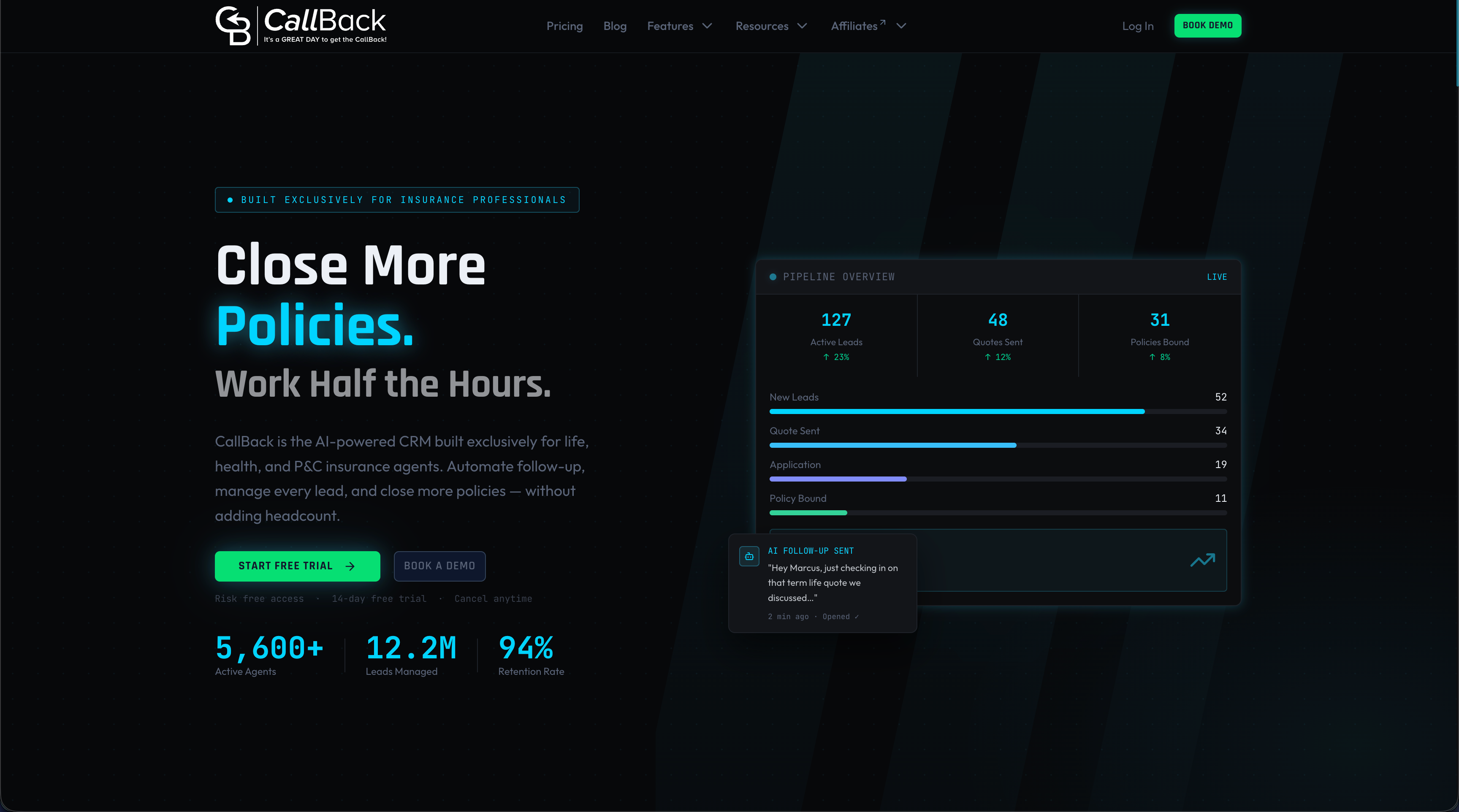
Act now to replace manual follow-ups with intelligent automation that prioritizes your highest value leads. Visit CallBack CRM to start your 14-day free trial and experience seamless pipeline and reputation management built for insurance workflows. Import your contacts, launch AI-powered outreach, and see your lead conversion improve in just days.
Frequently Asked Questions
How does Callbackcrm automate follow-up processes for insurance leads?
Callbackcrm automates follow-up processes through AI-driven sequences across SMS, email, and voicemail, ensuring efficient lead management. Its feature set specifically focuses on insurance sales processes, enabling automated responses that fit policy lifecycles. Consider exploring the automation options to reduce lead leakage and enhance engagement.
What is the difference between Callbackcrm and SalesPulse?
SalesPulse excels with its live inbound call marketplace and AI Copilot for real-time coaching during calls, which can be beneficial for agents needing immediate interaction. Callbackcrm, on the other hand, is better suited for agents who want a comprehensive platform for managing automated outreach and pipeline management without switching tools frequently. Analyze your team’s needs to determine the best fit.
Which platform offers a more transparent pricing structure for small teams, Callbackcrm or Lead Callback?
Lead Callback offers a flat monthly fee of $299, covering up to 500 engaged leads, providing budget predictability for mid-volume teams. Conversely, Callbackcrm’s most popular plan is priced at $97 per month, with a free trial, which can be ideal for solo agents looking to minimize initial costs. Assess your budget commitments against your team’s lead volume to make an informed decision.
Can I expect integration support when using Callbackcrm for my insurance agency?
Callbackcrm integrates with platforms like Zapier, Zoom, and Google Ads, simplifying the incorporation of your existing tools. This integration flexibility allows for a streamlined workflow tailored to insurance professionals, easing the transition for agencies looking to consolidate tools. If smooth integration is a key requirement, Callbackcrm could serve your needs well.
What unique feature does Wunderite offer compared to Callbackcrm?
Wunderite distinguishes itself with automated form autofill capabilities, which can streamline renewal processes significantly for agencies already using an AMS. While Callbackcrm focuses on enhancing follow-up automation, Wunderite’s approach can drastically reduce paperwork burden. Review your agency’s priorities to choose the right systems based on workflow needs.